Showing posts with label Bloomberg. Show all posts

Thursday, 14 December 2023

Hong Kong corporate governance tumbles to lowest in decades


14 Dec 2023, 11:28 am


(Dec 14): Hong Kong’s corporate governance ranking in Asia tumbled to the lowest level in decades, falling behind those of Japan and Singapore, amid concerns about the deterioration of minority shareholder rights and the independence of the judiciary in the city, according to a research report. 

The financial hub dropped to the sixth place this year from second, according to the Asian Corporate Governance Association’s CG Watch rankings. It’s the first time Hong Kong dropped out of the top three spots in the rankings since they began in 2003, according to the report, which was released with CLSA on Wednesday. 

The report marks the latest setback to Hong Kong’s efforts to revive its image as the region’s premier international finance centre. Banks have been eliminating jobs in the city amid a slump in deals, while the city’s benchmark Hang Seng Index is one of the worst performers among major bourses this year.   

Hong Kong’s introduction of a Beijing-led national security law and its crackdown on political activists have also eroded perceptions of the strength of its institutions and the free flow of information in the city, according to the report. 

“The independence of the judiciary and a stifling of the press and academia have also contributed to its current ranking,” the report said.

Hong Kong Chief Executive John Lee has repeatedly defended the merits of the security law, and government officials have balked at the idea that Hong Kong is losing its stature as an international hub.  

Meanwhile, Australia, which has ranked No 1 since 2016, kept its top spot. Japan jumped to No 2 for the first time since the study began, thanks to its “strong” government reforms and efforts by the local stock exchange to improve governance, according to the report.  

Singapore came third, tied with Taiwan, followed by Malaysia. 

Hong Kong corporate governance tumbles to lowest in decades (theedgemalaysia.com)


Credit Suisse disbands China onshore wealth unit, dozens depart


By Cathy Chan / Bloomberg

14 Dec 2023, 11:42 am


Credit Suisse’s push to build a wealth management business in China started to fall apart after it delayed the launch of its locally incorporated bank last year.

(Dec 14): Credit Suisse dismissed its entire wealth management team in China, scrapping its ambition to become one of the biggest foreign money managers in the country as UBS Group AG decided not to take on the staff, people familiar with the matter said. 

Those let go included at least 20 relationship managers and investment consultants as well as Wang Jing, the chief executive officer of Credit Suisse’s securities venture, the people said, asking not to be identified because the matter wasn’t public. Some support roles were also affected, they said, without being specific on the numbers. The division at one point had about 40 staff, one of the people said.

Spokespeople for UBS and Credit Suisse declined to comment.  

The dismissals come as Credit Suisse is trying to find a buyer for its securities business in China, which now consists of investment banking and brokerage operations after the wealth unit closed. UBS, which has yet to merge Credit Suisse’s entities in China, needs to sell the securities venture because it already controls one in the country and can’t hold two licences for the same business.

The job reductions at the wealth unit started in October as UBS felt Credit Suisse’s strategy of selling wealth products through bank branches was incompatible with its current model, one of the people said.

Wang was hired more than three years ago from China Merchants Bank Co to develop Credit Suisse’s wealth footprint on the mainland, and was made the CEO of the securities business last year after a reshuffle and an exodus of senior management. 

Credit Suisse’s push to build a wealth management business in China started to fall apart after it delayed the launch of its locally incorporated bank last year, the second postponement since the project was conceived in 2020. The firm had planned to build a branch network to distribute wealth products and fuel its money management business, joining other Wall Street firms that have poured billions into China. As recently as 2021, Credit Suisse had plans to triple its headcount in China within three years. 

The local bank project was delayed by a sluggish licensing process and was questioned by some senior Credit Suisse executives as China’s economy was reeling from Covid lockdowns and a crackdown on private enterprise, people familiar with the matter have said. 

Wang, the former head of private banking at China Merchants Bank, was seen as a key hire by former Asia CEO Helman Sitohang. She had helped build the Shenzhen-based lender into the nation’s biggest manager for high net worth clients during her more than two decades' stint.

Credit Suisse won approval in 2020 to take full control of a securities venture it had run with Founder Securities since 2008. The firm last year agreed to buy the remaining 49% stake from Founder for US$160 million (RM746.18 million). The deal was scrapped after UBS acquired Credit Suisse in a rescue brokered by Swiss authorities, people familiar with the matter said. 

UBS CEO Sergio Ermotti reiterated the firm’s commitment to China during a September visit to Beijing, while acknowledging the geopolitical situation has changed. UBS has “very limited” direct exposure to China real estate since the bank is mainly in the country to help people manage their wealth, he said in an interview.  

Wall Street firms have seen their business slow in China amid a sluggish economy and dearth of deals. UBS had seen strong growth, with mainland China revenue more than doubling to almost US$1 billion in 2021 from 2019, Bloomberg reported last year. The bank employed about 1,400 people in China as of January.

Across Asia, UBS is cutting hundreds of wealth-management jobs after completing the Credit Suisse takeover, Bloomberg News reported in September. The lender was set to eliminate roles that included relationship managers in Hong Kong and Singapore, the majority within Credit Suisse teams, the people said.

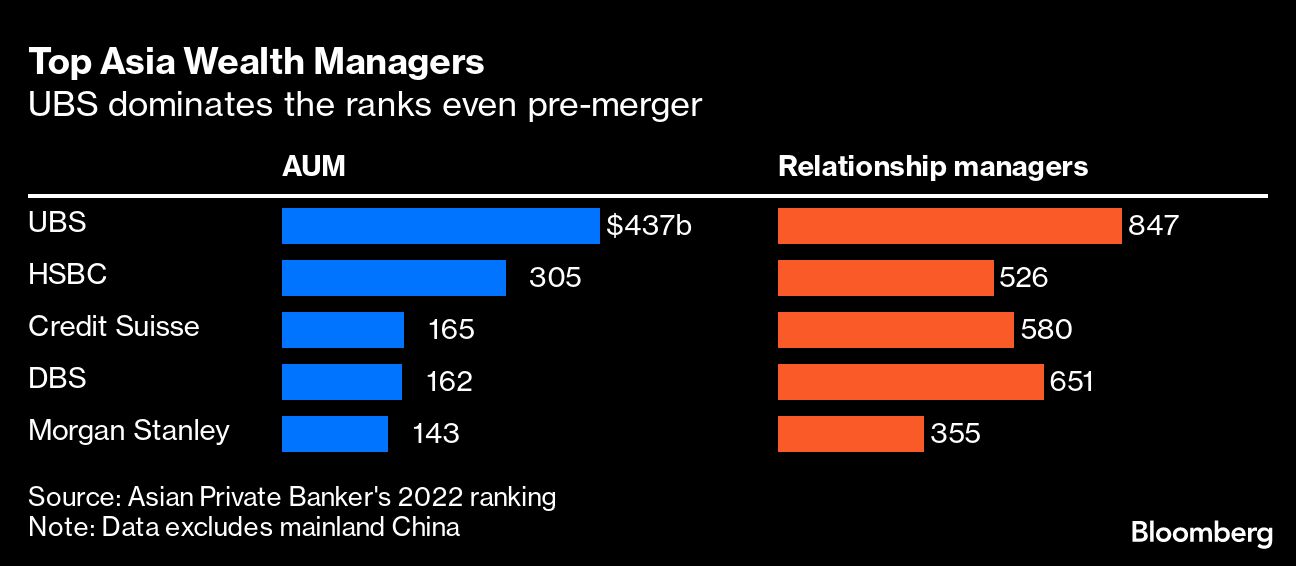
Still, the merger gives UBS the largest wealth team in Asia, with assets that top rivals including HSBC Holdings plc. Global wealth chief Iqbal Khan is betting Asia will continue to generate lucrative fees from rich clients.

Credit Suisse disbands China onshore wealth unit, dozens depart (theedgemalaysia.com)

Saturday, 13 May 2023

Ex-ByteDance executive claims reporting illegal conduct got him fired

 (May 13): ByteDance Inc’s former head of engineering in the US said in a lawsuit he was fired for voicing concerns to the management that the TikTok owner was stealing copyrighted content from other platforms, including Instagram and Snapchat. He also alleged that the company fabricated users to exaggerate its metrics, and help the China’s Communist Party spread propaganda to a larger audience.

 Joel Rosenblatt / Bloomberg

13 May 2023, 10:40 am


Yintao “Roger” Yu said he learned soon after he joined the company in 2017 that ByteDance had for years undertaken a “worldwide scheme (including in California) to steal and profit from the copyrighted works of others”, according to his complaint filed on Friday (May 12) in the San Francisco state court. 

He also discovered that the company was programming fabricated users to “like” and “follow” real user accounts to boost the engagement metrics relied on by potential investors, according to the complaint. 

Yu alleged that the company was driven by a “culture of lawlessness” that focused on growth at all costs.

“He was surprised by the brazenly unlawful conduct within the company, which was euphemistically excused as ‘entrepreneurship’,” according to the complaint.

When Yu reported his concerns to higher-ups, they were dismissive or asked him to hide the illegal activity, and he was eventually terminated in late 2018 after a medical leave, according to the suit, which identifies one supervisor who was in “a position to retaliate” against him as Kelly Zhang, who is now ByteDance China’s chief executive officer.

TikTok has been under intense scrutiny from Congress and a federal national security review over concerns about potential influence from the Chinese government, because ByteDance is based in China. Multiple bills have been introduced that would limit or ban the app in the US.

As recently as this month in a letter to Congress, the company said it “had never shared” any US user data with the Chinese government, and wouldn’t if requested to do so. TikTok says it is in the process of walling off its sensitive US operations into a separate entity with relevant data kept on Oracle Corp’s domestic servers.

ByteDance representatives didn’t immediately respond to a request for comment on the lawsuit. 

ByteDance relied on software to strip video from competitors’ websites to make its service appear more popular with users, according to the complaint. “These actions were taken without the permission of the content creators, and represented an unlawful effort to gain an edge against entrenched online video hosting websites,” according to the complaint.

Concerned about ByteDance’s skirting of “legal and ethical lines”, and the potential liability for the theft, Yu said he had repeatedly raised objections, including to a senior vice-president of engineering who reported directly to ByteDance CEO Yiming Zhang. But the senior vice-president dismissed his concerns and the infringement continued, according to the complaint.

Yu is seeking a court order directing ByteDance to stop scraping social media content that belongs to others.

The lawsuit also details Yu’s objection to the company’s treatment of an unidentified employee suffering from depression. He said he had lodged a complaint with ByteDance’s head of human resources about an illegal plan to fire the employee.

Yu, a resident of California, was hired with stock options and a guaranteed payment of US$600,000 (RM2.68 million) for the intellectual property of his own company, Tank Exchange, with the condition that he stayed with ByteDance for two years, according to the complaint.

ByteDance claims it notified Yu that his termination was due a reduction in headcount, but he argued he never received any notices, according to the suit. In November 2018, he was terminated without the stock option award which he said had vested. In 2019, he filed a discrimination complaint with California’s Department of Fair Employment and Housing, according to the suit.

The case is Yu v. ByteDance Inc, CGC-23-606246, California Superior Court, San Francisco County.


https://theedgemalaysia.com/node/666854

Wednesday, 19 April 2023

Russian memo said war leaves Moscow too reliant on Chinese tech

  ... the risks of becoming too dependent on Chinese technologies ...


Alberto Nardelli / Bloomberg

April 19, 2023 09:45 am +08

(April 19): Senior Russian officials privately raised concerns some 10 months ago about the risks of becoming too dependent on Chinese technologies after sanctions by the US and the European Union shut off access to alternative suppliers.

A previously unreported assessment from inside Russia’s Ministry of Digital Development, Communications and Mass Media suggests that some senior officials are worried that Chinese companies such as Huawei Technologies Co Ltd could come to dominate the Russian market and may pose a risk to the country’s information security and networks.

European officials familiar with the document said it suggests that Russia has backed itself into a corner since it struggles to produce advanced technology domestically and has been cut off from other foreign markets following the invasion of Ukraine. The report, drafted in the summer of 2022, highlights chips, network devices and electronics as areas of particular vulnerability. 

Since then, the Russian authorities have managed to import some sanctioned US and European components via third countries, including through mainland China and Hong Kong, Bloomberg previously reported. But the US and the EU are tightening efforts to enforce their trade restrictions, suggesting procuring advanced technology may get more difficult. 

The European officials said the assessment had been shared among several people in the General Staff of the Armed Forces, Russia’s most senior military body, as well as some on the Security Council, which includes the country’s defence and foreign affairs ministers and is led by President Vladimir Putin.  

The Russian worries about becoming over reliant on companies such as Huawei China Mobile Ltd and others echo some of the concerns raised in the US and parts of Europe about the security risk involved in using Chinese technology in sensitive parts of their information networks. 

The analysis also underlines one of many strategic costs that the Kremlin has incurred since most economic ties to the EU and the US were severed due to the war: increased leverage for China. 

The officials familiar with the memo said it confirms more recent reports that Russia has been seeking to source several technologies from China, such as radio electronics, routers, base stations, microelectronics, chips and materials used in semiconductors. 

While the officials said the document makes no mention of weapons, the US has sanctioned several Chinese companies for supplying components and goods allegedly used for military purposes in Ukraine.

There are still no signs of direct military support from China to Russia and the US and its allies are confident they would be able to detect any movement of significant military equipment from China, a European diplomat familiar with that assessment said. 

The Biden administration has warned Beijing not to provide Moscow with weapons. China has repeatedly said it hasn’t supplied Russia with weapons and accuses the US of stoking the conflict by providing arms to Ukraine.

The memo references multiple conversations between Russian and Chinese officials, including four video conference calls, in which the authors say supplies of tech components, boosting production capacity inside Russia and potential Chinese investments in Russian industry were discussed. According to the people familiar with the Russian document, those talks included officials from the ministry of trade and industry in Moscow and their Chinese counterparts, as well as representatives of Russian and Chinese companies. 

The Chinese Foreign Ministry said it could not verify the authenticity of the information and that Beijing has a normal trading relationship with Russia. The Ministry of Digital Development, Communications and Mass Media in Moscow didn’t reply to a request for comment. 

Russia prepared a list for Chinese officials detailing the goods it needs, also including equipment used in communications, networks, broadcasting and data centers, according to the people familiar with the document. 

Russian officials still have ambitions of producing critical equipment themselves and people who spoke with Bloomberg say the memo suggests they are worried that their reliance on China may also hold back their domestic industry. That said, the Russian military started trying to replace foreign-made components with locally produced parts in its weapons systems years ago, and that effort has mostly failed, underlining the challenges Moscow faces in replicating advanced technology. 

Not all the goods mentioned in the paper contain US- or EU-made parts, but, according to the Russian authors’ assessment, there are likely no technologies in the segments of interest that don’t at least depend on US or European intellectual property or production equipment such as chipmaking gear.

China has repeatedly criticised the use of sanctions to isolate Russia, but its companies have nevertheless been careful not to be seen in breach of US and EU measures, fearing that they could find themselves in the crosshairs of economic restrictions of their own. At a meeting with Putin last month, Chinese President Xi Jinping committed to significantly increase bilateral trade.

In March, Xi also met with Russian Prime Minister Mikhail Mishustin where the two committed to expand cooperation on trade, including on hi-tech, according to the news agency Xinhua. Russia is willing to strengthen cooperation with China in such areas as investment, trade, energy, natural gas, peaceful use of nuclear energy, aviation and aerospace, scientific and technological innovation, cross-border transportation and logistics, and strengthen communication and cooperation in the safety of supply and industrial chains, food security and other issues, Mishustin said. 

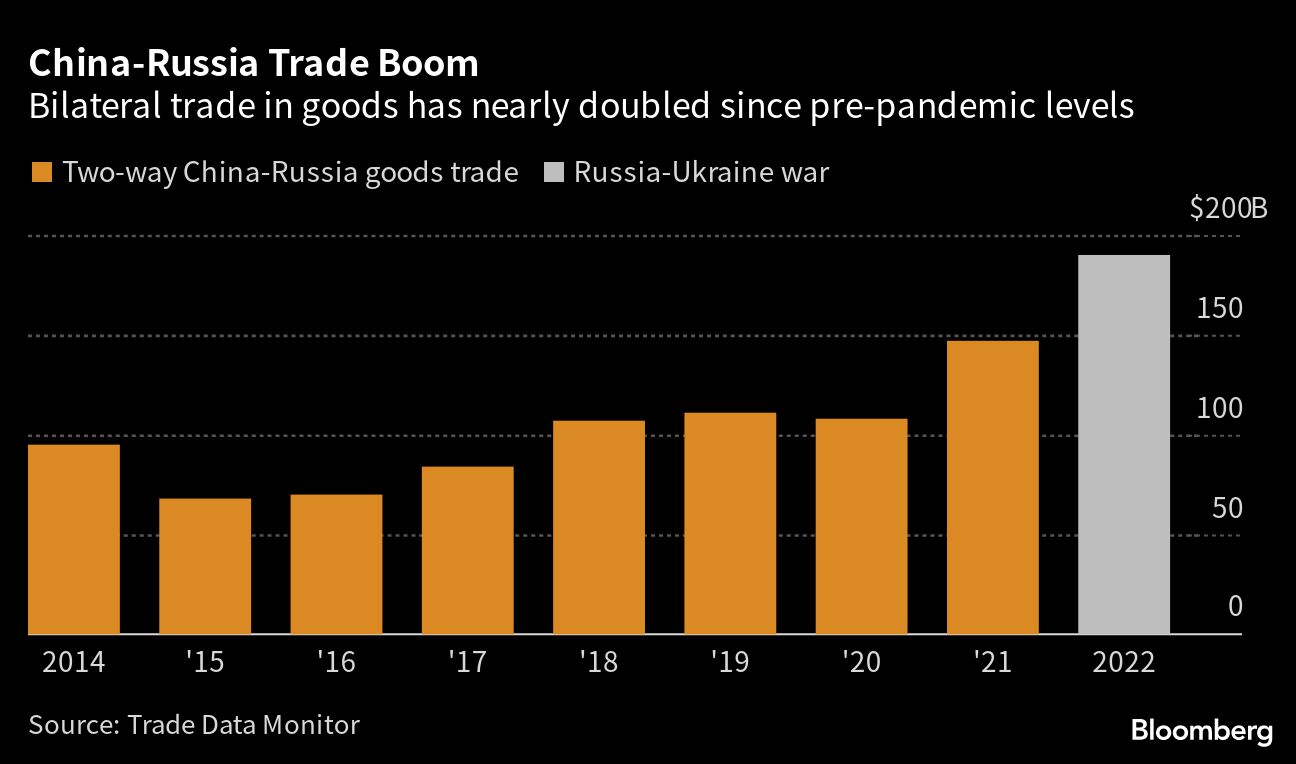
Total two-way merchandise trade between China and Russia jumped 72% to US$190.3 billion in 2022 versus the pre-pandemic level of US$110.9 billion in 2019, according to the Geneva-based Trade Data Monitor. The data show a marked increase in Russian imports of Chinese smartphones, motor vehicles and construction equipment. In return, Beijing increased its purchases of Russian energy products like oil, coal and natural gas.

The EU and Group of Seven nations have now stepped up their focus on sanctions circumvention, especially by enhancing their monitoring of so-called dual-use goods that can serve either military or civilian purposes. That effort has involved applying diplomatic pressure on third countries and putting in place tools to identify and target companies that may be helping Russia to get around restrictions.

Last Thursday, the US sanctioned dozens of entities in 20 countries it accused of helping Moscow evade sanctions.

The officials said that the memo describes how some more sensitive items such as radio-electronic devices may reach Russia through so-called partner channels. 

Under that system, a manufacturer moves the items via land to an intermediary which then exports them to Russia, often via a third country. Transactions would be carried out in local currency, and product labels and customs documents could be altered, according to accounts of the Russian assessment. Some equipment may be unbranded. 

Lower risk products such as mobile phones are often shipped through more regular paths but are increasingly sold through third-party dealers rather than directly.    

The European officials said that the paper sets out Russian concerns that having communications networks depend on Huawei devices poses a danger to information security, as well as to the reliability of networks and diminished opportunities for domestic providers. The assessment even suggests considering restrictions on technologies produced by Huawei and other Chinese companies in order to avoid a scenario of total dependence. 

Huawei’s press office in Berlin said it wasn’t able to immediately respond to a request for comment. The company has repeatedly rejected such allegations.

Among other potential countermeasures, it suggests:

  • Imposing quotas on Chinese goods
  • Pushing Chinese firms to shift production to Russia
  • Demanding Chinese providers use Russian nationals and sub-contractors
  • Limiting the use of unbranded equipment
  • Incentives such as long-term contracts and subsidies for Russian developers and telecommunication companies

Given the state of Russia’s communications networks, the officials said that the memo’s authors saw no immediate pressure for Russia to rush into full scale agreements with Chinese companies and Moscow had another one to two years to buy time that would be useful to enhance its domestic capacity and capabilities. That assessment though is now almost a year old.

Russian memo said war leaves Moscow too reliant on Chinese tech | The Edge Markets


Thursday, 20 October 2022

Chinese Markets Are Sinking Fast as Xi Fails to Boost Confidence

 The selloff in Chinese assets is intensifying as this week’s Communist Party Congress disappoints traders wanting relief from ...

·3 min read
https://news.yahoo.com/chinese-markets-sinking-fast-xi-031026333.html


(Bloomberg) -- The selloff in Chinese assets is intensifying as this week’s Communist Party Congress disappoints traders wanting relief from a strict Covid-Zero policy and help for an economy mired in a property crisis.

The benchmark CSI 300 Index has fallen more than 2% this week, after posting the worst three trading days since the start of a Congress from the gauge’s inception in 2005. High-yield dollar bonds have declined for seven straight days to a record low, while the offshore yuan slumped to its weakest since it started trading.

The extended weakness in China markets is due to “slower economic growth, both cyclically and structurally,” said Redmond Wong, market strategist at Saxo Capital Markets. While the credit impulse is bottoming, the nation’s transition to a new development model and “growth is going to be slower than previous decades,” he added.

The nation’s markets have been among the worst performers globally this year, leaving investors looking to the leadership gathering for policy signs to drive a recovery. While President Xi Jinping’s renewed pledge for technology self-reliance offered some reprieve, his defense of Covid Zero and the lack of measures for a crisis-hit property sector were seen as a disappointment.

An increase in Covid cases in Beijing to the highest in four months and the government’s decision to delay the release of key economic indicators have added to market jitters. The soft outlook projections from Chinese consumer companies also led to a selloff in the stocks Wednesday.

“Something other than technicals is driving the market down,” said Hao Hong, partner and chief economist at Grow Investment Group in Hong Kong. “The congress outcome may be different from what the market was expecting, in terms of Covid-Zero, property and senior leadership.”

Common Fears

An index of mainland Chinese companies listed in Hong Kong is heading for its lowest close in 14 years, while the benchmark Hang Seng Index slide by as much as 3%, with tech stocks leading a decline.

The stock and yuan weaknesses are a cumulation of concerns that China will fail to revive growth, with analysts pointing to its debt issues, slowing population growth and Xi’s continued drive for a “common prosperity goal.” There’s growing speculation that Beijing will impose property and inheritance taxes on the wealthy, driving outflows and draining talent at a time when a strategic tech race with the US worsens.

The offshore yuan fell 0.7% on Wednesday to 7.2747 against the dollar, the weakest since it started trading in August 2010. The currency has declined more than 12% in both onshore and offshore markets, even as the central bank uses a variety of tools to battle a surging dollar.

With the People’s Bank of China easing to help the economy, while the Federal Reserve embarks on aggressive rate hikes to battle inflation, analysts see no letup in yuan weakness.

“So long as you continue to expect the dollar to not let up, USD/CNY has room to push higher,” said Galvin Chia, emerging markets strategist at NatWest Markets in a Bloomberg Television interview. “Every time we come out with a new forecast they keep getting broken; initially we were thinking 7.25 but that probably needs to be revised higher given the price action.”

--With assistance from John Cheng.

https://news.yahoo.com/chinese-markets-sinking-fast-xi-031026333.html

Most Recent Post

Man charged for borrowing rare Chinese manuscripts from UCLA library, returning fakes

  Suspect Jeffrey Ying allegedly travelled to China after checking works out using several aliases Agence France-Presse Published: 12:11pm, ...

Popular Posts - Last 30 days