Showing posts with label Poverty. Show all posts

Monday, 15 May 2023

600 million Chinese earn 1,000 RMB a month — so are the Chinese rich or poor?

 Zaobao's Beijing correspondent Yang Danxu often marvels at the spending power of Chinese white-collar workers around her, and she too was surprised when Chinese Premier Li Keqiang remarked that China has 600 million people with a monthly income of 1,000 RMB. That is more than 40% of the Chinese population, and the figures portray a reality that is starkly different from common perception. Are Chinese people moving up the income ladder and are their lives becoming better as is the common refrain? Yang examines the facts.

Beijing Correspondent, Lianhe Zaobao

03 Jun 2020  (This article is almost 3 years old)

A woman cycles past a screen showing a news conference by Chinese Premier Li Keqiang after the closing session of the National People's Congress, in Beijing, China, on 28 May 2020. (Thomas Peter/Reuters)


When I first arrived in Beijing, I often complained to my friends in Singapore about the high cost of living in Beijing. 

Our office is situated in an office building at the Dongzhimen area. Every afternoon, white-collar workers in the building dine at the shopping malls nearby. Those who are keen to save some money would have a simple meal in the basement. But lunch easily costs around 50 RMB (S$10), and for those who are feeling a little extravagant and decide to have their lunch at the restaurants in the upper floors, it is common for them to pay an average of 120 RMB to 150 RMB for a meal.

I am always curious over one thing: how much must they earn each month to support such a lifestyle?

After lunch, some of these white-collar workers would buy imported fruits from the supermarket in the mall, or take away a cup of internet-celebrity-endorsed milk tea or Starbucks coffee to enjoy later at their desk. As a rough estimate, over 2,000 RMB can be spent on lunch each month.

Looking at the fashionable clothes they wear to work, the branded bags they carry, the various entertainment venues they go to, the internet-celebrity-endorsed cafes they frequent, the latest phone models they always seem to have, and perhaps even the sky-high housing rentals or loans they are paying in Beijing, I am always curious over one thing: how much must they earn each month to support such a lifestyle?

"Their monthly income is barely 1,000 RMB. It’s not even enough to rent a room in a medium Chinese city. And because of Covid-19, many families have encountered difficulties.” - Chinese Premier Li Keqiang

It is no longer news that the Chinese are getting richer. But Chinese Premier Li Keqiang made a shocking remark at a press conference following the closing session of the National People’s Congress meeting: China has 600 million people with a monthly income of 1,000 RMB. 

That was Li’s response to a question about poverty alleviation. He said without mincing his words, “Our country is a developing country with a big population. The per capita annual disposable income in China is 30,000 RMB. But there are still some 600 million people earning a medium or low income, or even less. Their monthly income is barely 1,000 RMB. It’s not even enough to rent a room in a medium Chinese city. And because of Covid-19, many families have encountered difficulties.”

Chinese Premier Li Keqiang is seen on a screen during a press conference held via online video link following the National People's Congress at the Great Hall of the People in Beijing on 28 May 2020. (Noel Celis/AFP)

He thus emphasised the importance of securing people’s livelihoods after the pandemic subsides and placed meeting the “essential needs of vulnerable groups and those families who have encountered new difficulties because of Covid-19” at a “very high priority on the government’s work agenda”.

Some netizens even find it hard to believe, and wonder if Li made an error at the press conference.

This speech comes as a rude shock. It is China’s plan to end poverty and build a moderately affluent society this year. While a monthly income of 1,000 RMB is above China’s official poverty line, that some 600 million people are at this lower-income level seems to contradict the saying that the Chinese are becoming richer. Chinese leaders rarely “expose their scars” under the spotlight, and in so doing, reveal another side of China to the masses. This is surprising to the people who are accustomed to hearing the mainstream narratives of China’s rise and its wealth creation miracle.

The bigger impact of this set of numbers comes from the facts behind it — it is starkly different from even what the ordinary Chinese citizen perceives it to be. 

Chinese netizens dislike various statistics and reports about income and assets the most. Whenever such numbers are released, they would say that these figures are a “bluff”. Many netizens would also claim that they are “being averaged out” (被平均), clearly implying that the statistics are making the Chinese seem richer than they actually are and are at odds with their perceived objective facts. It is the total opposite this time: nobody thinks that the facts have been manipulated. Some netizens even find it hard to believe, and wonder if Li made an error at the press conference.

The extent of their wealth is jaw-dropping even to foreigners. 

Indeed, China has experienced rapid development in over 40 years of reform and opening up. Its economy is already the second largest in the world and its GDP per capita has exceeded US$10,000 last year. China’s economic development is evidenced by its rapid “consumption upgrade” (demand for high-quality goods and services), the proliferation of various commercial districts in the cities, busy streets filled with vehicles, and latest phone models used by commuters on the trains.

Prior to the outbreak of the coronavirus, the Chinese were also the top spenders of international consumer markets and could be seen snapping up branded bags in Europe, cosmetics in Korea, and rice cookers in Japan. The extent of their wealth is jaw-dropping even to foreigners. 

What does it mean to be earning a monthly salary of 1,000 RMB? It may not even be enough for a Beijing white-collar worker to pay for a month’s worth of lunch. A woman wanting to look good can only afford one dress from a Beijing mall. It is only enough to pay for a half-day excursion around the suburbs of Beijing for an entire family with kids. A monthly salary of 1,000 RMB is unimaginable to many people living in first- and second-tier cities. But even more unimaginable is the fact that such an enormous number of people in China are surviving on so little. No wonder so many people find it surprising.

People wearing face masks cross a street on a bike in Beijing on 1 June 2020. (Noel Celis/AFP)

Thus, are the Chinese rich or not? In a country where stages of development are uneven; there are large disparities between cities and the countryside, and across regions; and where there is a wide income gap, this is indeed difficult to answer. In a population of 1.4 billion, some choose to splurge to live a decent life, while others are suffocating under the immense pressure of property prices and their child’s milk powder and school fees. Some live a middle-class life in first- and second-tier cities, while others living in the mountainous areas of western China worry about having enough food to eat and clothes to wear. The fact that 600 million Chinese are earning 1,000 RMB a month is perhaps just a situation that China cannot ignore at the present stage.

The Chinese society’s discussion of 600 million Chinese earning 1,000 RMB a month comes as a timely reminder to not neglect what’s happening domestically...

In recent years, China has been sending signals of “becoming richer and stronger” to the international community. It has also actively participated in international activities and projected its influence as a major power. The Chinese society’s discussion of 600 million Chinese earning 1,000 RMB a month comes as a timely reminder to not neglect what’s happening domestically and to shift its focus to issues related to the livelihoods of hundreds of millions of Chinese.

The Chinese leaders have wanted badly to fulfil their poverty alleviation mission, and have continued to keep their focus and resolve despite facing tough economic challenges brought about by the Covid-19 pandemic. A discussion on "600 million Chinese earning 1,000 RMB a month" at this juncture provides a much-needed reality check. 

Related: Property now a liability for China’s middle class | Without cash payouts, are China's Covid-19 economic measures enough? | China’s economy in worst shape in 30 years | Is China’s younger generation having it better? | Only 17 people left in poverty

https://www.thinkchina.sg/600-million-chinese-earn-1000-rmb-month-so-are-chinese-rich-or-poor?


Sunday, 5 March 2023

China’s 6 million ‘black lung’ workers living on just US$61 a month, with most struggling to survive

  • Pneumoconiosis, also known as black lung disease, is incurable and caused by long term exposure to dust in workplaces and is most common among coal miners

Last year, households of workers with black lung disease lived on an average monthly per capita
income of just 393 yuan, down by 16 per cent from a year earlier, according to a survey by
Love Save Pneumoconiosis, with three per cent receiving zero income last year. Photo: AP

  • The plight of some six million migrant workers in China currently suffering from the disease is set to be discussed at the ‘two sessions’ meetings in Beijing


Chinese migrant workers suffering from incurable black lung disease lived on an average monthly income of just 393 yuan (US$61) last year, far below the national average of over 4,000 yuan a month for other migrant workers, according to an annual survey from a non-governmental organisation.


Pneumoconiosis is caused by long-term exposure to dust in workplaces, and is most common among coal miners. It is the most common occupation-related disease in China, based on government data.


Around six million Chinese migrant workers currently suffer from the disease, according to an estimate by Love Save Pneumoconiosis, a Chinese non-governmental organisation founded by Chinese investigative journalist Wang Keqin in 2011.

Difficulties in the diagnosis of pneumoconiosis have been raised at the NPC and CPPCC for several years, but how much it has been improved is still a questionChen Jingyu


The problems faced by migrant workers with black lung disease will be a topic of discussion by top Chinese officials and advisers of the National People’s Congress (NPC) and the China People’s Political Consultative Conference (CPPCC) – the so-called “two sessions” which starts on Friday in Beijing.


In particular, there may be discussions about the difficulties migrant workers with black lung disease have in being covered by health or work injury insurance.


“From the perspective of our respiratory doctors, pneumoconiosis is pneumoconiosis. The diagnosis is not difficult at all. There is no problem in diagnosing pneumoconiosis based on the patient’s occupational dust exposure history, chest X-ray, and high-resolution spiral CT,” said Chen Jingyu, a doctor and a delegate to the NPC, at a panel discussion this week after the release of the survey.


“Difficulties in the diagnosis of pneumoconiosis have been raised at the NPC and CPPCC for several years, but how much it has been improved is still a question.”


Amid the coronavirus pandemic, migrant workers suffered greater income losses than other income groups, but those battling black lung disease were faced with even greater financial difficulties, according to the organisation’s latest survey of nearly 600 workers with the disease in seven Chinese provinces.


Last year, households of workers with black lung disease lived on an average monthly per capita income of just 393 yuan, down by 16 per cent from a year earlier, according to the survey, with three per cent receiving zero income last year.


This was far below the average for all migrant workers, which rose to 4,072 yuan (US$630) last year, up by 2.8 per cent from a year earlier, according to data from China’s National Bureau of Statistics (NBS).


The survey found that more than 80 per cent of families with workers suffering from black lung disease could not make ends meet last year, a sharp rise from 64 per cent in 2019. On average, the debt of these families was close to double their savings.


Around a third of their total expenditures went to medical bills, but only a small portion could be claimed back through medical and work injury insurance.


Less than 30 per cent of migrant workers were covered by work injury insurance in 2019, according to government data, with the NGO estimating that only 3.5 per cent of workers suffering from black lung disease had work injury insurance.


One of the key problems facing workers in receiving an official diagnosis of pneumoconiosis as an occupational disease is that they need to provide labour contracts to be able to claim work injury insurance.


But according to the survey, three out of four workers with black lung disease did not sign labour contracts and less than 20 per cent of employers provided workers with proof of employment.


In a widely reported case in 2009, a migrant worker from Henan province cut open his chest to reveal black lung disease after futile attempts to prove he was sick.


Even though more migrant workers have moved from industrial sectors to service sectors in recent years, around 46 per cent of workers remained in the construction and manufacturing sectors in 2019, according to the NBS.


The number of migrant workers in China fell to 285 million at the end of 2020, down by 1.8 per cent from a year earlier, partly because of travel restrictions caused by the coronavirus, according to official data. The number of workers who regularly travelled for work also dropped 2.7 per cent last year.


https://www.scmp.com/economy/china-economy/article/3124098/chinas-6-million-black-lung-workers-living-just-us61-month

Thursday, 30 June 2022

What’s next for poverty reduction policies in China?

 Earlier this year China’s government announced that it had eradicated absolute poverty, measured against a standard equivalent to $2.30 per person per day applied to rural areas. 

, and  


The latest Household Survey on Income, Expenditure and Living Conditions data by China’s National Bureau of Statistics, available for the year 2018, suggest that against an international poverty line of $1.90 per day, the poverty rate had declined to below 0.5 percent. This suggests China has reduced the number of poor people by close to 800 million since 1980. Whatever the specific numbers, China’s poverty reduction is a remarkable achievement. Yet, it cannot be the end of China’s efforts. As the country looks to the 2020s, what lessons can the authorities learn from the past 40 years and what should be the focus of policy?

GROWTH, MOSTLY

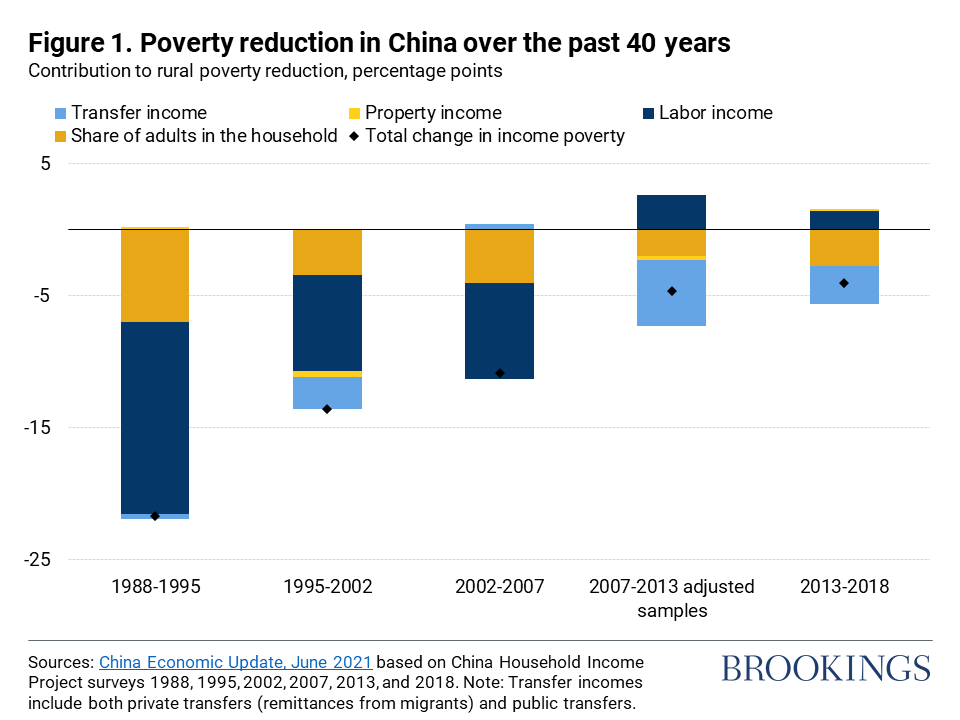
China’s poverty reduction success since 1980 is primarily a story of sustained economic growth. The first decade of reform saw rapid income gains in agriculture, as China removed some of the biggest distortions of the Mao era. In the second decade, industry took the leading role, both in urban and rural areas, as reforms widened and deepened. During the third decade, the dynamism of China’s export-oriented coastal areas spread further inland, as migration to the urban centers accelerated, infrastructure investments (such as with the “Western Development Strategy”) multiplied, and a growing proportion of China’s territory became economically integrated into global value chains. This decade also saw an expansion of China’s social policies, including place-based interventions in the most backward counties and the creation of a basic safety net for China’s rural population. During the final decade, these social policies were widened, culminating in the targeted poverty eradication campaign of the past five years. Only during this final period did transfers become a more important driver of poverty reduction than labor incomes (see Figure 1).

Poverty reduction in China over the past 40 years

Three lessons stand out:

  1. The speed and scale of China’s poverty reduction since 1980 is partially related to the starting point. As Martin Ravallion points out, China in 1980 was one of the poorest countries in the world, and yet had a relatively healthy and well-educated population—comparable to other East Asian countries with much higher levels of income. China’s savings rates were also high and land distribution equal—initial conditions that allowed other East Asian countries to grow rapidly during the 1960s and 1970s. China in the 1980s and 1990s was thus to some extent catching up with its peers.
  2. Market-oriented reforms drove the expansion of economic opportunities. China’s economic transformation from a largely rural and agrarian country to a predominantly urban, industrial powerhouse followed the country’s comparative advantage, using market signals to create appropriate incentives, and competition among regional governments to test policies and among companies to catalyze productivity gains. China introduced market incentives gradually. But its story of transformation and growth is consistent with classical economic theories of development.
  3. Although markets and business played the leading role, government policy was also instrumental. China’s state is endowed with high administrative capacity and the government used this to provide public goods and overcome collective action failures. This is most evident in the expansion of public infrastructure that helped integrate rural areas with urban economies, and in the coordination of stakeholders in the targeted poverty reduction. High-powered incentives in the management of China’s civil service created a strong performance orientation, while a high degree of decentralization allowed policy to be responsive to local conditions.

WHAT’S NEXT?

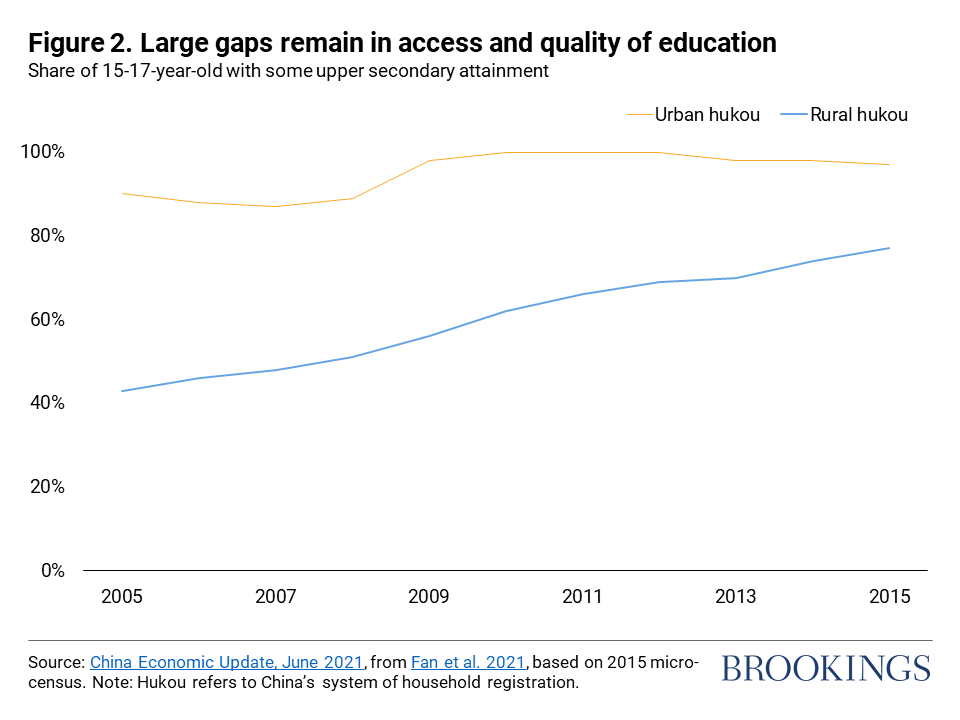
China’s conditions today create mixed prospects for growth and income gains among the poor. China’s technological capabilities and the competitiveness of its leading companies are on par with high-income countries, and its best performing schools and students rank top in the world. But these capabilities are not broadly shared. The dispersion of productivity levels across Chinese companies is high. Average educational attainment of the labor force is low by comparison with high-income countries and access to good education remains unequal (Figure 2). China needs to pay more attention to these inequalities.

Large gaps remain in access and quality of education

Market-oriented reforms could be an important catalyst for the greater diffusion of technological capabilities and for improved access to quality services. Among companies, leveling the playing field in access to finance and land could help promising small and medium businesses grow and create the jobs of the future. Lifting the remaining hukou related restrictions to labor mobility could help the current generation of school children access better education and health services in urban areas, improving social mobility and economic opportunities. This would over time help alleviate the risk of shortages of skilled labor, including in the urban service sector, which is likely to drive future productivity growth.


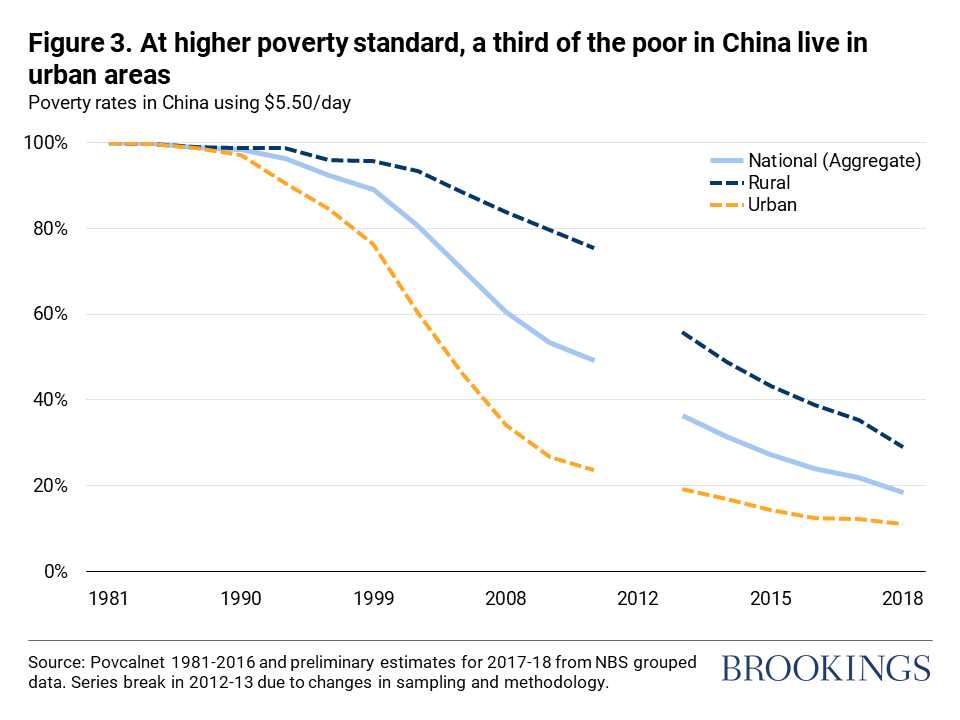
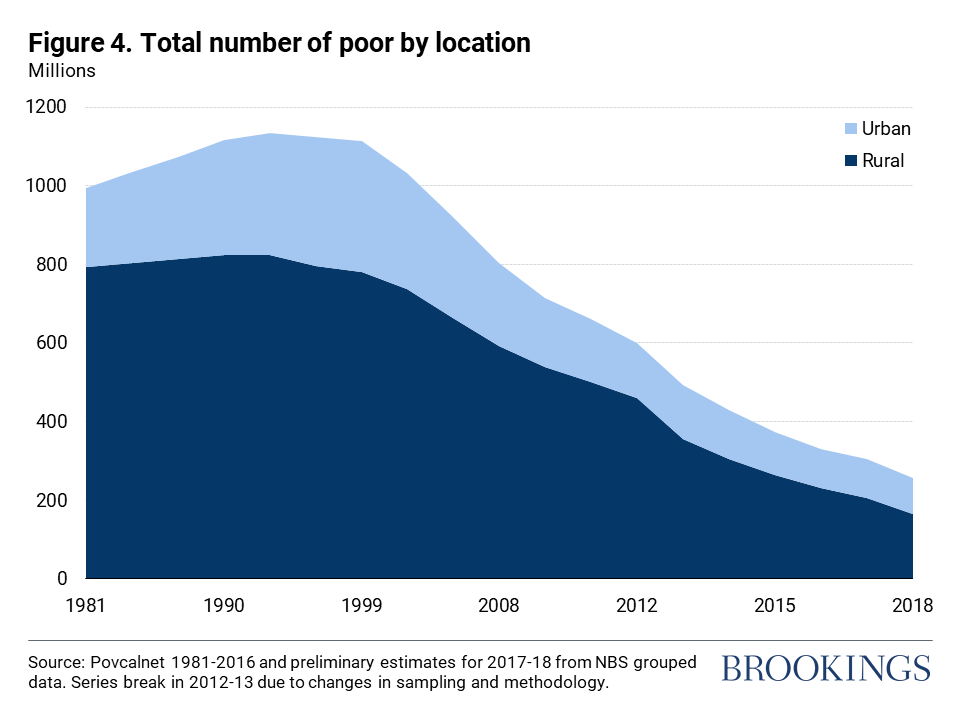
China’s administrative capacity is an asset in its transition to high income, but the government’s role in supporting the poor and vulnerable will have to shift. China’s poverty line is below the level in most upper-middle-income countries, and less than half the $5.50 per day typical of upper-middle-income countries. Adopting a higher line would change the profile of the poor: At $5.50, around one-third of the roughly 180 million poor would be in urban areas, for example, and many of them would be informal, migrant workers outside of agriculture. Among these groups, poverty is more likely to be transient, associated with spells of unemployment and out of pocket health and education expenses. Social policies would need to recognize these differences, just as targeted poverty reduction was based on an evaluation of household needs in rural areas.

At higher poverty standard, a third of the poor in China live in urban areas

Total number of poor by location

Following the eradication of absolute poverty, China has set the year 2035 as the target date to achieve common prosperity. This is understood as providing the opportunity for a decent standard of living to all Chinese citizens. Ensuring equal access to education, health care, and other services, leveraging market signals and competition to encourage innovation and the diffusion of technologies, and repeatedly adjusting government policies to ensure social transfers target key vulnerabilities and help China’s citizens manage the risk of a rapid socioeconomic transformation—these are the lesson of the past 40 years. They will continue to serve China well on the road ahead.

The Future Development blog informs and stimulates debate on key development issues.

This blog was first launched in September 2013 by the World Bank and the Brookings Institution in an effort to hold governments more accountable to poor people and offer solutions to the most prominent development challenges. Continuing this goal, Future Development was re-launched in January 2015 at brookings.edu.

For archived content, visit worldbank.org »

https://www.brookings.edu/blog/future-development/2021/09/24/whats-next-for-poverty-reduction-policies-in-china/


A hostess stands before the opening of the Forum on China-Africa Cooperation, (FOCAC) in Dakar, Senegal November 29, 2021. REUTERS/Cooper Inveen

MORE

FILE PHOTO: Employees wearing face masks work on a car seat assembly line at Yanfeng Adient factory in Shanghai, China, as the country is hit by an outbreak of a new coronavirus, February 24, 2020. REUTERS/Aly Song/File Photo

Most Recent Post

Man charged for borrowing rare Chinese manuscripts from UCLA library, returning fakes

  Suspect Jeffrey Ying allegedly travelled to China after checking works out using several aliases Agence France-Presse Published: 12:11pm, ...

Popular Posts - Last 30 days