Showing posts with label Putin. Show all posts

Thursday, 13 April 2023

Russia could become an ‘economic colony’ of China, according to CIA director

 Russia is becoming more and more dependent on China, and in some respects it risks becoming an economic colony of China over time

VLADIMIR ASTAPKOVICH—SPUTNIK/AFP/Getty Images

As many Western countries have weaned themselves off their reliance on Russian materials and imports since the invasion of Ukraine, China has remained Vladimir Putin’s closest major ally, continuing to buy Russian fuel and largely refusing to join the international chorus of condemnation against his invasion of Ukraine. But with Russia struggling to gain ground in Ukraine, a major intelligence chief in the United States called Putin’s efforts a “huge strategic failure for Russia” that has helped cement a Western coalition in support of Ukraine and may eventually make Russia economically subservient to another major power.

More from Fortune: 5 side hustles where you may earn over $20,000 per year—all while working from home Looking to make extra cash? This CD has a 5.15% APY right now Buying a house? Here's how much to save This is how much money you need to earn annually to comfortably buy a $600,000 home

China has toed the line between respecting Ukraine’s sovereignty and abstaining from criticizing Russia for starting the war over the past year. Chinese leaders have recently positioned themselves as peacemakers in the conflict, even deflecting blame to the U.S. for prioritizing its own economic interests and aggravating the crisis through sanctions on Russia. But this could all turn out to support China’s economic interests.

“If you look at the reality, Russia is becoming more and more dependent on China, and in some respects it risks becoming an economic colony of China over time,” William Burns, director of the Central Intelligence Agency, said Tuesday during an event at Rice University, in Houston.

Between Western companies leaving the country and multiple waves of unprecedented international sanctions, the Ukraine war has dealt a body blow to Russia’s economy. Russian GDP fell by 2.2% to 5.9% last year, according to estimates from the World Bank, the IMF, and the OECD. Its economy could shrink by a further 2.5% this year in a scenario calculated by the OECD.

Russia was forecasted to fare much worse in the early days of the war, but its economy was temporarily spared by a surge in oil and natural gas prices, which had yet to be targeted by Western sanctions. Russia earned a record 93 billion euros, or $102 billion, in fossil fuel exports during the first 100 days of the war alone, according to a June study.

But 2023 promises to be a different story. With European embargos on Russian coal and refined oil products now in place and European natural gas prices falling 86% from their peak last August, one of Russia’s remaining economic lifelines has been cut. China has stepped in over the past year to support Russia’s floundering energy export economy, which in 2021 accounted for 45% of the country’s federal budget. Soaring purchase volumes for Russian fossil fuels have been a bargain for China, which was able to acquire oil at a nearly 40% discount and gas at 50%, but keeping the relationship alive is quickly becoming a matter of survival for Russia.

Burns said Russia is becoming dependent on China for exports of “energy resources and raw materials,” in an alliance that is becoming rapidly unbalanced and a potential geopolitical concern for Putin, who risks become overreliant on a foreign actor.

“That all adds up in my view to a huge own goal for Putin’s Russia right now,” he said, with Putin’s reliance on Chinese President Xi Jinping as an export partner representing a strategic failure that will leave Russia with a short list of tenuous economic allies for the foreseeable future.

In some ways, Russia’s reliance on China has been set in stone since the invasion over a year ago. With Europe no longer a reliable gas export partner, Xi and Putin jointly announced plans in March for a new gas pipeline: The Power of Siberia 2, which will export natural gas to China via Mongolia, is slated to deliver at least 98 billion cubic meters of gas a year by 2030. Last year, Russia supplied China with 15.5 billion cubic meters of gas.

Russia’s material dependence on Chinese buyers has not been lost on Moscow officials, who see trade between the two countries as a cornerstone of Russia’s strategy to win the war in Ukraine and weather sanctions, the Financial Times reported last month, citing an unnamed source close to the Kremlin.

“The logic of events dictates that we fully become a Chinese resource colony,” the person said. “Our servers will be from Huawei. We will be China’s major suppliers of everything. They will get gas from Power of Siberia. By the end of 2023 the yuan [renminbi] will be our main trade currency.”

To be sure, Russia’s war in Ukraine is not entirely in China’s political interests. While an economically beneficial relationship, Russia may have also become a “burden” to China, Antonio Fatas, an economist and professor at the Insead business school in France, told CNBC Monday, adding that China wants to be seen as “leaders of the world, not leaders of the world that is causing war in Europe.”

Xi continued to play peacemaker earlier this month when top European leaders visited Beijing, and China is currently steering clear of turning its economic alliance with Russia into a military one by supplying Putin with Chinese arms, a move U.S. officials have actively discouraged.

Weeks before Russia invaded Ukraine, Putin and Xi declared a “no limits” friendship, but the long war has tested that relationship. Burns said that while the partnership between Xi and Putin today is a “strong one,” an overt military engagement with the West, or an escalation of nuclear warfare rhetoric from Putin, might still represent a limitation to how far China is willing to go. “To the best of our intelligence, Xi’s China has not yet provided weapons and ammunitions to Russia,” he said.

“It’s an important partnership. I think both leaders are committed to it. But it’s so far at least not a friendship without limits.”

This story was originally featured on Fortune.com

https://finance.yahoo.com/news/russia-could-become-economic-colony-180826282.html

Thursday, 15 September 2022

Putin-Xi talks: Russian leader reveals China's 'concern' over Ukraine

Vladimir Putin has acknowledged China's "concern" over Ukraine, in his first face-to-face talks with President Xi Jinping since the Russian invasion.

15 September 2022

By Tessa Wong & Simon Fraser
BBC News

https://www.bbc.com/news/world-asia-62912892

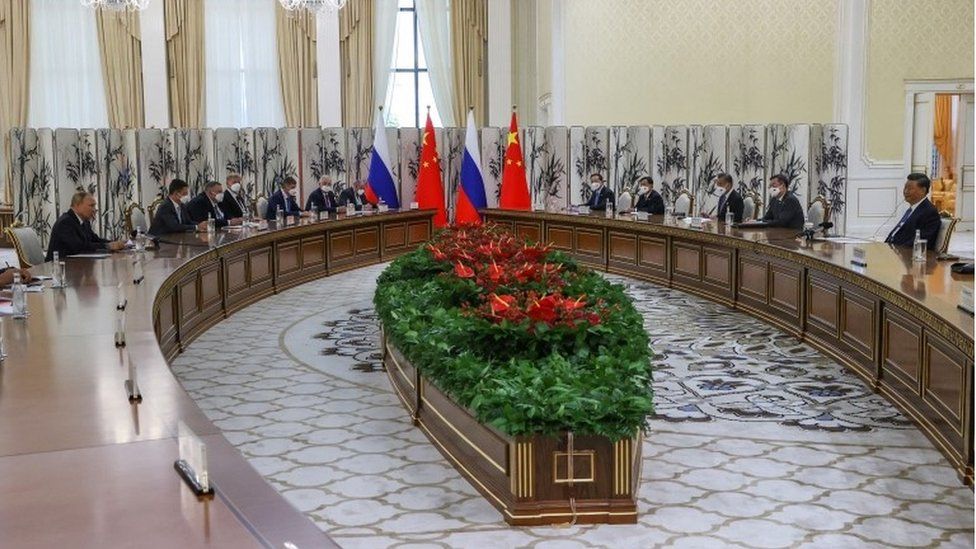
Russian President Vladimir Putin meets with Chinese President Xi Jinping on the sidelines of the Shanghai Cooperation Organization (SCO) summit in Samarkand, Uzbekistan September 15, 2022.IMAGE SOURCE,REUTERS
Image caption,
Mr Putin (far left) and Mr Xi (far right) met at the Shanghai Cooperation Organization summit in Samarkand

Vladimir Putin has acknowledged China's "concern" over Ukraine, in his first face-to-face talks with President Xi Jinping since the Russian invasion.

But speaking in Uzbekistan, Mr Putin also thanked China for its "balanced position" - and said US "attempts to create a unipolar world" would fail.

Mr Xi said China was willing to work with Russia as "major countries".

China hasn't endorsed Russia's invasion but has grown trade and other ties with Moscow since it was launched.

The two leaders' meeting on the sidelines of the Shanghai Cooperation Organisation (SCO) summit in Samarkand comes at a crucial point in the Ukraine war, as Russian troops lose ground in parts of the country.

"We highly value the balanced position of our Chinese friends when it comes to the Ukraine crisis," Mr Putin told Mr Xi, on only his second foray abroad since February's invasion.

Revealing that China had "questions and concern" about the situation in Ukraine, he said he understood.

"During today's meeting, we will of course explain our position," Mr Putin said.

In contrast to Mr Putin's statement, the Chinese government readout after the meeting notably did not mention the Ukraine war.

But it said Russia and China would extend "strong mutual support" on core interests. Together, the two would play "a leading role in injecting stability into a world of change and disorder", and Beijing called their partnership "as stable as mountains".

The invasion has plunged Moscow into its worst crisis with the West since the Cold War and has sent global food and energy prices soaring.

It also poses a huge challenge for China - whose relations with the West have nosedived in recent years over issues including human rights and the future of Taiwan.

Mr Putin and Mr Xi have met dozens of times over the years but their latest talks received particular scrutiny.

Their growing relationship - which they characterise as a bulwark to Western dominance - signifies a major shift in the world order following the demise of the Soviet Union in 1991.

The roles are reversed now, with China the dominant partner, having risen to become an economic superpower.

"Putin is getting more out of it than Xi - Russia is quite isolated internationally," Professor Emeritus Rosemary Foot, a senior research fellow in international relations at Oxford University, told the BBC.

"So it's important to show that China is a supportive partner, not an ally but certainly a supportive actor. There is a close relationship."

For Mr Xi, who described Mr Putin as "an old friend", the optics of the meeting were also significant.

He is seeking a historic third term at a Communist Party congress next month, and his visit to Central Asia is the first time he has left China since the start of the Covid pandemic.

His trip comes amid fresh lockdowns in China, where his "zero Covid" policy is still in place. While the rest of the world has opened up, Beijing continues to shut down entire cities and provinces every time cases flare up.

China and Russia have long sought to position the SCO, founded in 2001 with four ex-Soviet Central Asian nations, as an alternative to Western multilateral groups. India, Pakistan and Iran are also members.

During their last meeting in February - when Mr Putin travelled to Beijing for the Winter Olympics at Mr Xi's invitation - the two sought to demonstrate their close ties, famously declaring they shared a friendship with "no limits".

Days later Russia invaded Ukraine, prompting international condemnation and sanctions, while putting the China-Russia relationship under an intense spotlight.

Beijing has urged an end to hostilities and stressed the importance of national sovereignty. But it has also refused to call the war an invasion, as Russia refers to it as a "special military operation".

In recent weeks China has sent troops to take part in joint military exercises with Russia, and sent senior officials to meet Russian counterparts. It has also come to Russia's economic aid as Western sanctions were imposed.

This relationship has been a win-win for both countries. With Europe reducing its dependency on Russian oil and gas, China has increased its purchases, which it is reportedly getting at discounted rates.

Last month Beijing also agreed to pay for gas in Russian roubles and Chinese yuan, giving Moscow a much-needed alternative to dollars as a foreign reserve, while furthering China's interests in boosting the yuan as an international currency.

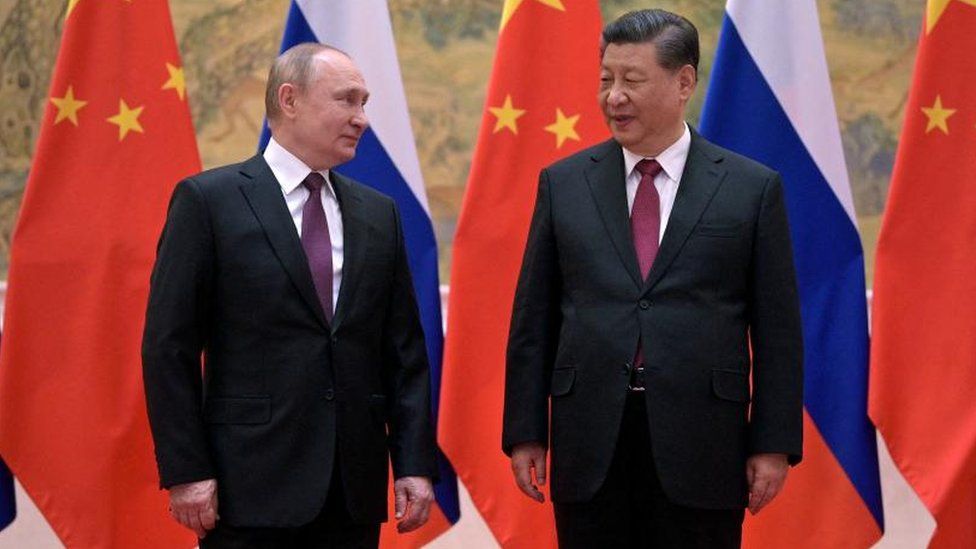
President Putin and President XiIMAGE SOURCE,REUTERS
Image caption,
The two leaders met in Beijing during the Winter Olympics

But China appears to have drawn a line.

US intelligence says Moscow is so desperate for weapons, it has turned to Iran and even North Korea for supplies. It has also apparently approached China - but there has been no indication so far that Beijing has agreed.

Some experts believe that despite the rosy picture of comradeship, Mr Xi will want to maintain some distance between him and Mr Putin for several reasons.

"It would be spectacularly inept to choose the moment of maximum Russian tactical retreat in Ukraine to lean into Moscow even harder than Beijing already has," said Evan Feigenbaum, vice-president for studies at the Carnegie Endowment for International Peace, in a recent commentary.

Another concern for Mr Xi is that former Soviet Central Asian countries, four of which are members of the SCO, do not support Russia's invasion of Ukraine - which also used to be part of the USSR.

"[Mr Xi] must be very aware that Central Asia is unhappy and nervous about what's going on," Prof Foot told the BBC.

Additional reporting by BBC Monitoring

https://www.bbc.com/news/world-asia-62912892


Tuesday, 30 August 2022

Tony Blair urges western powers to stand up to China

 Former prime minister warns era of political and economic dominance by west coming to an end

PA Media

Sat 16 Jul 2022 18.32 BST

https://www.theguardian.com/politics/2022/jul/16/tony-blair-urges-western-powers-to-stand-up-to-china

Tony Blair

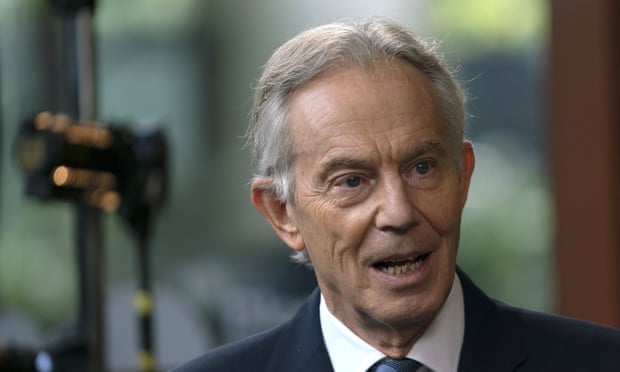
Tony Blair made the comment while giving the annual Ditchling lecture. Photograph: Bloomberg/Getty Images

Tony Blair has issued a rallying call to western nations to come together to develop a coherent strategy to counter the rise of China as “the world’s second superpower”.

Delivering the annual Ditchley lecture on Saturday, the former prime minister called for a policy towards Beijing of “strength plus engagement” as he warned the era of western political and economic dominance was coming to an end.

He said western powers needed to increase their defence spending in order to maintain their military superiority while extending their “soft power” by building ties with developing nations.

At the same time, they needed urgently to end the “craziness” in their domestic politics and to restore “reason and strategy”.

“How did Britain ever reach a point where Nigel Farage and Jeremy Corbyn came for a short but consequential time to shape our politics? Or America to a place where whether you got vaccinated denoted political allegiance?” he said.

“The craziness in our own politics has to stop. We can’t afford the luxury of indulging fantasy. We need to put reason and strategy back in the saddle. And we need to do so with urgency.”

On China, Blair said that it had already caught up with the US in many fields of technology, while President Xi Jinping had made no secret of his ambition to return Taiwan to Beijing’s rule.

At the same time, President Vladimir Putin’s “brutal and unjustified” invasion of Ukraine showed they could no longer automatically expect major world powers to abide by accepted international norms.

“As a result of the actions of Putin, we cannot rely on the Chinese leadership to behave in the way we would consider rational,” he said.

“Don’t misunderstand me. I am not saying in the near term that China would attempt to take Taiwan by force. But we can’t base our policy on the certainty that it wouldn’t. And even leaving to the side Taiwan, the reality is China under Xi’s leadership is competing for influence and doing so aggressively.”

He said Beijing would compete “not just for power but against our system, our way of governing and living” and that the west needed to be strong enough to defend its systems and values.

“The biggest geopolitical change of this century will come from China, not Russia,” he said. “We are coming to the end of western political and economic dominance. The world is going to be at least bipolar and possibly multipolar. It is the first time in modern history that the east can be on equal terms with the west.”

With China – as well as countries such as Russia, Turkey and Iran – pouring resources into the developing world while building strong defence and political links, Blair said it was essential the west did not forget the importance of soft power.

“We have a great opportunity. Developing countries prefer western business. They’re much more sceptical now of Chinese contracting than a decade ago. They admire the western system more than we realise,” he said.

Most Recent Post

Man charged for borrowing rare Chinese manuscripts from UCLA library, returning fakes

  Suspect Jeffrey Ying allegedly travelled to China after checking works out using several aliases Agence France-Presse Published: 12:11pm, ...

Popular Posts - Last 30 days