Showing posts with label Run philosophy. Show all posts

Monday, 29 August 2022

‘Run philosophy’: Why ‘zero COVID’ has young Chinese eyeing emigration

 June 8, 2022

https://www.csmonitor.com/World/Asia-Pacific/2022/0608/Run-philosophy-Why-zero-COVID-has-young-Chinese-eyeing-emigration


Through deserted Shanghai streets, some people silently pedaled bicycles, dragging roller bags with one hand or balancing luggage precariously on front wheels. Others fled the city’s lockdown on foot, wearing full hazmat suits and carrying possessions stuffed into plastic bags. They lined up for at least a mile on the access road to Hongqiao Railway Station, bedraggled refugees out of place against the backdrop of manicured boulevards and futuristic high rises. Among the crowd was Carol, a writer.

She recalls surveying the scene in May, shocked by how the ultramodern, cosmopolitan city she’d viewed as a splendid castle had transformed overnight into a place of mass deprivation.

“After this experience in Shanghai, everyone feels we aren’t living in a palace after all, but in a mud-brick house with a thatched roof,” says Carol, who spent more than two months confined to her apartment block with limited food during the country’s biggest COVID-19 outbreak. A Chinese citizen, she asked to use only her English name to protect her identity.

WHY WE WROTE THIS

Strict COVID-19 lockdowns, and the experience of having their liberties stripped away, have changed the perspective of some young Chinese people on their country. Once willing to sacrifice degree of freedom for economic security, many are now rethinking their futures.

Similar scenes of exodus have played out across the city of 25 million people in recent days and weeks. For many urban, educated millennials like Carol, the lockdowns and quarantines imposed in Shanghai and dozens of cities nationwide have been a traumatic, paradigm-shifting ordeal that has shaken their sense of security. People have fled Shanghai in droves, and now some are considering leaving China altogether. 

“The middle-class group expected a decent life,” says Chen Daoyin, a political scientist and former associate professor at the Shanghai University of Political Science and Law. “Before they exchanged freedom for security, but now they have neither freedom nor safety.” 

What struck Carol about the lockdown in Shanghai was that no one could protect themselves. “This thing is universal – your freedom of residence and freedom of travel will be restricted. ... All the people are suffering,” she says from her hotel room in a neighboring province. No matter how much money you have or how big your house is, she adds, “you may get a knock on the door and be taken away in the middle of the night.”
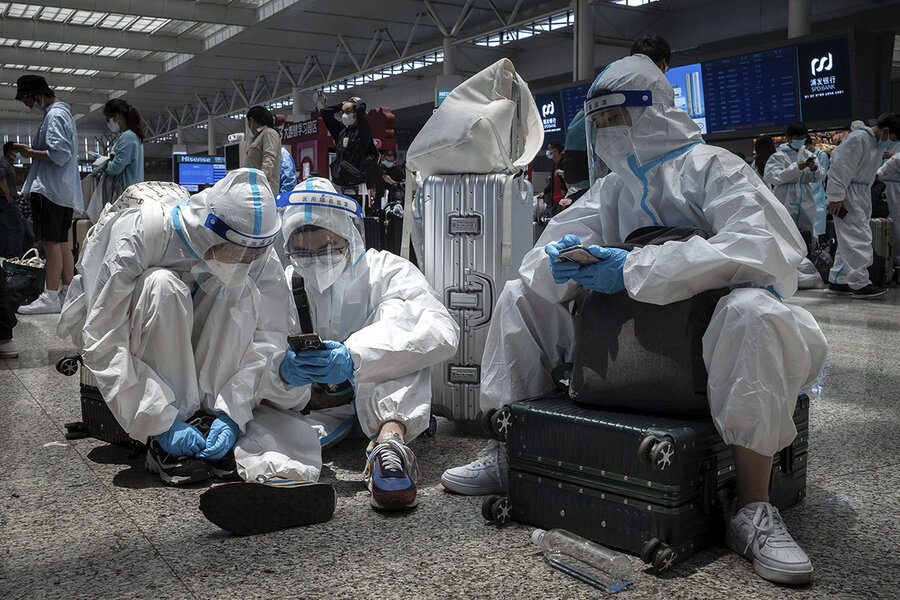
Chinatopix/AP
Passengers in protective suits wait for their train at the Hongqiao Railway Station in Shanghai, May 22, 2022. In recent weeks, people have fled the locked-down metropolis in droves.

Concerned that China’s strict zero-COVID-19 controls will further encroach on basic freedoms and lead to economic and social stagnation, Carol and many of her peers are exploring contingency plans to move overseas.

Carol, who has never lived abroad before, plans to work harder and earn more. “If I have enough money,” she says, “I will go.”

Running away

When Joanna returned to Shanghai three years ago after graduating from college in the United States, she expected to live in China for the rest of her life. A two-month lockdown changed her mind.

“This exceeded my worst predictions,” says the Shanghai-based media worker, asking to withhold her last name to protect her identity. Her goal now is to secure permanent residency in another country, while keeping her Chinese citizenship. “I want that option,” she says, to avoid the “terrifying” feeling that she is trapped in China.

China has allowed millions of its youth to study abroad in recent decades, but the majority have returned home, anticipating they will have better career opportunities here. Yet as the stringent COVID-19 policy exacts a rising economic and social toll, including high urban unemployment, some returned students like Joanna are again looking outward.

Joanna’s main concern is that the zero-COVID-19 policy, while it has succeeded in keeping cases and deaths in China low, is no longer economically feasible. Official figures show China’s economy contracting in recent months, with retail sales and industrial production declining. “If you keep suppressing people’s morale, everyone loses their desire to consume,” she says. 

Even since Shanghai mostly reopened June 1, new outbreaks have led authorities to impose fresh lockdowns, creating concerns about an endless cycle of easing and restrictions. More than 1 million people remain confined at home or in quarantine facilities.

Meanwhile, online discussions about “running away from China” have surged. Chinese netizens created a word for it – runxue, or “run philosophy,” a play on words using a Chinese character that sounds like “run” in English. 

“It reflects a kind of escapism psychology – people choosing to run away from this place,” says Dr. Chen.
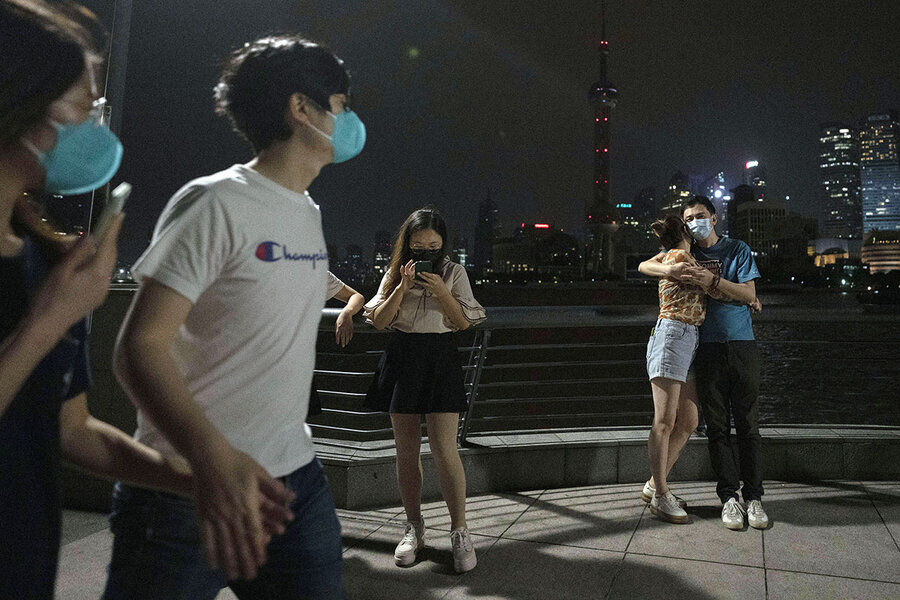
Ng Han Guan/AP
Residents gather to celebrate the lifting of a COVID-19 lockdown on the bund in Shanghai on June 1, 2022. City authorities said they would take major steps toward reopening China's largest city after a two-month lockdown that has set back the national economy and confined millions of people to their homes.

On WeChat, China’s top social media app, Chinese users searched for the term emigration more than 100 million times on a single day in May, according to data released by the company. Emigration has also been a popular topic on China’s Twitter-like social media platform, Weibo, and millions have viewed a question about “run philosophy” on Zhihu, China’s version of Quora.


Users of GitHub, the world’s largest open-source platform for software, set up a repository that is gathering detailed strategies and tips on how to emigrate from China. 

“To ‘run’ is a kind of risk aversion,” says Joanna. “Many people are thinking about it. They may not have pulled the trigger, but if things continue to go badly, I believe many people will take practical actions.”

Exit strategy

Allen Ai, a Chinese accounting student in Italy, left China a year ago after losing his job during the pandemic. He’s now fielding messages from contacts back home asking him for advice on moving abroad.

Yet even as the COVID-19 restrictions are pushing some young people to try to emigrate, Chinese authorities are imposing tighter controls on those attempting to leave.

Citing pandemic prevention requirements, the National Immigration Administration announced last month that it will “strictly restrict non-essential exit activities of Chinese citizens.” Last year, it said it would suspend issuing passports to people with “non-urgent” reasons for leaving the country.

China is unlikely to lift such overseas travel restrictions as long as it maintains the zero-COVID-19 policy, which is currently here to stay, experts say.


Ma Xiaowei, head of the National Health Commission, wrote in the Communist Party publication Qiushi on May 16 that China is planning to set up large numbers of booths for regular COVID-19 testing in all provincial capitals and cities with more than 10 million people, while also creating permanent quarantine centers. The goal is to maintain COVID-19 prevention while reducing disruptions to normal life – an approach that showed better results in Beijing recently.

“Mass testing, makeshift shelters, and green code for travel – this may be the status in China for the next three-to-five, or five-to-10 years,” Dr. Chen says, referring to the health code system that tracks each individual’s COVID-19 risk status.

As for Mr. Ai, he’s seeking permanent resident status in Italy, where he expects to have more opportunities. “I think I made a correct decision,” he says. “If I stay in China, I don’t know what I can do.”

https://www.csmonitor.com/World/Asia-Pacific/2022/0608/Run-philosophy-Why-zero-COVID-has-young-Chinese-eyeing-emigration

‘Run philosophy’: the Chinese citizens seeking to leave amid Covid uncertainty

With Beijing’s zero Covid policy set to continue, many disillusioned citizens have begun planning to leave the country

 China affairs correspondent

Wed 20 Jul 2022 05.12 BST

https://www.theguardian.com/world/2022/jul/20/run-philosophy-the-chinese-citizens-seeking-to-leave-amid-covid-uncertainty

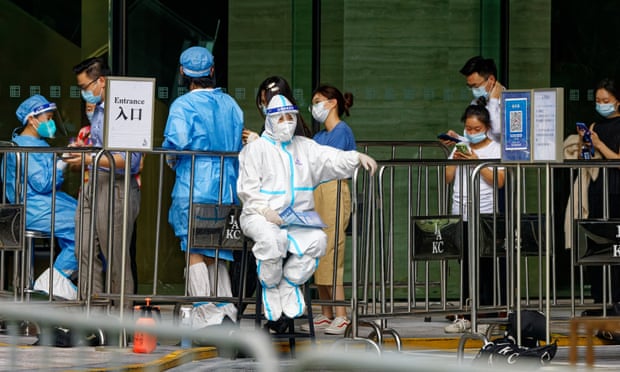
People stand in line for a mandatory Covid tests in Shanghai, China.

People stand in line for a mandatory Covid tests in Shanghai, China. Photograph: Alex Plavevski/EPA

When Wendy Luo*, a 29-year-old Chinese woman, handed over her passport to a border control officer in Shanghai airport last month, her heart began to beat fast. “I felt like my fate would be determined at that moment. Leave or stay, all at the officer’s mercy.”

After enduring months of lockdowns and weeks of food shortages, Luo had begun to look for an exit strategy from China. She was lucky, she said, because she quickly managed to find a job in Paris, having spent six years studying and working in France and being in possession of a resident visa.

“The border control officer in Shanghai asked many questions,” Luo said. “They included why I was leaving China, what did I do in Shanghai in the last couple of years, and what I was going to do in France. Most importantly, whether I plan to return to China any time soon. I pretended to be calm when giving my answers, but I was actually extremely nervous.”

Until last year, China’s zero-Covid policy had won much support from its citizens. When western countries such as the US and the UK recorded hundreds of thousands of deaths and millions of infections, the ruling Communist party used the opportunity to emphasise the virtues of its system of government.

Yet when strict lockdowns began to be enforced across many cities in China, including Shanghai, from the start of 2022, doubts and criticisms began to rise. China’s economy was hit hard, and young graduates complained about not being able to find work. The economy showed signs of rebound in June, but since the more transmissible Omicron subvariant, BA.5, was discovered this month, many have begun to speculate again whether renewed lockdowns in cities such as Shanghai are on the way.

Many disillusioned urban Chinese citizens have started planning to leave the country. Online, “run philosophy”, or “run xue” – a coded way of talking about emigrating – has become a buzzword. On Zhihu, a post explaining the phenomenon has been read more than 9m times since January.

Elsewhere on Chinese language social media, forums have been set up to exchange tips about how to maximise the chances of being admitted to overseas academic programmes. Immigration agencies reported the number of business inquiries had shot up too over the past few months.

An airport worker in personal protection equipment sprays disinfectant at the departure gates area inside Beijing international airport.
An airport worker in personal protection equipment sprays disinfectant at the departure gates area inside Beijing international airport. Photograph: Jérôme Favre/EPA

‘People’s rights can be so easily taken away’

Mark Li*, a 24-year-old history teacher in the southern province of Hainan, jokingly calls himself a member of the “run philosophy club”. After spending four years as an undergraduate student in the US, Li came back to China in the summer of 2020 to build a career in teaching.

“Initially, the idea of leaving China started with the frustration of censorship that began to build in my day-to-day job. And when lockdowns in Shanghai began, I started to think harder about it: people’s rights can be so easily taken away, even in the most outward-looking city like Shanghai,” he told the Guardian.

The last straw, according to Li, was the recent announcement in Beijing that it would “unremittingly grasp the normalisation of epidemic prevention and control in the next five years”. The line caught the eyes of China’s Covid-fatigued citizens. After an outcry online, the reference to “five years” was removed from Chinese media, and a related hashtag on Weibo was deleted.

Yet Li was determined. He saw all of this as a sign of deeper changes that are taking place in China today. “When I came back to China two years ago I was planning on a life and career in the country. I was very optimistic … But Covid seemed to have revealed the rotten core of Chinese politics and turned the country upside down – in a short span of two years.”

It is difficult to know how many of those who pondered leaving did leave in the end. Official emigration figures for this year are not immediately available. According to the United Nations population fund (UNFPA), there was only a total Chinese emigration of 6.9 million over the years from 2000 to 2021. And measured as a share of China’s total population, the UNFPA said, it is “negligible”. In May, Beijing said it would “strictly limit” unnecessary travel outside the country by Chinese citizens.

Rachel Murphy, a professor of Chinese development and society at Oxford University, said the rise of the run philosophy “sits alongside other sentiments that have in recent years become popular in China’s social media, such as ‘lying flat’” – taking an extended break from relentless work.

The popularity of run philosophy, she said, indicated that people want to opt out of a social order that has become hyper-competitive, exhausting and unpredictable.

“The recent lockdown in Shanghai also increased the visibility of unchecked party-state power on individuals,” she said. “Yet, the costs of using their voice to try to change things are too high for Chinese citizens. So that leaves them with dreams of exit.”

But Murphy said that this was not to say that these young people were not loyal to China and their nationalistic sentiments were very strong. “Right now, though, some people feel they want to escape the present circumstances of their lives.”

The sense of uncertainty was shared in China’s expatriate community across different industries, too. While Chinese citizens face tough hurdles to leave, foreign residents find it tough to stay. This pains Andrea Caballé, a Spanish lawyer who has called Beijing home for the past decade.

Last month, after she began the process of preparing to move back to Barcelona, her home town, Caballé broke into tears in her Hutong apartment in downtown Beijing. “I spent a decade of my life in China. I have loved this country, but now I feel that I have no choice but to go back home,” she said.

Spanish lawyer Andrea Caballé has been in Beijing since 2012
Spanish lawyer Andrea Caballé has been in Beijing since 2012. Photograph: Andrea Caballé

Caballé, who turned 37 this year, began her career as an intern in 2012 in the Chinese capital. Over the past decade, she has thrived professionally. She now works for the European Union in Beijing, facilitating legal exchanges between Europe and China.

But since Covid struck, Caballé said the sudden lockdowns brought her constant stress and were demoralising. “I don’t want to be told one day that I couldn’t leave due to Covid when I really have to, for example, visit my elderly parents in Spain,” she said.

Luo, now finally settled in Paris after months of distress, said she will stay in France for as long as she can. “I don’t know when I’ll be back in China next,” she said. “Rumour has it that ‘zero Covid’ probably won’t end until 2025. So I’ll have to find a way to stay in France until then, at least.”

*Names of the two Chinese interviewees were changed to protect their identity; additional reporting by Xiaoqian Zhu


https://www.theguardian.com/world/2022/jul/20/run-philosophy-the-chinese-citizens-seeking-to-leave-amid-covid-uncertainty


https://www.theguardian.com/world/2022/may/20/do-whatever-it-takes-beijing-urged-to-act-as-china-economy-falters


https://www.theguardian.com/world/2022/may/26/the-rise-of-bai-lan-why-chinas-frustrated-youth-are-ready-to-let-it-rot


Related stories

https://www.theguardian.com/world/2020/apr/06/iranian-official-backtracks-after-calling-chinese-covid-19-figures-a-joke

https://www.theguardian.com/technology/2021/dec/02/facebook-owner-meta-takes-down-chinese-network-spreading-fake-covid-posts

https://www.theguardian.com/world/2022/jun/10/china-calls-theory-that-covid-originated-in-chinese-lab-politically-motivated-lie

https://www.theguardian.com/world/2022/aug/19/covid-coronavirus-outbreak-tibet-china-tourists


Most Recent Post

Man charged for borrowing rare Chinese manuscripts from UCLA library, returning fakes

  Suspect Jeffrey Ying allegedly travelled to China after checking works out using several aliases Agence France-Presse Published: 12:11pm, ...

Popular Posts - Last 30 days