Chinese President Xi Jinping has made fighting official corruption a cornerstone of his reign.
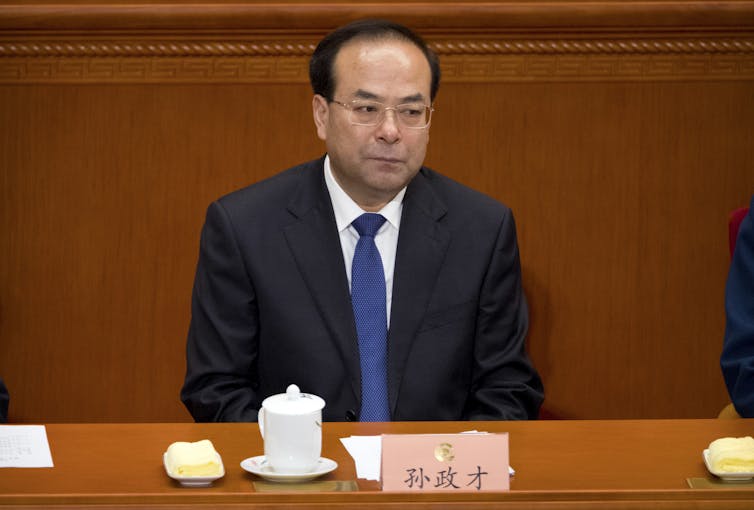
Judging by the numbers alone, the campaign has achieved impressive results. Astonishingly, the Chinese Communist Party (CCP) has disciplined well over one million officials since Xi took power in 2012. The anti-corruption campaign has snared hundreds of high-level leaders – including, most recently, former Chongqing Communist Party General Secretary and Politburo member Sun Zhengcai.
Xi’s fight against corruption has made him enormously popular among the Chinese people. As a political scientist and close observer of Chinese politics, however, I would argue that Xi’s enthusiasm to root out corrupt officials isn’t based on his own rectitude. Indeed, Xi’s family has inexplicably managed to accumulate over $1 billion in wealth, according to reports by Bloomberg. Rather, it rests on Xi’s determination to strengthen his personal power and that of the party he leads.
We should pay attention. If Xi succeeds in centralizing his control over the world’s most populous country, the United States will be presented with an increasingly confident and formidable competitor.
Sun Zhengcai was one of the more prominent targets of Xi Jinping’s crackdown on corruption.AP Photo/Mark Schiefelbein
As China scholar Minxin Pei has documented, corruption in China typically takes the form of organized schemes involving groups of bureaucrats and private business people to plunder state resources.
Corruption fuels job promotions, the awarding of government contracts and the transfer of public assets into private hands at fire sale prices. Corruption in China is rooted in the blurred lines that come with a system combining weak rule of law, considerable autonomy on the part of local officials and an economic model featuring opaque relations between private enterprise and a large state-owned sector.
Xi has approached the problem of corruption much like his predecessors, though with unusual vigor, scale and persistence. Periodically, the CCP leadership has undertaken highly visible campaigns against corruption. During these campaigns, teams of officers from the CCP’s Discipline Inspection Commission sweep the offices of municipal or provincial governments and party units. These efforts have succeeded in preventing corruption from overwhelming the political system and undermining the economy. But the misuse and plunder of state resources nevertheless remains pervasive.
If Xi were serious about rooting out corruption more thoroughly, deep institutional reforms would be required. In countries where corruption has been successfully addressed, these have included strengthened rule of law, greater judicial independence, democratic accountability, institutional transparency and greater space for media and civil society watchdogs.
In China, scholar Pei emphasizes the need for clearer property rights that prevent officials from exploiting public assets for private gain. Such measures would both limit the opportunities for graft and more easily expose that which does take place.
Yet Xi has shown little interest in these kinds of reforms, which would threaten the leading role of the Communist Party. Indeed, his attacks on rights lawyers, independent media and non-governmental organizations – precisely the groups that in other societies hold public officials to account – have pushed in the opposite directions.
Too many pigs at the trough
So if Xi has ruled out the most effective anti-corruption tools, why is he going after corrupt officials at all?
In The Dictator’s Handbook, political scientists Bueno de Mesquita and Alastair Smith theorize that authoritarian leaders cannot rule without the support of other powerful players, such as military generals, business leaders and key intellectuals. Their demands must be met. Such leaders survive, therefore, by channeling rewards to those supporters most essential to the leader’s maintenance of power. Over time, however, the number of individuals attached to the ruling coalition tends to grow, as does the price that each member demands for support. We might call this the “too many pigs at the trough” problem.
This may be sustainable if the economy is rapidly growing, but becomes more problematic once growth slows, as indeed it has in China in recent years. Because the monetary gains extracted by corrupt officials serve as dead weight from an economic perspective, corruption itself can become a source of worsening economic performance. The costs of paying off a bloated coalition of greedy supporters are considerable: a reduced take for the dictator himself, lagging revenue growth and declining popular legitimacy, the latter necessitating increasingly costly repression.
All of this explains why newly installed leaders move quickly to cull the number of pigs at the trough, as Xi has done since taking power in 2012. By retargeting private rewards only to those whose support is truly essential and reducing the size of payoffs to the minimum necessary to avert defection, the leader thereby shores up his power position with a smaller and more manageable ruling coalition.
Of course, culling the herd means more than simply cutting rewards to non-essential coalition members. They must be jailed or otherwise rendered incapable of retaliating. Factions organized around political rivals must be disrupted.
Such is the case with Xi’s recent uses of the anti-corruption campaign to undermine the Communist Youth League associated with Xi’s predecessor, former Chinese President Hu Jintao. Ruthlessness toward those unlucky enough to be targeted also sends a warning to the remaining coalition members.
Xi’s anti-corruption campaign is reshaping the magnitude and composition of the ruling coalition and the size of the payoffs to remaining members, thereby strengthening his own hold on power. But as long as China’s political order remains dominated by a single party, a system for funneling private rewards to members of the ruling coalition will remain essential to its functioning. Xi’s image as China’s “Mr. Clean” is more mirage than reality.
It is reasonable to assume Xi has close supporters within the party leadership. However, they are not as visible, for the most part, as was the case for Mao Zedong and Deng Xiaoping.
Director, China Studies Centre, Professor of Chinese Politics, University of Sydney
As the Chinese Communist Party’s sixth plenary session wraps up in Beijing, much of the focus outside China has been on two key aspects.
The first is the meeting was primarily designed to strengthen the political position of Xi Jinping as both general secretary of the CCP and president of the country heading into next year’s Party Congress when he looks certain to secure a third five-year term as leader.
The second is the approval of a resolution on Communist Party history. This was intended not only to cement Xi’s position in the party, but also determine the official narrative of CCP history that will provide an ideological guide to future policies.
Notwithstanding Xi’s centrality in all of this – as well as the significance of a resolution on party history – these interpretations of the events may be somewhat misleading.
Join 175,000 people who subscribe to free evidence-based news.
How Mao and Deng cemented power
The inner political dynamics of the CCP’s leadership are largely unknown. Commentators guess intelligently about groups and factions, about policy divides and preferences, about past experiences and future visions.
Xi occupies the leading position in the political system, and has done since 2012. At the same time, Xi’s current position in the party is different to that of former leaders Mao Zedong and Deng Xiaoping when they initiated the previous resolutions on party history in 1945 and 1981, respectively.
Both Mao and Deng had well-established political authority that was in many ways independent of their formal positions in the CCP.
From 1927 to the early 1940s, Mao had been on the outside of the party leadership in many ways. It was his insistence on a rural-based, guerrilla strategy to acquire national political power and to fight the Japanese that eventually proved successful – and proved others wrong. This became the political base of the CCP that was celebrated in 1945.
When the CCP used this strategy to take control of China in 1949, it essentially bestowed on Mao an almost unchallengeable authority over others, including apparently close colleagues (including Deng). That authority was a major contributing factor in the development of the Cultural Revolution.
Mao Zedong with female representatives of the Democracy Youth League of China at the 3rd National Representative Conference in 1957.Wikimedia Commons
A recognition of the “political errors” of the years from 1966 to Mao’s death in 1976 was a major point of the 1981 resolution on party history, passed under Deng’s leadership.
Deng was able to bring about China’s opening up and economic reforms in the late 1970s. He also had the power to re-interpret the past because of his role in the CCP’s early development, and the fact he had been a victim of the Cultural Revolution, as well as one of Mao’s righthand men from the early 1930s.
During those years, he developed close relationships with others in the CCP’s leadership, which helped him when he was in trouble, such as during the Cultural Revolution.
How strong is Xi’s support?
It is reasonable to assume Xi has had close supporters within the leadership of the CCP, and even among former leaders. However, they are not as visible, for the most part, as was the case for Mao and Deng.
In both their cases, many of their supporters and allies were relatively well-known. In Xi’s case, this is remarkably less the case.
At the moment, he certainly does not have the degree of independent political authority enjoyed by Mao and Deng, though he may be considerably respected in his positions as the Chinese president and general secretary of the CCP.
The CCP’s formal events, such as this week’s plenary session and next year’s Party Congress, do not determine policies or party ideology, or decide on appointments and leaders. All these actions are settled well in advance. The purpose of such meetings is to transmit political messages.
Much attention will inevitably be paid to how the new resolution on party history deals with the interpretation of the past 100 years since the founding of the CCP. Of more immediate interest, though, are the pointers to the future.
Xi’s role is clearly seen as central to the party’s leadership, and especially its ideological development.
Much has been made of the change to the PRC constitution in 2018 to remove the two-term limit on presidents, enabling Xi to stay in the office after 2023. Interestingly, though, there have never been any term limits to the significantly more important position of CCP general secretary.
Only time will tell whether this will result in a personal political position with the same kind of authority and independence as Mao or Deng, as some have claimed, or the further manifestation of the coalition of ideas, people and forces who have supported him since 2012.
Souvenir plates bearing images of Xi Jinping, left, and Mao Zedong, are displayed at a shop near Tiananmen Square in Beijing.Andy Wong/EPA
What other messages emerged from the meeting?
The party meeting is also significant because it confirms recent shifts in the party’s policies and strategies. These are not as dramatic as those formulated in 1981 when the country opened up, but they are likely to prove significant not just for China, but also the rest of the world.
Much of the recent commentary on political change in China over the last few years, for example, has highlighted the CCP’s appeals to nationalism and patriotism.
The communique from the meeting reinforces this, focusing on the strength of China’s emerging position in both the region in the world.
China was content in the early years of its post-Mao economic growth to keep a low profile internationally. Now, however, it has become more assertive in its international reach, not only towards Hong Kong and the South China Sea, but also through international economic institutions and strategies such as the Asian Infrastructure Investment Bank and the Belt and Road Initiative.
At the same time, domestic considerations are central to the CCP’s new ideological goals. Most obvious is the drive to grow a middle class consumer society, a goal frequently described by the CCP as creating an “olive-shaped” society.
The new (but so far largely undetailed) policy goal of “common prosperity” is designed to assist poorer people to learn new skills to improve their economic positions, while reassuring the still relatively small middle class their social status and economic wealth are not under threat.
The party was less explicit, however, in how it will deal with the likely challenge of generational change in China and the public’s continued belief in the CCP’s centrality in political life and wider society.
Generational change within the CCP leadership may also be of concern to many of its senior members.
This is where Xi may play a central role in holding together the CCP’s leadership coalition. Certainly this would seem to be the case from the formal communique of the party meeting.
Xi’s contributions to the party’s leadership since 2012 and for the future are indeed emphasised. At the same time, this is part of a historical trajectory that highlights not only Mao and Deng, but also Xi’s immediate predecessors, Jiang Zemin and Hu Jintao.
History will weigh heavily on the meeting in Beijing this week, which will affirm the Chinese president’s power and outline the political agenda for the coming years.
History is weighing heavily on a hotel in the western suburbs of Beijing this week, as the 300 members of the Central Committee of the Chinese Communist Party chart a course for China’s next five-year political cycle.
Not least of the tasks before the ruling Communist elite will be to endorse the consolidation of Xi Jinping’s position as China’s most powerful leader, certainly since Deng Xiaoping and possibly since Mao Zedong himself.
Those deliberations will be rubber-stamped at the 20th National Party Congress to be held next year.
Over the next few days, world attention will turn towards Xi’s anointing, and resolutions of this sixth plenary session of the 19th Central Committee. China scholars, intelligence analysts and diplomatic representatives will scrutinise every last word that emanates from Beijing’s propaganda machine.
History is being etched in these deliberations, which will ripple beyond China’s borders. It is hard to exaggerate the significance of these few days in Beijing, in which issues like China’s mission to achieve Taiwan’s reunification with the mainland will be canvassed.
In this centenary year of the founding of the party in Shanghai in 1921, the sixth plenum will rank with three other critical moments in Communist Party history.
These three moments include two sixth plenums. In the first in 1945, Mao vanquished his party opponents to become sole leader. In the second in 1981, Deng removed the ideological debris of the destructive Mao era.
The sixth plenum will consolidate Xi Jinping as the country’s most powerful leader since Deng Xiaoping and even Mao Zedong.Wu Hong/EPA/AAP
The other event of particular importance in Communist Party history is the third plenum of the 11th Central Committee in 1978. In that year, a recently rehabilitated Deng re-emerged to take control of his party and his country and ultimately shift the world away from a hitherto American-dominated axis.
Both the 1945 and 1981 plenums were enshrined in historical documents that served a political purpose.
In Mao’s case, the aim was to remove and sideline his political opponents. In Deng’s, he used the 1981 sixth plenum to bury the excesses of Maoism in an historical document. It resolved that Mao had made serious mistakes, but recognised his achievements.
So historical documentation has long been a weapon of choice for Chinese Communist Party leaders seeking to impose their will on a party and a country.
In 2021, a contemporary historical reckoning will dwell not so much on the past but on the future in the world’s most populous country, second-largest economy and rival to US power and influence.
In 1945, Mao’s “coup” against his party opponents largely went unnoticed in a world consumed by the last days of the second world war. In 1981, Deng’s artful burying of Maoism, while not jettisoning Mao’s revolutionary contribution, garnered world attention. But this manoeuvre was not seen as a harbinger of what has proved an extraordinary leap forward in China’s economic development.
In the 1981 plenum, Deng (pictured here in 1985) artfully buried Maoism while still celebrating its achievements.AP/AAP
In 1981, not even the most committed Sinophiles were predicting that within a generation China would upset a global status quo and transform itself from a development backwater to one that challenged the West on many different fronts.
Sixth plenums of central committees are aimed at building consensus and clearing the decks of outstanding differences before party congresses. Xi may appear all-powerful to the outside world, but internal party disputation, manoeuvring and infighting is part and parcel of the world’s largest political organisation, with some 95 million members.
However, it is more likely that, apart from the constraints on travel in a pandemic, China’s leader will have used his time to prepare for this sixth plenum, in what will have been an exhaustive process of consultation and consensus-building.
Having buried a requirement that would have prevented him serving a third five-year term as China’s new emperor, Xi is no doubt leaving little to chance in his continuing efforts to consolidate his rule and root out potential naysayers.
Xi’s “common prosperity” drive is central to his efforts to distinguish his era from the past. This includes Deng’s unleashing of Chinese entrepreneurial instincts with such sayings as “to get rich is glorious” and “it doesn’t matter if the cat is black or white as long as it catches mice”.
In this latest period, Xi is facing a different set of challenges from his inspirational predecessor. In Deng’s case, his mission was to foster the creative energies of a country that had been subjected to a rolling series of disasters, culminating in the Great Proletarian Cultural Revolution of 1966-76.
In Xi’s case, his challenges are perhaps no less than Deng’s in transforming China from an export-led low-wage economy to one driven by its vast consumer market.
These challenges have been exposed in recent months by the near-collapse of Evergrande, China’s biggest property developer, the precariousness of others in the same space, and power generation shortages and blackouts.
Evergrande, China’s biggest property developer, has been on the brink of collapse.Alex Plavevski/AP/AAP
On top of all of this, China’s economy has been slowing in a manner that will be concerning Beijing central planners; although the point is well made that the country’s economic growth should be regarded as a multiple of a much larger economy these days than in the past when double-digit growth rates were the norm.
Central Committee delegates are unlikely to dwell this week on the Third Plenary Session of the 11th Central Committee of 1978. But its shadow will extend over deliberations in the sense that China would not have moved as far and as fast as it has without that event’s endorsement of a process of “reform and opening”.
It was at the third plenum that Deng and his supporters weaponised the phrase “seek truth from facts” to face down Maoist holdouts who were standing in the way of a process of economic liberalisation and opening to the outside world.
Four decades later, Xi will seek to build on that process by championing his “common prosperity” theme, which itself owes much to Deng’s aim of building a “moderately prosperous” China.
The phrase “common prosperity”, given weight by Xi in the October 16 edition of the party theoretical Qiushi Journal, will colour the resolutions of the sixth plenum.
In that contribution, Xi provided more than a hint that he plans to be around for quite some time. He set 2035 as a target for the realisation of his efforts to correct China’s income inequality and achieve his goal of providing more equal access to basic services.
That benchmark date, 2035, is two further five-year cycles of the National Party Congress. In 2035, Xi would be 82, having ruled China for 20 years.
After the 1989 fall of communism in the Soviet bloc, five self-declared communist states remain today: China, Cuba, Laos,North Koreaand Vietnam.BelarusandVenezuelacan also be added to the mix as they fulfil the criteria of a communist state – even though they do not officially invoke the ideology. So, at present, the number stands at seven. The question is, now that capitalism is the engine of China’s economy, what is communism today? And if the number of communist states is poised togrow in the near future, as some predict, what does this prospect mean for democracy?
26 October 2021
Tomasz Kamusella Reader in Modern History, University of St Andrews
My interest in communism goes beyond my work as a historian – it’s personal. I was born and raised in communist Poland in the 1970s and 1980s. It was a grey country where people seemed to have lost all hope. All essentials, including shoes and coffee, were rationed. But rationing cards did not mean you would get what you wanted, or even needed. Queuing for hours (sometimes even days) to buy anything that had just been delivered to a shop was a regular occurrence.
I have no doubt that my upbringing shaped my life and inspired my career. My research has examined modern central and eastern Europe, nationalism and the politics of language – particularly in the region’s totalitarian and authoritarian regimes during the past two centuries.
During my youth in the 1980s, bartering became more common, while scarce goods could only be bought with US dollars. You could exchange a summer dress two sizes too large for a T-bone steak (kotlet), or a record player that you did not need for a large can of baby formula. Only vinegar seemed to be in constant supply on the near-empty shop shelves – perhaps accounting for the sour faces and almost permanent lack of smiles. Western scholars came up with an apt term to describe this existence. They called it the “economy of scarcity” – the impact of central planning on production and the population.
People queue for meat sold from the back of a truck in Kraków, Poland in 1990.from www.alamy.com
And it wasn’t just a lack of food. Freedom was scarce, too. Poland, like all Soviet bloc countries, was kept under a “double lock” – meaning it was even difficult to travel to another socialist country, be it neighbouring Czechoslovakia or East Germany. You needed to apply for a particular kind of passport to travel to the “people’s democracies” (that is, Soviet bloc countries) in Europe. And after coming back home from your travels, this precious document had to be returned to a local militia headquarters (the police was then known by this militarised sobriquet).
If you wanted to visit a European capitalist country, like West Germany, you needed a another kind of passport. But only a single member of any family would be allowed to go to the “rotten capitalist west” (as it was often referred to). So the rest of your family remained as the state’s hostages to ensure you wouldn’t dare to defect. I never once saw the passport that permitted travel to all the countries of the world, which allowed the lucky few to travel to the US or Australia.
This story is part of Conversation Insights
The Insights team generates long-form journalism and is working with academics from different backgrounds who have been engaged in projects to tackle societal and scientific challenges.
To me, and many others, my home country felt like one big prison. Stringent censorship of publications, films and television aimed to convince us that life in Poland and the Soviet bloc was much better than in New York or Paris. But few believed the propaganda. People clandestinely listened to Radio Free Europe and Voice of America (despite the state attempting to jam them). And during the 1980s, it became easier to buy banned books in the form of samizdat (uncensored, underground publications).
Among the youth, the dream was to escape this prison and enjoy a “normal life” in a “normal country”. In a place with no rationing cards and well-stocked supermarkets, where working a single job you would be able to afford a decent standard of living, an apartment and summer holidays in the Canaries. The slang Polish name for this Spanish archipelago, “Kanary”, became colloquial shorthand for the unattainable.
Pie in the sky, our parents warned us. Their advice was to be quiet, to do what we were told by teachers or overseers – and to never say what we thought. After all, refusing to toe the Communist Party’s line, not praising Poland’s socialism – let alone opposing the system – might cost you a coveted place at a university, the loss of an apartment, or land you in prison. In the 1950s, at the height of Stalinism, people were even executed for such ideological misdemeanours.
But, unexpectedly, the cold war between the western democracies and the communist Soviet bloc came to an end in 1989, followed, two years later, by the collapse of the Soviet Union itself. This communist superpower simply and peacefully (at least in Europe) vanished into thin air, causing communism as a political and economic system to disappear from much of the world.
We were free. The last General Secretary of the Soviet Union Mikhail Gorbachev was the good fairy, who made our heartfelt dream come true. The Soviet leader decided that starving his own people in order to keep up with the west in the arms race was no way forward. The subsequent systemic transition, in the span of a decade and a half, enabled former Soviet bloc states, from Poland and Hungary to Romania and Bulgaria, to accede to NATO and the European Union.
With my newfound freedom, I continued my education in South Africa and the Czech Republic. I researched in Italy, the US and Japan, before finding university positions in Ireland and Scotland.
But in the case of the 15 countries that emerged from the defunct Soviet Union, only the Baltic republics of Estonia, Latvia and Lithuania became truly western and democratic. Most, Russia included, became autocracies – even if they stuck to the pretence of parliamentary elections.
But at present, not a single post-communist or post-Soviet state declares itself to be communist.
China leads the autocracies
With the economic and political demise of Soviet-style communism, most of the communist regimes supported by the Soviet Union across the world, like Ethiopia, Afghanistan and South Yemen also collapsed. Communist Cuba is a lone exception to this trend. The Caribbean island has been a permanent thorn in the side of the US since 1961.
Present-day communism, then, is led by China – the world’s second largest economy. Beijing has been proudly communist since 1949 and is now taking on the US, which still leads – though falteringly – the globe’s shrinking camp of democracies. Since 2010, an increasing number of states have parted with democracy.
On July 1, 2019, China’s Communist Party celebrated its 100th birthday.From www.alamy.com
China’s population of 1.4 billion means that a fifth of all humankind lives under its communist regime. The other three self-declared communist states – Laos, North Korea and Vietnam – all border China. A new communist – and Sinic (Chinese influenced) – bloc, indeed.
So, after the two decades of decline in the wake of the 1989 collapse of the Soviet bloc, is the turbocharged Chinese-style communism 2.0 – which embraces capitalism – going to take over?
The rise and fall of democracy
The looser post-cold war definition of communism marries capitalism with socialism, as understood in the former Soviet Union. The overarching principle of socialism (seen as communism in the west) says: “From each according to his ability, to each according to his contribution.” In practice, this unorthodox mix of Soviet-style socialism and capitalism means an authoritarian, or even totalitarian, regime under a single party’s full and (these days) AI-enhanced control. This control extends over the now capitalist-style economy, too. Through this mono-party, the invariably male leader single-handedly rules.
Often a cult of personality is developed for him and the deal is sweetened with a modicum of a welfare state. In most cases these states advertise themselves as being communist. Others, like Belarus and Venezuela may not actually call it “communism” and a different name may be given to this ideology.
For example Bolivarianism in Venezuela, national unity in Belarus or Juche in North Korea. The mono-party political system makes the Communist Party into the state and its leader into the de-facto dictator. Unchecked collectivism, or the ruling dictator’s self-serving and populist rhetoric of prioritising masses (referred to as “nation or people”) over individuals, “justifies” his rule and the system. In places like Belarus and China, this has led to dissenters being repressed and concentration camps being built to remove them from “healthy society”.
Like the pre-1989 communist states, all these countries’ ruling regimes are anti-western in their official rhetoric, and often in their actions too. This anti-western aggression was another important defining feature of the communist states of the 20th century.
But will this number rise or fall in the 21st century? During the two decades following the fall of communism in Europe, democracy as the doctrine of human and political rights steadily spread across the world. Dictators felt pressured to keep up at least the appearance of working electoral democracy in their countries. Amnesty International and Freedom House successfully shamed autocrats into mending their notorious ways and freeing political prisoners.
But after 2010, this trend was incrementally reversed. Symbolically, in this year the Chinese writer and pro-democracy dissident Liu Xiaobo was awarded the Nobel Peace Prize. Beijing felt offended by the west and took steps to suppress Liu, his family and friends. The authorities denied Liu cancer treatment and he died prematurely seven years later.
An exhibition honouring Liu Xiaobo opened at the Nobel Peace Centre in Oslo on December 11, 2010.Scott London / Alamy Stock Photo
Liu’s ashes were scattered in the sea to prevent the establishment of a grave for a person many saw as a democratic hero and martyr. That would have been a focal point for China’s democrats, who might have gone on pilgrimages to pay respect to Liu’s unwavering loyalty to liberty and democracy.
Then, in 2020, the pandemic created an ideal opportunity for Beijing to dismantle democracy in Hong Kong, and a place that was once a beacon of political and economic freedom fell. Autocrats of all stripes took note.
‘To get rich is glorious’
But isn’t the whole idea of capitalism and profit anathema to the central tenets of communism? And if so, how did these two opposites attract? In the wake of then Chinese leader Deng Xiaoping’s 1978 reforms, a great discovery of applied politics was made in China: that you can have capitalism without democracy. Spotting a gap in the market of ideas, Deng decreed that “to get rich is glorious”, meaning that capitalism was ideologically neutral and could serve the needs of a communist regime.
The current marriage of capitalism and communism is a lesson for democrats not to trust in their wishful thinking. Instead, the often touted hypothesis about capitalism’s democratising effects must be put to the test. It is clear that capitalism does not make authoritarian or totalitarian Belarus, China, Laos or Vietnam any less authoritarian or more pro-democratic or pro-western. Cuba, North Korea and Venezuela ditched capitalism once before, when they became communist, in 1948 and 1959 and 1999 respectively, and they are reluctant to re-embrace it. But China’s enthusiasm for undemocratic capitalism since 2004 – known as the Beijing consensus in the west – may compel them to follow suit soon.
China’s economic success, if it lasts for several generations, may lead to the fortification of nascent communism 2.0, with capitalism as an integral part of this ideology. Communist-capitalism is not an oxymoron any more, as long as the ruling communist party keeps entrepreneurs subservient to its ideology and governance.
So what are the specific characteristics of the new communist 2.0 state? Perhaps, the self-declaration of being a communist state is the most obvious and that this features in the constitution. Even if some states give it a different name.
A similar level of abuse is observed in North Korea and Vietnam. And growing repression has also been observed in Belarus and Cuba.
Recently, the west woke up to the dangers that its liberal and democratic values may face and the fact that capitalism alone cannot guarantee freedom and human rights. The fear that the age of communist China’s imperialism has already arrived motivated Australia, the UK and the US, for example, to form a new military pact. Imperfectly – and probably to Beijing’s delight – AUKUS agreement excludes the EU.
Technological totalitarianism
In China, the traditional features of totalitarianism have become irretrievably combined with the system’s appetite for hi-tech conditioning and surveillance. For example, the total control of Xinjiang’s Muslims is made possible through the region’s mass database of the population’s DNA and irises.
Technology and AI are communism 2.0’s largely bloodless methods for extending total control over the population, making sure that every individual toes the party’s line. This compliance is also enabled by the emerging military surveillance industrial complex, which is going to be at the core of successful communist-capitalism.
More control means more job openings in this complex, directly translating into economic growth, that in turn will go back into financing that control – totalitarianism’s perfect feedback loop, with no way out. And so repression becomes recognised as the engine of the economy; a guarantee of prosperity for most (though not all).
The seismic shift from Soviet-style communism 1.0, based on heavy industry, to China’s AI-supported communism 2.0 can be observed to different degrees across those seven communist states. North Korea remains an outlier and a squarely communism 1.0 state. To this day, Pyongyang refuses to follow the communism 2.0 path, despite Beijing’s quiet nudges in that direction (although there are signs that could be changing). Cuba and Venezuela, meanwhile, are also closer to communism 1.0, still making non-pragmatic choices informed by idealism and ideology. At the other end of the spectrum, Belarus, Laos and Vietnam are using whatever works economically (as long as the ruling party controls production and profits). They are China’s conscientious pupils, bent on implementing communism 2.0.
Democratic alternatives
Unless the world’s democracies come up with attractive and effective solutions to socioeconomic ills such as unemployment, falling living standards and income, and inaccessible medical care, then I am afraid that communism 2.0 is going to win hands down. In this scenario, the number of communist states is bound to grow and individual and political freedoms will diminish.
China’s Belt and Road Initiative (BRI) is exactly the type of ambitious project that the world’s democracies acutely lack at this moment in time. The plan is to link and build a coordinated network of railway, road and maritime corridors to span all of Africa, Asia and Europe for the seamless export of products from China and the easy import of raw materials to this communist powerhouse.
Construction of Egypt’s new administrative capital, March 2021. Egypt partnered with the China State Construction Engineering Company (CSCEC) as part of China’s Belt and Road Initiative.Khaled Elfiqi/EPA-EFE
Adoptions of the Chinese model’s signature mix of welfare state policies with growing authoritarian tendencies and a single party’s aspiration to seize all power have been observed in present-day Europe since 2015, be it in Bulgaria, Hungary, Poland or Serbia. Unsurprisingly, these countries’ pro-authoritarian leaders are enamoured with Chinese economic and political success. They hope to establish privileged links and collaboration with the communist superpower and they may not be the last western states to fall under its spell.
To curry favour with Beijing, Europe’s aspiring autocracies are busy dismantling democracy and putting curbs on political rights and freedoms at home. Since 2015, Poland has repeatedly been risking tens of billions of Euros in developmental aid from the EU by rejecting the basic principle of EU legal primacy. Facing growing censure, in 2017, incredulously, the Polish prime minister said that it did not matter, because in such a case China would offer Poland more money than Brussels.
I fear that, after my childhood in communist Poland, I may have to live out my old age under a communist 2.0 regime of renewed oppression. However colourful and hi-tech its façade may be, the enforcement of the ruling party’s line in this possible future will be swifter and more totalitarian than in the Soviet bloc’s pre-cyberspace past.
Vast databases of citizens’ DNA and irises will make personal identifications impossible to fake, while ubiquitous online, mobile and CCTV monitoring will liquidate privacy and any possibility of organised dissent.
In the state’s gaze, each person will stand naked with no choice but to do the autocrat’s bidding or be vanished and die, forgotten by all, out of sight in a “black jail” or in an officially non-existent concentration camp.