Showing posts with label Geopolitical risks. Show all posts

Saturday, 28 May 2022

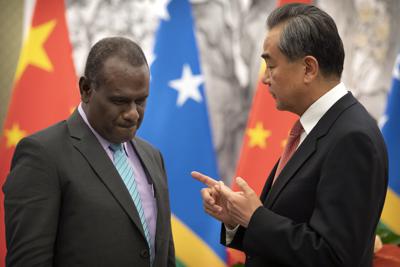
China’s Pacific plan seen as regional strategic game-changer

WELLINGTON, New Zealand (AP) — When China signed a security pact with the Solomon Islands in April it raised concerns from the U.S. and its allies that Beijing may be seeking a military outpost in the South Pacific, an area of traditional American naval dominance.

28 May 2022
By DAVID RISING and NICK PERRY


But China upped the ante further this week, reaching out to the Solomon Islands and nine other island nations with a sweeping security proposal that, even if only partially realized, could give it a presence in the Pacific much nearer Hawaii, Australia, New Zealand and on the doorstep of the strategic American territory of Guam.

China insists its proposals are targeted at regional stability and economic growth, but experts and governments fear that beneath the surface, it is a brazen attempt to expand its influence in a strategically critical area.

David Panuelo, the president of Micronesia, one of the nations targeted by China, warned the others against signing on, saying it “threatens to bring a new Cold War at best, and a world war at worst.”

“Aside from the impacts on our sovereignty ... it increases the chances of China getting into conflict with Australia, Japan, the United States and New Zealand on the day when Beijing decides to invade Taiwan,” Panuelo warned in a letter obtained by The Associated Press, noting China has not ruled out using force to take the self-governing island, which it claims as its own territory.

A draft of the proposal obtained by The Associated Press shows that China wants to train Pacific police officers, team up on “traditional and non-traditional security” and expand law enforcement cooperation.

China also wants to jointly develop a marine plan for fisheries, and raises the possibility of a free trade area with the Pacific nations.

It targets Solomon Islands, Kiribati, Samoa, Fiji, Tonga, Vanuatu, Papua New Guinea, the Cook Islands, Niue and Micronesia — and pointedly leaves out the Marshall Islands, Nauru, Palau and Tuvalu, all of which recognize Taiwan as a country.

Like many other nations, the U.S. has a “one China” policy, which does not recognize Taiwan, but also opposes any unilateral changes to the status quo.

The islands dot a vast area of ocean between the continental United States and Asia, and were a center of the Pacific Theater fighting during World War II following the surprise Japanese attack on Pearl Harbor in Hawaii.

After the U.S. fleet decisively beat Imperial Japan’s navy at the Battle of Midway in 1942, it embarked upon a campaign to take them back from Japan, starting with the invasion of Guadalcanal in the Solomon Islands and including fierce battles for the Tarawa atoll, now part of Kiribati, Peleliu, which is one of the Palau islands, and Guam.

Though the nearest is thousands of kilometers (miles) from Taiwan, they are nonetheless strategically important to China, should it invade the island.

From a military perspective, a Chinese presence on some of the Pacific islands would mean a better ability to delay U.S. naval assets and disrupt supply lines in case of a conflict, said Euan Graham, a senior fellow with the International Institute for Strategic Studies in Singapore.

“You only have to look at a map to deduce the basic logic of what China is up to,” he said.

“This is prime real estate. Most of it is water, but if you connect up those islands, archipelagos, that’s an island chain that runs between Australia and the United States, between Australia and Japan.”

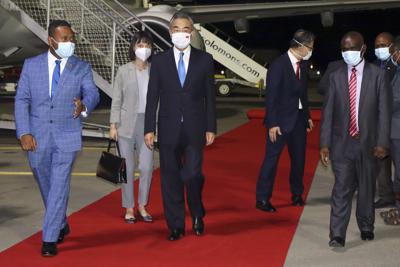
China dispatched its top diplomat, Foreign Minister Wang Yi, this week to visit seven of the island nations and hold virtual talks with the other three in the hope they will endorse the agreement on May 30 at a meeting in Fiji.

The diplomatic blitz comes just after regional powerhouse Australia ushered in a new government, and Beijing may have decided to act now to try to catch new Prime Minister Anthony Albanese off guard, Graham said.

“This follows a period of shadowboxing between Australia and the United States and China for the last few years, in which there were clear suspicions that China was indirectly trying to make inroads through dual-use and infrastructure investment deals, but not doing so in an overt government-to-government way,” he said.

“Now this is China in the most visible, high-level way literally on a door-knocking tour of the region to try and lock in whatever gains it can.”

Albanese, however, was sworn into office in record time so he could take part in meetings with U.S. President Joe Biden and the leaders of India and Japan in Tokyo, and swiftly dispatched Foreign Minister Penny Wong to Fiji in her first week on the job.

“We need to respond to this because this is China seeking to increase its influence in the region of the world where Australia has been the security partner of choice since the Second World War,” he told the Australian Broadcasting Corp.

Albanese said that “Australia dropped the ball” in its relations with the islands, largely over outgoing Prime Minister Scott Morrison’s stance climate change, and pledged to reengage with them. Many of the low-lying Pacific islands consider climate change their most pressing and existential threat, while Morrison continued to be a big supporter of Australia’s coal industry.

“We need to be offering more support and, otherwise, we can see the consequences with the deal that was done with the Solomons,” he said. “We know that China sees that as the first of many.”

Chinese Foreign Ministry spokesperson Wang Wenbin defended his country’s proposal this week, saying it “is based on the principle of mutual benefit, win-win cooperation, openness and inclusiveness.”

“Our relations are not exclusive or posing a threat to any third party, and should not be interfered with by third parties,” he said.

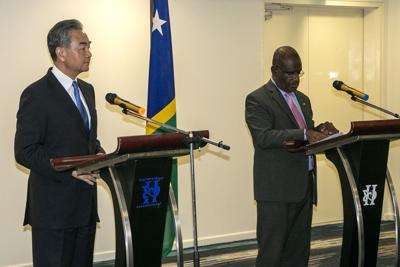
Wang started his tour Thursday in the Solomon Islands, where a news conference was restricted to selected media and only one question was permitted of him, from China’s state-owned CCTV broadcaster.

On Friday he was in Kiribati, where the government announced in November it plans to end a commercial fishing ban in the Phoenix Islands Protected Area, a UNESCO World Heritage site.

Already, there are fears that China’s proposal may give its massive commercial fishing fleet unfettered access to the fragile grounds, said Anna Powles, a senior lecturer in security studies at New Zealand’s Massey University.

There are also concerns that any kind of base for Chinese commercial fishing fleets in Kiribati could also be used as an additional hub for Beijing’s surveillance activities, she said.

The Solomon Islands and Kiribati both shifted their allegiances from Taiwan to mainland China in 2019, and are seen as among the most amenable to China’s proposal. Vanuatu is also seen as likely in that camp, having just signed a contract with China for a runway extension at its Pekoa airport.

But Powles said Panuelo’s letter echoed strong overall concerns about the Chinese proposal, and that there are “significant areas of concern” about many areas, including the increased engagement in fisheries and the security cooperation agreements.

“It will only change things if countries agree to adopt this communique, and it doesn’t sound like people are particularly happy about it,” she said.

Graham said he did not think any country would see the Chinese proposal as a need to choose either Beijing or the West, but that even if a few countries signed on it could have significant effects.

“If they could get the Solomon Islands, Kiribati and Vanuatu, that right there is some pretty important real estate,” he said. “From a purely geostrategic point of view that would change the odds, that would dramatically alter Australia’s future defense planning.”

In his letter, Panuelo stressed to the others that Micronesia would reject the proposal.

“Geopolitics like these are the kind of game where the only winning move is not to play,” he said.

___

Rising reported from Bangkok.

https://apnews.com/article/china-new-zealand-australia-beijing-57693d7d7efc52401d042d5691de2e10


OTHERS:


Monday, 25 April 2022

Foreign investors are ditching China. Russia's war is the latest trigger - MUST READ

Hong Kong (CNN Business)Investors are ditching China on an unprecedented scale as a cocktail of political and business risks, and rising interest rates elsewhere, make the world's second biggest economy a less attractive place to keep their money.


Updated 1340 GMT (2140 HKT) April 25, 2022


China witnessed $17.5 billion worth of portfolio outflows last month, an all-time high, according to most recent data from the Institute of International Finance (IIF). The US-based trade association called this capital flight by overseas investors "unprecedented," especially as there were no similar outflows from other emerging markets during this period. The outflows included $11.2 billion in bonds, while the rest were equities.
Data from the Chinese government also showed a record bond-market retreat by foreign investors in recent months. Overseas investors offloaded a net 35 billion yuan ($5.5 billion) of Chinese government bonds in February, the largest monthly reduction on record, according to China Central Depository and Clearing. The sell-off accelerated in March, hitting a new high of 52 billion yuan ($8.1 billion).
    "China's support for the Russian invasion of Ukraine was clearly the catalyst for capital to leave China," said George Magnus, an associate at the China Centre at Oxford University and former chief economist for UBS.

      Geopolitical risks

      China and Russia proclaimed in February that their friendship had "no limits." That was before Russia invaded Ukraine. Now, with Russia's economy being slammed with sanctions from all over the world, Beijing has not rushed to help out its northern neighbor, fearing that it too could get caught up in sanctions. But it has also refused to condemn Russia's attack on Ukraine, seeking to portray itself as a neutral actor and blaming the situation on the United States.

       "There is nervousness about China's ambiguous, but Russia-leaning stance on the Ukraine conflict, which raises worries that China could be targeted by sanctions if it helps Russia," said Martin Chorzempa, a senior fellow at the Peterson Institute for International Economics, who has studied China's economy and US-China relations.

        The war in Ukraine has also heightened concerns about the risk that China could increase its military force against Taiwan, triggering a massive flight of capital from the Asian island.
        But geopolitical tension is not the only reason behind the exodus. The rate hike in the United States and China's strict Covid-related lockdowns have also played a role in scaring investors.
        The US Federal Reserve is increasing interest rates for the first time since 2018 to tame inflation, while the People's Bank of China has entered an easing cycle to bolster its faltering economy. That means China looks less attractive to investors when compared with the United States. Earlier this month, yields on China's 10-year government bond fell below US Treasury yields for the first time in 12 years. And the yuan hit a six-month low against the US dollar.
        "The rise in interest rates, especially in the US, makes the nominal return associated with Chinese fixed income assets less attractive on a relative basis," Chorzempa said.
        Furthermore, Beijing's unwavering commitment to its zero Covid policy has taken a massive economic toll, and increased uncertainties about future growth.
        "The economy is enfeebled and being made worse by government actions and by zero Covid policies," said Magnus.
        'The city completely lost its shine': Expats vent about Shanghai's strict Covid measures
        'The city completely lost its shine': Expats vent about Shanghai's strict Covid measures 03:38
        China's economy slowed sharply in March — consumption slumped for the first time in more than a year, while unemployment in 31 major cities surged to a record high — as escalating Covid lockdowns in Shanghai and other major cities severely hit growth and supply chains.
        Some economists are even talking about the possibility of a recession this quarter, as Beijing looks determined to hold on to its zero Covid policy despite the hefty price.
        A number of investment banks have slashed their forecasts for China's full-year growth in the past week. The International Monetary Fund on Tuesday cut its growth forecast for China to 4.4%, down from 4.8%, citing risks from Beijing's strict zero Covid policy. This is well below China's official forecast of around 5.5%.

        Confusion about the future

        With these worries mounting, some fund managers and analysts have started questioning whether they should invest in China at all.
        "China is seeing deep foreign capital outflows as doubts increase regarding its basic investability," said Brock Silvers, managing director for Kaiyuan Capital, a private equity investment firm based in Shanghai.
        The pandemic is not the only reason behind China's slowdown. A lot of the country's current economic pain can be traced back to the sweeping regulatory crackdown on the private sector, which was unleashed by President Xi Jinping in 2020. There are fears that the government will continue to clampdown on sectors ranging from education to technology this year.
        "Global investors don't want to play regulatory guessing games or worry that tomorrow's news may deplete another otherwise attractive company or business model," Silvers said.
        The speed and ferocity with which authorities have acted against private enterprise have startled even the closest China watchers.
        A set of rules unveiled last July essentially shut down the $120 billion private tutoring industry, putting tens of thousands of companies out of business. Another decision by regulators to ban Didi — the country's biggest ride-hailing app -— days after its US IPO stunned international investors and cost them dearly. The crackdown resulted in a steep sell-off in Chinese stocks worldwide.
        The Nasdaq Golden Dragon index, a popular index that tracks more than 90 US-listed Chinese companies, lost 31% in the third quarter of 2021, the worst quarter on record. It then shed another 14% in the final quarter of last year. By comparison, the S&P 500 rose 0.2% and 11% respectively in the third and fourth quarters of last year. The Nasdaq Composite also surged 8% in the final quarter of 2021.
        Some of the money flowing out of China may have gone into US dollar assets, while there is also "a notable switch from China to India," according to Qi Wang, chief investment officer for MegaTrust Investment in Hong Kong.

        Shrinking appetite

        The crackdown on the private sector has also impacted private equity funds that focus on China.
        Funds that raise US dollars to invest in China only attracted $1.4 billion in the first quarter of 2022, down 70% from the previous quarter, according to Preqin, a London-based investment data firm.
        A separate survey by Bain & Company showed that Greater China-focused private equity funds attracted $28 billion in new funding for the second half of last year, down 54% from the first half, as global investors are increasingly concerned about political and economic uncertainty in the Chinese market.
        "Looking ahead, about 55% of respondents expect the [fundraising] situation to be more challenging in next 12 months," said Kai Zhong, a manager on the China Private Equity team at Bain & Company.

        On the fence

        However, while bond and equity funds may be slashing their exposure to China, there's evidence that global companies are continuing to invest in Chinese businesses.
        Foreign direct investment inflows to China hit a record high of $173 billion in 2021, up 20% from the previous year, according to data from China's Ministry of Commerce.
        Chorzempa noted that the record FDI came even though "the regulatory uncertainty and a darkening view among policymakers outside of China was already highly salient."
        "So it is not clear whether the data from the last two months represents a paradigm shift or more of a temporary recalibration to a still very strong investment relationship, especially with Europe," he said.
        According to an annual survey conducted by the European Union Chamber of Commerce in China last year, only 9% of nearly 600 European companies operating in China planned on shifting any current or planned investment out of China, the lowest share on record.
        Still, there are signs that some of them have become anxious about China's zero Covid policy.
        Earlier this week, China's commerce minister Wang Wentao met with a few foreign chambers to discuss the impact of the country's zero Covid policy.
        Jens Hildebrandt, executive director of the German Chamber of Commerce in North China, told CNN Business that the participants raised some pressing issues member companies are facing related to the Covid-containment strategy, especially in Shanghai.
        An ongoing lockdown in Shanghai — a major business and manufacturing hub — has forced most businesses to shut down for weeks, threatening to disrupt key supply chains for autos and electronics. It has also made port delays worse and forced the suspension of many passenger flights, sending air freight rates soaring and putting even more pressure on global supply chains.
          "The current policy with lockdowns leading to productions stops, logistic and supply chain disruptions and restrictions on the movement of people do not only pose a short-term concern, but will leave their marks on the long run," Hildebrandt said in an emailed response to CNN Business.
          "As foreign companies are suffering economically, we are looking for clear signals on how the Chinese government will help to ease the burden through relief programs," he added.

          https://edition.cnn.com/2022/04/25/investing/china-capital-outflows-covid-ukraine-war-intl-mic-hnk/index.html

          Most Recent Post

          Man charged for borrowing rare Chinese manuscripts from UCLA library, returning fakes

            Suspect Jeffrey Ying allegedly travelled to China after checking works out using several aliases Agence France-Presse Published: 12:11pm, ...

          Popular Posts - Last 30 days