Showing posts with label Cold War. Show all posts

Tuesday, 25 April 2023

China distances itself from ambassador's 'absurd' remarks over Ukraine independence


Argentina G20 Leaders' Summit 2018 - Day 1 Of Sessions

Argentina G20 Leaders' Summit 2018 - Day 1 Of Sessions© Getty

China has sought to distance itself from controversial remarks about the sovereignty of Ukraine after widespread outrage. China's Paris ambassador Lu Shaye made the comments last week, and now Bejing has been urged to clarify its position. On Monday, China's foreign ministry rowed back against the comments and insisted that Beijing respected the independence of all post-Soviet republics, rejecting Lu's position.

Story by Tim McNulty • Tuesday 25 April 2023

During an interview with Frances' LCI network, Lu called into question Ukraine's right to defend it's sovereignty under international law.

He said: "Even these former Soviet countries don't have an effective status under international law because there is no international agreement under international law to concretise their status as sovereign countries."

According to a statement from the Chinese embassy in Paris, Lu's remarks were viewed as a personal point of view and should not be taken too seriously.

Three Baltic countries, Lithuania, Latvia, and Estonia, have summoned Chinese representatives to clarify Lu's remarks, which have been criticised by other European Union foreign ministers.

FRANCE-CHINA-ZOO-ANIMAL-PANDA
FRANCE-CHINA-ZOO-ANIMAL-PANDA© Getty
UKRAINE-RUSSIA-CONFLICT-WAR
UKRAINE-RUSSIA-CONFLICT-WAR© Getty

Mykhaylo Podolyak, a presidential assistant in Ukraine, called Lu's understanding of international law and approach to Crimea "absurd."

Chinese Foreign Ministry spokeswoman Mao Ning publically rebuked Lu's comments on Monday.

She insisted that while "the Soviet Union was a federal state and had the status of an entity of international law in its entirety in foreign affairs... this does not deny the fact that each member republic of the Soviet Union has the status of a sovereign state after the dissolution of the Soviet Union".

Meanwhile, British Foreign Secretary James Cleverly is set to deliver a speech at Mansion House in London, where he will call on China to be transparent about its military expansion, which he describes as the biggest in peacetime history.

Read more: Sudan forces agree nationwide ceasefire after days of bloodshed

The Foreign Secretary is tipped to warn of the risks of a new cold war with China and the possibility of a "tragic miscalculation" in the Indo-Pacific region if China continues its aggressive behaviour.

Despite his concerns about the situation in the Xinjiang region, he argues that Britain must continue to engage with China and that it would be a betrayal of British interests to isolate the country.

The speech comes amid rising tensions with Beijing over Taiwan and concerns that China will try to take over the island nation, similar to Russia's actions in Ukraine.

The Telegraph reports that Mr Cleverely will say: "It would be clear and easy - perhaps even satisfying - for me to declare a new cold war and say that our goal is to isolate China.
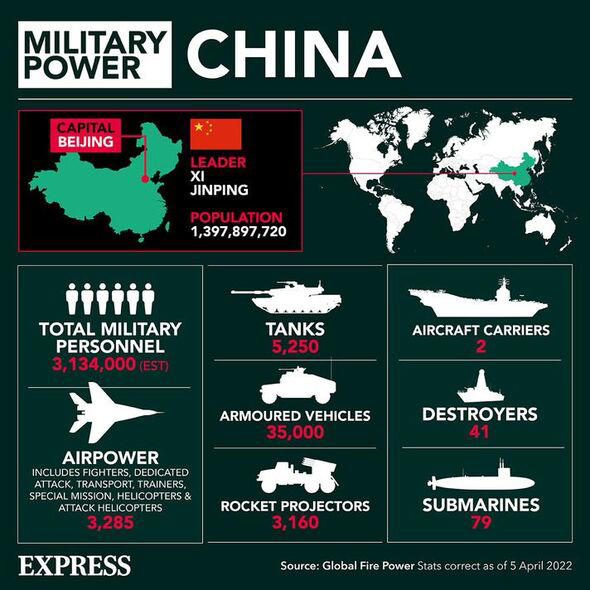
China: Military Power
China: Military Power© Express

"Clear, easy, satisfying - and wrong. Because it would be a betrayal of our national interest and a wilful misunderstanding of the modern world."

The main topic of the Mansion House speech, a platform historically used by foreign secretaries to express their opinions on a wide range of foreign policy matters, will be China.

According to the Pentagon, China is growing its nuclear missile silos and on track to have a stockpile of 1,500 nuclear warheads by 2035.

Furthermore, China is developing hypersonic missiles capable of evading US defences, as well as space weapons capable of deactivating satellites.

LinkChina must come clean on 'biggest military build-up in peacetime', warns James Cleverly

TOPSHOT-CHINA-TAIWAN-POLITICS

https://www.msn.com/en-GB/news/world/china-distances-itself-from-ambassadors-absurd-remarks-over-ukraine-independence/ar-AA1aiXBF


Saturday, 28 May 2022

China’s Pacific plan seen as regional strategic game-changer

WELLINGTON, New Zealand (AP) — When China signed a security pact with the Solomon Islands in April it raised concerns from the U.S. and its allies that Beijing may be seeking a military outpost in the South Pacific, an area of traditional American naval dominance.

28 May 2022
By DAVID RISING and NICK PERRY


But China upped the ante further this week, reaching out to the Solomon Islands and nine other island nations with a sweeping security proposal that, even if only partially realized, could give it a presence in the Pacific much nearer Hawaii, Australia, New Zealand and on the doorstep of the strategic American territory of Guam.

China insists its proposals are targeted at regional stability and economic growth, but experts and governments fear that beneath the surface, it is a brazen attempt to expand its influence in a strategically critical area.

David Panuelo, the president of Micronesia, one of the nations targeted by China, warned the others against signing on, saying it “threatens to bring a new Cold War at best, and a world war at worst.”

“Aside from the impacts on our sovereignty ... it increases the chances of China getting into conflict with Australia, Japan, the United States and New Zealand on the day when Beijing decides to invade Taiwan,” Panuelo warned in a letter obtained by The Associated Press, noting China has not ruled out using force to take the self-governing island, which it claims as its own territory.

A draft of the proposal obtained by The Associated Press shows that China wants to train Pacific police officers, team up on “traditional and non-traditional security” and expand law enforcement cooperation.

China also wants to jointly develop a marine plan for fisheries, and raises the possibility of a free trade area with the Pacific nations.

It targets Solomon Islands, Kiribati, Samoa, Fiji, Tonga, Vanuatu, Papua New Guinea, the Cook Islands, Niue and Micronesia — and pointedly leaves out the Marshall Islands, Nauru, Palau and Tuvalu, all of which recognize Taiwan as a country.

Like many other nations, the U.S. has a “one China” policy, which does not recognize Taiwan, but also opposes any unilateral changes to the status quo.

The islands dot a vast area of ocean between the continental United States and Asia, and were a center of the Pacific Theater fighting during World War II following the surprise Japanese attack on Pearl Harbor in Hawaii.

After the U.S. fleet decisively beat Imperial Japan’s navy at the Battle of Midway in 1942, it embarked upon a campaign to take them back from Japan, starting with the invasion of Guadalcanal in the Solomon Islands and including fierce battles for the Tarawa atoll, now part of Kiribati, Peleliu, which is one of the Palau islands, and Guam.

Though the nearest is thousands of kilometers (miles) from Taiwan, they are nonetheless strategically important to China, should it invade the island.

From a military perspective, a Chinese presence on some of the Pacific islands would mean a better ability to delay U.S. naval assets and disrupt supply lines in case of a conflict, said Euan Graham, a senior fellow with the International Institute for Strategic Studies in Singapore.

“You only have to look at a map to deduce the basic logic of what China is up to,” he said.

“This is prime real estate. Most of it is water, but if you connect up those islands, archipelagos, that’s an island chain that runs between Australia and the United States, between Australia and Japan.”

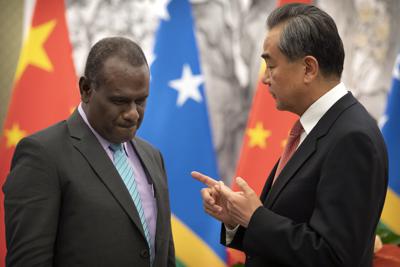
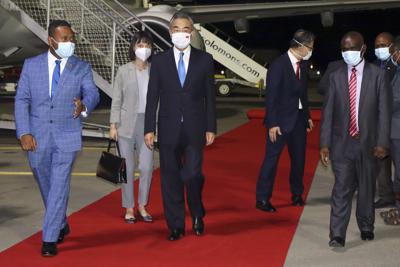
China dispatched its top diplomat, Foreign Minister Wang Yi, this week to visit seven of the island nations and hold virtual talks with the other three in the hope they will endorse the agreement on May 30 at a meeting in Fiji.

The diplomatic blitz comes just after regional powerhouse Australia ushered in a new government, and Beijing may have decided to act now to try to catch new Prime Minister Anthony Albanese off guard, Graham said.

“This follows a period of shadowboxing between Australia and the United States and China for the last few years, in which there were clear suspicions that China was indirectly trying to make inroads through dual-use and infrastructure investment deals, but not doing so in an overt government-to-government way,” he said.

“Now this is China in the most visible, high-level way literally on a door-knocking tour of the region to try and lock in whatever gains it can.”

Albanese, however, was sworn into office in record time so he could take part in meetings with U.S. President Joe Biden and the leaders of India and Japan in Tokyo, and swiftly dispatched Foreign Minister Penny Wong to Fiji in her first week on the job.

“We need to respond to this because this is China seeking to increase its influence in the region of the world where Australia has been the security partner of choice since the Second World War,” he told the Australian Broadcasting Corp.

Albanese said that “Australia dropped the ball” in its relations with the islands, largely over outgoing Prime Minister Scott Morrison’s stance climate change, and pledged to reengage with them. Many of the low-lying Pacific islands consider climate change their most pressing and existential threat, while Morrison continued to be a big supporter of Australia’s coal industry.

“We need to be offering more support and, otherwise, we can see the consequences with the deal that was done with the Solomons,” he said. “We know that China sees that as the first of many.”

Chinese Foreign Ministry spokesperson Wang Wenbin defended his country’s proposal this week, saying it “is based on the principle of mutual benefit, win-win cooperation, openness and inclusiveness.”

“Our relations are not exclusive or posing a threat to any third party, and should not be interfered with by third parties,” he said.

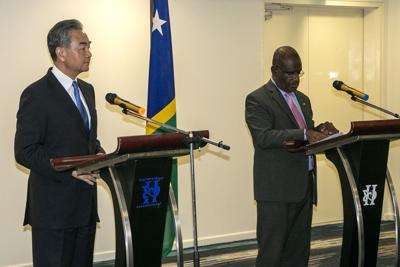
Wang started his tour Thursday in the Solomon Islands, where a news conference was restricted to selected media and only one question was permitted of him, from China’s state-owned CCTV broadcaster.

On Friday he was in Kiribati, where the government announced in November it plans to end a commercial fishing ban in the Phoenix Islands Protected Area, a UNESCO World Heritage site.

Already, there are fears that China’s proposal may give its massive commercial fishing fleet unfettered access to the fragile grounds, said Anna Powles, a senior lecturer in security studies at New Zealand’s Massey University.

There are also concerns that any kind of base for Chinese commercial fishing fleets in Kiribati could also be used as an additional hub for Beijing’s surveillance activities, she said.

The Solomon Islands and Kiribati both shifted their allegiances from Taiwan to mainland China in 2019, and are seen as among the most amenable to China’s proposal. Vanuatu is also seen as likely in that camp, having just signed a contract with China for a runway extension at its Pekoa airport.

But Powles said Panuelo’s letter echoed strong overall concerns about the Chinese proposal, and that there are “significant areas of concern” about many areas, including the increased engagement in fisheries and the security cooperation agreements.

“It will only change things if countries agree to adopt this communique, and it doesn’t sound like people are particularly happy about it,” she said.

Graham said he did not think any country would see the Chinese proposal as a need to choose either Beijing or the West, but that even if a few countries signed on it could have significant effects.

“If they could get the Solomon Islands, Kiribati and Vanuatu, that right there is some pretty important real estate,” he said. “From a purely geostrategic point of view that would change the odds, that would dramatically alter Australia’s future defense planning.”

In his letter, Panuelo stressed to the others that Micronesia would reject the proposal.

“Geopolitics like these are the kind of game where the only winning move is not to play,” he said.

___

Rising reported from Bangkok.

https://apnews.com/article/china-new-zealand-australia-beijing-57693d7d7efc52401d042d5691de2e10


OTHERS:


Sunday, 20 February 2022

Putin humiliated by China after Beijing urges Moscow to drop Ukraine war plans

Beijing's Foreign Minister said that Ukraine had the right to safeguard its sovereignty, independence and territorial integrity. 


John Varga   Daily Express

20 February 2022


The Russian President has amassed close to 200,000 troops on Ukraine's northern, eastern and southern flanks, according to US officials. Defence analysts working for the Atlantic Council organisation warned that the Kremlin had completed preparations for a large-scale offensive operation.

They said that Russian forces could "likely execute a further invasion of Ukraine with less than twelve hours of unambiguous warning."

With an invasion looking increasingly imminent, China's top diplomat used his appearance at the Munich security conference on Saturday to warn Mr Putin against following through on his expansionist ambitions.

Wang Yi affirmed Ukraine's right to safeguard its territorial integrity and urged a diplomatic solution to the escalating crisis.

He called the Minsk Agreement the "only way out" and urged all parties to come together and solve the crisis peacefully.

Mr Yi also said that Ukraine should not be a frontline for competition among major powers.

The Minsk Agreement refers to a diplomatic accord signed in February 2015 in the Belarus capital by representatives of Russia, Ukraine, the Organisation for Security and Cooperation in Europe (OSCE) and the leaders of two pro-Russian separatist regions.

© Getty Vladimir Putin

© Getty Vladimir Putin

The deal set out a series of military and political steps that remain unimplemented.

A major blockage has been Russia's insistence that it is not a party to the conflict and therefore is not bound by its terms.

Moscow also wants the breakaway regions to have autonomy over economic and foreign policy - something Kyiv would find very hard to countenance.

Wang Yi's slap-down of Mr Putin comes as a major surprise, given that China's President Xi Jinping appeared to back Mr Putin's Ukraine policy.

The two leaders met in Beijing at the start of the Beijing Winter Olympics.

READ MORE: Putin mocked as Russian missile test ridiculed for 'missing' target

© Getty China


© Getty Ukraine Conflict
They issued a joint statement calling on the West to "abandon the ideologised approaches of the cold war".

In a nod to Russian interests in Ukraine, China said it understood and supported "the proposals put forward by the Russian Federation on the formation of long-term legally binding security guarantees in Europe."

Volodymr Zelenskiy, Ukraine's President, attended the Munich security conference today, where he met with Boris Johnson.

The Prime Minister reiterated the UK's "unequivocal support for Ukraine's sovereignty and territorial integrity", a Downing Street spokesperson said.

They added: "The prime minister told Zelenskiy that the UK continues to cooperate closely with international partners to make clear that any Russia incursion will be met with strength, including significant economic consequences.

DON'T MISS

Putin mobilises fearsome Chechen brigades as war fears escalate [REVEAL]

PM calls for West to dodge bloodshed in Ukraine by showing solidarity [SPOTLIGHT]

Russia-Ukraine: 'False flag' fear as massive war game launched [INSIGHT]

© Getty Vladimir Putin

"The leaders agreed that any further Russian incursion into Ukraine would be a profound miscalculation which would be met with fierce resistance from Ukraine.

"They agreed there was still time for Putin to choose the path of peace and diplomacy."

Western leaders continued to issue last minute appeals to the Russian President to pull back from the brink of war.

Olaf Scholz, the German Chancellor, said it was unacceptable that Europe was facing a war over an issue that was not even an agenda - namely Ukraine's membership of NATO.

He said: "It will not happen the next time. It will not happen in the near time. Putin knows that."

https://www.msn.com/en-gb/news/world/vladimir-putin-humiliated-by-china-after-beijing-urges-moscow-to-drop-ukraine-war-plans/ar-AAU4cr8

Thursday, 30 December 2021

The disinformation tactics used by China

The Chinese embassy in London has criticised the BBC following a documentary about Chinese disinformation campaigns.

By Krassi Twigg and Kerry Allen
BBC Monitoring


Published
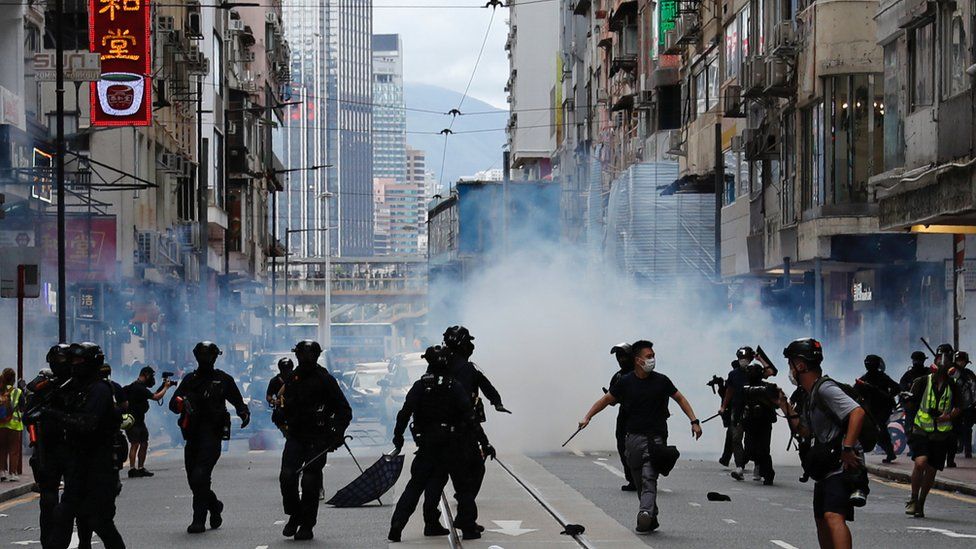
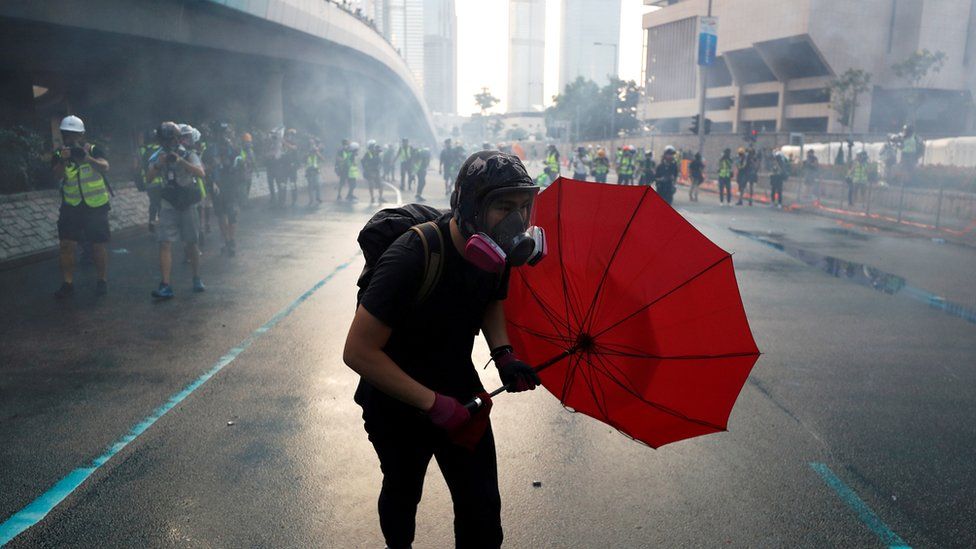
Street view of riot police and protesters in Hong KongIMAGE SOURCE,REUTERS

Image caption,
Facebook and Twitter removed accounts linked to China during unrest in Hong Kong in 2019

There have also recently been a series of denials from Beijing over reports into forced imprisonment of its minority Uighur population - these have included baseless accusations against media and human rights organisations.

In the latest attack, an official falsely claimed a Uighur interviewee on a BBC programme was an actress.

So what tactics does China use in the spread of misleading and false information?

Increasing anti-BBC coverage

There have been almost daily anti-BBC articles in Chinese state media since mid-February.

It follows a decision by the UK broadcasting regulator Ofcom to revoke the licence for China's state-run overseas broadcaster, CGTN.

For years, China has broadly criticised Western outlets for reports on affairs in Xinjiang and elsewhere in China, saying they should not intervene in China's "internal affairs".

But these latest attacks on Western media are a clear escalation.

Chinese domestic media outlets have praised their government for banning the BBC's World News channel, although it was only available in some international hotels and residential compounds where foreigners live.

Reports from leading outlets like China's Global Times have criticised the "Cold War" mentality when it comes to China - on topics ranging from Hong Kong, the Uighur population of Xinjiang and the Covid-19 pandemic.

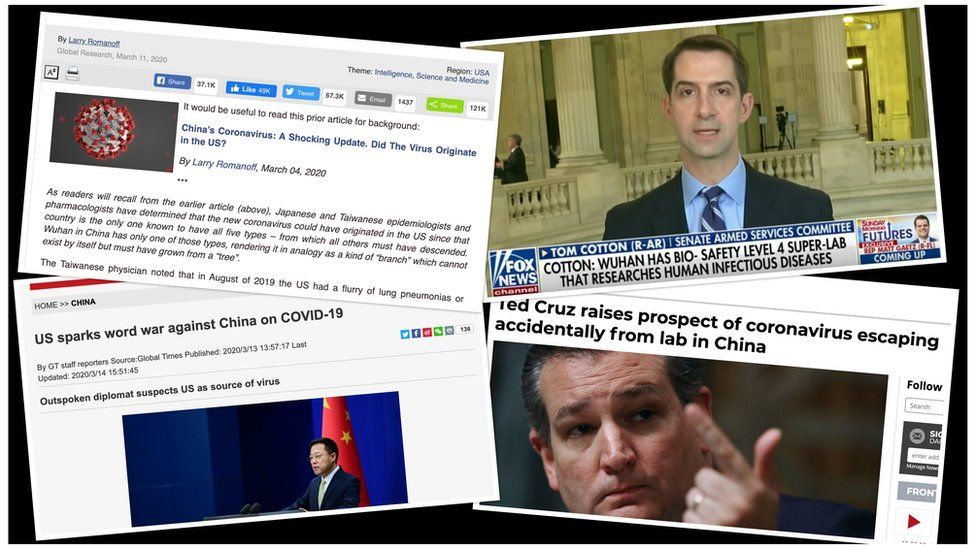
When China was facing a backlash over its handling of early stages of the pandemic last year, and some US officials were floating the theory that the virus could have escaped from a Wuhan lab, CGTN started to push its own conspiracy theory.

Despite a complete lack of evidence, the station suggested the virus originated at a military base in Maryland in the US and was brought to China by American soldiers during an athletics competition.

Find out more

Finger pointing at mobile phone screenIMAGE SOURCE,GETTY IMAGES
Presentational grey line

'Wolf warriors' on social media

In recent months, China experts have noticed dozens of new and highly active official social media accounts representing Chinese embassies and leading diplomats.

This has become known as "wolf warrior" diplomacy. The best-known account belongs to Zhao Lijian from the Chinese foreign ministry.

He caused controversy in March after tweeting articles suggesting that coronavirus originated in the United States.

Composite picture of websites
Image caption,
The US and China traded unverified theories about the origins of coronavirus

Those tweets have been shared more than 40,000 times and referenced in 54 different languages, according to research from the Digital Forensic Research Lab, part of the Atlantic Council think tank.

Popular hashtags referencing the posts have made waves at home too - they've been viewed by users of Chinese social network Weibo more than 300 million times.

In December, Zhao Lijian was widely criticised for sharing a fake image of an Australian soldier killing an Afghan child, for which China refused to apologise.

'Keyboard army'

China draws on millions of citizens to monitor the internet and influence public opinion on a massive scale online. These recruits are known as the "50 cent army" - so named because of reports that they were paid 0.5 yuan per post.

This "keyboard army" has long been active on Chinese social media platforms. Its aim has been to aggressively defend and protect China's image overseas.

When tweeting in English, the messages are aimed at a Western audience, much like troll farms in Russia that sow discord.

To the unsuspecting reader, they might appear as patriotic citizens acting independently, but frequently they are taking directions from Chinese authorities.

One example is the way in which video footage of violent protests in Hong Kong in 2019 was promoted on social media via this keyboard army using terms such as "terrorism", while coverage of peaceful protests was censored.

A Hong Kong protesterIMAGE SOURCE,REUTERS

In August 2019, Facebook and Twitter announced they had removed accounts linked to a state-backed information campaign.

Facebook said: "Although the people behind this activity attempted to conceal their identities, our investigation found links to individuals associated with the Chinese government."

Twitter identified more than 900 accounts from China. But these were only the most active components of the campaign, which the company said involved some 200,000 accounts.

Fake social media accounts

A BBC investigation in May 2020 found hundreds of fake or hijacked social media accounts promoting pro-China messages on Facebook, Twitter and YouTube. Some 1,200 accounts targeted people critical of how Beijing was handling the pandemic.

There was no definitive evidence tying these accounts to the Chinese government, but it did display similar characteristics to the state-backed network removed by Facebook and Twitter in 2019.

It also resembled another network dubbed "Spamouflage Dragon", which pumped out pro-China posts and attacked critics with spam, which was uncovered by the social analytics firm Graphika.

Subsequently Twitter said it had removed more than 23,000 accounts linked to China involved in a range of "manipulative and co-ordinated activities".

In response to comments made by Yang Xiaoguang, from the Chinese Embassy in the UK on the BBC Today programme, a BBC spokesman said: "We completely reject these claims and stand by our journalism. BBC News reporting in Xinjiang has been accurate and impartial - we did not use any false images and the interviewee who appeared on the BBC was not an 'actress' as claimed."

Additional reporting by Jack Goodman

https://www.bbc.com/news/56364952

Most Recent Post

Man charged for borrowing rare Chinese manuscripts from UCLA library, returning fakes

  Suspect Jeffrey Ying allegedly travelled to China after checking works out using several aliases Agence France-Presse Published: 12:11pm, ...

Popular Posts - Last 30 days