Showing posts with label Sovereignty. Show all posts

Thursday, 20 July 2023

At 100, it’s time for Kissinger to stop embarrassing himself and retire

 The centenarian statesman has allowed himself to be made into a ventriloquist’s dummy for the People's Republic

Henry Kissinger with Councilor Wang Yi CREDIT: PRC Ministry of Foreign Affairs


On the face of it, Henry Kissinger’s visit to China looks like a masterstroke of diplomacy.  Following a  recent stream of serving senior US visitors to Beijing – Secretary of State Blinken, Treasury Secretary Yellen and Climate Envoy Kerry among them – it awakened echoes of historical reconciliation and revival in the US-China relationship. The centenarian US statesman, warmly welcomed in person by Xi Jinping as an ‘old friend of China’, bearing hopes for reconciliation between two estranged superpowers dangerously near the brink of conflict – what could be a better way to get bilateral relations back on track? 

Sadly, the reality is very different. The Biden administration says Kissinger travelled ‘of his own volition, as a private citizen’. If the administration had no hand in his mission, the results of the visit suggest that letting it go ahead was a bad mistake. If Kissinger was in fact tasked to convey top-level US government wishes for a thaw in relations, then this must be looking like an even worse miscalculation. 

What is the basis for this pessimistic assessment?

Xi and his top colleagues gave Kissinger a far friendlier reception than those granted recently to the senior serving US officials, framing them in contrast as little more than a string of needy supplicants. Welcoming Kissinger as an ‘old friend of China’ gave Xi a  perfect opportunity to pose as supreme leader of a stable state – the rising Chinese superpower – graciously welcoming a frail old emissary bearing an olive branch from its declining, divided and decadent rival. 

Obviously, Chinese state media made relentless propaganda hay of this. At the start of the visit, the minister of defence reportedly said that ‘friendly US/China communication had been destroyed because some people in the US did not meet China half-way’. China’s top diplomat said that ‘US policy towards China requires diplomatic wisdom like Kissinger’s and political courage like Nixon’s.’ He noted that it was ‘impossible’ to ‘transform, encircle or contain China’. 

Xi is quoted as telling Kissinger that ‘China never forgets its old friends’, and that ‘the key (to improving bilateral relations) is to follow the principles of mutual respect, peaceful co-existence and win-win co-operation’. 

Beneath patronising leadership rhetoric lies a colder under-current of realpolitik, which as usual the state-directed Global Times makes explicit.

‘Under the toxic environment of its domestic politics, US China policy has deviated from a rational and sound track’  and is ‘eager to transform or contain China, which is doomed to fail’. ‘Bilateral ties have hit a historical low point due to… Washington’s wrong and provocative deeds on the Taiwan question and mishandling of the Chinese balloon incident’. Most explicitly, the rise of China brooks no resistance. ‘China’s development has a strong internal driving force and an inevitable historical logic.’ Making no bones of his private status, China had ‘delivered this message to the Biden administration through the talks with Kissinger’.  

Remarks attributed to Kissinger by the state news agency Xinhua are similarly slanted for propaganda purposes. Perhaps he did indeed say that it was ‘a great honour to visit China’, whatever one might make of this ‘honour’ from the perspective of  Ukraine, Tibet, Inner Mongolia or Xinjiang. But the following verbiage is surely pure ventriloquism; the language is copy-book Party jargon. 

‘The [Sino-US] relationship is a matter of world peace and the progress of human society … under the current circumstances, it is imperative to maintain the principles established by the Shanghai Communique, appreciate the utmost importance China attaches to the one-China principle, and move the relationship in a positive direction, Kissinger said in the meeting.’ He also reportedly commented that ‘neither the US nor China can afford to treat the other as an adversary’.

The best that the US has so far come up with as an objective for recent attempts to unblock relations is a vague wish to revive ‘frank dialogue and fair competition’. If there is one thing they ought to have learnt from 44 years of the diplomatic relations that Henry Kissinger brokered, it’s that neither of those are in the Chinese Communist Party playbook. 

So, based on public coverage, we may conclude that the following is all the Kissinger visit really achieved. It provided Xi Jinping, at no cost whatsoever,  the chance to take an initiative and pass a tacitly threatening message to an embattled President Biden, in words quoted in the foreign ministry media statement: ‘China and the United States are once again at the crossroads of where to go, and the two sides need to make new decisions’.

But what sort of decisions are needed when – despite the fact that China faces no foreign military threats whatever – Xi is driving forward a massive military buildup, including new nuclear weapons, hypersonic missiles, space and cyber warfare capabilities? When daily he increases military aggression against Taiwan, a free, democratic state of 24 million people? When he provides crucial political and economic support for Putin’s pointless, barbarous attempts to destroy Ukraine? When he is doing everything in his power, as amply demonstrated by the so-called ‘Foreign Relations Law’ passed on 1 July 23, to weaken China’s commitments to international rules and norms in favour of powers to break them in furtherance of China’s ‘national security and sovereignty’?  And when – despite assurances – he and the Party he leads do indeed regard both the US and its allies as existential adversaries to be subjugated to a new China-led authoritarian world order? 

The People’s Republic of China under Xi Jinping is an intelligence state in which Chinese spy agencies  call their best foreign agents ‘deeply-connected friends’. No doubt Dr Kissinger had nothing but worthy motives for visiting China. But it seems that the visit did little good for the cause of freedom and democracy, at a time when China threatens both.

Perhaps it is now time for him to make a truly honourable withdrawal from the world of Sino-US relations.

https://www.telegraph.co.uk/news/2023/07/20/kissinger-xi-jinping-china-visit-embarrassment/

Friday, 28 April 2023

Analysis: China's Ukraine plan mixes peace, self-interest

 Chinese leader Xi Jinping faces daunting obstacles if he is serious about trying to help end the 14-month-old war.

Story by By JOE McDONALD, Associated Press • Yesterday 19:39
In this photo released by Xinhua News Agency, Chinese President Xi Jinping delivers a speech after receiving the credentials of 70 ambassadors to China held at the Great Hall of the People in Beijing on April 24, 2023. Chinese leader Xi Jinping's plan to send an envoy to Ukraine allows his government to deflect criticism of its support for Moscow and pursue a bigger role as a diplomatic force, but Xi faces daunting obstacles if he is serious about trying to help end the 14-month-old war. (Yin Bogu/Xinhua via AP)
In this photo released by Xinhua News Agency, Chinese President Xi Jinping delivers a speech after receiving the credentials of 70 ambassadors to China held at the Great Hall of the People in Beijing on April 24, 2023. Chinese leader Xi Jinping's plan to send an envoy to Ukraine allows his government to deflect criticism of its support for Moscow and pursue a bigger role as a diplomatic force, but Xi faces daunting obstacles if he is serious about trying to help end the 14-month-old war. (Yin Bogu/Xinhua via AP)© Provided by The Associated Press

BEIJING (AP) — Chinese leader Xi Jinping faces daunting obstacles if he is serious about trying to help end the 14-month-old war.

The biggest: Neither Ukraine nor Russia is ready to stop fighting.

Xi’s plan to send an envoy to Ukraine allows his government to deflect criticism of its support for Moscow and pursue a bigger role as a diplomatic force. His announcement Wednesday in a phone call with Ukrainian President Volodymyr Zelenskyy prompted optimism Beijing might use its warm relations with Russia's Vladimir Putin to push for peace. That was followed by skeptical questions about whether Beijing is more focused on ending an invasion it refuses to criticize, or serving its own interests.

FILE - Russian President Vladimir Putin, right, speaks to Chinese President Xi Jinping as they attend an official welcome ceremony at The Grand Kremlin Palace, in Moscow, Russia, March 21, 2023. Chinese leader Xi Jinping's plan to send an envoy to Ukraine allows his government to deflect criticism of its support for Moscow and pursue a bigger role as a diplomatic force, but Xi faces daunting obstacles if he is serious about trying to help end the 14-month-old war.(Sergei Karpukhin, Sputnik, Kremlin Pool Photo via AP, File)
FILE - Russian President Vladimir Putin, right, speaks to Chinese President Xi Jinping as they attend an official welcome ceremony at The Grand Kremlin Palace, in Moscow, Russia, March 21, 2023. Chinese leader Xi Jinping's plan to send an envoy to Ukraine allows his government to deflect criticism of its support for Moscow and pursue a bigger role as a diplomatic force, but Xi faces daunting obstacles if he is serious about trying to help end the 14-month-old war.(Sergei Karpukhin, Sputnik, Kremlin Pool Photo via AP, File)© Provided by The Associated Press

China's starting point is a peace proposal issued in February that called for a ceasefire, negotiations and an end to sanctions against Russia. It offered few details, but repeated Russian accusations that Western governments were to blame for the invasion.

China has good reasons to want to see the war ended. It jolted the Chinese economy by pushing up oil, wheat and other commodity prices. Beijing also warned Wednesday about the dangers of nuclear war, after Russia announced earlier it would move atomic weapons into neighboring Belarus.

FILE - In this file photo released by Xinhua News Agency, Iran's Foreign Minister Hossein Amirabdollahian, left, hold hands with his Saudi Arabian counterpart Prince Faisal bin Farhan Al Saud, right, and Chineses counterpart Qin Gang in Beijing Thursday, April 6, 2023. In March, Saudi Arabia and Iran announced the end of a 7-year diplomatic split following Chinese-organized talks. (Ding Lin/Xinhua via AP, File)
FILE - In this file photo released by Xinhua News Agency, Iran's Foreign Minister Hossein Amirabdollahian, left, hold hands with his Saudi Arabian counterpart Prince Faisal bin Farhan Al Saud, right, and Chineses counterpart Qin Gang in Beijing Thursday, April 6, 2023. In March, Saudi Arabia and Iran announced the end of a 7-year diplomatic split following Chinese-organized talks. (Ding Lin/Xinhua via AP, File)© Provided by The Associated Press

“China’s self-interest happens to align with ending the war,” said John Delury, an international relations specialist at Yonsei University in Seoul.

“Beijing has no interest in seeing Russia humiliated, nor is it in China’s interest for Russia to be triumphant,” Delury said. “The best option is a cease-fire and, with it, economic opportunities to participate in Ukraine’s post-war reconstruction.”

Wednesday’s statement gave no indication how China might recommend addressing the questions the two countries are fighting over, including Crimea, the Black Sea peninsula seized by Moscow from Ukraine in 2014.

PLAYING PEACEMAKER HELPS BEIJING IN EUROPE

By playing peacemaker, Beijing might also be looking to separate European allies from the United States, which Xi accuses of trying to block China's economic and political rise.

Beijing is trying to repair relations with Europe after an uproar over a Chinese ambassador’s comment that former Soviet republics might not be sovereign countries. That group includes Ukraine, and European Union members Estonia, Latvia and Lithuania.

Leaders including French President Emmanuel Macron have visited Beijing and appealed for help with Ukraine, highlighting the challenges faced by Washington in holding together allies to oppose China’s assertive policies abroad.

“Trying to drive a wedge between the U.S. and European partners is an important goal,” said Alexander Gabuev of the Carnegie Endowment for International Peace. “For that, China needs to pretend that it’s an active force for peace.”

Xi's call with Zelenskyy might sustain European hopes that China can be persuaded to "wield its influence to help end the war" but is “unlikely to change the Western assessment of Beijing’s stance as one of ‘pro-Russian neutrality,'” said Eurasia Group analysts in a report.

XI SHOWS HE DOESN'T ALWAYS SUPPORT PUTIN

The announcement gives Beijing a chance to show it doesn't always agree with Moscow, though the differences might be too subtle for Western critics. They complain China helps Putin resist Western sanctions by purchasing Russian oil and gas and provides political support.

Xi’s government sees the Kremlin as a partner in opposing U.S. domination of global affairs. China has used its status as one of five permanent U.N. Security Council members to block efforts to censure Russia.

Xi and Putin said in a joint statement before the February 2022 invasion their governments had a “no limits friendship.” Their navies held joint exercises with Iran in March.

Despite that, the Chinese government says they have a “non-alliance” relationship. Beijing has promised not to supply armaments to either side in the Ukraine war.

“China has never taken one side,” said Da Wei, an international relations specialist at Tsinghua University in Beijing and director of its Center for Strategic and Security Studies.

“Which Western leader has maintained communication with leaders of both parties directly involved in the crisis?” said Da. “I think this call is an indication of China’s fair and impartial objective in promoting peace talks."

A Chinese statement Wednesday also cited “mutual respect for sovereignty and territorial integrity” as a foundation of relations with Ukraine.

While Russia is trying to move borders by annexing portions of Ukraine, Beijing is intensely sensitive about respecting territorial sovereignty. It says borders must be respected and no country has a right to meddle in another’s affairs.

BEIJING'S EFFORT TO RAISE GLOBAL PROFILE

Positioning itself as a mediator also helps Beijing as it pursues a bigger role in managing global affairs as part of efforts to restore China to what the Communist Party sees as its rightful place as a political, economic and cultural leader.

Beijing should “actively participate in the reform and construction of the global governance system” and promote “global security initiatives,” Xi said in March. A proposal for a “Global Security Initiative” issued in February said China is “ready to conduct bilateral and multilateral security cooperation with all countries.”

Also in March, Saudi Arabia and Iran announced the end of a 7-year diplomatic split following Chinese-organized talks. This year, Xi’s government has also offered to mediate Israeli-Palestinian talks, set up a new Middle East security structure, and help African countries resolve disputes.

If Beijing can organize peace talks, “that backs up Xi Jinping’s ambitions to being a global power,” said Delury.

China's diplomatic ambition is a reversal from decades of staying out of other countries’ disputes and most international affairs to focus on economic development.

Its peacemaking initiatives are also at odds with confrontational Chinese behavior toward its neighbors in territorial disputes and threats to attack Taiwan, the self-ruled island democracy claimed by Beijing as part of its territory.

DIM HOPES FOR PEACE TALKS

Zelenskyy’s government said in a statement his conversation with Xi might lead toward “possible interaction with the aim of establishing a just and sustainable peace for Ukraine.” Zelenskyy said March 29 he had invited Xi to visit, but neither government has indicated whether that might happen.

Despite that, political analysts see little chance for progress. Ukraine is believed to be preparing a new offensive to recapture Russian-occupied territory.

A resolution is "maybe years, even decades, away, because the Russian and Ukrainian positions are still miles apart," said Gabuev.

Shi Yinhong, an international relations specialist at Renmin University in Beijing, noted Russia’s Foreign Ministry has said peace talks are “almost impossible," while Zelenskyy stressed to Xi the importance of recovering all captured territory.

“Neither side in the war materially echoed China’s initiative, which fell far short of what they were striving for,” said Shi.

___

Joe McDonald has reported from China for The Associated Press since 1997.

___

AP researcher Wanqing Chen in Beijing and AP Writer Andrew Katell contributed.

https://www.msn.com/en-gb/news/world/analysis-china-s-ukraine-plan-mixes-peace-self-interest/ar-AA1aqaGb

Tuesday, 25 April 2023

China distances itself from ambassador's 'absurd' remarks over Ukraine independence


Argentina G20 Leaders' Summit 2018 - Day 1 Of Sessions

Argentina G20 Leaders' Summit 2018 - Day 1 Of Sessions© Getty

China has sought to distance itself from controversial remarks about the sovereignty of Ukraine after widespread outrage. China's Paris ambassador Lu Shaye made the comments last week, and now Bejing has been urged to clarify its position. On Monday, China's foreign ministry rowed back against the comments and insisted that Beijing respected the independence of all post-Soviet republics, rejecting Lu's position.

Story by Tim McNulty • Tuesday 25 April 2023

During an interview with Frances' LCI network, Lu called into question Ukraine's right to defend it's sovereignty under international law.

He said: "Even these former Soviet countries don't have an effective status under international law because there is no international agreement under international law to concretise their status as sovereign countries."

According to a statement from the Chinese embassy in Paris, Lu's remarks were viewed as a personal point of view and should not be taken too seriously.

Three Baltic countries, Lithuania, Latvia, and Estonia, have summoned Chinese representatives to clarify Lu's remarks, which have been criticised by other European Union foreign ministers.

FRANCE-CHINA-ZOO-ANIMAL-PANDA
FRANCE-CHINA-ZOO-ANIMAL-PANDA© Getty
UKRAINE-RUSSIA-CONFLICT-WAR
UKRAINE-RUSSIA-CONFLICT-WAR© Getty

Mykhaylo Podolyak, a presidential assistant in Ukraine, called Lu's understanding of international law and approach to Crimea "absurd."

Chinese Foreign Ministry spokeswoman Mao Ning publically rebuked Lu's comments on Monday.

She insisted that while "the Soviet Union was a federal state and had the status of an entity of international law in its entirety in foreign affairs... this does not deny the fact that each member republic of the Soviet Union has the status of a sovereign state after the dissolution of the Soviet Union".

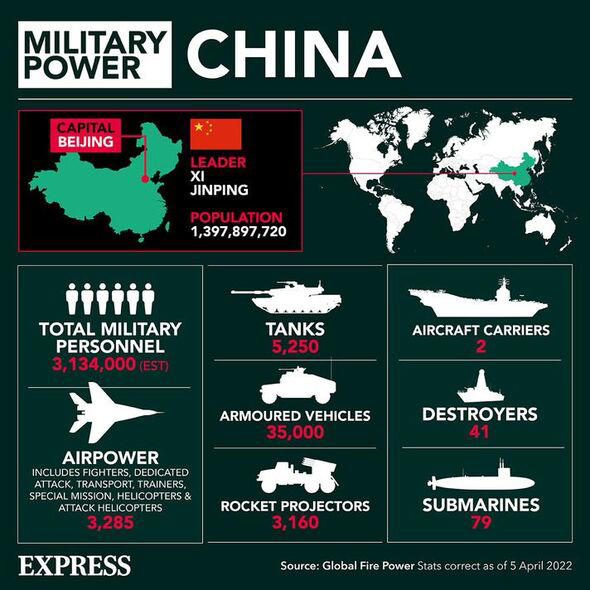
Meanwhile, British Foreign Secretary James Cleverly is set to deliver a speech at Mansion House in London, where he will call on China to be transparent about its military expansion, which he describes as the biggest in peacetime history.

Read more: Sudan forces agree nationwide ceasefire after days of bloodshed

The Foreign Secretary is tipped to warn of the risks of a new cold war with China and the possibility of a "tragic miscalculation" in the Indo-Pacific region if China continues its aggressive behaviour.

Despite his concerns about the situation in the Xinjiang region, he argues that Britain must continue to engage with China and that it would be a betrayal of British interests to isolate the country.

The speech comes amid rising tensions with Beijing over Taiwan and concerns that China will try to take over the island nation, similar to Russia's actions in Ukraine.

The Telegraph reports that Mr Cleverely will say: "It would be clear and easy - perhaps even satisfying - for me to declare a new cold war and say that our goal is to isolate China.

China: Military Power
China: Military Power© Express

"Clear, easy, satisfying - and wrong. Because it would be a betrayal of our national interest and a wilful misunderstanding of the modern world."

The main topic of the Mansion House speech, a platform historically used by foreign secretaries to express their opinions on a wide range of foreign policy matters, will be China.

According to the Pentagon, China is growing its nuclear missile silos and on track to have a stockpile of 1,500 nuclear warheads by 2035.

Furthermore, China is developing hypersonic missiles capable of evading US defences, as well as space weapons capable of deactivating satellites.

LinkChina must come clean on 'biggest military build-up in peacetime', warns James Cleverly

TOPSHOT-CHINA-TAIWAN-POLITICS

https://www.msn.com/en-GB/news/world/china-distances-itself-from-ambassadors-absurd-remarks-over-ukraine-independence/ar-AA1aiXBF


Most Recent Post

Man charged for borrowing rare Chinese manuscripts from UCLA library, returning fakes

  Suspect Jeffrey Ying allegedly travelled to China after checking works out using several aliases Agence France-Presse Published: 12:11pm, ...

Popular Posts - Last 30 days