Putin’s end goal isn’t Ukraine but western civilization – the hatred for which he lapped up in the black milk he drank from the KGB’s teat
This article is more than 4 months old
Vladimir Sorokin
Sun 27 Feb 2022 07.14 GMT

‘For Putin, life itself has always been a special operation.’ Photograph: Fabio Frustaci/ANSA/Zuma/Rex/Shutterstock
On 24 February, the armor of the “enlightened autocrat” that had housed Vladimir Putin for the previous 20 years cracked and fell to pieces. The world saw a monster – crazed in its desires and ruthless in its decisions. The monster had grown gradually, gaining strength from year to year, marinating in its own absolute authority, imperial aggression, hatred for western democracy, and malice fueled by the resentment engendered by the fall of the USSR. Now, Europe will have to deal, not with the former Putin, but the new Putin who has cast aside his mask of “business partnership” and “peaceful collaboration”. There shall never again be peace with him. How and why has this come to pass?
In the final film of Peter Jackson’s The Lord of the Rings trilogy, when Frodo Baggins has to throw into the seething lava the cursed Ring of Power, the ring which has brought so much suffering and war to the inhabitants of Middle Earth, he suddenly decides to keep it for himself. And, by the will of the ring, his face suddenly begins to change, becoming evil and sinister. The Ring of Power had taken total possession of him. Even so, in Tolkien’s book, there’s a happy ending …
When Putin was put on the throne of Russian power by an ailing Boris Yeltsin in 1999, his face was rather sympathetic, attractive even – and his rhetoric was entirely sound. It seemed to many that the man ascending the heights of the Russian pyramid of power was an intelligent official devoid of pride and arrogance and a modern individual who understood that post-Soviet Russia had only one possible path into the future: democracy. He talked about democracy quite a bit in his interviews back then, promising the citizens of the Russian Federation continued reforms, free elections, freedom of speech, the observance of human rights by the authorities, cooperation with the west, and, most importantly, a constant rotation of those in power.
“I have no intention of holding on to this chair!” he said.
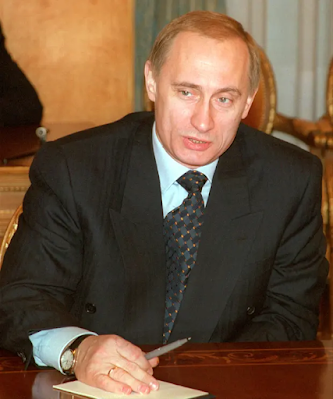 |
| Vladimir Putin was put on the throne of Russian power by an ailing Boris Yeltsin in 1999. Photograph: AP |
In Russia, as everyone knows, people still believe in the words and appearances woven by their rulers. And, back then, this man was “an individual pleasant in every respect”, as Nikolai Gogol wrote of his protagonist in Dead Souls: open to discussion, seeking to understand everyone, serious, but not devoid of humor or even the ability to make fun of himself.
Furthermore, certain politicians, intellectuals, and political theorists who are now fierce opponents of Putin and his system, supported him, some of them even passing through the doors of his campaign headquarters to help him win the coming elections. And he did. But the fatal Ring of Russian Power was already on his finger and doing its insidious work; an imperial monster began to take the place of this handsome, lively individual.
In Russia, power is a pyramid. This pyramid was built by Ivan the Terrible in the 16th century – an ambitious, brutal tsar overrun by paranoia and a great many other vices. With the help of his personal army – the oprichnina – he cruelly and bloodily divided the Russian state into power and people, friend and foe, and the gap between them became the deepest of moats. His friendship with the Golden Horde convinced him that the only way to rule the hugeness of Russia was by becoming an occupier of this enormous zone. The occupying power had to be strong, cruel, unpredictable and incomprehensible to the people. The people should have no choice but to obey and worship it. And a single person sits at the peak of this dark pyramid, a single person possessing absolute power and a right to all.
Paradoxically, the principle of Russian power hasn’t even remotely changed in the last five centuries. I consider this to be our country’s main tragedy. Our medieval pyramid has stood tall for all that time, its surface changing, but never its fundamental form. And it’s always been a single Russian ruler sitting at its peak: Pyotr I, Nicholas II, Stalin, Brezhnev, Andropov … Today, Putin has been sitting at its peak for more than 20 years. Having broken his promise, he clutches on to his chair with all his might. The Pyramid of Power poisons the ruler with absolute authority. It shoots archaic, medieval vibrations into the ruler and his retinue, seeming to say: “you are the masters of a country whose integrity can only be maintained by violence and cruelty; be as opaque as I am, as cruel and unpredictable, everything is allowed to you, you must call forth shock and awe in your population, the people must not understand you, but they must fear you.”
Judging by recent events, the idea of restoring the Russian Empire has entirely taken possession of Putin
Judging by recent events, the idea of restoring the Russian Empire has entirely taken possession of Putin.
Alas, Yeltsin, who came to power on the crest of the wave of perestroika, did not destroy the pyramid’s medieval form; he simply refurbished its surface: instead of gloomy Soviet concrete, it became colorful and was covered over with billboards advertising western goods. The Pyramid of Power exacerbated Yeltsin’s worst traits: he became rude, a bully and an alcoholic. His face turned into a heavy, motionless mask of impudent arrogance. Toward the end of his reign, Yeltsin unleashed a senseless war on to Chechnya when it decided to secede from the Russian Federation. The pyramid built by Ivan the Terrible had succeeded in awakening the imperialist even in Yeltsin, only a short-lived democrat; as a Russian tsar, he sent tanks and bombers into Chechnya, dooming the Chechen people to death and suffering.
Yeltsin and the other creators of perestroika surrounding him not only didn’t destroy the vicious Pyramid of Power, they didn’t bury their Soviet past either – unlike the post-war Germans who buried the corpse of their nazism in the 1950s. The corpse of this monster, which had annihilated tens of millions of its own citizens and thrown its country back 70 years into the past, was propped up in a corner: it’ll rot on its own, they thought. But it turned out not to be dead.
After coming to power, Putin began to change. And those who initially welcomed his reign gradually understood that these changes didn’t bode well for Russia. The TV channel NTV was destroyed, other channels began to pass into the hands of Putin’s comrades-in-arms, after which a regime of strict censorship came into effect; from that point forward, Putin was beyond criticism.

Mikhail Khodorkovsky, the head of the richest and most successful company in Russia, was arrested and imprisoned for 10 years. His company Yukos was looted by Putin’s friends. This “special operation” was designed to intimidate the other oligarchs. And it did: some of them left the country, but the rest swore allegiance to Putin, some of them even becoming his “coin purses”.
The Pyramid of Power was vibrating and its vibrations stopped time. Like a huge iceberg, the country was floating through the past – first its Soviet past, then only its medieval past.
Putin declared that the collapse of the USSR was the greatest catastrophe of the 20th century. For all clear-headed Soviet people, its collapse had been a blessing; it was impossible to find a single family unscathed by the red wheel of Stalinist repressions. Millions were annihilated. Tens of millions were poisoned by the fumes of communism – an unattainable goal requiring moral and physical sacrifices by Soviet citizens. But Putin didn’t manage to outgrow the KGB officer inside of him, the officer who’d been taught that the USSR was the greatest hope for the progress of mankind and that the west was an enemy capable only of corruption. Launching his time machine into the past, it was as if he were returning to his Soviet youth, during which he’d been so comfortable. He gradually forced all his subjects to return there as well.
The perversity of the Pyramid of Power lies in the fact that he who sits at its peak broadcasts his psychosomatic condition to the country’s entire population
The perversity of the Pyramid of Power lies in the fact that he who sits at its peak broadcasts his psychosomatic condition to the country’s entire population. The ideology of Putinism is quite eclectic; in it, respect for the Soviet lies side by side with feudal ethics, Lenin sharing a bed with Tsarist Russia and Russian Orthodox Christianity.
Putin’s favorite philosopher is Ivan Ilyin – a monarchist, Russian nationalist, anti-Semite, and ideologist of the White movement who was expelled by Lenin from Soviet Russia in 1922 and ended his life in exile. When Hitler came to power in Germany, Ilyin congratulated him hotly for “bringing the Bolshevization of Germany to a halt.
“I categorically refuse to evaluate the events of the last three months in Germany from the perspective of German Jews … The liberal-democratic hypnosis of non-resistance has been cast off …” he wrote. However, when Hitler declared the Slavs to be a second-class race, Ilyin was offended and the Gestapo soon took him into custody for the criticisms he’d begun to level. He was then rescued by Sergei Rachmaninov, after which he left for Switzerland.
In his articles, Ilyin hoped that, after the fall of Bolshevism, Russia would have its own great führer, who would bring the country up from its knees. Indeed, “Russia rising from its knees” is the preferred slogan of Putin and of his Putinists. It was also taking his cue from Ilyin that he spoke contemptuously of a Ukrainian state “created by Lenin”. In fact, the independent Ukraine was not created by Lenin, but by the Central Rada in January 1918, immediately after the dissolution of the Constituent Assembly by Lenin. This state arose because of Lenin’s aggression, but not thanks to his efforts. Ilyin was convinced that if, after the Bolsheviks, the authorities in Russia were “[to become] anti-national and anti-state, obsequious toward foreigners, [to dismember] the country, [to become] patriotically unprincipled, not exclusively protecting the interests of the great Russian nation without any regard for whorish Lesser Russians [Ukrainians], to whom Lenin gave statehood, then the revolution [would] not end, but enter its new phase of perishing from western decadence.”
“Under Putin, Russia has gotten up from its knees!” his supporters often chant. Someone once joked: the country got up from its knees, but quickly got down onto all fours: corruption, authoritarianism, bureaucratic arbitrariness and poverty. Now we might add another: war.
A lot has happened in the last 20 years. The president of the Russian Federation’s face has turned into an impenetrable mask, radiating cruelty, anger, and discontent. His main instrument of communication has become lies – lies small and big, naively superficial and highly structured, lies he seems to believe himself and lies he doesn’t. Russians are already accustomed to their president’s lie-filled rhetoric. But, now, he’s also inured Europeans to those lies. Yet another head of a European country flies to the Kremlin so as to listen through their traditional portion of fantastical lies (now at an enormous, totally paranoid table), to nod their head, to say that “the dialogue turned out to be fairly constructive” at a press conference, then to just fly away.
Angela Merkel admitted that, in her opinion, Putin lives in his own fantasy land. If that’s so, what’s the point of seriously engaging with such a ruler? He’s not a writer or an artist; he has to live in the real world and be responsible for every single one of his words. For 16 years, Merkel, who grew up in the GDR and should therefore understand Putin’s true nature, “has established a dialogue”. The results of that dialogue: the seizure of certain territories in Georgia, the annexation of Crimea, the capture of the DPR and LPR, and now a full-scale war with Ukraine. After the war with Georgia and the seizure of its territories, the “peacemaker” Obama offered Putin … a reset of their relations! Which is to say, c’mon, Vladimir, let’s forget all of that and start from scratch. The result of that “reset” was the annexation of Crimea and the war in Eastern Ukraine.

Putin’s inner monster wasn’t just brought up by our Pyramid of Power and the corrupt Russian elite, to whom Putin, like the tsar to the satraps, throws fat, juicy bits of corruption from his table.
It was also cultivated by the approval of irresponsible western politicians, cynical businessmen and corrupt journalists and political scientists.
“A strong and consistent ruler!” This bewitched them. “A new Russian tsar” was, for them, something like Russian vodka and caviar: invigorating!
During this period of time, I met many admirers of Putin in Germany, from taxi drivers to businessmen and professors. One aged participant in the student revolution of ’68 confessed:
“I really like your Putin!”
“And why exactly is that?”
“He’s strong. Tells the truth. And he’s against America. Not like the slugs we’ve got here.”
“And it doesn’t bother you that, in Russia, there’s monstrous corruption, there are practically no elections or independent courts, the opposition is being destroyed, the provinces are impoverished, Nemtsov was murdered, and TV’s become propaganda?”
“No. Those are your internal affairs. If Russians accept all of that and don’t protest, that must mean they like Putin.”
Ironclad logic. The experience of Germany in the 30s didn’t seem to have taught such Europeans anything.
But I hope most Europeans aren’t like that. That they know the difference between democracy and dictatorship – between war and peace. In his lie-filled address, Putin called the attack on Ukraine a “military special operation” against “Ukrainian aggressors”. Which is to say: the peace-loving Russia first annexed Crimea from the “Ukrainian junta”, then unleashed a hybrid war in eastern Ukraine, and is now attacking the whole country. Pretty much exactly like Stalin with Finland in 1939.
Now, one thing has become clear: with this war, Putin has crossed a line – a red line
For Putin, life itself has always been a special operation. From the black order of the KGB, he learned not only contempt for “normal” people, always a form of expendable matter for the Soviet Moloch-state, but also the Chekist’s main principle: not a single word of truth. Everything must be hidden away, classified. His personal life, relatives, habits – everything has always been hidden, overgrown with rumors and speculation.
Now, one thing has become clear: with this war, Putin has crossed a line – a red line. The mask is off, the armor of the “enlightened autocrat” has cracked. Now, all westerners who sympathize with the “strong Russian tsar” have to shut up and realize that a full-scale war is being unleashed in 21st century Europe. The aggressor is Putin’s Russia. It will bring nothing but death and destruction to Europe. This war was unleashed by a man corrupted by absolute power, who, in his madness, has decided to redraw the map of our world. If you listen to Putin’s speech announcing a “special operation”, America and Nato are mentioned more than Ukraine. Let us also recall his recent “ultimatum” to Nato. As such, his goal isn’t Ukraine, but western civilization, the hatred for which he lapped up in the black milk he drank from the KGB’s teat.
Who’s to blame? Us. Russians. And we’ll now have to bear this guilt until Putin’s regime collapses. For it surely will collapse and the attack on a free Ukraine is the beginning of the end.
Putinism is doomed because it’s an enemy of freedom and an enemy of democracy. People have finally understood this today. He attacked a free and democratic country precisely because it is a free and democratic country. But he’s the one who is doomed because the world of freedom and democracy is far bigger than his dark and gloomy lair. Doomed because what he wants is a new Middle Ages, corruption, lies and trampling on human freedoms. Because he is the past. And we must do everything in our power to make this monster remain there – in the past – for all time, together with his Pyramid of Power.
Vladimir Sorokin has written numerous novels, plays, short stories and film scripts. His novels Telluria and Their Four Hearts, translated by Max Lawton, will be published this year
This essay was translated by Max Lawton
https://www.theguardian.com/commentisfree/2022/feb/27/vladimir-putin-russia-ukraine-power


