Showing posts with label CGTN. Show all posts

Tuesday, 1 February 2022

A Uyghur gets death sentence, as China bans once OK’d books

 TAIPEI, Taiwan (AP) — As the Chinese government tightened its grip over its ethnic Uyghur population, it sentenced one man to death and three others to life in prison last year for textbooks drawn in part from historical resistance movements that had once been sanctioned by the ruling Communist Party.

February 1, 2022


An AP review of images and stories presented as problematic in a state media documentary, and interviews with people involved in editing the textbooks, found they were rooted in previously accepted narratives — two drawings are based on a 1940s movement praised by Mao Zedong, who founded the communist state in 1949. Now, as the party’s imperatives have changed, it has partially reinterpreted them with devastating consequences for individuals, while also depriving students of ready access to a part of their heritage.

It is a less publicized chapter in a wide-ranging crackdown on Uyghurs and other largely Muslim groups, which has prompted the U.S. and others to stage a diplomatic boycott of the Beijing Olympics that open Friday. Foreign experts, governments and media have documented the detention of an estimated 1 million or more people, the demolition of mosques and forced sterilization and abortion. The Chinese government denies human rights violations and says it has taken steps to eliminate separatism and extremism in its western Xinjiang region.

The attack on textbooks and the officials responsible for them shows how far the Communist Party is going to control and reshape the Uyghur community. It comes as President Xi Jinping, in the name of ethnic unity, pushes a more assimilationist policy on Tibetans, Mongolians and other ethnic groups that scales back bilingual education. Scholars and activists fear the disappearance of Uyghur cultural history, handed down in stories of heroes and villains across generations.

“There’s much more intense policing of Uyghur historic narratives now,” said David Brophy, a historian of Uyghur nationalism at the University of Sydney. “The goalposts have shifted, and rather than this being seen as a site of negotiation and tension, now it’s treated as separatist propaganda.”

Sattar Sawut, a Uyghur official who headed the Xinjiang Education Department, was sentenced to death, a court announced last April, saying he led a separatist group to create textbooks filled with ethnic hatred, violence and religious extremism that caused people to carry out violent acts in ethnic clashes in 2009. He may not be executed, as such death sentences are often commuted to life in prison after two years with good behavior.

Details about the textbooks were then presented in a documentary by CGTN, the overseas arm of state broadcaster CCTV, on what it called hidden threats in Xinjiang in a 10-minute segment. It included what amounted to on-camera confessions by Sawut and another former education official, Alimjan Memtimin, who got a life sentence.

The Xinjiang government and CGTN did not respond to written questions about the material.

Drawings from the textbooks are presented as evidence Sawut led others to incite hatred between Uyghurs and China’s majority Han population.

In one, a man points a pistol at another. The image is flashed over an on-camera statement by Memtimin, who says they wanted to “incite ethnic hatred and such thoughts.”

But both men in the drawing are Uyghurs. One, named Gheni Batur, holds up a gun to a traitor who had been sent to assassinate him. Batur was seen as a “people’s hero” in a 1940s uprising against China’s then-ruling Nationalist Party over its repression and discrimination against ethnic groups, said Nabijan Tursun, a Uyghur American historian and a senior editor at Radio Free Asia.

The Communists toppled the Nationalists and took power in 1949. Mao invited then-Uyghur leader Ehmetjan Qasimi to the first meeting of a national advisory body and said, “Your years of struggle are a part of our entire Chinese nation’s democratic revolution movement.” However, Qasimi died in a plane crash en route to the meeting.

Despite Mao’s approval, this period of history has always been debated by Chinese academics, Brophy said, and the attitude has shifted more and more toward hostility.

Another element in the story came to the fore after a series of knifings and bombings in 2013-14 by Uyghur extremists, who were angered by harsh treatment by the authorities.

The Uyghur movement had briefly carved out a nominally independent state, the second East Turkestan Republic, in northern Xinjiang in 1944. It had the backing of the Soviet Union, which had real control.

A recently leaked 2017 document, one of a trove given to an unofficial Uyghur Tribunal in Britain last September, shows that a Communist Party working group dealing with Xinjiang criticized elements of the uprising.

“The Three District Revolution is a part of our people’s democratic revolution, but there were serious mistakes made in the early stages,” the notice said.

Blaming interference by the Soviet Union, it said that ethnic separatists infiltrated the revolutionary ranks and “stole the right to lead, established a splitting regime, ... and committed the grave mistake of ethnic division.”

The document still said that Qasimi should be respected for his role in history.

The CGTN documentary, though, singles out a photo of Qasimi wearing a medal that was the symbol of the second East Turkestan Republic. “It shouldn’t appear in this textbook at all,” Shehide Yusup, an art editor at Xinjiang Education Publishing House, said in the documentary.

Another textbook illustration, drawn from the same period, shows what appears to be Nationalist solider pointing a knife at a Uyghur rebel sprawled on the ground.

Both stories come from novels by Uyghur writers published by government publishing houses. One of the writers, Zordun Sabir, is a member of the state-backed Chinese Writer’s Association. The textbooks themselves were published only after high-level approval, said Kündüz, a former editor at the Xinjiang University newspaper who uses only one name.

When the textbooks were reviewed in 2001, the Uyghur stories hardly got any attention, said Abduweli Ayup, a Uyghur linguist who as a then-graduate student translated some of the stories into Chinese for the review.

Stories that portrayed the Nationalists as the enemy were not considered controversial. Instead, the Uyghur editors worried about foreign stories, said Ayup, an activist who now lives in Norway, such as a line from a Tolstoy story and a Hungarian poem.

Another story cited by CGTN goes back to the Qing Dynasty, which ruled China until 1912. Yusup, the art editor tells CGTN: “This is the legend of seven heroic Uyghur girls. It’s all fabricated. Han Chinese soldiers trapped them at a cliff and they jumped to their death to defend their homeland. It’s meant to incite ethnic hatred.”

But the soldiers were not Han, they were ethnic Manchu who founded the Qing Dynasty in 1644. The text of the story visible in the CGTN documentary says so, reading in part, “The Manchu soldiers started to climb Mount Möljer from all sides. Maysikhan (a leader of the Uyghur girls) saw the Manchus clambering up the mountain and told the girls to roll rocks down at them.”

The story is based on a local rebellion against the Qing Dynasty. A shrine dedicated to the seven girls stands in the Xinjiang city of Uchturpan, which partially funded it. Epics, articles and dramas about the story are popular.

“For the Chinese government to praise the uprising and then criminalize the inclusion of the story in textbooks is shocking,” Tursun, the historian said.

From even earlier, officials have been increasing the amount of instruction in Chinese in Xinjiang, especially after ethnic clashes in 2009 in Urumqi, the regional capital, said Minglang Zhou, an expert on China’s bilingual education policies at the University of Maryland.

Xi, as China’s leader, has stressed the consolidation of the nation, a move away from the “one unified nation with diversity” promoted by his predecessors, Zhou said. “He sees diversity as a threat to a unified nation.”

Kündüz lamented that her son, growing up in Urumqi, studied more in Chinese than in Uyghur. “They want to assimilate us, they want us to erase us,” she said from Sweden, where she now lives.

To this day, her son speaks Chinese better than Uyghur.

https://apnews.com/article/uyghur-death-sentence-china-banned-books


Thursday, 30 December 2021

The disinformation tactics used by China

The Chinese embassy in London has criticised the BBC following a documentary about Chinese disinformation campaigns.

By Krassi Twigg and Kerry Allen
BBC Monitoring


Published
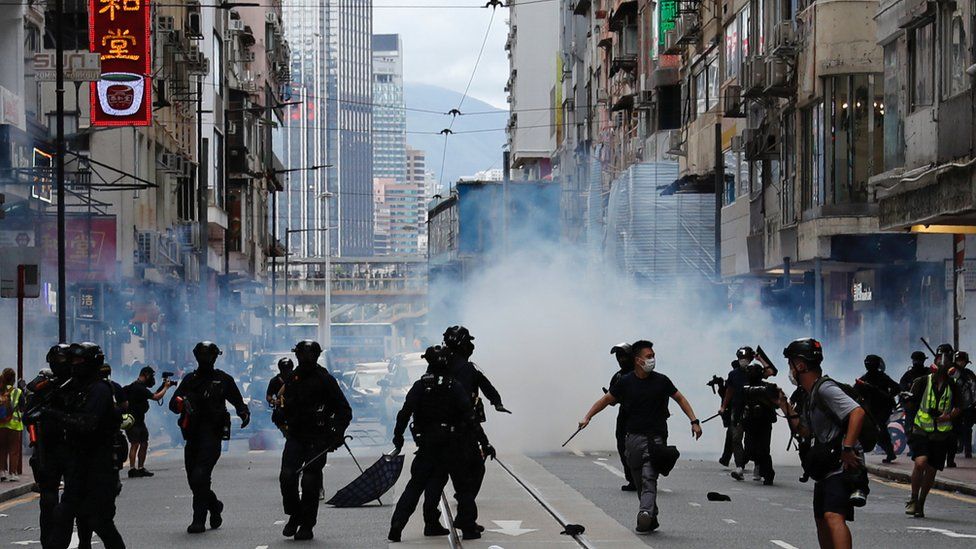
Street view of riot police and protesters in Hong KongIMAGE SOURCE,REUTERS

Image caption,
Facebook and Twitter removed accounts linked to China during unrest in Hong Kong in 2019

There have also recently been a series of denials from Beijing over reports into forced imprisonment of its minority Uighur population - these have included baseless accusations against media and human rights organisations.

In the latest attack, an official falsely claimed a Uighur interviewee on a BBC programme was an actress.

So what tactics does China use in the spread of misleading and false information?

Increasing anti-BBC coverage

There have been almost daily anti-BBC articles in Chinese state media since mid-February.

It follows a decision by the UK broadcasting regulator Ofcom to revoke the licence for China's state-run overseas broadcaster, CGTN.

For years, China has broadly criticised Western outlets for reports on affairs in Xinjiang and elsewhere in China, saying they should not intervene in China's "internal affairs".

But these latest attacks on Western media are a clear escalation.

Chinese domestic media outlets have praised their government for banning the BBC's World News channel, although it was only available in some international hotels and residential compounds where foreigners live.

Reports from leading outlets like China's Global Times have criticised the "Cold War" mentality when it comes to China - on topics ranging from Hong Kong, the Uighur population of Xinjiang and the Covid-19 pandemic.

When China was facing a backlash over its handling of early stages of the pandemic last year, and some US officials were floating the theory that the virus could have escaped from a Wuhan lab, CGTN started to push its own conspiracy theory.

Despite a complete lack of evidence, the station suggested the virus originated at a military base in Maryland in the US and was brought to China by American soldiers during an athletics competition.

Find out more

Finger pointing at mobile phone screenIMAGE SOURCE,GETTY IMAGES
Presentational grey line

'Wolf warriors' on social media

In recent months, China experts have noticed dozens of new and highly active official social media accounts representing Chinese embassies and leading diplomats.

This has become known as "wolf warrior" diplomacy. The best-known account belongs to Zhao Lijian from the Chinese foreign ministry.

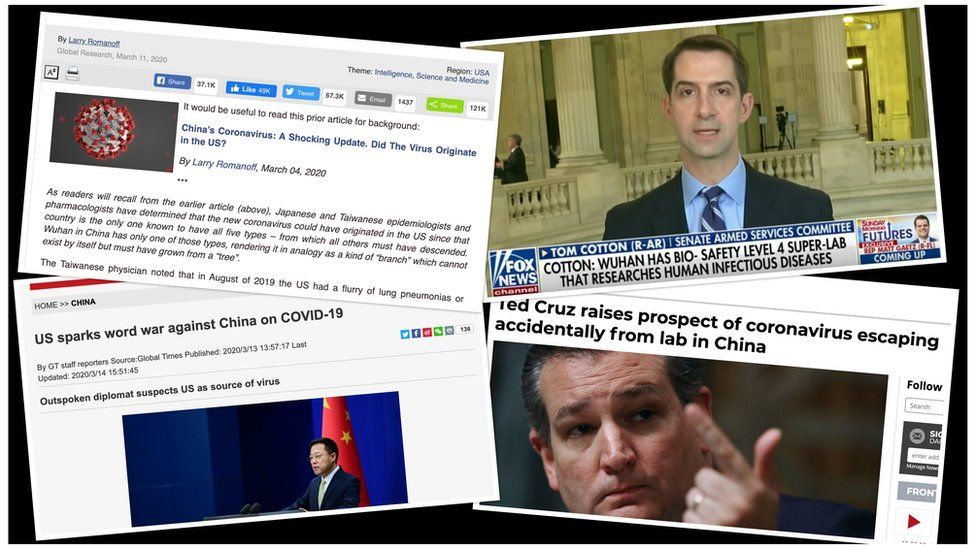
He caused controversy in March after tweeting articles suggesting that coronavirus originated in the United States.

Composite picture of websites
Image caption,
The US and China traded unverified theories about the origins of coronavirus

Those tweets have been shared more than 40,000 times and referenced in 54 different languages, according to research from the Digital Forensic Research Lab, part of the Atlantic Council think tank.

Popular hashtags referencing the posts have made waves at home too - they've been viewed by users of Chinese social network Weibo more than 300 million times.

In December, Zhao Lijian was widely criticised for sharing a fake image of an Australian soldier killing an Afghan child, for which China refused to apologise.

'Keyboard army'

China draws on millions of citizens to monitor the internet and influence public opinion on a massive scale online. These recruits are known as the "50 cent army" - so named because of reports that they were paid 0.5 yuan per post.

This "keyboard army" has long been active on Chinese social media platforms. Its aim has been to aggressively defend and protect China's image overseas.

When tweeting in English, the messages are aimed at a Western audience, much like troll farms in Russia that sow discord.

To the unsuspecting reader, they might appear as patriotic citizens acting independently, but frequently they are taking directions from Chinese authorities.

One example is the way in which video footage of violent protests in Hong Kong in 2019 was promoted on social media via this keyboard army using terms such as "terrorism", while coverage of peaceful protests was censored.

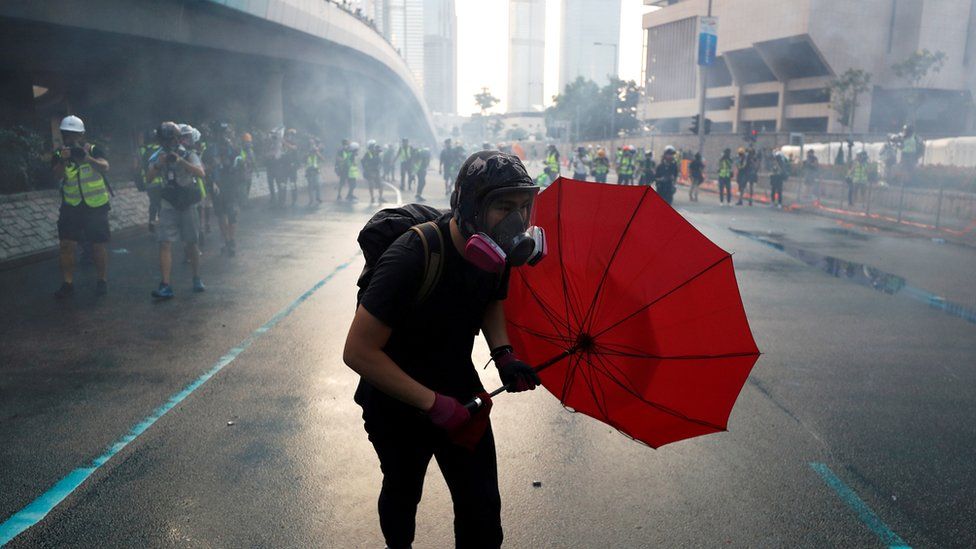
A Hong Kong protesterIMAGE SOURCE,REUTERS

In August 2019, Facebook and Twitter announced they had removed accounts linked to a state-backed information campaign.

Facebook said: "Although the people behind this activity attempted to conceal their identities, our investigation found links to individuals associated with the Chinese government."

Twitter identified more than 900 accounts from China. But these were only the most active components of the campaign, which the company said involved some 200,000 accounts.

Fake social media accounts

A BBC investigation in May 2020 found hundreds of fake or hijacked social media accounts promoting pro-China messages on Facebook, Twitter and YouTube. Some 1,200 accounts targeted people critical of how Beijing was handling the pandemic.

There was no definitive evidence tying these accounts to the Chinese government, but it did display similar characteristics to the state-backed network removed by Facebook and Twitter in 2019.

It also resembled another network dubbed "Spamouflage Dragon", which pumped out pro-China posts and attacked critics with spam, which was uncovered by the social analytics firm Graphika.

Subsequently Twitter said it had removed more than 23,000 accounts linked to China involved in a range of "manipulative and co-ordinated activities".

In response to comments made by Yang Xiaoguang, from the Chinese Embassy in the UK on the BBC Today programme, a BBC spokesman said: "We completely reject these claims and stand by our journalism. BBC News reporting in Xinjiang has been accurate and impartial - we did not use any false images and the interviewee who appeared on the BBC was not an 'actress' as claimed."

Additional reporting by Jack Goodman

https://www.bbc.com/news/56364952

Wednesday, 29 December 2021

China: Swiss embassy urges media to remove scientist fake news

 The Swiss embassy in China has urged Chinese media to take down articles and posts it says contain "false" news.

By Suranjana Tewari
BBC News

Published

The Swiss embassy said it had to inform the Chinese public of the false news


In a Twitter post, the embassy said an alleged Swiss biologist who had been quoted in Chinese media in recent days likely did not exist.

State media outlets were among those that carried articles with comments from "Wilson Edwards" on the origins of Covid-19 and the WHO's independence.

Many outlets have since removed any reference to him.

"While we appreciate the attention on our country, the Embassy of Switzerland must unfortunately inform the Chinese public that this news is false," the Swiss embassy said in a statement posted on Twitter.

Organisations including CGTN, Shanghai Daily and Global Times had cited the so-called biologist based on his Facebook profile.

However, the Swiss embassy said the Facebook account was opened two weeks ago and only had three friends.

"It is likely that this Facebook account was not opened for social networking purposes," the Swiss embassy added.

The mission said that there was no registry of a Swiss citizen with the name "Wilson Edwards" and no academic articles under the name.

The BBC is not responsible for the content of external sites.View original tweet on Twitter
1px transparent line

In one article seen by the BBC before it was altered, "Wilson Edwards" is referred to as a biologist in Switzerland.

The line from the China Daily article reads: "[Wilson Edwards] said on his Facebook account: 'As a biologist, I've witnessed in consternation over the past months how the origin-tracing of Covid-19 was politicized.'"

In the altered version, all reference to Wilson Edwards were removed.

Shanghai Daily's digital platform Shine had said in a post: "A European biologist has come to the fore with a startling claim that a World Health Organization (WHO) advisory group on tracing the origins of pathogens including the virus responsible for the Covid-19 pandemic, would become a "political tool".

It added that the biologist was worried about the "WHO's independence" and quotes him as saying "the US is so obsessed with attacking China on the origin-tracing issue that it is reluctant to open its eyes to the data and findings".

The Swiss embassy assured readers that it assumed the spreading of the story was done in good faith but "kindly asked" for the stories to be taken down or corrected.

Related Topics

https://www.bbc.com/news/world-asia-china-58168588

Most Recent Post

Man charged for borrowing rare Chinese manuscripts from UCLA library, returning fakes

  Suspect Jeffrey Ying allegedly travelled to China after checking works out using several aliases Agence France-Presse Published: 12:11pm, ...

Popular Posts - Last 30 days