Showing posts with label Uyghurs. Show all posts

Friday, 19 January 2024

Afghan-Sino Relations: A Different Mindset. A Different Outcome?

Both economic and security measures are crucial to reducing Islamic extremism in Afghanistan. While Chinese economic measures offer hope for financial growth and regional stability, terrorist acts continue to endanger China. China’s strategy toward Afghanistan varies from the US approach. The Chinese approach could lead to the economic uplifting of the masses in Afghanistan and subsequent reductions in terrorism and extremism through cooperation with the Taliban.

Veena Ramachandran & Amit Kumar
Date Published: January 17, 2024
https://gjia.georgetown.edu/2024/01/17/afghan-sino-relations-a-different-mindset-a-different-outcome/


Introduction

For two decades, the Taliban and other rebel organizations have been the target of US and North Atlantic Treaty Organization (NATO) military operations in Afghanistan. China has never participated in operations such as the International Security Assistance Force (ISAF). However, China has contributed significantly to Afghanistan’s economic growth, reconstruction, and reconciliation attempts. Almost every nation withdrew their embassies and personnel during the US exit from Afghanistan and Taliban takeover in August 2021, but China was the sole exception.

Beijing has taken a different approach than the United States to managing Afghanistan. Beijing seeks to maintain the stability-security paradigm of Xinjiang by neutralizing the Uyghur militants on Afghan soil before they plan operations against the Beijing government and aggravate the already fragile Xinjiang. Beijing is also intrigued by the vast unexplored mineral wealth in Afghanistan. Indeed, China is particularly intrigued by the rare earth minerals that are necessary in burgeoning industries such as semiconductors. Afghanistan also represents an appealing market for Chinese goods. China’s approach to Afghanistan promises to yield better results than that of the United States, as China promotes the political stability and economic progress in Afghanistan that all sides support.

Contrasting Mindsets

Since September 11, 2001, the United States has maintained a significant presence in Afghanistan. Following NATO’s overthrow of the Taliban regime, NATO troops have engaged in a prolonged counterinsurgency operation against Al-Qaeda and the Taliban. With over 100,000 American troops deployed at the height of the conflict, the United States made significant political and military investments in Afghanistan, providing billions of dollars in aid to the Afghan government to train Afghan forces and equip them with arms and ammunition. The United States has also provided aid to international humanitarian organizations working on the ground in Afghanistan. The United States focused primarily on fighting terrorism with bullets and boots on the ground while reconstructing Afghanistan based on democratic ideals–reestablishing civil and political rights for the locals. The United States had effectively remodeled Afghanistan based on American values and principles.

Washington’s strategy sought to prevent Afghanistan from becoming a terrorist launchpad. A stable, self-sustaining democratic government has been the American vision for Afghanistan. To realize this vision, America promoted democratic institutions like free and fair elections and a free press. The continuous turmoil and unrest that followed Afghanistan’s capture by the Taliban in 2021, however, obstructs the values that America had attempted to impose, rendering the two-decade-long effort largely ineffective. The mission to integrate all the components of Afghan society into one powerful, self-sufficient, and prosperous nation was not successful. The ineffectiveness of Afghanistan’s democratic government was evidenced by its inability to withstand the force of the Taliban for even a single day following US withdrawal.

In contrast, China kept itself militarily aloof, contributing to Afghanistan’s attempts to rebuild and strengthen its economy. Beijing prioritized commerce and its national security, refusing to meddle with the Afghan interim government. Afghanistan has received substantial financial aid from China, including investments in infrastructure initiatives such as roads, trains, and power plants. The China-Afghanistan-Pakistan Economic Corridor of 2016, which aims to increase commerce and investment in Afghanistan, is one such example. China follows a unique strategy of boosting the Afghan economy, which could eventually influence Afghan politics in the long run. Per the Chinese calculation, the population of Afghanistan will be lured away from extremism and terrorism when economic prosperity reaches the poorest socio-economic segment of the population. According to Einar Tangen, a China Global Television Network political and economic affairs commentator, once Afghans experience a secure, prosperous, and peaceful existence, they will never return to the paths of terrorism.

China’s Afghanistan Engagement Strategy

China’s diplomatic engagement helps gain the trust of the newly formed Afghan interim government, assuring them that Beijing’s policy does not seek to destabilize but rather assist in consolidating and strengthening Afghan national security.  By doing so, China promotes its national interest by safeguarding Xinjiang’s vulnerable society from terrorism and extremism, limiting its spread to the Af-Pak region, and neutralizing it with Taliban and Pakistan’s support. Independent of NATO, China seeks to shape regional counterterrorism efforts with regional actors’ support and protect its Belt and Road Initiatives (BRI) in the region. China is concerned about the possibility of violence and unrest in Afghanistan spreading to the Xinjiang province. China’s covert and diplomatic outreach to the Taliban both before and after Kabul’s fall demonstrates China’s astute foreign policy judgment. Beijing perceives the Taliban as competent, recognizing its importance in controlling regional terrorist organizations and neutralizing anti-Taliban and anti-China terror groups such as the Islamic State of Khorasan. The growth of the Islamic State of Khorasan Province (ISKP) in the Af-Pak region presents Uyghur militants with a new base of operations, enabling the province and militants to assist each other in accomplishing their agendas. This symbiotic relationship threatens China, its workforce abroad, and the internal stability of Xinjiang.

As a part of its BRI, which aims to increase China’s economic and geopolitical power over the region, China is forging business relations with the Taliban. A stable Afghanistan will offer China a reliable land connection to Iran and the rest of the Middle East. Hence, Afghanistan is Beijing’s first move in securing the Middle Eastern market and streamlining its energy transit. The cash-strapped Taliban government, under sanctions, has agreed with China and Pakistan to expand the China-Pakistan Economic Corridor (CPEC) to Afghanistan, attracting billions for infrastructure investment. China’s economic involvement includes investments in mineral exploitation worth over $1 trillion. The Xinjiang Central Asia Petroleum and Gas Company (CAPEIC) recently signed a $540 million oil and gas deal. Chinese company Gochin also offered to invest $10 billion in Afghanistan’s lithium mining industry, which is valued at $1 trillion. In a recent Aljazeera documentary, Professor Wang Duanyong of Shanghai International Studies University, who leads research on China’s overseas investment, emphasized the importance of Chinese companies respecting Afghanistan’s local laws, customs, and culture. Professor Wang is also an investor in China Town Kabul, which recently signed a $200 million contract with the Afghan Ministry of Land. The company is currently scouting potential locations for a new metropolis designed to accommodate 3 million people and foster factories and commerce. China’s strategy is limited to government-to-government negotiations without meddling in Afghan politics. Chinese investment plans and development initiatives in various economic sectors across Afghanistan are poised to generate capital assets, create local employment opportunities, and empower the lower economic strata, contributing to the promotion of peace and prosperity. This aligns with Rashid Dostum’s perspective, the former Vice President of Afghanistan, who argues that the United States made two critical mistakes during its twenty-year occupation. The first error was attempting to enforce centralized, democratic governance on a nation with a unique political and cultural background. Dostum suggests that more attention should have been directed towards enhancing the livelihoods of rural Afghans, utilizing the country’s abundant mines, oil, and gas resources. He contends that preventing mass emigration by providing jobs and addressing basic needs would have paved the way for the organic development of democracy.

Different Outcomes

The US approach to negotiating peace in Afghanistan faced several hurdles due to its liberal agenda enforcement and high levels of corruption among the Afghan administrators themselves. In contrast, Beijing distanced itself from the political structures in place. In its peace agenda, it highlighted the value of regional economic growth to foster peace and stability. Following the Doha Agreement 2020, China recognized the Taliban’s power and quickly stepped up several secret talks, realizing that the Taliban would gain significant influence in the current power structure or perhaps entirely overthrow it. China’s diplomatic foresight helped to forge positive ties with the Taliban with both sides respecting each other’s needs.

The Taliban wanted investment, international legitimacy, and votes to join multilateral organizations from China. Chinese investments would revive the Taliban’s economy and provide crucial infrastructure support. The Taliban could then use Afghanistan’s abundant lithium and cobalt reserves as a negotiating chip to further its own international political and economic goals. On the other hand, Beijing wished for security assurances in its northwestern frontiers, the neutralization and deportation of any Uyghur militants planning terror attacks, and the elimination of any terrorist groups, such as the ISKP, becoming more sympathetic to the Uyghurs. Beyond security measures, Afghanistan’s mineral reserves hold strategic value for Beijing. China seeks to strengthen its position in the global minerals supply chain by exploiting Kabul’s abundant mineral resources, particularly cobalt, lithium, and rare earth metals. The acquisition of these resources would bolster China’s dominance in battery storage technology, providing them with a competitive advantage over the West. Consequently, China’s diplomatic engagements with the Taliban are primarily focused on safeguarding their security and economic interests without interfering in the day-to-day operations of the Afghan government. This approach ensures the protection of China’s interests both at home and abroad.

Conclusion

In their approaches to Afghanistan, the United States and China diverge significantly. The United States had a political-militaristic strategy and made significant political changes to Afghanistan’s governance structure and institutions. However, large US grants and aid only enriched Afghan politicians and their close associates; the ordinary Afghan populace did not benefit. It is also difficult to discern if the general populace was ready to accept this softening of rigid Islamic and tribal customs brought about by the gradual introduction of Western values.

China, meanwhile, has prioritized diplomacy and economic growth. The Chinese presence and influence have progressively increased due to the void left by America’s withdrawal of its military from Afghanistan last year. China’s strategy is top-down with a precise focus on economic benefit to both itself and Afghanistan–while also serving the security interests of Beijing. Chinese investments in heavy industries, factories, and commercial estates could lead to the development of local jobs and prosperity for the lowest rungs of the Afghan economic pyramid. Financially empowering society’s lower strata would bring peace and prosperity. As society advances, it will be empowered to demand a more effective government.

Ultimately, Afghanistan’s future depends on ties with its neighbors, including China, India, and Central Asian nations. China’s approach in this regard is not that of a rival superpower but rather one centered on promoting mutual growth and defense. Under this strategy, the Taliban would be strengthened and consolidated as a powerful government that could reduce terrorism in China while enhancing its citizens’ quality of life. This strategy could deliver Afghanistan the stability that all sides support.

Amit Kumar is a doctoral candidate at the Birla Institute of Technology and Science, in Pilani, India. In addition, he is an Adjunct Researcher at The MirYam Institute in New York. He also works for The Defence Horizon Journal in Austria as an Associate Editor.

Dr Veena Ramachandran is an Assistant Professor at the Department of Humanities and Social Sciences, Birla Institute of Technology and Science, Rajasthan, India. Her specialization is in China Studies.

Image Credit: flickr

https://gjia.georgetown.edu/2024/01/17/afghan-sino-relations-a-different-mindset-a-different-outcome/


 2024 Walsh School of Foreign Service

Georgetown University

Saturday, 28 May 2022

UN human rights chief asks China to rethink Uyghur policies

BEIJING (AP) — The top U.N. human rights official said Saturday that she raised concerns with Chinese officials about the impact of the broad application of counterterrorism and deradicalization measures on the rights of Uyghurs and other predominantly Muslim groups in China’s Xinjiang region.


28 May 2022
By KEN MORITSUGU

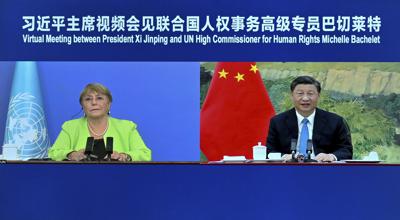
In this image made from online video, United Nations High Commissioner for Human Rights Michelle Bachelet speaks during an online press conference in Guangzhou in southern China's Guangdong Province, Saturday, May 28, 2022. Bachelet is on a six-day visit to China that includes Xinjiang, a region where the Chinese government has been accused of human rights violations. (United Nations High Commissioner for Human Rights via AP)


Michelle Bachelet, who visited the northwestern region as part of a six-day trip to China, said the visit was not an investigation but a chance to have direct talks with senior Chinese leaders and pave the way for more regular interactions to support China in fulfilling its obligations under international human rights law.

“It provides an opportunity for me to better understand the situation in China, but also for the authorities in China to better understand our concerns and to potentially rethink policies that we believe may impact negatively on human rights,” she said in a video news conference before leaving the country.

Bachelet’s measured words, while expected, did not satisfy activists and likely will not sit well with governments such as the United States, which have been critical of her decision to visit Xinjiang. China’s ruling Communist Party, which has vehemently denied all reports of human rights violations and genocide in Xinjiang, showed no sign of being open to change in a government statement on the trip.

The statement, attributed to Vice Foreign Minister Ma Zhaoxu, accused some Western countries and anti-China elements of fabricating sensational lies about Xinjiang under the guise of human rights. It said that the government had adopted lawful measures to combat violent terrorism and brought security, stability and prosperity to the region in China’s northwest.

“The Chinese side pointed out that essentially, Xinjiang is not at all a human rights issue, but a major issue concerning upholding national sovereignty, security and territorial integrity,” the statement said. “All ethnic groups of Xinjiang belong to the family of the Chinese nation.”

Agnes Callamard, the secretary general of Amnesty International, said that Bachelet should condemn human rights violations in Xinjiang, and call on China to release people arbitrarily detained and end systematic attacks on ethnic minorities in the region.

“The high commissioner’s visit has been characterized by photo opportunities with senior government officials and manipulation of her statements by Chinese state media, leaving an impression that she has walked straight into a highly predictable propaganda exercise for the Chinese government,” Callamard said in a news release.

Bachelet, making the first visit by a U.N. high commissioner for human rights to China in 17 years, said she raised the lack of independent judicial oversight for a system of internment camps that swept up a million or more Uyghurs and other ethnic minorities, according to estimates by experts.

China, which describes the camps as vocational training and education centers to combat extremism, says they have been closed. The government has never publicly said how many people passed through them.

Bachelet, who visited a prison and a former center in the Xinjiang city of Kashgar, noted the reliance by police on 15 indicators to determine “tendencies towards violent extremism” that could result in detention, the allegations of use of force and reports of unduly severe restrictions on religious practices.

“It is critical that counterterrorism responses do not result in human rights violations,” she said. “The application of relevant laws and policies, and any mandatory measures imposed on individuals, need to be subject to independent judicial oversight, with greater transparency of judicial proceedings. All victims must be able to seek redress.”

Bachelet described as “deeply worrying” the arrest of lawyers, activists, journalists and others under Hong Kong’s national security law, noting the semi-autonomous Chinese city’s reputation as a center for human rights and independent media in Asia.

She said it is important to protect the linguistic, religious and cultural identity of Tibetans and that they be allowed to participate fully and freely in decisions about their religious life. “I ... stressed the importance of children learning in their language and culture in the setting of their families or communities,” she said.

Before her trip, Bachelet heard from Uyghur families living abroad that have lost contact with their relatives. In her meetings in China, she said she appealed to authorities to make it a priority to take steps to provide information to families.

“To those who have sent me appeals asking me to raise issues or cases with the authorities, I have heard you,” she said. “Your advocacy matters and my visit was an opportunity to raise a number of specific situations and issues of concern with the government.”

The U.N. and China agreed to set up a working group to hold follow-up discussions on a range of issues, including the rights of minorities, counterterrorism and human rights, and legal protection, Bachelet said.

https://apnews.com/article/china-united-nations-terrorism-counterterrorism-michelle-bachelet-3203405d3420f6bea8c9e9fa2fa1a7fb


Sunday, 20 February 2022

ANI China Headlines: 19 - 20 Feb 2022


China might implement zero-Covid policy in Hong Kong if surge in c

Updated : 11 Hours, 49 min ago IST

Hong Kong, February 19 (ANI): As Hong Kong faces its worst-ever COVID-19 outbreak, China might implement the draconian Zero-Covid policy on the island if the cases of infections don't reduce in the coming week, said a media report.

Read More
China: Former provincial political advisor expelled from communist

Updated : 9 Hours, 10 min ago IST

Beijing [China], February 19 (ANI): A former senior political advisor of China's Liaoning Province, has been expelled from the Chinese Communist Party (CCP) over serious violations of Party laws, media reports said on Saturday.

Rea
China reports 101 new COVID-19 cases

Updated : 1 Min ago IST

Beijing [China], February 20 (ANI): The Chinese mainland has reported 101 locally transmitted COVID-19 cases in the last 24 hours, local news reported citing the National Health Commission said on Sunday.

Read More
Companies in paradox as winning in China now means losing somewher

Updated : 1 Hour, 8 min ago IST

Beijing [China], February 20 (ANI): Multinational firms that are trying to comply with new import restrictions from other countries have found themselves facing penalties in China.

Read More


Hong Kong at verge of witnessing worst ever COVID outbreak: Report

Updated : 20 Hours, 4 min ago IST

Hong Kong, February 19 (ANI): Hong Kong has been facing its worst-ever COVID-19 outbreak, as the people are suddenly witnessing a severely overstretched healthcare system, depicting China's unsuccessful "zero-Covid" policy.

Read More
China growing its influence in US using media ecosystem

Updated : 1 Day, 13 hours ago IST

Beijing [China], February 18 (ANI): Chinese corporations have been acquiring the controlling rights in the US media ecosystem, as Beijing owns a 60 per cent stake in an American company that leases almost all of the station's program.

Read More
EU files case at WTO against China over protection of patents

Updated : 1 Day, 14 hours ago IST

Brussels [Belgium], February 18 (ANI): The European Union (EU) on Friday filed a case against China at the World Trade Organization (WTO) for restricting EU companies from going to a foreign court to protect and use their patents.

Read More
China sentences Uyghur high school principal to 18 years in prison

Updated : 1 Day, 4 hours ago IST

Washington [US], February 19 (ANI): China sentenced an Uyghur educator and principal of a high school in Korla (Kuerle in Chinese) in northwestern China's Xinjiang region to 18 years in prison for inviting two Uyghur scholars to give presentations.

Read More
Despite tough rules, China's online gaming thriving among underage

Updated : 1 Day, 5 hours ago IST

Beijing [China], February 19 (ANI): Despite anti-addiction rules introduced last year, China's online gaming sector is thriving among underage players.

Read More
US adds WeChat, AliExpress to list of piracy markets

Updated : 1 Day, 11 hours ago IST

Washington [US], February 18 (ANI): The United States has added WeChat's e-commerce ecosystem and AliExpress, an e-commerce site owned by Alibaba, to an annual list of markets that it says engage in counterfeiting and copyright violations.

Read More
Chinese electronic warfare plane enters Taiwan's air defence zone

Updated : 1 Day, 12 hours ago IST

Taipei [Taiwan], February 18 (ANI): A Chinese electronic warfare plane entered Taiwan's air defence identification zone (ADIZ) on Thursday, marking the 10th intrusion this month.

Read More

Tuesday, 1 February 2022

A Uyghur gets death sentence, as China bans once OK’d books

 TAIPEI, Taiwan (AP) — As the Chinese government tightened its grip over its ethnic Uyghur population, it sentenced one man to death and three others to life in prison last year for textbooks drawn in part from historical resistance movements that had once been sanctioned by the ruling Communist Party.

February 1, 2022


An AP review of images and stories presented as problematic in a state media documentary, and interviews with people involved in editing the textbooks, found they were rooted in previously accepted narratives — two drawings are based on a 1940s movement praised by Mao Zedong, who founded the communist state in 1949. Now, as the party’s imperatives have changed, it has partially reinterpreted them with devastating consequences for individuals, while also depriving students of ready access to a part of their heritage.

It is a less publicized chapter in a wide-ranging crackdown on Uyghurs and other largely Muslim groups, which has prompted the U.S. and others to stage a diplomatic boycott of the Beijing Olympics that open Friday. Foreign experts, governments and media have documented the detention of an estimated 1 million or more people, the demolition of mosques and forced sterilization and abortion. The Chinese government denies human rights violations and says it has taken steps to eliminate separatism and extremism in its western Xinjiang region.

The attack on textbooks and the officials responsible for them shows how far the Communist Party is going to control and reshape the Uyghur community. It comes as President Xi Jinping, in the name of ethnic unity, pushes a more assimilationist policy on Tibetans, Mongolians and other ethnic groups that scales back bilingual education. Scholars and activists fear the disappearance of Uyghur cultural history, handed down in stories of heroes and villains across generations.

“There’s much more intense policing of Uyghur historic narratives now,” said David Brophy, a historian of Uyghur nationalism at the University of Sydney. “The goalposts have shifted, and rather than this being seen as a site of negotiation and tension, now it’s treated as separatist propaganda.”

Sattar Sawut, a Uyghur official who headed the Xinjiang Education Department, was sentenced to death, a court announced last April, saying he led a separatist group to create textbooks filled with ethnic hatred, violence and religious extremism that caused people to carry out violent acts in ethnic clashes in 2009. He may not be executed, as such death sentences are often commuted to life in prison after two years with good behavior.

Details about the textbooks were then presented in a documentary by CGTN, the overseas arm of state broadcaster CCTV, on what it called hidden threats in Xinjiang in a 10-minute segment. It included what amounted to on-camera confessions by Sawut and another former education official, Alimjan Memtimin, who got a life sentence.

The Xinjiang government and CGTN did not respond to written questions about the material.

Drawings from the textbooks are presented as evidence Sawut led others to incite hatred between Uyghurs and China’s majority Han population.

In one, a man points a pistol at another. The image is flashed over an on-camera statement by Memtimin, who says they wanted to “incite ethnic hatred and such thoughts.”

But both men in the drawing are Uyghurs. One, named Gheni Batur, holds up a gun to a traitor who had been sent to assassinate him. Batur was seen as a “people’s hero” in a 1940s uprising against China’s then-ruling Nationalist Party over its repression and discrimination against ethnic groups, said Nabijan Tursun, a Uyghur American historian and a senior editor at Radio Free Asia.

The Communists toppled the Nationalists and took power in 1949. Mao invited then-Uyghur leader Ehmetjan Qasimi to the first meeting of a national advisory body and said, “Your years of struggle are a part of our entire Chinese nation’s democratic revolution movement.” However, Qasimi died in a plane crash en route to the meeting.

Despite Mao’s approval, this period of history has always been debated by Chinese academics, Brophy said, and the attitude has shifted more and more toward hostility.

Another element in the story came to the fore after a series of knifings and bombings in 2013-14 by Uyghur extremists, who were angered by harsh treatment by the authorities.

The Uyghur movement had briefly carved out a nominally independent state, the second East Turkestan Republic, in northern Xinjiang in 1944. It had the backing of the Soviet Union, which had real control.

A recently leaked 2017 document, one of a trove given to an unofficial Uyghur Tribunal in Britain last September, shows that a Communist Party working group dealing with Xinjiang criticized elements of the uprising.

“The Three District Revolution is a part of our people’s democratic revolution, but there were serious mistakes made in the early stages,” the notice said.

Blaming interference by the Soviet Union, it said that ethnic separatists infiltrated the revolutionary ranks and “stole the right to lead, established a splitting regime, ... and committed the grave mistake of ethnic division.”

The document still said that Qasimi should be respected for his role in history.

The CGTN documentary, though, singles out a photo of Qasimi wearing a medal that was the symbol of the second East Turkestan Republic. “It shouldn’t appear in this textbook at all,” Shehide Yusup, an art editor at Xinjiang Education Publishing House, said in the documentary.

Another textbook illustration, drawn from the same period, shows what appears to be Nationalist solider pointing a knife at a Uyghur rebel sprawled on the ground.

Both stories come from novels by Uyghur writers published by government publishing houses. One of the writers, Zordun Sabir, is a member of the state-backed Chinese Writer’s Association. The textbooks themselves were published only after high-level approval, said Kündüz, a former editor at the Xinjiang University newspaper who uses only one name.

When the textbooks were reviewed in 2001, the Uyghur stories hardly got any attention, said Abduweli Ayup, a Uyghur linguist who as a then-graduate student translated some of the stories into Chinese for the review.

Stories that portrayed the Nationalists as the enemy were not considered controversial. Instead, the Uyghur editors worried about foreign stories, said Ayup, an activist who now lives in Norway, such as a line from a Tolstoy story and a Hungarian poem.

Another story cited by CGTN goes back to the Qing Dynasty, which ruled China until 1912. Yusup, the art editor tells CGTN: “This is the legend of seven heroic Uyghur girls. It’s all fabricated. Han Chinese soldiers trapped them at a cliff and they jumped to their death to defend their homeland. It’s meant to incite ethnic hatred.”

But the soldiers were not Han, they were ethnic Manchu who founded the Qing Dynasty in 1644. The text of the story visible in the CGTN documentary says so, reading in part, “The Manchu soldiers started to climb Mount Möljer from all sides. Maysikhan (a leader of the Uyghur girls) saw the Manchus clambering up the mountain and told the girls to roll rocks down at them.”

The story is based on a local rebellion against the Qing Dynasty. A shrine dedicated to the seven girls stands in the Xinjiang city of Uchturpan, which partially funded it. Epics, articles and dramas about the story are popular.

“For the Chinese government to praise the uprising and then criminalize the inclusion of the story in textbooks is shocking,” Tursun, the historian said.

From even earlier, officials have been increasing the amount of instruction in Chinese in Xinjiang, especially after ethnic clashes in 2009 in Urumqi, the regional capital, said Minglang Zhou, an expert on China’s bilingual education policies at the University of Maryland.

Xi, as China’s leader, has stressed the consolidation of the nation, a move away from the “one unified nation with diversity” promoted by his predecessors, Zhou said. “He sees diversity as a threat to a unified nation.”

Kündüz lamented that her son, growing up in Urumqi, studied more in Chinese than in Uyghur. “They want to assimilate us, they want us to erase us,” she said from Sweden, where she now lives.

To this day, her son speaks Chinese better than Uyghur.

https://apnews.com/article/uyghur-death-sentence-china-banned-books


Most Recent Post

Man charged for borrowing rare Chinese manuscripts from UCLA library, returning fakes

  Suspect Jeffrey Ying allegedly travelled to China after checking works out using several aliases Agence France-Presse Published: 12:11pm, ...

Popular Posts - Last 30 days