Showing posts with label Georgetown University. Show all posts

Monday, 22 July 2024

De-dollarization, the Belt and Road Initiative, and the Future of the Chinese Yuan

 For a while, the globalization of the yuan seemed inevitable. In this article, we explore the recent developments regarding the Chinese currency, showing how the speculative attack of 2016 has shifted the priorities of Chinese authorities. Instead of a full-blown de-dollarization strategy and Belt and Road Initiative, China now focuses on developing cross-border yuan-denominated trade settlement systems. State-owned companies have a limited ability to purchase foreign companies as in the past, and the government has stopped making voluminous loans to poor countries; China now pursues tight controls over capital outflows and a slightly more volatile Renminbi.

Rodrigo Zeidan
Date Published: April 18, 2024

https://gjia.georgetown.edu/2024/04/18/de-dollarization-the-belt-and-road-initiative-and-the-future-of-the-chinese-yuan/


Introduction

China no longer seeks a global yuan due to the actions of state-owned companies and Chinese individuals moving money abroad. In 2013, the Belt and Road Initiative (BRI) was organized to expel US dollars from the Chinese economy and limit the need for market interventions. However, Chinese state-owned companies initiated a speculative attack that forced the hand of the People’s Bank of China (PBOC). Chinese authorities propped up capital markets, restricting households that sought to move capital overseas. Meanwhile, the United States has increasingly weaponized the global greenback, and the increasing threat of US sanctions has limited the options of Chinese policymakers.

Central to the yuan’s future is whether China will attempt to de-dollarize the global economy or merely hedge against potential US sanctions. China is constrained to the latter for the next few years. Attempting to de-dollarize would require China to maintain free capital markets. However, lessons from 2015 suggest that doing so would risk another financial crisis in China. Still, China should continue to build central bank agreements for cross-border trade settlements in Renminbi to counteract the US dollar’s sanctioning power.

Strict Capital Controls Post-2008

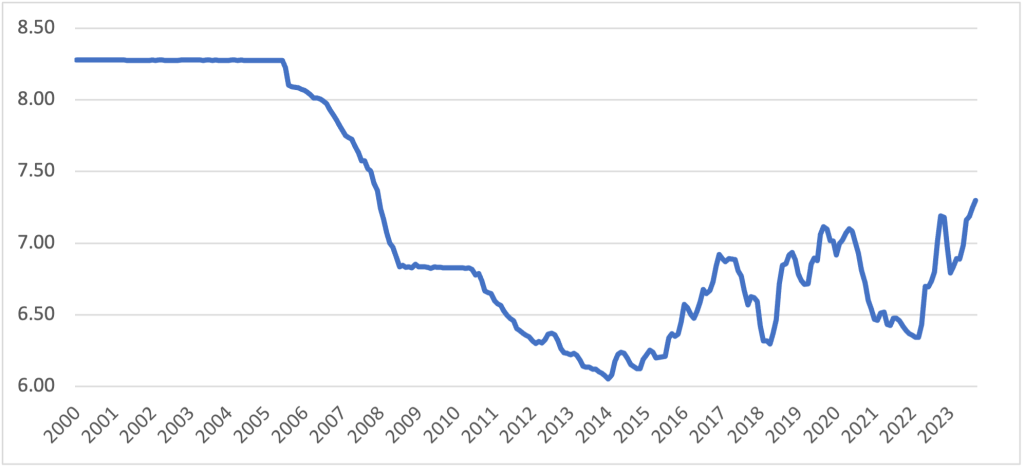
In 2008, China maintained an undervalued peg to the US dollar; the Chinese government artificially devalued the yuan to induce higher exports. As the economy recovered from the Great Recession in 2009 and 2010, the PBOC allowed the Renminbi to appreciate as a “crawling peg”  (Figure 1).

Figure 1 – Chinese Yuan Renminbi to US Dollar Spot Exchange Rate, annually.
Source: Board of Governors of the Federal Reserve System (U.S.).

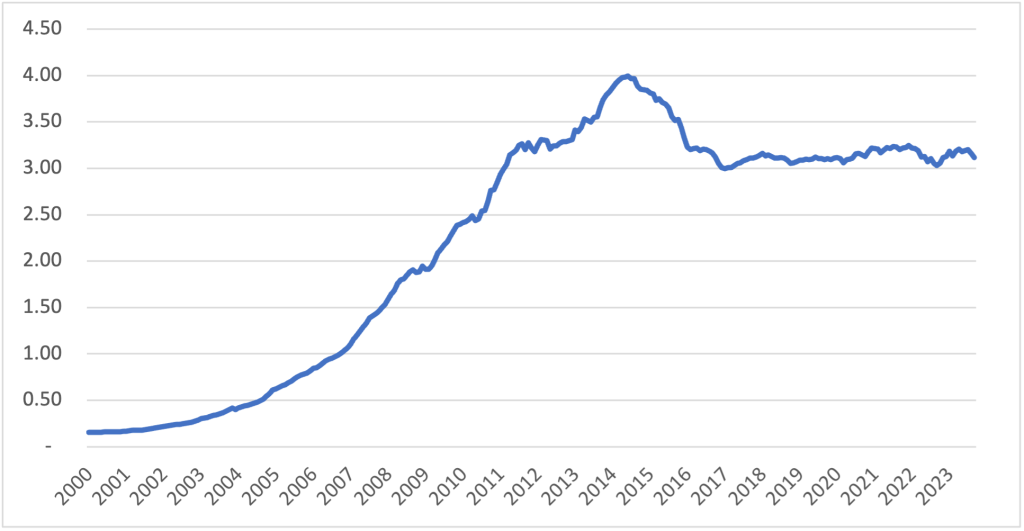
The Chinese currency remained undervalued relative to true market value, its “shadow price,” as the PBOC made massive purchases of foreign currencies, mainly US dollars. Chinese foreign reserves climbed inexorably until the country had accumulated almost USD 4 trillion in June 2014 (Figure 2).

Figure 2 – China Foreign Exchange Reserves (USD trillion)
Source: International Monetary Fund.

Globalized Yuan Aspirations

For the first five years after the great financial crisis, Chinese foreign reserves doubled from USD 2 trillion to 4 trillion. But starting in 2013, the Chinese government generated considerable demand for the yuan by launching the Belt and Road Initiative while quickly selling US dollars. With loans totaling over USD 120 billion, the BRI-backed projects ranged from highways to power plants. From 2000 to 2013, net capital inflows to China averaged USD 800 billion annually and remained at similarly high levels in subsequent years (Figure 2). The Chinese government sought to internationalize the yuan, culminating with the Chinese currency’s inclusion in the Special Drawing Rights (SDR), the IMF’s international reserve asset.[1] China, flush with foreign investment, hoped the yuan would replace the US dollar as the global reserve currency.

Governments are typically faced with a trilemma. They can choose at most two of three policies: monetary policy autonomy, fixed exchange rates, and free capital flows. The United States, Japan, Brazil, and India, among others, maintain monetary policy autonomy and free capital flows but lack a fixed exchange rate regime. Eurozone countries abandoned monetary autonomy (outsourced to the European Central Bank) to create a euro-to-euro peg between their countries and allow money to flow between these economies unimpeded. Historically, China has opted for monetary policy autonomy and a fixed exchange rate with the US dollar (and, later, with several currencies). According to the trilemma, capital should not move freely in and out of the country—that was the reality for Chinese consumers and companies throughout the 2000s due to the country’s strict capital controls.

Pre-2013 trends fueled Chinese global currency aspirations. With demand for the yuan growing rapidly, Chinese authorities pursued yuan internationalization and more free capital markets, ignoring the trilemma. China believed that seemingly infinite reserves would preclude speculative attacks that commonly cause the downfall of governments that try to maintain fixed exchange rate regimes, monetary policy autonomy, and open capital accounts. Authorities thought it impossible that enough capital would leave the Chinese economy to deplete its reserves.

Economic Crisis and China’s Response

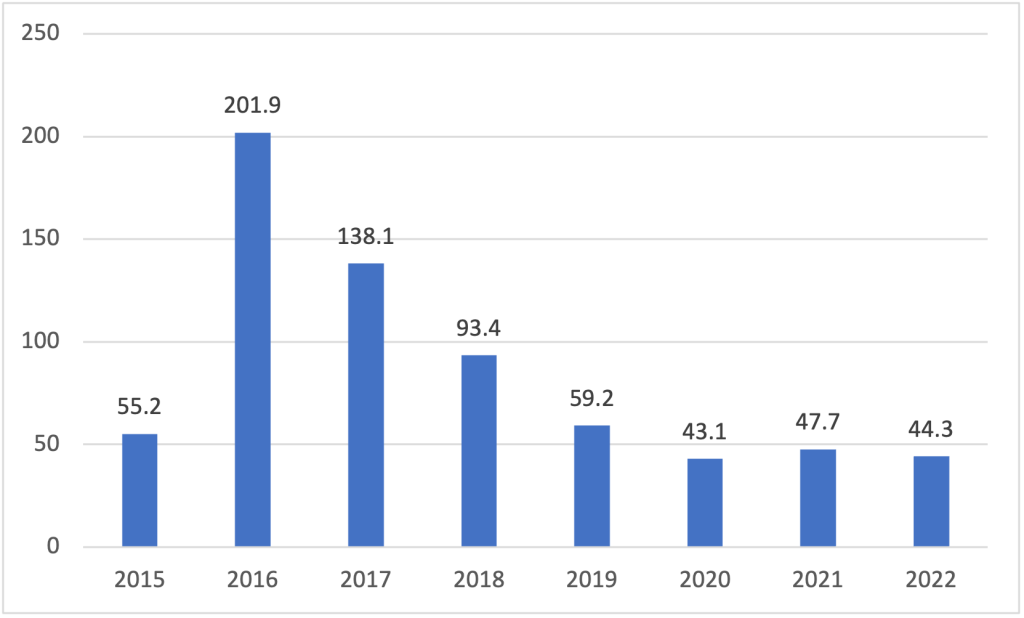
However, in early 2015, the Federal Reserve raised US interest rates for the first time since 2008. Simultaneously, expectations for the Chinese economy turned. A consensus formed that the Chinese economy would suffer a hard landing. Thus, the yuan became overvalued relative to its shadow price. Capital started flowing out of China rapidly, leading to a speculative attack on the currency as investors sold yuan assets. In 2016, households sought to transfer as much money as possible when their limits for sending US dollars to foreign accounts reset. Almost USD 1 trillion left the Chinese economy in 2016. With restrictions on capital outflows lifted and ample credit from local banks, state-owned companies purchased global businesses in deals totaling USD 200 billion. Chinese 2016 outbound mergers and acquisitions (M&A) reached almost four times as large as the previous year (Figure 3). Chinese companies were effectively betting on the yuan’s devaluation by buying foreign businesses. Thus, a speculative attack marred authorities’s intentions of a global Renminbi.

Figure 3 – Outbound M&A deal value by companies from China between 2015 and 2022 (in billions USD)
Source: PWC, 2023.

In August 2016, the PBOC took action against the speculative attack. It allowed the yuan to devalue by over 3 percent daily for two consecutive days but tightened capital controls. In September, the government introduced a 100,000 yuan annual limit on cash withdrawals from foreign ATMs and restricted underground transfers. But most critically, the PBOC tightened capital controls for private and public companies. This caused the value of outbound M&A to fall by 90 percent from 2016 to 2023, as Chinese companies had limited access to debt to finance the acquisition of Western firms.

Nevertheless, Chinese authorities did not simply return to a currency system with a non-volatile exchange rate, tight capital controls, and monetary autonomy. Today, the yuan is much closer to a free-floating currency. Before 2016, the yuan fluctuated little, but it now varies according to the business cycle. For instance, the Chinese currency devalued at the beginning of the 2020 COVID-19 pandemic, appreciated when restrictions in the country eased, and devalued again as Western central banks lifted interest rates (Figure 1). Since the speculative attack in 2016, China’s foreign reserves have remained almost constant at USD 3 trillion (Figure 2). Instead of intervening to keep the yuan under certain thresholds, the PBOC has allowed it to appreciate and depreciate according to the relative amounts of foreign currency entering or leaving China.

After the speculative attack of 2015, the Chinese government changed its currency system, adopting a dirty floating exchange rate system, not the strict peg of the early 2000s. Despite China’s claims that it wants to de-dollarize, the PBOC is unlikely to entirely abandon capital controls. The fear of currency volatility destabilizing the Chinese economy will likely trump the desire of Chinese policymakers to make the yuan a global currency. The speculative attack from individual agents, consumers, and companies ended hopes of a genuine Renminbi standard. It also required Chinese authorities to fundamentally change the BRI. Since 2017, annual BRI disbursements have declined substantially and are now almost exclusively lightly subsidized loans for Chinese companies to build infrastructure in foreign countries. De-dollarization is still a goal, but authorities are handcuffed by their preference for capital controls.

Chinese entities will continue to have to cope with restricted access to foreign currency. Capital controls make local financial markets more resilient to crises but less efficient. Capital controls restrict foreign companies’ routine business operations, such as receiving payments from Chinese customers as well as paying dividends and royalties to Chinese stakeholders. More informed investors will continue to pursue the few avenues for sending money abroad, such as through the Qualified Domestic Institutional Investor (QDII) program. All the energy spent procuring ways to send money abroad saps Chinese productivity.

China’s Strategy Moving Forward

In the past, Chinese authorities believed a global alternative to the dollar system was possible. However, today, China focuses almost exclusively on promoting the yuan through trade. Instead of being paid in US dollars, exporters are paid in their local currency with trade being settled when Chinese importers buy local products. Thus, an Argentinian exporter may be paid in pesos, while a Chinese exporter to Argentina is paid in yuan, bypassing US dollars. Yet, without a commitment to free capital flows, China cannot pursue de-dollarization moving forward. Authorities must take a wait-and-see approach unless economic priorities change.

Presently, de-dollarization is, in essence, a risk management measure for China. The United States can sanction institutions by limiting their ability to access international payments in US dollars, an option no other country shares. (Only Europe and the United Kingdom come close with their abilities to limit transactions in pounds and euros). China’s current stance limits the potential damage to the Chinese economy from possible US sanctions. However, they do not match past de-dollarization goals. Due to the risk posed by potential US sanctions, Chinese authorities should continue to devise measures to limit the dollar’s potential as a weapon if the economic conflict with the United States intensifies. Still, China cannot allow capital to flow entirely freely into its economy without risking another domestic currency crisis.

Rodrigo Zeidan is a Professor of Practice of Business and Finance at NYU Shanghai and an Affiliate Professor at Fundacao Dom Cabral. Professor Zeidan is the author of Economics of Global Business (MIT Press), The General Model of Working Capital Management (Palgrave Macmillan), and five other books. His research has also been published in some of the top journals in finance and economics, such as the Journal of Corporate Finance, Nature Sustainability, Energy Economics, Harvard Business Review, International Journal of Production Economics, and Journal of Business Ethics. His recent research focuses on Sustainable Finance alongside Corporate Finance and Industrial Economics issues. Rodrigo has a biweekly column at Folha de S. Paulo, the largest Brazilian newspaper. He has written extensively for international media outlets, including the New York New Times, CNN, the World Economic Forum, Bloomberg, and Americas Quarterly. Rodrigo is also Associate Editor of the Journal of Economic Surveys, Journal of Sustainable Finance & Investment, and the Brazilian Review of Finance. He holds a position as a Senior Scholar at the Center for Sustainable Business, NYU Stern.

[1] The SDR is not a currency, but its value is based on a basket of five currencies—the US dollar, the euro, the Chinese Renminbi, the Japanese yen, and the British pound sterling.

Image credit: Eric Prouzet via Unsplash.


© 2024 Walsh School of Foreign Service

Georgetown University

Georgetown Journal of International Affairs
ICC 301 · 37th and O Streets
NW Washington, D.C. 20057

https://gjia.georgetown.edu/2024/04/18/de-dollarization-the-belt-and-road-initiative-and-the-future-of-the-chinese-yuan/

The first issue of GJIA was published in the spring of 2000. Since then, GJIA has served as a resource for scholars, business leaders, policy makers, and students of international relations alike, cultivating a dialogue accessible to those with all levels of knowledge about foreign affairs and international politics.


GJIA publishes a peer-reviewed edition sold online, indexed in academic databases, and distributed in bookstores around the country. GJIA also publishes shorter pieces on our website on a rolling basis.

Saturday, 10 February 2024

US Indo-Pacific Allies and Partners Must Remain in the Spotlight

 In the face of an array of competing priorities, the Biden administration scored landmark achievements in its Indo-Pacific defense networks in 2023. But new challenges loom large in 2024.

Alice Nason
Date Published: February 8, 2024
https://gjia.georgetown.edu/2024/02/08/us-indo-pacific-allies-and-partners-must-remain-in-the-spotlight/


Since entering office, the Biden administration has been unwavering in recognizing that US Indo-Pacific allies are a “force multiplier” and the country’s “greatest asset.” Administration officials promised that 2023 would be the most transformative year in US regional force posture in a generation. Though this claim faced heavy skepticism at the time, it was borne out in dramatic increases in the scale and ambition of US defense cooperation.

At the outset of 2024, this article assesses key achievements from last year and obstacles on the horizon. The US standing in the Indo-Pacific improved in 2023, buoyed not only by progress in a spate of security partnerships but also by partners’ increased willingness to collectively confront China’s destabilizing behavior in the region. With ongoing conflicts in Europe and the Middle East and strategic competition in the Indo-Pacific only intensifying, 2024 stands to be a fraught year for US foreign policy. In the face of new pressures, the administration must keep its attention equally trained on the region in 2024.

The role of allies and partners in strategic competition with China

As strategic competition between the United States and China in the Indo-Pacific has intensified, coalition-building efforts have ensued. Though most countries’ cooperation with China is primarily economic, China is also advancing defense partnerships in the region. President Xi Jinping’s Global Security Initiative seeks to build a model of “indivisible security” in the region. In 2023, the People’s Liberation Army (PLA) conducted an array of bilateral exercises with Thailand, Laos, and Cambodia and regular joint patrols of the Mekong with Southeast Asian partners. Beijing sought further cooperation through arms sales and joint naval exercises–including the forthcoming sale of a frigate and a submarine to Thailand and through the multilateral exercise “Peace and Friendship 2023.”

The US Department of Defense acknowledges that it cannot confront strategic adversaries alone and that security threats are best confronted far away from US shores. Its long-standing alliances with Japan, South Korea, the Philippines, Australia, and Thailand underpin all recent strategy documents. These realities are well understood by the public, with more than half of Americans thinking that US alliances with Australia (53 percent) and Japan (52 percent) make the United States more secure. The United States maintains a distinct edge over China in the strength of its regional defense partnerships. The US military conducts 120 exercises annually with partner countries in the region.

The Biden administration’s record on Asia policy in its first two years in office was mixed. Though there were certainly highlight moments for its Indo-Pacific alliances, critics argued that the administration was “struggling to act on its [Indo-Pacific] agenda with the urgency required.” Senior official diplomacy got off to a slow start in Southeast Asia and had an outsized concentration on Europe. The most glaring issue was the administration’s failure to advance a trade policy for the region to compensate for President Trump’s withdrawal from the Trans-Pacific Partnership. Administration officials fortified traditional Indo-Pacific alliances through regular engagement and expanded force posture cooperation,  but ‘heavy lifting’ remained to advance US standing in the region more broadly.

Empowered partners for competitive advantage

In 2023, progress in US Indo-Pacific defense partnerships was substantial and more convincing than any adjacent Chinese efforts. The Biden administration succeeded in three key areas: it modernized its defense partnerships, networked partners through strategic trilateral and multilateral groupings, and empowered its allies to better provide for their national defense. The Biden administration progressed the aims of its Indo-Pacific Strategy by demonstrating closer substantive cooperation with its bilateral defense allies. Two Australia-US Ministerial Meetings led the alliance into previously “uncharted territory” in its force posture cooperation–the continued rotation of US Bomber Task Forces and the future rotational deployment of nuclear-powered submarines stand out as the most advanced efforts. The administration initiated further deployments and additional cooperation on defense technology and defense supply chains with Japan. It strengthened its commitment to the combined defense of the Republic of Korea through the Washington Declaration. The Philippines granted the United States access to four additional bases under the Enhanced Defense Cooperation Agreement. Taken together, these initiatives demonstrate a high degree of trust in partners and a long-term commitment to regional partnership.

Modernization efforts extended beyond traditional allies. The administration also made inroads in the Pacific, signing a major defense pact with Papua New Guinea. India and the United States increasingly demonstrated their alignment, expanding defense industrial cooperation and enhancing interoperability through the India-U.S. Defense Acceleration Ecosystem. President Biden upgraded US-Vietnam relations to a Comprehensive Strategic Partnership in September, a move US officials have long pursued. Biden similarly elevated US-Indonesia relations in November. These moves expanded the regularity and sophistication of US defense cooperation in Southeast Asia.

The administration enriched trilateral and multilateral networks that will further US objectives in the region moving forward. In March, the optimal pathway to implementing the Australia, UK, and US AUKUS partnership on nuclear-powered, conventionally armed submarines was unveiled. If successful, this partnership will further commit the United Kingdom to the region and dramatically increase Australia’s naval capability. AUKUS advanced technologies were trialed for the first time in areas such as cyber security, electronic warfare, and information sharing. President Biden hosted Japanese Prime Minister Fumio Kishida and South Korean President Yoon Suk-yeol at Camp David for a historic summit, demonstrating a previously unattainable degree of alignment. The Trilateral Strategic Dialogue with Japan and Australia was also strengthened–most recently, with the expansion of trilateral defense cooperation to include unmanned aerial vehicles. In October, Japan invited Australia to join two regular command post-military exercises it holds with the United States.

The above commitments have breathed life into more coordinated US regional force posture and defense cooperation in 2024. The National Defense Authorization Act signed in December 2023 authorized $14.7 billion for the Pacific Deterrence Initiative and extended it through fiscal year 2024. However, with an enormous and growing list of defense cooperative initiatives and a limited capacity, implementation remains daunting.

Winning the competition for ideas

To be successful in strategic competition, the United States must win a competition of ideas in the Indo-Pacific. The shift in regional partners’ perceptions of the importance of the rules-based order and the risks posed by China was perhaps the Biden administration’s greatest success in 2023. Many experts lamented the administration’s heavy-handed emphasis on championing democratic values in its early months in office. This approach neglected regional dynamics and alienated prospective partners in Southeast Asia and the South Pacific, many of whom are not democracies or, like the Philippines and Thailand, are experiencing democratic regression.

By framing threats to regional stability in terms of state sovereignty and freedom from coercion in 2023, the Biden administration spoke to the region in terms it understands. In 2023, key documents like the 2023 Quad Leaders’ Statement and the most recent Australia-United States Ministerial Consultation (AUSMIN) joint statement focused on “sovereignty,” “territorial integrity,” and freedom from coercion, values that are prized across the region. Shortly after, however, China violated these norms, as Chinese vessels continuously blocked, fired water cannons at, and rammed Filipino ships on resupply missions to Filipino forces at Second Thomas Shoal. China also harassed Malaysian and Vietnamese vessels in their Exclusive Economic Zones (EEZ). Either due to more artful US messaging or China’s behavior, US Indo-Pacific partners vocally critiqued Chinese behavior for threatening regional peace and stability.

More frequent efforts by US partners to cooperate independent of the United States represented another critical development in 2023. Japanese Prime Minister Kishida and South Korean President Yoon are engaging bilaterally on shared concerns for their strategic environment. For the first time, an Indian submarine visited Australia’s port HMAS Stirling, and Australia, Indonesia, and India conducted a trilateral sail. Most credit for this growing convergence of US coalition partners has been given to Xi Jinping’s behavior in causing regional instability. Regardless, these developments are undoubtedly beneficial for US interests.

Avoiding self-sabotage in 2024

Competing for influence in the Indo-Pacific has become a bipartisan priority in an otherwise divided US Congress. The Freedom Caucus, which exercises significant influence in the House and has been hostile to US commitments in other regions, has collectively recognized the importance of succeeding in strategic competition with China. Altogether, political factions  agree on the priority placed on Asia–the greatest question now surrounds the urgency of implementation.

Dysfunction in the US Congress throughout the year is a troubling reminder that domestic politics are the greatest determinant of US objectives in Asia. Delays in the passage of the National Defense Authorization Act left spectators concerned about the future of key enablers of US defense cooperation in the Indo-Pacific. Both sides of the aisle are committed to a firm Asia strategy, but costly commitments far away from the mainland United States are always vulnerable to public scrutiny. US Indo-Pacific strategy hangs in the balance of the US presidential election in 2024.

Trade, already the weakest component of US engagement in Asia, is the policy area with the most tenuous prospects. Former President Trump, the probable Republican nominee, has sworn that the Indo-Pacific Economic Framework (IPEF), the only trade-related initiative the Biden administration has advanced to the region, would be “dead on day one.” With free trade lacking support at the political level among both Democrats and Republicans, pursuing an economic agenda attractive to Indo-Pacific partners will be difficult. In 2023, the Biden administration abandoned the digital trade negotiations of both the World Trade Organization and IPEF without pursuing an alternate solution. For US ambitions of presence and influence in Asia to be realized to the fullest extent, the victor in 2024 must marry its defense cooperation with tangible economic initiatives.

The Biden administration has strengthened its Indo-Pacific alliances and partnerships. To win over a region historically skeptical of US commitment, the US must continue to engage with the Indo-Pacific. Developing AUKUS advanced technologies must be one such priority. Whether Biden substantiates agreements negotiated in 2023 and produces tangible outcomes in the lead-up to his re-election will test his administration’s resolve. For the administration to sustain the hard-won momentum in its regional partnerships, it must provide the right economic levers and continue to reach out to unaligned states.

Alice Nason is a Research Associate in the Foreign Policy and Defence Program at the United States Studies Centre. She is also a Councillor at the Australian Institute of International Affairs. Her research focuses on US Indo-Pacific strategy and Australian foreign and defense policy, with a focus on AUKUS and diplomatic statecraft.

Image Credit: Agenzia Nova

https://gjia.georgetown.edu/2024/02/08/us-indo-pacific-allies-and-partners-must-remain-in-the-spotlight/


 2024 Walsh School of Foreign Service

Georgetown University

Friday, 19 January 2024

Afghan-Sino Relations: A Different Mindset. A Different Outcome?

Both economic and security measures are crucial to reducing Islamic extremism in Afghanistan. While Chinese economic measures offer hope for financial growth and regional stability, terrorist acts continue to endanger China. China’s strategy toward Afghanistan varies from the US approach. The Chinese approach could lead to the economic uplifting of the masses in Afghanistan and subsequent reductions in terrorism and extremism through cooperation with the Taliban.

Veena Ramachandran & Amit Kumar
Date Published: January 17, 2024
https://gjia.georgetown.edu/2024/01/17/afghan-sino-relations-a-different-mindset-a-different-outcome/


Introduction

For two decades, the Taliban and other rebel organizations have been the target of US and North Atlantic Treaty Organization (NATO) military operations in Afghanistan. China has never participated in operations such as the International Security Assistance Force (ISAF). However, China has contributed significantly to Afghanistan’s economic growth, reconstruction, and reconciliation attempts. Almost every nation withdrew their embassies and personnel during the US exit from Afghanistan and Taliban takeover in August 2021, but China was the sole exception.

Beijing has taken a different approach than the United States to managing Afghanistan. Beijing seeks to maintain the stability-security paradigm of Xinjiang by neutralizing the Uyghur militants on Afghan soil before they plan operations against the Beijing government and aggravate the already fragile Xinjiang. Beijing is also intrigued by the vast unexplored mineral wealth in Afghanistan. Indeed, China is particularly intrigued by the rare earth minerals that are necessary in burgeoning industries such as semiconductors. Afghanistan also represents an appealing market for Chinese goods. China’s approach to Afghanistan promises to yield better results than that of the United States, as China promotes the political stability and economic progress in Afghanistan that all sides support.

Contrasting Mindsets

Since September 11, 2001, the United States has maintained a significant presence in Afghanistan. Following NATO’s overthrow of the Taliban regime, NATO troops have engaged in a prolonged counterinsurgency operation against Al-Qaeda and the Taliban. With over 100,000 American troops deployed at the height of the conflict, the United States made significant political and military investments in Afghanistan, providing billions of dollars in aid to the Afghan government to train Afghan forces and equip them with arms and ammunition. The United States has also provided aid to international humanitarian organizations working on the ground in Afghanistan. The United States focused primarily on fighting terrorism with bullets and boots on the ground while reconstructing Afghanistan based on democratic ideals–reestablishing civil and political rights for the locals. The United States had effectively remodeled Afghanistan based on American values and principles.

Washington’s strategy sought to prevent Afghanistan from becoming a terrorist launchpad. A stable, self-sustaining democratic government has been the American vision for Afghanistan. To realize this vision, America promoted democratic institutions like free and fair elections and a free press. The continuous turmoil and unrest that followed Afghanistan’s capture by the Taliban in 2021, however, obstructs the values that America had attempted to impose, rendering the two-decade-long effort largely ineffective. The mission to integrate all the components of Afghan society into one powerful, self-sufficient, and prosperous nation was not successful. The ineffectiveness of Afghanistan’s democratic government was evidenced by its inability to withstand the force of the Taliban for even a single day following US withdrawal.

In contrast, China kept itself militarily aloof, contributing to Afghanistan’s attempts to rebuild and strengthen its economy. Beijing prioritized commerce and its national security, refusing to meddle with the Afghan interim government. Afghanistan has received substantial financial aid from China, including investments in infrastructure initiatives such as roads, trains, and power plants. The China-Afghanistan-Pakistan Economic Corridor of 2016, which aims to increase commerce and investment in Afghanistan, is one such example. China follows a unique strategy of boosting the Afghan economy, which could eventually influence Afghan politics in the long run. Per the Chinese calculation, the population of Afghanistan will be lured away from extremism and terrorism when economic prosperity reaches the poorest socio-economic segment of the population. According to Einar Tangen, a China Global Television Network political and economic affairs commentator, once Afghans experience a secure, prosperous, and peaceful existence, they will never return to the paths of terrorism.

China’s Afghanistan Engagement Strategy

China’s diplomatic engagement helps gain the trust of the newly formed Afghan interim government, assuring them that Beijing’s policy does not seek to destabilize but rather assist in consolidating and strengthening Afghan national security.  By doing so, China promotes its national interest by safeguarding Xinjiang’s vulnerable society from terrorism and extremism, limiting its spread to the Af-Pak region, and neutralizing it with Taliban and Pakistan’s support. Independent of NATO, China seeks to shape regional counterterrorism efforts with regional actors’ support and protect its Belt and Road Initiatives (BRI) in the region. China is concerned about the possibility of violence and unrest in Afghanistan spreading to the Xinjiang province. China’s covert and diplomatic outreach to the Taliban both before and after Kabul’s fall demonstrates China’s astute foreign policy judgment. Beijing perceives the Taliban as competent, recognizing its importance in controlling regional terrorist organizations and neutralizing anti-Taliban and anti-China terror groups such as the Islamic State of Khorasan. The growth of the Islamic State of Khorasan Province (ISKP) in the Af-Pak region presents Uyghur militants with a new base of operations, enabling the province and militants to assist each other in accomplishing their agendas. This symbiotic relationship threatens China, its workforce abroad, and the internal stability of Xinjiang.

As a part of its BRI, which aims to increase China’s economic and geopolitical power over the region, China is forging business relations with the Taliban. A stable Afghanistan will offer China a reliable land connection to Iran and the rest of the Middle East. Hence, Afghanistan is Beijing’s first move in securing the Middle Eastern market and streamlining its energy transit. The cash-strapped Taliban government, under sanctions, has agreed with China and Pakistan to expand the China-Pakistan Economic Corridor (CPEC) to Afghanistan, attracting billions for infrastructure investment. China’s economic involvement includes investments in mineral exploitation worth over $1 trillion. The Xinjiang Central Asia Petroleum and Gas Company (CAPEIC) recently signed a $540 million oil and gas deal. Chinese company Gochin also offered to invest $10 billion in Afghanistan’s lithium mining industry, which is valued at $1 trillion. In a recent Aljazeera documentary, Professor Wang Duanyong of Shanghai International Studies University, who leads research on China’s overseas investment, emphasized the importance of Chinese companies respecting Afghanistan’s local laws, customs, and culture. Professor Wang is also an investor in China Town Kabul, which recently signed a $200 million contract with the Afghan Ministry of Land. The company is currently scouting potential locations for a new metropolis designed to accommodate 3 million people and foster factories and commerce. China’s strategy is limited to government-to-government negotiations without meddling in Afghan politics. Chinese investment plans and development initiatives in various economic sectors across Afghanistan are poised to generate capital assets, create local employment opportunities, and empower the lower economic strata, contributing to the promotion of peace and prosperity. This aligns with Rashid Dostum’s perspective, the former Vice President of Afghanistan, who argues that the United States made two critical mistakes during its twenty-year occupation. The first error was attempting to enforce centralized, democratic governance on a nation with a unique political and cultural background. Dostum suggests that more attention should have been directed towards enhancing the livelihoods of rural Afghans, utilizing the country’s abundant mines, oil, and gas resources. He contends that preventing mass emigration by providing jobs and addressing basic needs would have paved the way for the organic development of democracy.

Different Outcomes

The US approach to negotiating peace in Afghanistan faced several hurdles due to its liberal agenda enforcement and high levels of corruption among the Afghan administrators themselves. In contrast, Beijing distanced itself from the political structures in place. In its peace agenda, it highlighted the value of regional economic growth to foster peace and stability. Following the Doha Agreement 2020, China recognized the Taliban’s power and quickly stepped up several secret talks, realizing that the Taliban would gain significant influence in the current power structure or perhaps entirely overthrow it. China’s diplomatic foresight helped to forge positive ties with the Taliban with both sides respecting each other’s needs.

The Taliban wanted investment, international legitimacy, and votes to join multilateral organizations from China. Chinese investments would revive the Taliban’s economy and provide crucial infrastructure support. The Taliban could then use Afghanistan’s abundant lithium and cobalt reserves as a negotiating chip to further its own international political and economic goals. On the other hand, Beijing wished for security assurances in its northwestern frontiers, the neutralization and deportation of any Uyghur militants planning terror attacks, and the elimination of any terrorist groups, such as the ISKP, becoming more sympathetic to the Uyghurs. Beyond security measures, Afghanistan’s mineral reserves hold strategic value for Beijing. China seeks to strengthen its position in the global minerals supply chain by exploiting Kabul’s abundant mineral resources, particularly cobalt, lithium, and rare earth metals. The acquisition of these resources would bolster China’s dominance in battery storage technology, providing them with a competitive advantage over the West. Consequently, China’s diplomatic engagements with the Taliban are primarily focused on safeguarding their security and economic interests without interfering in the day-to-day operations of the Afghan government. This approach ensures the protection of China’s interests both at home and abroad.

Conclusion

In their approaches to Afghanistan, the United States and China diverge significantly. The United States had a political-militaristic strategy and made significant political changes to Afghanistan’s governance structure and institutions. However, large US grants and aid only enriched Afghan politicians and their close associates; the ordinary Afghan populace did not benefit. It is also difficult to discern if the general populace was ready to accept this softening of rigid Islamic and tribal customs brought about by the gradual introduction of Western values.

China, meanwhile, has prioritized diplomacy and economic growth. The Chinese presence and influence have progressively increased due to the void left by America’s withdrawal of its military from Afghanistan last year. China’s strategy is top-down with a precise focus on economic benefit to both itself and Afghanistan–while also serving the security interests of Beijing. Chinese investments in heavy industries, factories, and commercial estates could lead to the development of local jobs and prosperity for the lowest rungs of the Afghan economic pyramid. Financially empowering society’s lower strata would bring peace and prosperity. As society advances, it will be empowered to demand a more effective government.

Ultimately, Afghanistan’s future depends on ties with its neighbors, including China, India, and Central Asian nations. China’s approach in this regard is not that of a rival superpower but rather one centered on promoting mutual growth and defense. Under this strategy, the Taliban would be strengthened and consolidated as a powerful government that could reduce terrorism in China while enhancing its citizens’ quality of life. This strategy could deliver Afghanistan the stability that all sides support.

Amit Kumar is a doctoral candidate at the Birla Institute of Technology and Science, in Pilani, India. In addition, he is an Adjunct Researcher at The MirYam Institute in New York. He also works for The Defence Horizon Journal in Austria as an Associate Editor.

Dr Veena Ramachandran is an Assistant Professor at the Department of Humanities and Social Sciences, Birla Institute of Technology and Science, Rajasthan, India. Her specialization is in China Studies.

Image Credit: flickr

https://gjia.georgetown.edu/2024/01/17/afghan-sino-relations-a-different-mindset-a-different-outcome/


 2024 Walsh School of Foreign Service

Georgetown University

Sunday, 24 December 2023

A “Floor” for US-China Relations in 2024: Insights on the Biden-Xi Summit from Professor Dennis Wilder

US President Joe Biden and Chinese President Xi Jinping convened on November 15th, 2023 during the Asia-Pacific Economic Cooperation (APEC) conference in San Francisco. The Biden-Xi summit marks a pivotal moment amid the recent shifts in United States-China relations, ranging from the Chinese spy balloon incident in February and the Biden administration’s high-profile visits to China over the summer.

 Professor Dennis Wilder (MSFS’79), a former Special Assistant to the President and the Senior Director for East Asian Affairs at the White House’s National Security Council, joins GJIA to discuss the key takeaways of the Biden-Xi summit and the state of US-China relations.

Dennis Wilder
Date Published: December 22, 2023

https://gjia.georgetown.edu/2023/12/22/a-floor-for-us-china-relations-in-2024-insights-on-the-biden-xi-summit-from-professor-dennis-wilder/


GJIA: Could you share with us some of the key takeaways from the Biden-Xi summit?

DW: You know, the Chinese love to say that we need “win-win cooperation.” In this case, there was “win-win” on both sides. Let me explain.

For the Biden administration, one of the most important things that they needed to get out of this summit was an agreement on fentanyl and fentanyl precursors. If you’ve been following this story, it is the largest killer of eighteen to forty-five-year-old Americans today. We have to find a way to stop these chemicals from coming into the United States, and companies in China are directly responsible for getting those precursors to Mexico, where gangs make them into pills. We hadn’t been able to get the Chinese to shut this down because of how bad relations had been. But at the summit, Xi Jinping agreed to shut it down. And we are already seeing steps taken to do so by the Chinese. Secondly, the United States wanted to restart its military-to-military relationship with the Chinese, which had been shut down because of Nancy Pelosi’s visit to Taiwan last August. Eight different military-to-military communications had been shut down, but the Chinese agreed to restore two, and they’re important ones. It’s not a complete restoration yet, but it is a step in the right direction. Hopefully, such communications with China will help the United States avoid incidents at sea or incidents in the air. As you may know, there have been some unsafe and worrying activities by Chinese aircraft and ships.

On the Chinese side, what Xi Jinping wanted most out of this visit was respect. He wanted a great visit to San Francisco and a first-class welcome by the American people. If you looked at the atmospherics, he got a lot of what he wanted. First of all, the meeting was at a grand estate where scenes from the popular nighttime television soap opera Dynasty had been filmed. President Biden did several things that were very personal. Biden remembered that Madam Peng’s birthday was the week of the visit, the same day as Biden’s, and he said something to Xi about it. He also showed him on his phone a picture of Xi Jinping, when he visited as a young man, standing near the Golden Gate Bridge. Even as they were leaving, [Biden] went out and complimented Xi Jinping on his armored car saying, “Wow, what a vehicle you’ve got.” Biden then pointed out that what we call “The Beast”, the American presidential vehicle, was not as sleek as the Chinese vehicle. The second part that was important to Xi Jinping was a big dinner in San Francisco with all of the kingpins of American industry, including Elon Musk, Tim Cook, Steve Schwarzman, and others. To sit at the head table, you had to pay $40,000 a person. If you just wanted to sit at one of the regular tables, you had to pay $2,000. Xi Jinping received several standing ovations during his speech. Chinese Central TV portrayed Xi Jinping as taking San Francisco by storm. You almost didn’t know that there was an APEC summit or any foreign leader there other than Xi Jinping. It was overwhelmingly a Xi Jinping show. It was a show of the Americans paying him the respect the Chinese leader believed was due. Overall, I think both sides gained a lot.

GJIA: How do you perceive the interplay between strategic competition and collaboration in US-China relations evolving in the near future?

DW: One of my friends said, “Before this summit, we had competition; after this summit, hopefully, we have competition with communication.” You have to understand why this summit was so important. Looking ahead to 2024, President Biden will be campaigning for the presidential election the whole year. There is almost no chance that he would go to Asia during the year, as no president has done so in an election year. He’s not going to do a return trip to Beijing; he’s not going to the ASEAN events; he’s not going to go to any of the other summitry that will take place in Asia. Similarly, Xi Jinping is not going to be invited to Washington because the issue of Chinese relations is so fraught in American politics that it would be political suicide for Biden to make that invitation. 2024 poses a challenge with two major events that could disrupt US-China relations, and they are the bookends. On the front end, you have the Taiwan election in January. On the back end, you have the American election in November.

The Taiwan election, depending on who wins, could be very disruptive to relations across the strait and therefore to US-China relations. In the past, we’ve had Taiwan presidents like Ma Ying-jeou who were very accommodating to China, and things ran relatively well. Then, we had Chen Shui-bian, who made very inflammatory statements that disrupted cross-strait relations and consequently US-China relations.

Similarly, with US elections, you’ve already seen the Republicans hitting very hard. They have bemoaned “zombie engagement” with the Chinese, in which the United States has been sending several cabinet officials to China for little in return. We’re going to get more heated rhetoric on China during the year; there’s no question about it. Obviously, the Chinese aren’t going to like that. They’re pretty thin-skinned about criticism, so the American election will likely disrupt relations with the United States. I see this meeting as a firewall against 2024. The significance lies less in the agreements made than in the effort to put a floor under the relationship just through 2024.

GJIA: In what ways could the re-opening of some military-to-military dialogue between the United States and China influence both regional and global security?

DW: Okay, not to get too technical, because when you get into these military talks, they get very complicated, but let me explain. The two dialogues that were reopened were at working levels. One of them is called the Military Maritime Consultative Agreement (MMCA). It’s a maritime agreement, where Navy-to-Navy operators get together on the Chinese and American sides to discuss how to avoid incidents in the air and in the South China Sea, East China Sea, and so forth. The MMCA is not meant to be strategic but rather a tactical process to ensure the safety of ships and planes operating in close proximity. The other restored dialogue is the Defense Policy Coordination Talks (DPT). Again, these are discussions at a lower bureaucratic level and not at a senior strategic level. The third thing that was put back in place is the hotline between the US commander in the Indo-Pacific and China’s Eastern Theater Command (who is in charge of Taiwan). This hotline ensures that if an incident in Taiwan occurs, the US Indo-Pacific commander can talk to his counterpart in charge of that situation. I think that once the Chinese have picked a new defense minister, they will open that channel with Secretary Lloyd Austin. This is all important, but what hasn’t been restored are strategic discussions between the US military and China. Senior US officials at the Office of the Secretary of Defense, for example, used to have dialogues with their Chinese counterparts. Those talks have been suspended since Speaker Nancy Pelosi visited Taiwan in August 2022. So far, the Chinese haven’t indicated that they’re willing to reopen those dialogues.

GJIA: In October, the United States accused China of conducting a centralized and concerted campaign of harassment against US and allied aircrafts. How concerned are you about the possibility of an escalation in tensions? Do you believe the recent Biden-Xi meeting has reduced these concerns?

DW: It was very disturbing to read the Department of Defense (DoD) report. Previously, some of us weren’t sure whether these pilots were simply hot-dogging on their own or they had instructions. The DoD report is now saying that this is a Chinese national policy and that Chinese pilots have been instructed to make unsafe flights. Well, that is a little scary. We’re hoping to see, in the wake of the meeting, that there are new orders sent out to these pilots to not conduct such unsafe flights. A troubling event occurred recently when an Australian navy ship stopped in international waters to clear some fishing nets from its rudders and propellers. The Australians had sent divers into the water to cut the net away before a Chinese navy vessel came up close. Though the vessel was warned away because of the divers, it came close and used its massive sonar system on the boat. The problem with that is when you send a sonar signal out like that and there are divers in the water, it can harm their hearing. So, the Australians immediately had to pull those divers out of the water. If such incidents continue, I’m afraid that the United States will need to have a very real discussion with the Chinese about why they think this is appropriate behavior because it doesn’t follow any of the international norms that have long been established.

GJIA: During the opening remarks of the Biden-Xi summit, President Xi stated that “Earth is big enough for the United States and China to succeed.” How do you interpret this statement in the context of the current global challenges?

DW: I was very interested in that statement, perhaps in a way you might not think. In the past, I remember Xi Jinping would say that the “Pacific” is big enough for both of us. But when he says, “The globe is big enough,” it suggests to me that he sees China as a global superpower and that he is no longer thinking regionally. We’ve seen China try to position itself as a leader in the global South, very much international.

I think Xi Jinping is trying to say that we don’t need to worry about competing with each other and that we can find cooperation. The Chinese are very disturbed that the United States uses the term competition to describe their relationship. Because in China’s view—which I think is a very different view from the view Americans have—competition means somebody wins and somebody loses. Somebody gets the medal, and somebody doesn’t. Americans think of competition in a different way. Americans believe that when they compete in school and other places, all of us become better. These are two very different views of the world. When Xi says we can share the world, it means, “Hey, we don’t need to be competitors. We can cooperate.”

This transcript has been lightly edited for clarity and length.

Interview conducted by Andy Xu Sofia.

Dennis Wilder is a Professor and Senior Fellow for the Initiative for US-China Dialogue on Global Issues at Georgetown University, where he previously served as the managing director. Prior to this, he served as the Deputy Assistant Director for East Asia and the Pacific for the Central Intelligence Agency from 2015 to 2016. He also was the former Special Assistant to the President and Senior Director for East Asian Affairs at the White House’s National Security Council from 2005 to 2009.

Image Credit: Ethnic Media Services

https://gjia.georgetown.edu/2023/12/22/a-floor-for-us-china-relations-in-2024-insights-on-the-biden-xi-summit-from-professor-dennis-wilder/


 2024 Walsh School of Foreign Service

Georgetown University

Most Recent Post

Man charged for borrowing rare Chinese manuscripts from UCLA library, returning fakes

  Suspect Jeffrey Ying allegedly travelled to China after checking works out using several aliases Agence France-Presse Published: 12:11pm, ...

Popular Posts - Last 30 days