Showing posts with label Defence. Show all posts

Thursday, 5 June 2025

U.S. Aircraft Carriers “Sitting Ducks” For Chinese Hypersonic Missiles; Is Pete Hegseth Hyping Chinese Threat?


The US Defense Secretary Pete Hegseth has reignited the debate about the safety of the US Navy’s massive aircraft carriers in the face of China’s burgeoning hypersonic missile arsenal. He contends that hypersonic missiles could sink all US aircraft carriers within minutes of a potential conflict.

However, this prognosis contradicts the evidence gathered from the sinking of the only supercarrier ever.

Hegseth’s remarks from an interview have been in the spotlight, where he claimed that China has been building its military prowess for the sole purpose of defeating the US. The arsenal of Hypersonic Missiles is an essential piece in their quest to achieve supremacy over the US, whose power is projected beyond its borders through aircraft carriers.

“So, if our whole power projection platform is aircraft carriers, and the ability to project power that way strategically around the globe. And, yeah, we have a nuclear triad and all that, but [carriers are] a big part of it. And if 15 hypersonic missiles can take out our 10 aircraft carriers in the first 20 minutes of a conflict, what does that look like?” he said in an interview that has recently surfaced.

The defense secretary’s comments have been gaining attention lately, and defense experts have been contending that the US aircraft carrier strike groups have limited defenses against hypersonic missiles.

Trump Sends F-16 Fighting Falcons To Ukraine! There’s A Catch, These Combat Jets Don’t Fly! Here’s Why


Missile attack on an aircraft carrier. AI image.

Globally, the race to develop hypersonic weapons is intensifying. China is touted by the US Department of Defense as the world leader in hypersonic technology, having surpassed the US and Russia in developing both conventional and nuclear-capable hypersonic weapons.

Hypersonic missiles fly at least five times the speed of sound and can change course in flight, challenging defense systems on US Navy ships, especially its floating air bases.

According to a recent intelligence leak, the People’s Liberation Army successfully tested its DF-27 intermediate-range ballistic missile with a hypersonic glide vehicle in 2023, enabling it to effortlessly breach missile defense systems.

According to the 2023 China Military Power Report, the DF-17 HGV-armed medium-range ballistic missile “will transform the PLA’s missile force.” Although it can carry nuclear weapons, it is designed for conventional missions.

“Big Threat” To U.S. Passenger Jets As Nearly One Million Drones Fly In The Country; U.S. Could Use Laser Weapons To Disable Them

Thursday, 18 July 2024

Premier Cho reiterates US ties after Trump remarks

 CHIPS AND DEFENSE: Trump said the US had lost its chip business and Taipei should pay it for defense, and added that ‘we’re no different than an insurance company’

  • By Jake Chung / Staff writer, with CNA and Bloomberg
  • Thu, Jul 18, 2024 page1
  • https://www.taipeitimes.com/News/front/archives/2024/07/18/2003820956


Taiwan-US relations are solid, and both sides are in agreement that peace and stability in the Taiwan Strait and the Indo-Pacific region are everyone’s concern, Premier Cho Jung-tai (卓榮泰) said yesterday following comments by former US president Donald Trump that Taiwan “should pay” for US defense.

Taiwan is thankful to the US for supporting Taiwan’s bid to participate in international organizations, Cho told a news conference in Taipei.

“I know the people very well, respect them greatly. They did take about 100 percent of our chip business,” Trump told Bloomberg on June 25 in an interview that was published on Tuesday.

“I think Taiwan should pay us for defense,” Trump added. “You know, we’re no different than an insurance company. Taiwan doesn’t give us anything.”

In the long run, the continuation of policies demonstrating that Taiwan is shouldering the responsibility of being a part of the international community would win it the support of more nations, Cho said.

Taiwan occupies a critical position in the high-tech supply chain, and while manufacturing is spread around the world, research and development would remain in Taiwan, Cho said when asked about the government’s response if Trump were to return to the White House and demand that Taipei relocate research and development to the US.

Republican presidential nominee Donald Trump gestures on the second day of the 

Republican National Convention. Trump has called into question US support for Taiwan.

Photo: EPA


The TAIEX closed nearly 1 percent lower yesterday. Taiwan Semiconductor Manufacturing Co (台積電), the most heavily weighted firm on the index, declined 2.4 percent ahead of its scheduled second-quarter earnings release today after adding more than 9 percent this month through Tuesday.

The Ministry of Foreign Affairs declined to comment on the remarks of the presumptive Republican candidate for the US presidential election on Nov. 5.

The next administration enters the White House in January next year.

Trump is to accept his party’s nomination at the Republican National Convention today.

Democratic Progressive Party caucus secretary-general Rosalia Wu (吳思瑤) said she could not comment on Trump’s interview.

US-Taiwan relations are built on solid foundations of equal and mutually beneficial development in military, economic and cultural interactions, Wu said.

The public should take note of Trump’s running mate, J.D. Vance, who has repeatedly stated that the US would do its best to bolster interactions with Taiwan across all sectors instead of focusing on Trump’s one comment, she added.

Pegatron chairman Tung Tzu-hsien (童子賢) said that Taiwan should refrain from commenting on US elections and should respect the democratic systems of other nations.

Instead of focusing on campaign talk in the US, Taiwan should instead make sure that whoever is elected would continue to understand the importance of Taiwan and its role as a benign and contributing member of the international community, Tung said.

Taiwan People’s Party Legislator Huang Kuo-chang (黃國昌) said that Trump’s comments were understandable, as he is still on the campaign trail and is focused on delivering the message that he is all about US interests.

President William Lai’s (賴清德) administration must clarify how it intends to handle Taiwan-US ties after the US elections, Huang said.

Trump’s comments clearly indicate that relations between countries cannot continue if one side is perpetually giving, he added.

https://www.taipeitimes.com/News/front/archives/2024/07/18/2003820956

Saturday, 10 February 2024

US Indo-Pacific Allies and Partners Must Remain in the Spotlight

 In the face of an array of competing priorities, the Biden administration scored landmark achievements in its Indo-Pacific defense networks in 2023. But new challenges loom large in 2024.

Alice Nason
Date Published: February 8, 2024
https://gjia.georgetown.edu/2024/02/08/us-indo-pacific-allies-and-partners-must-remain-in-the-spotlight/


Since entering office, the Biden administration has been unwavering in recognizing that US Indo-Pacific allies are a “force multiplier” and the country’s “greatest asset.” Administration officials promised that 2023 would be the most transformative year in US regional force posture in a generation. Though this claim faced heavy skepticism at the time, it was borne out in dramatic increases in the scale and ambition of US defense cooperation.

At the outset of 2024, this article assesses key achievements from last year and obstacles on the horizon. The US standing in the Indo-Pacific improved in 2023, buoyed not only by progress in a spate of security partnerships but also by partners’ increased willingness to collectively confront China’s destabilizing behavior in the region. With ongoing conflicts in Europe and the Middle East and strategic competition in the Indo-Pacific only intensifying, 2024 stands to be a fraught year for US foreign policy. In the face of new pressures, the administration must keep its attention equally trained on the region in 2024.

The role of allies and partners in strategic competition with China

As strategic competition between the United States and China in the Indo-Pacific has intensified, coalition-building efforts have ensued. Though most countries’ cooperation with China is primarily economic, China is also advancing defense partnerships in the region. President Xi Jinping’s Global Security Initiative seeks to build a model of “indivisible security” in the region. In 2023, the People’s Liberation Army (PLA) conducted an array of bilateral exercises with Thailand, Laos, and Cambodia and regular joint patrols of the Mekong with Southeast Asian partners. Beijing sought further cooperation through arms sales and joint naval exercises–including the forthcoming sale of a frigate and a submarine to Thailand and through the multilateral exercise “Peace and Friendship 2023.”

The US Department of Defense acknowledges that it cannot confront strategic adversaries alone and that security threats are best confronted far away from US shores. Its long-standing alliances with Japan, South Korea, the Philippines, Australia, and Thailand underpin all recent strategy documents. These realities are well understood by the public, with more than half of Americans thinking that US alliances with Australia (53 percent) and Japan (52 percent) make the United States more secure. The United States maintains a distinct edge over China in the strength of its regional defense partnerships. The US military conducts 120 exercises annually with partner countries in the region.

The Biden administration’s record on Asia policy in its first two years in office was mixed. Though there were certainly highlight moments for its Indo-Pacific alliances, critics argued that the administration was “struggling to act on its [Indo-Pacific] agenda with the urgency required.” Senior official diplomacy got off to a slow start in Southeast Asia and had an outsized concentration on Europe. The most glaring issue was the administration’s failure to advance a trade policy for the region to compensate for President Trump’s withdrawal from the Trans-Pacific Partnership. Administration officials fortified traditional Indo-Pacific alliances through regular engagement and expanded force posture cooperation,  but ‘heavy lifting’ remained to advance US standing in the region more broadly.

Empowered partners for competitive advantage

In 2023, progress in US Indo-Pacific defense partnerships was substantial and more convincing than any adjacent Chinese efforts. The Biden administration succeeded in three key areas: it modernized its defense partnerships, networked partners through strategic trilateral and multilateral groupings, and empowered its allies to better provide for their national defense. The Biden administration progressed the aims of its Indo-Pacific Strategy by demonstrating closer substantive cooperation with its bilateral defense allies. Two Australia-US Ministerial Meetings led the alliance into previously “uncharted territory” in its force posture cooperation–the continued rotation of US Bomber Task Forces and the future rotational deployment of nuclear-powered submarines stand out as the most advanced efforts. The administration initiated further deployments and additional cooperation on defense technology and defense supply chains with Japan. It strengthened its commitment to the combined defense of the Republic of Korea through the Washington Declaration. The Philippines granted the United States access to four additional bases under the Enhanced Defense Cooperation Agreement. Taken together, these initiatives demonstrate a high degree of trust in partners and a long-term commitment to regional partnership.

Modernization efforts extended beyond traditional allies. The administration also made inroads in the Pacific, signing a major defense pact with Papua New Guinea. India and the United States increasingly demonstrated their alignment, expanding defense industrial cooperation and enhancing interoperability through the India-U.S. Defense Acceleration Ecosystem. President Biden upgraded US-Vietnam relations to a Comprehensive Strategic Partnership in September, a move US officials have long pursued. Biden similarly elevated US-Indonesia relations in November. These moves expanded the regularity and sophistication of US defense cooperation in Southeast Asia.

The administration enriched trilateral and multilateral networks that will further US objectives in the region moving forward. In March, the optimal pathway to implementing the Australia, UK, and US AUKUS partnership on nuclear-powered, conventionally armed submarines was unveiled. If successful, this partnership will further commit the United Kingdom to the region and dramatically increase Australia’s naval capability. AUKUS advanced technologies were trialed for the first time in areas such as cyber security, electronic warfare, and information sharing. President Biden hosted Japanese Prime Minister Fumio Kishida and South Korean President Yoon Suk-yeol at Camp David for a historic summit, demonstrating a previously unattainable degree of alignment. The Trilateral Strategic Dialogue with Japan and Australia was also strengthened–most recently, with the expansion of trilateral defense cooperation to include unmanned aerial vehicles. In October, Japan invited Australia to join two regular command post-military exercises it holds with the United States.

The above commitments have breathed life into more coordinated US regional force posture and defense cooperation in 2024. The National Defense Authorization Act signed in December 2023 authorized $14.7 billion for the Pacific Deterrence Initiative and extended it through fiscal year 2024. However, with an enormous and growing list of defense cooperative initiatives and a limited capacity, implementation remains daunting.

Winning the competition for ideas

To be successful in strategic competition, the United States must win a competition of ideas in the Indo-Pacific. The shift in regional partners’ perceptions of the importance of the rules-based order and the risks posed by China was perhaps the Biden administration’s greatest success in 2023. Many experts lamented the administration’s heavy-handed emphasis on championing democratic values in its early months in office. This approach neglected regional dynamics and alienated prospective partners in Southeast Asia and the South Pacific, many of whom are not democracies or, like the Philippines and Thailand, are experiencing democratic regression.

By framing threats to regional stability in terms of state sovereignty and freedom from coercion in 2023, the Biden administration spoke to the region in terms it understands. In 2023, key documents like the 2023 Quad Leaders’ Statement and the most recent Australia-United States Ministerial Consultation (AUSMIN) joint statement focused on “sovereignty,” “territorial integrity,” and freedom from coercion, values that are prized across the region. Shortly after, however, China violated these norms, as Chinese vessels continuously blocked, fired water cannons at, and rammed Filipino ships on resupply missions to Filipino forces at Second Thomas Shoal. China also harassed Malaysian and Vietnamese vessels in their Exclusive Economic Zones (EEZ). Either due to more artful US messaging or China’s behavior, US Indo-Pacific partners vocally critiqued Chinese behavior for threatening regional peace and stability.

More frequent efforts by US partners to cooperate independent of the United States represented another critical development in 2023. Japanese Prime Minister Kishida and South Korean President Yoon are engaging bilaterally on shared concerns for their strategic environment. For the first time, an Indian submarine visited Australia’s port HMAS Stirling, and Australia, Indonesia, and India conducted a trilateral sail. Most credit for this growing convergence of US coalition partners has been given to Xi Jinping’s behavior in causing regional instability. Regardless, these developments are undoubtedly beneficial for US interests.

Avoiding self-sabotage in 2024

Competing for influence in the Indo-Pacific has become a bipartisan priority in an otherwise divided US Congress. The Freedom Caucus, which exercises significant influence in the House and has been hostile to US commitments in other regions, has collectively recognized the importance of succeeding in strategic competition with China. Altogether, political factions  agree on the priority placed on Asia–the greatest question now surrounds the urgency of implementation.

Dysfunction in the US Congress throughout the year is a troubling reminder that domestic politics are the greatest determinant of US objectives in Asia. Delays in the passage of the National Defense Authorization Act left spectators concerned about the future of key enablers of US defense cooperation in the Indo-Pacific. Both sides of the aisle are committed to a firm Asia strategy, but costly commitments far away from the mainland United States are always vulnerable to public scrutiny. US Indo-Pacific strategy hangs in the balance of the US presidential election in 2024.

Trade, already the weakest component of US engagement in Asia, is the policy area with the most tenuous prospects. Former President Trump, the probable Republican nominee, has sworn that the Indo-Pacific Economic Framework (IPEF), the only trade-related initiative the Biden administration has advanced to the region, would be “dead on day one.” With free trade lacking support at the political level among both Democrats and Republicans, pursuing an economic agenda attractive to Indo-Pacific partners will be difficult. In 2023, the Biden administration abandoned the digital trade negotiations of both the World Trade Organization and IPEF without pursuing an alternate solution. For US ambitions of presence and influence in Asia to be realized to the fullest extent, the victor in 2024 must marry its defense cooperation with tangible economic initiatives.

The Biden administration has strengthened its Indo-Pacific alliances and partnerships. To win over a region historically skeptical of US commitment, the US must continue to engage with the Indo-Pacific. Developing AUKUS advanced technologies must be one such priority. Whether Biden substantiates agreements negotiated in 2023 and produces tangible outcomes in the lead-up to his re-election will test his administration’s resolve. For the administration to sustain the hard-won momentum in its regional partnerships, it must provide the right economic levers and continue to reach out to unaligned states.

Alice Nason is a Research Associate in the Foreign Policy and Defence Program at the United States Studies Centre. She is also a Councillor at the Australian Institute of International Affairs. Her research focuses on US Indo-Pacific strategy and Australian foreign and defense policy, with a focus on AUKUS and diplomatic statecraft.

Image Credit: Agenzia Nova

https://gjia.georgetown.edu/2024/02/08/us-indo-pacific-allies-and-partners-must-remain-in-the-spotlight/


 2024 Walsh School of Foreign Service

Georgetown University

Saturday, 3 September 2022

US approves $1.1bn Taiwan arms sale, angering China

 The US has agreed to sell $1.1bn (£955m) in weaponry to Taiwan, provoking anger from China.

3 September 2022

https://www.bbc.com/news/world-us-canada-62775544

The US has agreed to sell $1.1bn (£955m) in weaponry to Taiwan, provoking anger from China.

The proposed deal includes a radar system to track incoming strikes and anti-ship and anti-air missiles.

It comes after US House of Representatives Speaker Nancy Pelosi last month became the most senior US official in 25 years to visit Taipei.

The Chinese embassy in Washington called on the US to revoke the deal or face "counter-measures".

Spokesman Liu Pengyu said the deal "severely jeopardises" relations between Washington and Beijing.

"China will resolutely take legitimate and necessary counter-measures in light of the development of the situation," he added.

Beijing sees the self-ruled island as a part of its territory and insists it should be unified with the mainland, by force if necessary.

It launched large-scale military drills around Taiwan last month, following the American delegation's visit.

The US arms sale agreed on Friday still needs to be voted on by the strongly pro-Taiwan US Congress.

The package includes a $655m radar warning system and $355m for 60 Harpoon missiles, which are capable of sinking ships.

It includes $85.6m for Sidewinder surface-to-air and air-to-air missiles, according to the Pentagon's Defense Security Cooperation Agency.

A spokesperson for the Department of State said the deal was "essential for Taiwan's security", and called on Beijing "to cease its military, diplomatic and economic pressure against Taiwan and instead engage in meaningful dialogue".

"These proposed sales are routine cases to support Taiwan's continuing efforts to modernise its armed forces and to maintain a credible defensive capability," the spokesperson said.

The Pentagon last month created a task force to help streamline the sale of American weaponry to foreign allies, the Wall Street Journal reported on Friday.

US lawmakers say that orders placed by Taiwan years ago have gone unfulfilled. Among the backlog are Harpoon and Stinger missiles, which have been sent to Ukraine instead, according to Defense News.

In another move likely to irk Beijing, the Biden administration said it would keep in place for now billions of dollars in tariffs on Chinese imports that were enacted during the Trump administration.

The US Trade Representative's office said it had received requests to maintain the 2018-19 duties from businesses and other interested parties.

US officials had been considering revoking the tariffs, citing the need to ease inflation.

On Friday, meanwhile, President Joe Biden asked Congress to approve $13.7bn in emergency funding for Ukraine, amid the ongoing war with Russia.

The Pentagon said last week that total US military aid to Ukraine had already topped $13bn.

https://www.bbc.com/news/world-us-canada-62775544

Monday, 25 July 2022

Chinese-made Huawei equipment could disrupt US nuclear arsenal communications: CNN Exclusive: FBI investigation determined


Updated 2012 GMT (0412 HKT) July 25, 2022


 Washington (CNN)On paper, it looked like a fantastic deal. In 2017, the Chinese government was offering to spend $100 million to build an ornate Chinese garden at the National Arboretum in Washington DC. Complete with temples, pavilions and a 70-foot white pagoda, the project thrilled local officials, who hoped it would attract thousands of tourists every year.   

  
But when US counterintelligence officials began digging into the details, they found numerous red flags. The pagoda, they noted, would have been strategically placed on one of the highest points in Washington DC, just two miles from the US Capitol, a perfect spot for signals intelligence collection, multiple sources familiar with the episode told CNN.  
Also alarming was that Chinese officials wanted to build the pagoda with materials shipped to the US in diplomatic pouches, which US Customs officials are barred from examining, the sources said.    
Federal officials quietly killed the project before construction was underway.    The Wall Street Journal first reported about the security concerns in 2018.      
The canceled garden is part of a frenzy of counterintelligence activity by the FBI and other federal agencies focused on what career US security officials say has been a dramatic escalation of Chinese espionage on US soil over the past decade.        
Since at least 2017, federal officials have investigated Chinese land purchases near critical infrastructure, shut down a high-profile regional consulate believed by the US government to be a hotbed of Chinese spies and stonewalled what they saw as clear efforts to plant listening devices near sensitive military and government facilities.    
Among the most alarming things the FBI uncovered pertains to Chinese-made Huawei equipment atop cell towers near US military bases in the rural Midwest. According to multiple sources familiar with the matter, the FBI determined the equipment was capable of capturing and disrupting highly restricted Defense Department communications, including those used by US Strategic Command, which oversees the country's nuclear weapons.
While broad concerns about Huawei equipment near US military installations have been well known, the existence of this investigation and its findings have never been reported. Its origins stretch back to at least the Obama administration. It was described to CNN by more than a dozen sources, including current and former national security officials, all of whom spoke on condition of anonymity because they were not authorized to speak publicly.  
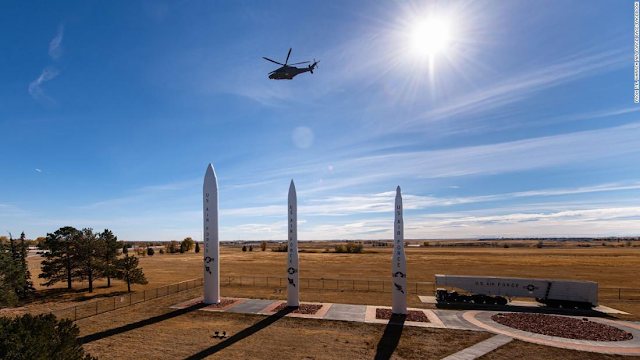
F.E. Warren Air Force Base, a strategic missile base, is located in Cheyenne, Wyoming, an area near a host of cell towers using Huawei equipment.

It's unclear if the intelligence community determined whether any data was actually intercepted and sent back to Beijing from these towers. Sources familiar with the issue say that from a technical standpoint, it's incredibly difficult to prove a given package of data was stolen and sent overseas.   
The Chinese government strongly denies any efforts to spy on the US. Huawei in a statement to CNN also denied that its equipment is capable of operating in any communications spectrum allocated to the Defense Department. 
But multiple sources familiar with the investigation tell CNN that there's no question the Huawei equipment has the ability to intercept not only commercial cell traffic but also the highly restricted airwaves used by the military and disrupt critical US Strategic Command communications, giving the Chinese government a potential window into America's nuclear arsenal.  
"This gets into some of the most sensitive things we do," said one former FBI official with knowledge of the investigation. "It would impact our ability for essentially command and control with the nuclear triad. "That goes into the 'BFD' category."      
"If it is possible for that to be disrupted, then that is a very bad day," this person added.     

Turning doves into hawks

Former officials described the probe's findings as a watershed moment. The investigation was so secret that some senior policymakers in the White House and elsewhere in government weren't briefed on its existence until 2019, according to two sources familiar with the matter.      
That fall, the Federal Communications Commission initiated a rule that effectively banned small telecoms from using Huawei and a few other brands of Chinese made-equipment. "The existence of the investigation at the highest levels turned some doves into hawks," said one former US official.     
In 2020, Congress approved $1.9 billion to remove Chinese-made Huawei and ZTE cellular technology across wide swaths of rural America.       
But two years later, none of that equipment has been removed and rural telecom companies are still waiting for federal reimbursement money. The FCC received applications to remove some 24,000 pieces of Chinese-made communications equipment—but according to a July 15 update from the commission, it is more than $3 billion short of the money it needs to reimburse all eligible companies.
Absent more money from Congress, the FCC says it plans to begin reimbursing approved companies for about 40 percent of the costs of removing Huawei equipment. The FCC did not specify a timeframe on when the money will be disbursed.
In late 2020, the Justice Department referred its national security concerns about Huawei equipment to the Commerce Department, and provided information on where the equipment was in place in the US, a former senior US law enforcement official told CNN.
After the Biden administration took office in 2021, the Commerce Department then opened its own probe into Huawei to determine if more urgent action was needed to expunge the Chinese technology provider from US telecom networks, the former law enforcement official and a current senior US official said.
That probe has proceeded slowly and is ongoing, the current US official said. Among the concerns that national security officials noted was that external communication from the Huawei equipment that occurs when software is updated, for example, could be exploited by the Chinese government.
Depending on what the Commerce Department finds, US telecom carriers could be forced to quickly remove Huawei equipment or face fines or other penalties.
Reuters first reported the existence of the Commerce Department probe.
"We cannot confirm or deny ongoing investigations, but we are committed to securing our information and communications technology and services supply chain. Protecting US persons safety and security against malign information collection is vital to protecting our economy and national security," a Commerce Department spokesperson said.

Inside Huawei's connection to rural America 02:55
US counterintelligence officials have recently made a priority of publicizing threats from China. This month, the US National Counterintelligence and Security Center issued a warning to American businesses and local and state governments about what it says are disguised efforts by China to manipulate them to influence US policy.
FBI Director Christopher Wray just traveled to London for a joint meeting with top British law enforcement officials to call attention to the Chinese threats.
In an exclusive interview with CNN, Wray said the FBI opens a new China counterintelligence investigation every 12 hours. "That's probably about 2,000 or so investigations," said Wray. "And that's not even talking about their cyber theft, where they have a bigger hacking program than that of every other major nation combined, and have stolen more of Americans' personal and corporate data than every nation combined."
Asked why after years of national security concerns raised over Huawei, the equipment is still largely in place atop cell towers near US military bases, Wray said that, "We're concerned about allowing any company that is beholden to a nation state that doesn't adhere to and share our values, giving that company the ability to burrow into our telecommunications infrastructure."
He noted that in 2020, the DOJ indicted Huawei with racketeering conspiracy and conspiracy to steal trade secrets.
"And I think that's probably about all I can say on the topic," said Wray.

Critics see xenophobic overreach

Despite its tough talk, the US government's refusal to provide evidence to back up its claims that Huawei tech poses a risk to US national security has led some critics to accuse it of xenophobic overreach. The lack of a smoking gun also raises questions of whether US officials can separate legitimate Chinese investment from espionage.   
"All of our products imported to the US have been tested and certified by the FCC before being deployed there," Huawei said in its statement to CNN. "Our equipment only operates on the spectrum allocated by the FCC for commercial use. This means it cannot access any spectrum allocated to the DOD." 
"For more than 30 years, Huawei has maintained a proven track record in cyber security and we have never been involved in any malicious cyber security incidents," the statement said.  
In its zeal to sniff out evidence of Chinese spying, critics argue the feds have cast too wide a net — in particular as it relates to academic institutions. In one recent high-profile case, a federal judge acquitted a former University of Tennessee engineering professor whom the Justice Department had prosecuted under its so-called China Initiative that targets Chinese spying, arguing "there was no evidence presented that [the professor] ever collaborated with a Chinese university in conducting NASA-funded research."      
And on Jan. 20, the Justice Department dropped a separate case against an MIT professor accused of hiding his ties to China, saying it could no longer prove its case. In February, the Biden administration shut down the China Initiative entirely.   
The federal government's reticence across multiple administrations to detail what it knows has led some critics to accuse the government of chasing ghosts.   
"It really comes down to: do you treat China as a neutral actor — because if you treat China as a neutral actor, then yeah, this seems crazy, that there's some plot behind every tree," said Anna Puglisi, a senior fellow at Georgetown University's Center for Security and Emerging Technology. "However, China has shown us through its policies and actions it is not a neutral actor."    

Chinese tech in the American heartland

As early as the Obama administration, FBI agents were monitoring a disturbing pattern along stretches of Interstate 25 in Colorado and Montana, and on arteries into Nebraska. The heavily trafficked corridor connects some of the most secretive military installations in the US, including an archipelago of nuclear missile silos.        
For years, small, rural telecom providers had been installing cheaper, Chinese-made routers and other technology atop cell towers up and down I-25 and elsewhere in the region. Across much of these sparsely populated swaths of the west, these smaller carriers are the only option for cell coverage. And many of them turned to Huawei for cheaper, reliable equipment.        
Beginning in late 2011, Viaero, the largest regional provider in the area, inked a contract with Huawei to provide the equipment for its upgrade to 3G. A decade later, it has Huawei tech installed across its entire fleet of towers, roughly 1,000 spread over five western states.   
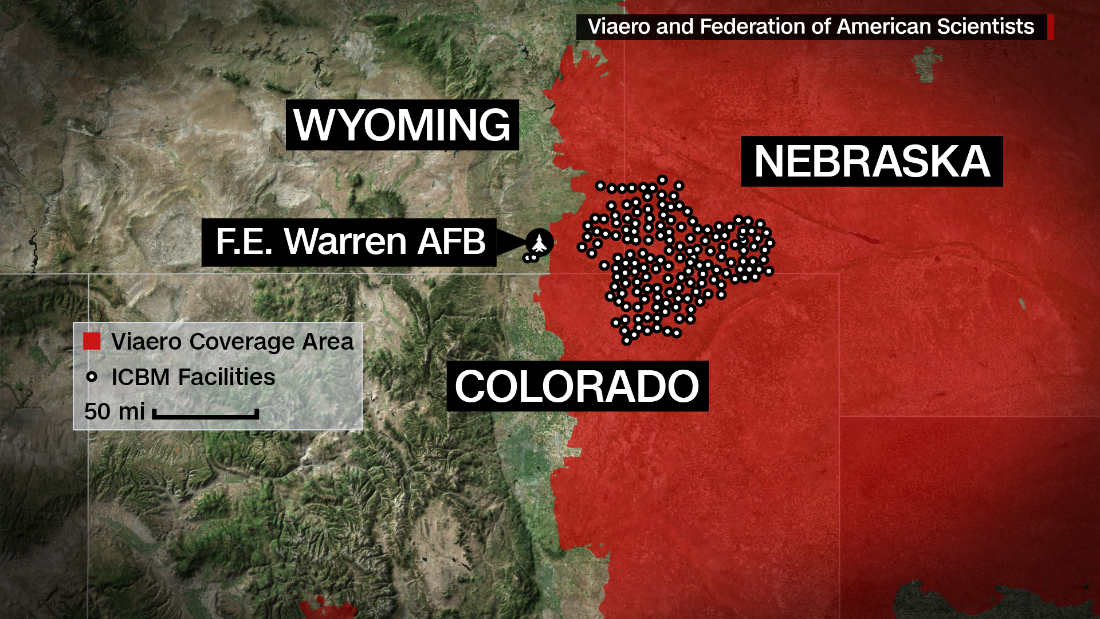

As Huawei equipment began to proliferate near US military bases, federal investigators started taking notice, sources familiar with the matter told CNN. Of particular concern was that Huawei was routinely selling cheap equipment to rural providers in cases that appeared to be unprofitable for Huawei — but which placed its equipment near military assets.      
Federal investigators initially began "examining [Huawei] less from a technical lens and more from a business/financial view," explained John Lenkart, a former senior FBI agent focused on counterintelligence issues related to China. Officials studied where Huawei sales efforts were most concentrated and looked for deals that "made no sense from a return-on-investment perspective," Lenkart said.    
"A lot of [counterintelligence] concerns were uncovered based on" those searches, Lenkart said.   
By examining the Huawei equipment themselves, FBI investigators determined it could recognize and disrupt DOD-spectrum communications — even though it had been certified by the FCC, according to a source familiar with the investigation.  
"It's not technically hard to make a device that complies with the FCC that listens to nonpublic bands but then is quietly waiting for some activation trigger to listen to other bands," said Eduardo Rojas, who leads the radio spectrum lab at Embry-Riddle Aeronautical University in Florida. "Technically, it's feasible." 
To prove a device had clandestine capabilities, Rojas said, would require technical experts to strip down a device "to the semi-conductor level" and "reverse engineer the design." But, he said, it can be done.   
And there was another big concern along I-25, sources familiar with the investigation said.

Weather camera worries 

Around 2014, Viaero started mounting high-definition surveillance cameras on its towers to live-stream weather and traffic, a public service it shared with local news organizations. With dozens of cameras posted up and down I-25, the cameras provided a 24-7 bird's eye view of traffic and incoming weather, even providing advance warning of tornadoes.      
But they were also inadvertently capturing the movement of US military equipment and personnel, giving Beijing — or anyone for that matter — the ability to track the pattern of activity between a series of closely guarded military facilities.    
The intelligence community determined the publicly posted live-streams were being viewed and likely captured from China, according to three sources familiar with the matter. Two sources briefed on the investigation at the time said officials believed that it was possible for Beijing's intelligence service to "task" the cameras — hack into the network and control where they pointed. At least some of the cameras in question were running on Huawei networks.    
Viaero CEO Frank DiRico said it never occurred to him the cameras could be a national security risk.         
"There's a lot of missile silos in areas we cover. There is some military presence," DiRico said in an interview from his Colorado office. But, he said, "I was never told to remove the equipment or to make any changes."  
In fact, DiRico first learned of government concerns about Huawei equipment from newspaper articles — not the FBI — and says he has never been briefed on the matter.    
DiRico doesn't question the government's insistence that he needs to remove Huawei equipment, but he is skeptical that China's intelligence services can exploit either the Huawei hardware itself or the camera equipment.      
"We monitor our network pretty good," DiRico said, adding that Viaero took over the support and maintenance for its own networks from Huawei shortly after installation. "We feel we've got a pretty good idea if there's anything going on that's inappropriate."  

Scouring the country for Chinese investments 

By the time the I-25 investigation was briefed to the White House in 2019, counterintelligence officials begin looking for other places Chinese companies might be buying land or offering to develop a piece of municipal property, like a park or an old factory, sometimes as part of a "sister city" arrangement. 
In one instance, officials shut down what they believed was a risky commercial deal near highly sensitive military testing installations in Utah sometime after the beginning of the I-25 investigation, according to one former US official. The military has a test and training range for hypersonic weapons in Utah, among other things. Sources declined to provide more details.        
Federal officials were also alarmed by what  sources described as a host of espionage and influence activities in Houston and, in 2020, shut down the Chinese  consulate there.     
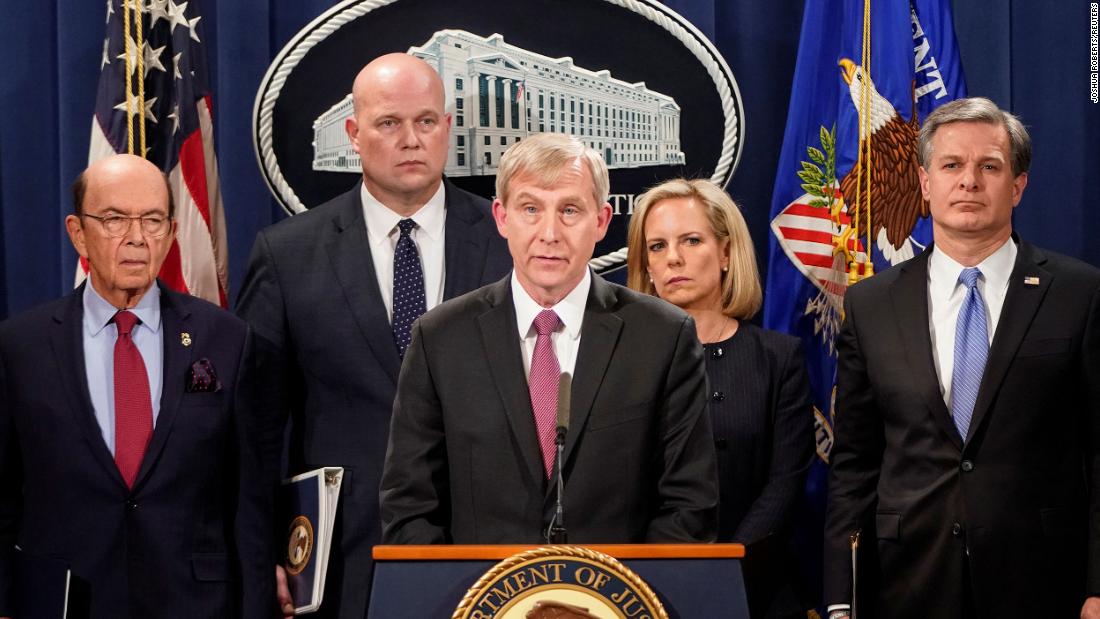
US Attorney for the Eastern District of New York Richard P. Donoghue announcing indictments against China's Huawei Technologies Co Ltd, several of its subsidiaries and its chief financial officer Meng Wanzhou on January 28, 2019.
Bill Evanina, who until early last year ran the National Counterintelligence and Security Center, told CNN that it can sometimes be hard to differentiate between a legitimate business opportunity and espionage — in part because both might be happening at the same time.       
"What we've seen is legitimate companies that are three times removed from Beijing buy [a given] facility for obvious logical reasons, unaware of what the [Chinese] intelligence apparatus wants in that parcel [of land]," Evanina said. "What we've seen recently — it's been what's underneath the land."       
"The hard part is, that's legitimate business, and what city or town is not going to want to take that money for that land when it's just sitting there doing nothing?" he added.   

A complicated problem

After the results of the I-25 investigation were briefed to the Trump White House in 2019, the FCC ordered that  telecom companies who receive federal subsidies to provide cell service to remote areas — companies like Viaero — must "rip and replace" their Huawei and ZTE equipment.      
The FCC has since said that the cost could be more than double the $1.9 billion appropriated in 2020 and absent an additional appropriation from Congress, the agency is only planning to reimburse companies for a fraction of their costs.  
Given the staggering strategic risk, Lenkart said, "rip and replace is a very blunt and inefficient remediation."     
DiRico, the CEO of Viaero, said the cost of "rip and replace" is astronomical and that he doesn't expect the reimbursement money to be enough to pay for the change. According to the FCC, Viaero is expected to receive less than half of the funding it is actually due. Still, he expects to start removing the equipment within the next year.     
"It's difficult and it's a lot of money," DiRico said.        
Some former counterintelligence officials expressed frustration that the US government isn't providing more granular detail about what it knows to companies — or to cities and states considering a Chinese investment proposal. They believe that not only would that kind of detail help private industry and state and local governments understand the seriousness of the threat as they see it, but also help combat the criticism that the US government is targeting Chinese companies and people, rather than Chinese state-run espionage.      
"This government has to do a better job of letting everyone know this is a Communist Party issue, it's not a Chinese people issue," Evanina said. "And I'll be the first to say that the government has to do better with respect to understanding the Communist Party's intentions are not the same intentions of the Chinese people."        
A current FBI official said the bureau is giving more defensive briefings to US businesses, academic institutions and state and local governments that include far more detail than in the past, but officials are still fighting an uphill battle.    
"Sometimes I feel like we're a lifeguard going out to a drowning person, and they don't want our help," said the current FBI official.  But, this person said, "I think sometimes we [the FBI] say 'China threat,' and we take for granted what all that means in our head. And it means something else to the people that we're delivering it to."    
"I think we just need to be more careful about how we speak about it and educate folks on why we're doing what we're doing."   
In the meantime, the "rip and replace" program has remained fiercely controversial.    
"It's not going to be easy," DiRico said. "I'm going to be up nights worrying about it, but we'll do what we're told to do."   

Most Recent Post

Man charged for borrowing rare Chinese manuscripts from UCLA library, returning fakes

  Suspect Jeffrey Ying allegedly travelled to China after checking works out using several aliases Agence France-Presse Published: 12:11pm, ...

Popular Posts - Last 30 days