Showing posts with label De-dollarization. Show all posts

Friday, 8 November 2024

Can BRICS Break the Dollar’s Grip? The Global Shift Toward De-Dollarization

 For over eight decades, the U.S. dollar has held a dominant position as the world’s leading reserve currency, shaping global finance under the mantle of US dollar hegemony. 


Written by   5:40 pm

https://colitco.com/brics-de-dollarization-global-shift/


However, an emerging alliance of nations under the BRICS banner—Brazil, Russia, India, China, and South Africa—is not just questioning this supremacy but actively seeking to reshape the international financial structure, making it less reliant on the greenback. The 2024 BRICS summit was a testament to this determination, as it heavily focused on exploring pathways to a multipolar world in currency and trade.

At the summit in Johannesburg, Russian President Vladimir Putin declared that the momentum toward “de-dollarization” is both “irreversible” and accelerating. BRICS leaders, including Brazilian President Luiz Inacio Lula da Silva, emphasised the need for options beyond the dollar—a sentiment resonating with developing economies across the Global South as they seek independence from the dollar-centric system.

Economic Sanctions and Rising Interest Rates Spur De-Dollarization

The push for alternatives is not new, but recent geopolitical developments have intensified this drive. Economic sanctions against Russia over the Ukraine conflict, including freezing foreign reserves and limitations on SWIFT access, spotlighted the vulnerabilities inherent in dollar dependency. China, too, has faced sanctions through restrictions on semiconductor exports, which further motivates Beijing to secure its global financial stance through other means, including boosting renminbi influence.

“The US’s weaponisation of the dollar in sanctions has triggered a wave of interest in alternative currencies for trade and investment,” said Shirley Ze Yu, a senior visiting fellow at the London School of Economics. Rising U.S. interest rates, which have escalated the cost of dollar-denominated debt for developing nations, have added urgency to the search for other currencies, particularly for countries like Brazil and South Africa.

Could a BRICS Common Currency Become a Reality? Experts Express Doubt

Some speculate that BRICS+ members, which could potentially include other emerging economies, might introduce a shared currency as an alternative to the dollar. A proposed BRICS common currency pegged to a basket of BRICS-member currencies or gold has captured the imagination, but experts remain sceptical.

Gustavo de Carvalho, a South African Institute of International Affairs policy analyst, described the currency as a “long-term goal at best.” According to Danny Bradlow, a professor at the University of Pretoria, a BRICS currency would require extensive institutional support and common economic values—challenging to achieve given the diverse economic landscapes of BRICS countries. Chris Weafer, a strategic analyst, argued that such a currency could end up dominated by China’s massive economy, making smaller economies hesitant to relinquish their monetary autonomy. These potential challenges underscore the complexity of the de-dollarization process.

Local Currencies Gain Traction in Bilateral Trade

For now, BRICS is promoting local currencies in bilateral trade. Russia and China, for instance, now primarily trade in rubles or yuan, and India and the UAE have begun to settle transactions in rupees. This move offers some protection from dollar dependency but introduces practical challenges, such as limited currency convertibility.

“The use of local currencies is promising but challenging,” said Weafer. “Each country would need to hold reserves in their partner’s currency, and challenges like India’s capital controls make this difficult.” This complexity underscores the appeal of a more integrated BRICS financial system while highlighting the existing barriers.

Dollar to Remain King—For Now

Despite these efforts, experts agree that dethroning the dollar will be a long journey. Weafer estimates that any serious challenge to the dollar’s dominance remains “decades away.” Even if BRICS+ adopts a shared currency, it will face significant competition from the dollar, which remains the benchmark for global commodities.

South African BRICS ambassador Anil Sooklal emphasised that BRICS does not aim to replace the dollar but offers alternative options. The Pan-African Payment and Settlement System, which facilitates trade within Africa outside of SWIFT, is an example of the multipolar vision BRICS leaders advocate for.

While the BRICS expansion continues to build momentum, the dollar’s liquidity and established infrastructure keep it firmly at the centre of global finance. The drive for a multipolar system may be underway. However, meaningful shifts away from the dollar will likely unfold gradually, over a long period of time. The greenback will maintain its influential role in the foreseeable future, and any significant challenge to its dominance remains ‘decades away.’

https://colitco.com/brics-de-dollarization-global-shift/

Monday, 22 July 2024

De-dollarization, the Belt and Road Initiative, and the Future of the Chinese Yuan

 For a while, the globalization of the yuan seemed inevitable. In this article, we explore the recent developments regarding the Chinese currency, showing how the speculative attack of 2016 has shifted the priorities of Chinese authorities. Instead of a full-blown de-dollarization strategy and Belt and Road Initiative, China now focuses on developing cross-border yuan-denominated trade settlement systems. State-owned companies have a limited ability to purchase foreign companies as in the past, and the government has stopped making voluminous loans to poor countries; China now pursues tight controls over capital outflows and a slightly more volatile Renminbi.

Rodrigo Zeidan
Date Published: April 18, 2024

https://gjia.georgetown.edu/2024/04/18/de-dollarization-the-belt-and-road-initiative-and-the-future-of-the-chinese-yuan/


Introduction

China no longer seeks a global yuan due to the actions of state-owned companies and Chinese individuals moving money abroad. In 2013, the Belt and Road Initiative (BRI) was organized to expel US dollars from the Chinese economy and limit the need for market interventions. However, Chinese state-owned companies initiated a speculative attack that forced the hand of the People’s Bank of China (PBOC). Chinese authorities propped up capital markets, restricting households that sought to move capital overseas. Meanwhile, the United States has increasingly weaponized the global greenback, and the increasing threat of US sanctions has limited the options of Chinese policymakers.

Central to the yuan’s future is whether China will attempt to de-dollarize the global economy or merely hedge against potential US sanctions. China is constrained to the latter for the next few years. Attempting to de-dollarize would require China to maintain free capital markets. However, lessons from 2015 suggest that doing so would risk another financial crisis in China. Still, China should continue to build central bank agreements for cross-border trade settlements in Renminbi to counteract the US dollar’s sanctioning power.

Strict Capital Controls Post-2008

In 2008, China maintained an undervalued peg to the US dollar; the Chinese government artificially devalued the yuan to induce higher exports. As the economy recovered from the Great Recession in 2009 and 2010, the PBOC allowed the Renminbi to appreciate as a “crawling peg”  (Figure 1).

Figure 1 – Chinese Yuan Renminbi to US Dollar Spot Exchange Rate, annually.
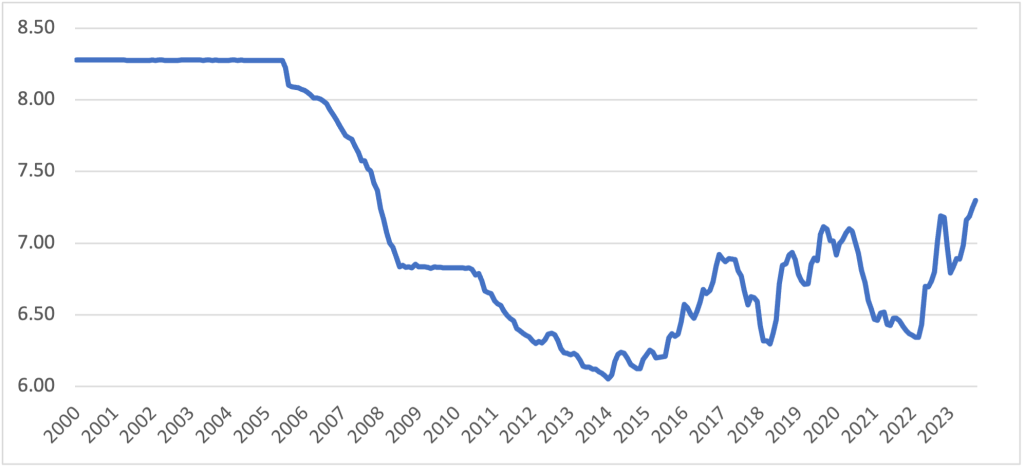
Source: Board of Governors of the Federal Reserve System (U.S.).

The Chinese currency remained undervalued relative to true market value, its “shadow price,” as the PBOC made massive purchases of foreign currencies, mainly US dollars. Chinese foreign reserves climbed inexorably until the country had accumulated almost USD 4 trillion in June 2014 (Figure 2).

Figure 2 – China Foreign Exchange Reserves (USD trillion)
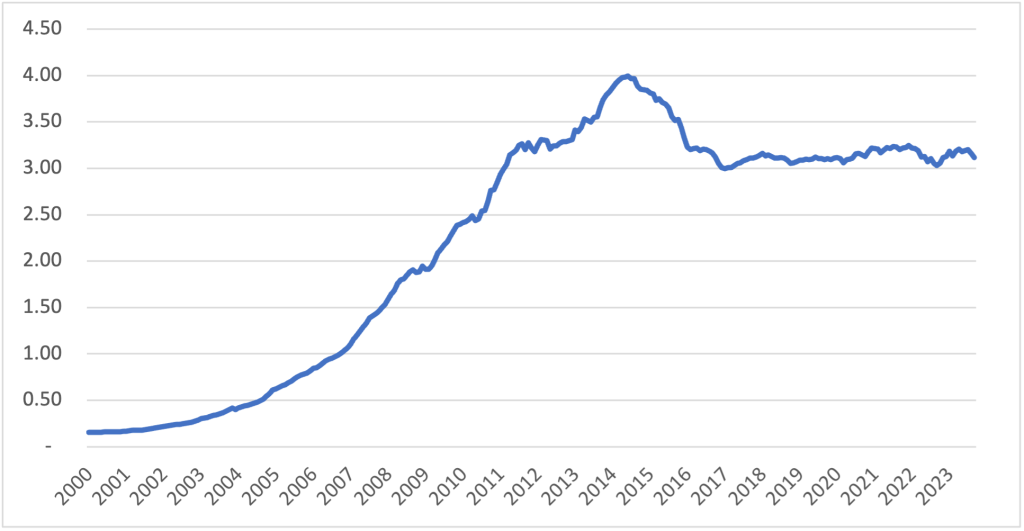
Source: International Monetary Fund.

Globalized Yuan Aspirations

For the first five years after the great financial crisis, Chinese foreign reserves doubled from USD 2 trillion to 4 trillion. But starting in 2013, the Chinese government generated considerable demand for the yuan by launching the Belt and Road Initiative while quickly selling US dollars. With loans totaling over USD 120 billion, the BRI-backed projects ranged from highways to power plants. From 2000 to 2013, net capital inflows to China averaged USD 800 billion annually and remained at similarly high levels in subsequent years (Figure 2). The Chinese government sought to internationalize the yuan, culminating with the Chinese currency’s inclusion in the Special Drawing Rights (SDR), the IMF’s international reserve asset.[1] China, flush with foreign investment, hoped the yuan would replace the US dollar as the global reserve currency.

Governments are typically faced with a trilemma. They can choose at most two of three policies: monetary policy autonomy, fixed exchange rates, and free capital flows. The United States, Japan, Brazil, and India, among others, maintain monetary policy autonomy and free capital flows but lack a fixed exchange rate regime. Eurozone countries abandoned monetary autonomy (outsourced to the European Central Bank) to create a euro-to-euro peg between their countries and allow money to flow between these economies unimpeded. Historically, China has opted for monetary policy autonomy and a fixed exchange rate with the US dollar (and, later, with several currencies). According to the trilemma, capital should not move freely in and out of the country—that was the reality for Chinese consumers and companies throughout the 2000s due to the country’s strict capital controls.

Pre-2013 trends fueled Chinese global currency aspirations. With demand for the yuan growing rapidly, Chinese authorities pursued yuan internationalization and more free capital markets, ignoring the trilemma. China believed that seemingly infinite reserves would preclude speculative attacks that commonly cause the downfall of governments that try to maintain fixed exchange rate regimes, monetary policy autonomy, and open capital accounts. Authorities thought it impossible that enough capital would leave the Chinese economy to deplete its reserves.

Economic Crisis and China’s Response

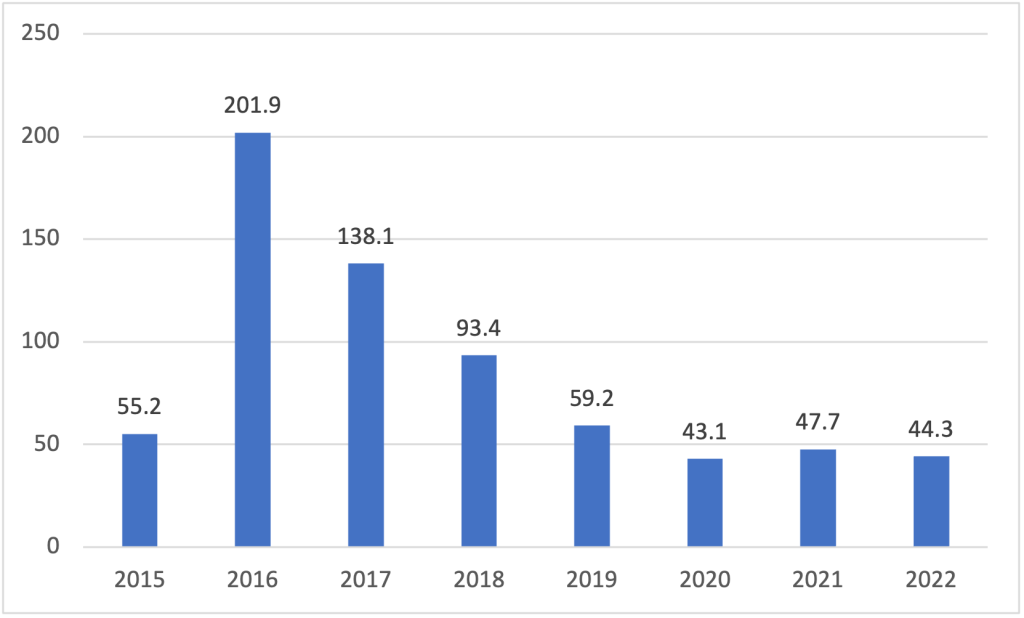
However, in early 2015, the Federal Reserve raised US interest rates for the first time since 2008. Simultaneously, expectations for the Chinese economy turned. A consensus formed that the Chinese economy would suffer a hard landing. Thus, the yuan became overvalued relative to its shadow price. Capital started flowing out of China rapidly, leading to a speculative attack on the currency as investors sold yuan assets. In 2016, households sought to transfer as much money as possible when their limits for sending US dollars to foreign accounts reset. Almost USD 1 trillion left the Chinese economy in 2016. With restrictions on capital outflows lifted and ample credit from local banks, state-owned companies purchased global businesses in deals totaling USD 200 billion. Chinese 2016 outbound mergers and acquisitions (M&A) reached almost four times as large as the previous year (Figure 3). Chinese companies were effectively betting on the yuan’s devaluation by buying foreign businesses. Thus, a speculative attack marred authorities’s intentions of a global Renminbi.

Figure 3 – Outbound M&A deal value by companies from China between 2015 and 2022 (in billions USD)
Source: PWC, 2023.

In August 2016, the PBOC took action against the speculative attack. It allowed the yuan to devalue by over 3 percent daily for two consecutive days but tightened capital controls. In September, the government introduced a 100,000 yuan annual limit on cash withdrawals from foreign ATMs and restricted underground transfers. But most critically, the PBOC tightened capital controls for private and public companies. This caused the value of outbound M&A to fall by 90 percent from 2016 to 2023, as Chinese companies had limited access to debt to finance the acquisition of Western firms.

Nevertheless, Chinese authorities did not simply return to a currency system with a non-volatile exchange rate, tight capital controls, and monetary autonomy. Today, the yuan is much closer to a free-floating currency. Before 2016, the yuan fluctuated little, but it now varies according to the business cycle. For instance, the Chinese currency devalued at the beginning of the 2020 COVID-19 pandemic, appreciated when restrictions in the country eased, and devalued again as Western central banks lifted interest rates (Figure 1). Since the speculative attack in 2016, China’s foreign reserves have remained almost constant at USD 3 trillion (Figure 2). Instead of intervening to keep the yuan under certain thresholds, the PBOC has allowed it to appreciate and depreciate according to the relative amounts of foreign currency entering or leaving China.

After the speculative attack of 2015, the Chinese government changed its currency system, adopting a dirty floating exchange rate system, not the strict peg of the early 2000s. Despite China’s claims that it wants to de-dollarize, the PBOC is unlikely to entirely abandon capital controls. The fear of currency volatility destabilizing the Chinese economy will likely trump the desire of Chinese policymakers to make the yuan a global currency. The speculative attack from individual agents, consumers, and companies ended hopes of a genuine Renminbi standard. It also required Chinese authorities to fundamentally change the BRI. Since 2017, annual BRI disbursements have declined substantially and are now almost exclusively lightly subsidized loans for Chinese companies to build infrastructure in foreign countries. De-dollarization is still a goal, but authorities are handcuffed by their preference for capital controls.

Chinese entities will continue to have to cope with restricted access to foreign currency. Capital controls make local financial markets more resilient to crises but less efficient. Capital controls restrict foreign companies’ routine business operations, such as receiving payments from Chinese customers as well as paying dividends and royalties to Chinese stakeholders. More informed investors will continue to pursue the few avenues for sending money abroad, such as through the Qualified Domestic Institutional Investor (QDII) program. All the energy spent procuring ways to send money abroad saps Chinese productivity.

China’s Strategy Moving Forward

In the past, Chinese authorities believed a global alternative to the dollar system was possible. However, today, China focuses almost exclusively on promoting the yuan through trade. Instead of being paid in US dollars, exporters are paid in their local currency with trade being settled when Chinese importers buy local products. Thus, an Argentinian exporter may be paid in pesos, while a Chinese exporter to Argentina is paid in yuan, bypassing US dollars. Yet, without a commitment to free capital flows, China cannot pursue de-dollarization moving forward. Authorities must take a wait-and-see approach unless economic priorities change.

Presently, de-dollarization is, in essence, a risk management measure for China. The United States can sanction institutions by limiting their ability to access international payments in US dollars, an option no other country shares. (Only Europe and the United Kingdom come close with their abilities to limit transactions in pounds and euros). China’s current stance limits the potential damage to the Chinese economy from possible US sanctions. However, they do not match past de-dollarization goals. Due to the risk posed by potential US sanctions, Chinese authorities should continue to devise measures to limit the dollar’s potential as a weapon if the economic conflict with the United States intensifies. Still, China cannot allow capital to flow entirely freely into its economy without risking another domestic currency crisis.

Rodrigo Zeidan is a Professor of Practice of Business and Finance at NYU Shanghai and an Affiliate Professor at Fundacao Dom Cabral. Professor Zeidan is the author of Economics of Global Business (MIT Press), The General Model of Working Capital Management (Palgrave Macmillan), and five other books. His research has also been published in some of the top journals in finance and economics, such as the Journal of Corporate Finance, Nature Sustainability, Energy Economics, Harvard Business Review, International Journal of Production Economics, and Journal of Business Ethics. His recent research focuses on Sustainable Finance alongside Corporate Finance and Industrial Economics issues. Rodrigo has a biweekly column at Folha de S. Paulo, the largest Brazilian newspaper. He has written extensively for international media outlets, including the New York New Times, CNN, the World Economic Forum, Bloomberg, and Americas Quarterly. Rodrigo is also Associate Editor of the Journal of Economic Surveys, Journal of Sustainable Finance & Investment, and the Brazilian Review of Finance. He holds a position as a Senior Scholar at the Center for Sustainable Business, NYU Stern.

[1] The SDR is not a currency, but its value is based on a basket of five currencies—the US dollar, the euro, the Chinese Renminbi, the Japanese yen, and the British pound sterling.

Image credit: Eric Prouzet via Unsplash.


© 2024 Walsh School of Foreign Service

Georgetown University

Georgetown Journal of International Affairs
ICC 301 · 37th and O Streets
NW Washington, D.C. 20057

https://gjia.georgetown.edu/2024/04/18/de-dollarization-the-belt-and-road-initiative-and-the-future-of-the-chinese-yuan/

The first issue of GJIA was published in the spring of 2000. Since then, GJIA has served as a resource for scholars, business leaders, policy makers, and students of international relations alike, cultivating a dialogue accessible to those with all levels of knowledge about foreign affairs and international politics.


GJIA publishes a peer-reviewed edition sold online, indexed in academic databases, and distributed in bookstores around the country. GJIA also publishes shorter pieces on our website on a rolling basis.

Saturday, 6 May 2023

Dollar dominance isn't going anywhere. Here are 5 myths about de-dollarization. MUST READ

 The dollar's dominance isn't fading anytime soon, and commentators that have warned recently of a de-dollarized global economy are operating on a handful of key misconceptions, experts say.

A 100 yuan banknote (R) is placed next to $100 banknotes in this picture illustration taken in Beijing Nov. 1, 2010. 

Reuters/Petar Kujundzic


  • The dollar's dominance isn't at risk, three currency experts told Insider.
  • That's because the greenback is an entrenched encumbent and widely trusted as a safe haven. 
  • Economists and currency experts shared five misconceptions about the dollar's position in global markets.

The dollar's dominance isn't fading anytime soon, and commentators that have warned recently of a de-dollarized global economy are operating on a handful of key misconceptions, experts say.

There's been growing talk that the dollar could soon be displaced by a rival currency, both as a reserve currency in central banks around the world, as well as the currency used in an overwhelming percentage of global trade.

Vocal observers, like Tesla CEO Elon Musk, have warned that the threat of de-dollarization is real, as countries like China take measures to supplant the dollar. 

But for the most part, those efforts aren't amounting to much, and there's very little chance the dollar will be toppled by a rival anytime soon, three economists told Insider.

They debunked five myths and misconceptions that are commonly touted by dollar doomsayers:

1. Central banks are rapidly shedding the dollar as a reserve currency

The dollar's use as a global reserve currency has actually remained stable from year-to-year, and despite small slides in dollar reserves, the greenback is still by far the largest reserve currency among world central banks.

The US accounted for 54% of  foreign exchange reserves in the fourth quarter of 2022, down slightly from 54.8% recorded in the fourth quarter 2021, according to data from the International Monetary Fund. Dollar reserves still dwarf the volume of all other reserve currencies, with the euro accounting for around 19% of reserves, and the Japanese yen accounting for just 5% in the fourth quarter of last year.

That's because the dollar's incumbency is simply very hard to displace, according to Bob Stark, the head of market strategy at Kyriba. Once a currency is recognized as a safe, countries will habitually choose that currency to hold unless there's a seismic economic shift, he added.

"If you're transacting something to millions or billions just as a organization, or if you're looking to park your cash somewhere and want to it to be as resilient as possible, you're probably going to choose the US dollar because it's the least volatile of the currencies. That's that," Stark said.

2. The dollar is losing its stance as the top currency in global trade

This claim also isn't supported by data. Of the 7.5 million currency transactions that occurred daily as April 2022, the US dollar accounted for at least one side in 6.6 million transactions, according to data from the Bank of International Settlements, meaning it has a role in 88% of all global trade.

That number has remained relatively stable for the past several decades — despite concentrated efforts by some nations to shun the dollar's use, Jay Zagorsky, a markets professor at Boston University told Insider.

"For the last 35 years, the dollar share hasn't changed," Zagorsky said. "I think the amount of political rhetoric has heated up tremendously, but people's actions haven't changed." 

3. China's yuan is the biggest threat to the dollar

The Chinese yuan has a minor role in the global economy, especially when compared to the greenback. The yuan accounted 2% of all foreign exchange reserves in the fourth quarter of last year, the IMF reported, and nearly a third of that is held by Russia, according to a 2022 IMF paper.

The yuan was also used in one side of just 7% of all foreign exchange transactions last year, BIS said. 

China, for its part, has taken efforts to de-dollarize its economy, such as by securing agreements with other countries to transact in yuan, and selling billions of its own currency to Russia. But for the most part, that's had a small effect on the overall dominance of the dollar in global markets, since efforts to de-dollarize are coming from countries with a smaller economy, Zagorsky said.

"Could I see the Chinese taking over from the greater British pound that Great Britain pound? Yes. And I see it maybe potentially taking over Japan. Yes. But it's a pretty far jump to move from China all the way up to beating the euro, beating the US dollar," he added.

4. The dollar could be rivaled by another currency soon

Even with de-dollarization efforts underway, it takes a long time for the dominance of a currency to end – again, because people are looking for a safe place to park their cash.

"Those relationships are only going to move the needle a very small amount," Stark said referring to ties between China and its allies.

Though the percentage of dollar reserves has slipped, he estimates it would take around 24 years for global dollar reserves to drop another 12%. And even in that scenario, the greenback would still outpace reserves of all other currencies.

Perry Mehrling, an economics professor at Boston University, speculates that much of the anti-dollar talk today is spurred from discontent from other countries whose currencies are valued lower than the greenback, not because the dollar is actually at risk of being challenged anytime soon.

He pointed, for instance, to growing de-dollarization efforts after the western nations cut Russia off from the international financial communication system, SWIFT, which sparked fears that the dollar could be weaponized. 

"This simmering discontent with being at the bottom of the international hierarchy of money gives [de-dollarization] a focal point," he said. "Mostly, it doesn't do much."

5.The end of dollar dominance would be catastrophic for the US economy and stocks

The dollar being displaced by a rival currency probably wouldn't have much impact on the US economy at all, the economists said.

According to Mehrling, the effects of de-dollarization largely take place on the balance sheets of foreign banks, which are largely disconnected from the US financial ecosystem.

"This isn't directly connected to the pipeline to the United States," he said. "It's not like it can swamp the domestic system."

A drop in the dollar could dissuade foreign institutions from investing in US Treasury bills and Treasury securities, but that would likely just mean the US economy would need to find a difference source of funding, Stark said. In terms of economic growth, he doesn't think it would change very much.

That's contrary to what commentators have implied, with Elon Musk calling the dollar's decline a "serious issue."

"You know, I don't wanna insult Elon Musk," Zagorsky said. "He's into AI, he's into solar power, he is into all these things. He might not be an expert on currency."

https://markets.businessinsider.com/news/currencies/dedollarization-dollar-dominance-currency-war-greenback-china-yuan-economy-2023-5

Friday, 21 April 2023

Larry Summers Says the Dollar Isn’t Losing Its Dominance in Global Economy


Former Treasury chief doubts China’s reserve-currency appeal Summers says US must step up on world stage to secure position


Former Treasury Secretary Lawrence Summers rejected speculation that the dollar is rapidly losing its dominance in the global economy, and highlighted China’s detractions in providing an alternative reserve currency.

“There has never been a country where there was strong a desire to move as much capital out of the country as we’re seeing in China right now,” though capital controls are restraining the outflow, Summers said on Bloomberg Television’s “Wall Street Week” with David Westin. “Is that really going to be a place where people are going to decide they want to 

sSee

https://www.bloomberg.com/news/articles/2023-04-21/summers-spurns-de-dollarization-hype-flags-china-capital-flight#xj4y7vzkg

Thursday, 13 April 2023

De-dollarization has started, but the odds that China's yuan will take over are 'profoundly unlikely to essentially impossible'

 De-dollarization has begun as recent trade deals elevate rivals, but the greenback is likely to remain a global currency, according to economist Peter C. Earle.


Dollar vs. Yuan
Dollar vs. YuanByoungJoo/Getty Images
  • De-dollarization has begun as recent trade deals elevate other currencies, Peter Earle wrote.

  • But the dollar is likely to remain a top global currency, according to the economist.

  • And the odds that China's yuan will replace the dollar are "essentially impossible," he added.

De-dollarization has begun as recent trade deals elevate rivals, but the greenback is likely to remain a global currency, according to economist Peter C. Earle.

He pointed to last month's deal between China and Brazil to settle trade in each other's currencies, noting that it's the latest example of a growing trend.

Writing in the American Institute for Economic Research last week, Earle added that use of the dollar in "economic warfare" as well as "error-fraught monetary policy regimes" are driving countries away from the greenback.

"And slower or more quickly, the dollar will lose ground abroad," he said.

But in a follow-up post on Tuesday, Earle added that while rivals make gains, the dollar is still likely to remain a global currency.

"First, barring a truly extraordinary event or series of developments, a scenario in which the dollar is no longer used (at all) in international trade is highly unlikely," he said.

He cited the vast size of the US economy and the breadth of its trading relationships, adding that there are high barriers to exit as well as high costs for switching currencies. Such a shift would take decades, if not generations, he said.

Meanwhile, despite China's efforts to elevate the yuan on the world stage and replace the dollar, Earle is highly skeptical.

"Even beyond the decades that such a change would probably take, the likelihood of the yuan becoming the global reserve currency ranges between profoundly unlikely to essentially impossible," he wrote.

Earle's note comes as China has actively established agreements with countries such as Kazakhstan, Pakistan, Laos and Brazil to use the yuan for cross-border transactions, replacing the dollar.

The renminbi has overtaken the dollar as the most used foreign currency in Russia, especially as the country improves its ties with China since being cut off from global finance after its invasion of Ukraine.

But the yuan is poorly suited to become the world's central currency, as it is virtually pegged to the dollar, Earle said. The yuan is only allowed to trade in a 2% range against a midpoint determined daily by China's central bank.

Alongside the fact that Chinese authorities also decide on what capital can flow out of the country, this makes the yuan unreceptive to free market flows.

"These (and a handful of other characteristics) are simply not conducive to establishing a currency that will be used as a unit of account, medium of exchange, and/or basis for settlement in countless international transactions daily," he wrote.

Venture capitalist Chamath Palihapitiya also described de-dollarization concerns as a "nothingburger," and cited similar reasons in arguing that the yuan would not become the dominant currency.

Meanwhile, Carson Group noted that the dollar would be around for a while, pointing to the world's proven trust in it and its prominence in international trade.

Read the original article on Business Insider


https://finance.yahoo.com/news/dollarization-started-odds-chinas-yuan-020938603.html

Monday, 3 April 2023

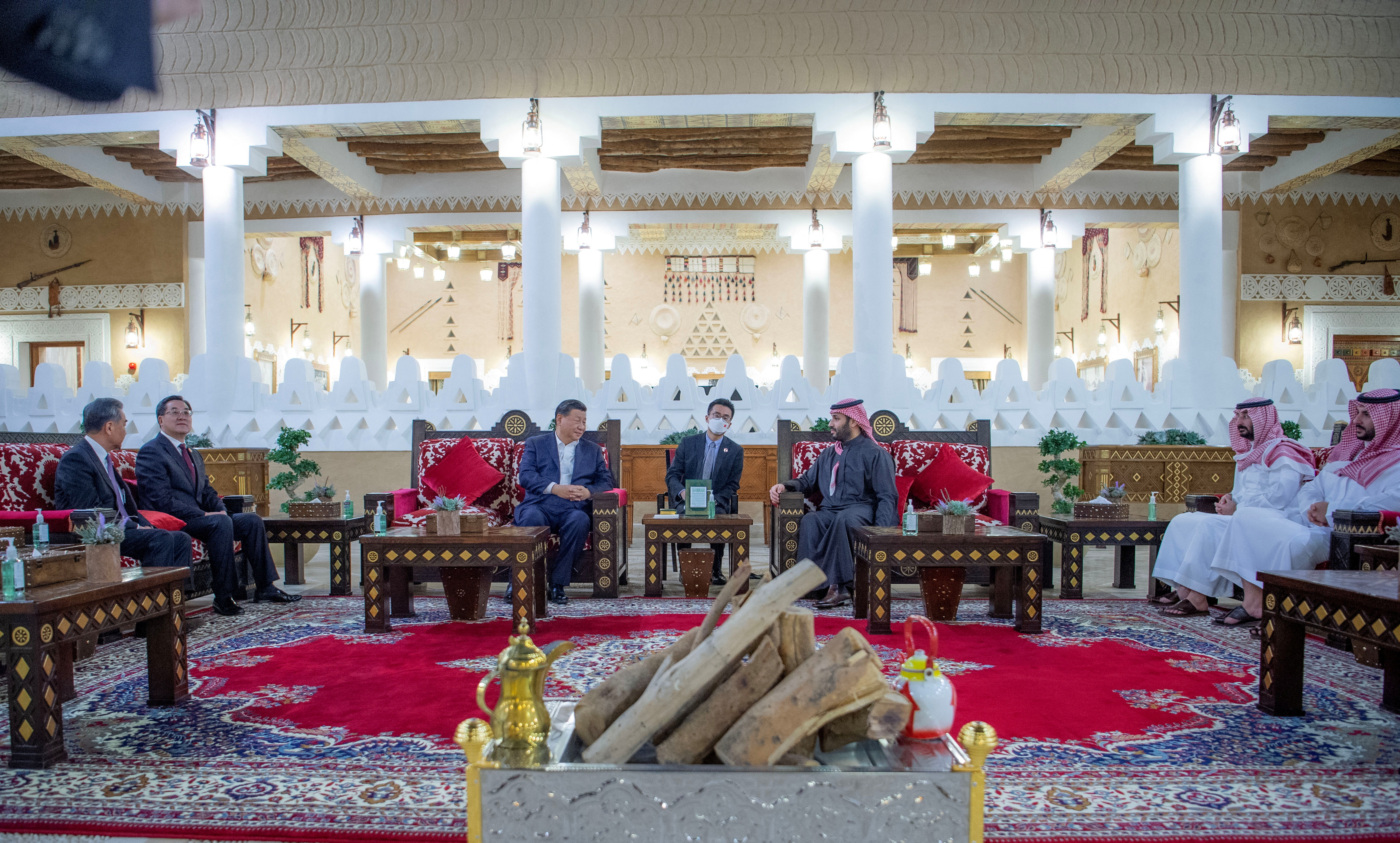
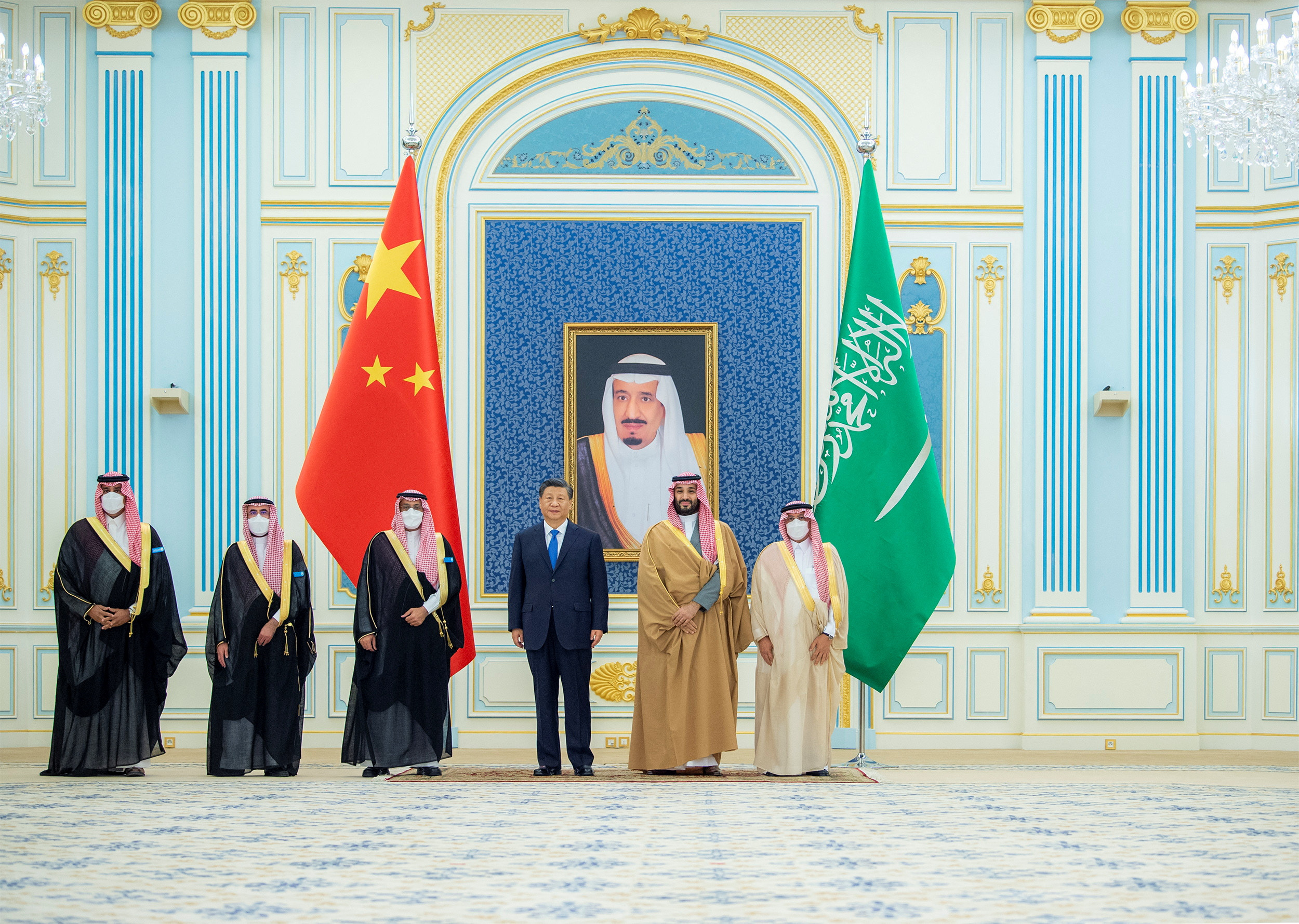
China's Xi calls for oil trade in yuan at Gulf summit in Riyadh - 10 Dec 2022


  • Xi says summit with Gulf, Arab League is 'milestone'
  • U.S. wary of growing Chinese influence in Arab world
  • Arabs defy U.S. pressure to limit China ties, cut off Russia
  • Summits showcase Saudi Crown Prince Mohammed as key leader

December 10, 2022


RIYADH, Dec 9 (Reuters) - President Xi Jinping told Gulf Arab leaders on Friday that China would work to buy oil and gas in yuan, a move that would support Beijing's goal to establish its currency internationally and weaken the U.S. dollar's grip on world trade.

Xi was speaking in Saudi Arabia where Crown Prince Mohammed bin Salman hosted two "milestone" Arab summits with the Chinese leader which showcased the powerful prince's regional heft as he courts partnerships beyond close historic ties with the West.

Top oil exporter Saudi Arabia and economic giant China both sent strong messages during Xi's visit on "non-interference" at a time when Riyadh's relationship with Washington has been tested over human rights, energy policy and Russia.

Any move by Saudi Arabia to ditch the dollar in its oil trade would be a seismic political move, which Riyadh had previously threatened in the face of possible U.S. legislation exposing OPEC members to antitrust lawsuits.

China's growing influence in the Gulf has unnerved the United States. Deepening economic ties were touted during Xi's visit, where he was greeted with pomp and ceremony and on Friday met with Gulf states and attended a wider summit with leaders of Arab League countries spanning the Gulf, Levant and Africa.

At the start of Friday's talks, Prince Mohammed heralded a "historic new phase of relations with China", a sharp contrast with the awkward U.S.-Saudi meetings five months ago when President Joe Biden attended a smaller Arab summit in Riyadh.

Asked about his country's relations with Washington in light of the warmth shown to Xi, Foreign Minister Prince Faisal bin Farhan Al Saud said Saudi Arabia would continue to work with all its partners. "We don't see this as a zero sum game," he said.

"We do not believe in polarisation or in choosing between sides," the prince told a news conference after the talks.

Though Saudi Arabia and China signed several strategic and economic partnership deals, analysts said relations would remain anchored mostly by energy interests, though Chinese firms have made forays into technology and infrastructure sectors.

"Energy concerns will remain front and centre of relations," Robert Mogielnicki, senior resident scholar at the Arab Gulf States Institute in Washington, told Reuters.

"The Chinese and Saudi governments will also be looking to support their national champions and other private sector actors to move forward with trade and investment deals. There will be more cooperation on the tech side of things too, prompting familiar concerns from Washington."

Saudi Arabia agreed a memorandum of understanding with Huawei this week on cloud computing and building high-tech complexes in Saudi cities. The Chinese tech giant has participated in building 5G networks in Gulf states despite U.S. concerns over a possible security risk in using its technology.

NATURAL PARTNERS

Saudi Arabia and its Gulf allies have defied U.S. pressure to limit dealings with China and break with fellow OPEC+ oil producer Russia over its invasion of Ukraine, as they try to navigate a polarised world order with an eye on national economic and security interests.

Riyadh is a top oil supplier to China and the two countries reaffirmed in a joint statement the importance of global market stability and energy collaboration, while striving to boost non-oil trade and enhance cooperation in peaceful nuclear power

Xi said Beijing would continue to import large quantities of oil from Gulf Arab countries and expand imports of liquefied natural gas, adding that their countries were natural partners who would cooperate further in upstream oil and gas development.

China would also "make full use of the Shanghai Petroleum and National Gas Exchange as a platform to carry out yuan settlement of oil and gas trade," he said.

Beijing has been lobbying for use of its yuan currency in trade instead of the U.S. dollar.

A Saudi source, speaking before Xi's visit, told Reuters that a decision to sell small amounts of oil in yuan to China could make sense in order to pay Chinese imports directly, but "it is not yet the right time".

Most of Saudi Arabia's assets and reserves are in dollars including more than $120 billion of U.S. Treasuries that Riyadh holds, and the Saudi riyal, like other Gulf currencies, is pegged to the dollar.

Earlier, the Chinese leader said his visit heralded a new era in relations, voicing hope the Arab summits would become "milestone events in the history of China-Arab relations".

China's Xi calls for oil trade in yuan at Gulf summit in Riyadh | Reuters

Most Recent Post

Man charged for borrowing rare Chinese manuscripts from UCLA library, returning fakes

  Suspect Jeffrey Ying allegedly travelled to China after checking works out using several aliases Agence France-Presse Published: 12:11pm, ...

Popular Posts - Last 30 days