New Zealand ... expressed concerns over the South China Sea and tensions in the Taiwan Strait ...
March 25, 20238:54 AM GMT+8
New Zealand Foreign Minister Nanaia Mahuta speaks during a session of the UN Human Rights Council, which voted to hold an urgent debate about Russia's deadly invasion of Ukraine at Kyiv's request, amid widespread international condemnation of Moscow's attack, in Geneva, Switzerland February 28, 2022. Fabrice Coffrini/Pool via REUTERS
SYDNEY, March 25 (Reuters) - New Zealand Foreign Affairs Minister Nanaia Mahuta said on Saturday she had expressed concerns over the South China Sea and tensions in the Taiwan Strait during talks with her Chinese counterpart at the end of a visit to Beijing.
Mahuta also said in a statement she "noted New Zealand’s deep concerns regarding the human rights situation in Xinjiang and the erosion of rights and freedoms in Hong Kong", during her meeting with Chinese Foreign Affairs Minister Qin Gang.
"Nanaia Mahuta expressed concerns over developments in the South China Sea and increasing tensions in the Taiwan Strait," the foreign minister's statement said.Mahuta said she reiterated New Zealand’s condemnation of Russia’s invasion of Ukraine. China is a key ally of Russia and both have criticised the U.S. and NATO for undermining global stability.
Mahuta arrived in China on Wednesday for the four-day trip, the first by a New Zealand minister since 2019, and also met China's top diplomat Wang Yi as well as business and women leaders.
Wang told Mahuta that China and New Zealand had always respected and trusted each other, according to a statement by the Chinese foreign ministry.
New Zealand has long been seen as the moderate voice on China in the Five Eyes intelligence-sharing alliance also involving the United States, Australia, Britain, and Canada. But New Zealand's tone on security and China's growing presence in the South Pacific toughened in the past year after China and the Solomon Islands struck a security pact.
New Zealand has consistently expressed concerns about the potential militarisation of the Pacific, amid China's military buildup in the South China Sea.
China views democratically governed Taiwan as its own territory and has never renounced the option of using force to take the island under its control, and claims a large part of the South China Sea.
Mahuta said the countries looked forward to resuming in-person dialogue on a range of issues following a gap of several years in face-to-face contacts.
She invited Qin to visit New Zealand, and also flagged a potential visit by New Zealand Prime Minister Chris Hipkins to China, perhaps this year. Hipkins became prime minister in January after Jacinda Ardern resigned.
Reporting by Sam McKeith; Editing by Stephen Coates
Students and teachers at Nanjing University of the Arts watch Xi's speech
Many people in China normally don't pay much attention to these set-piece, long, predictable speeches from their leaders.
However this year they were looking for any indication that the country's strict Covid amelioration measures might be eased after the Communist Party Congress.
The short answer from Chinese leader Xi Jinping: no.
He said that there would be no wavering on zero-Covid because of the need to prioritise saving people's lives.
The lockdowns, the mass testing, the health code scanning, the quarantine, the travel restrictions are all here to stay for the foreseeable future.
There was not even the slightest acknowledgement of the social and economic pain being caused by the policy.
Other massive challenges being faced by the government but which didn't get a mention include: soaring youth unemployment and the property crisis.
Instead, this nearly two-hour long speech was heavy on standard Party rhetoric and short on actual solutions to China's problems.
If you are a university graduate who can't find a job in the tech sector following government crackdowns on these companies, Xi Jinping urging you to "follow the Party's guidance… striving to be the new generation, building a modern socialist county" is not going to be much comfort.
The largest applause, no doubt scripted, came when Mr Xi spoke about unification between the mainland and Taiwan.
He said Beijing would encourage economic cooperation with the island, that it would genuinely strive for peaceful unification but that the Party would "never promise to renounce the use of force as an option".
He also defended the much-criticised state security law in Hong Kong which he said had restored order to the city.
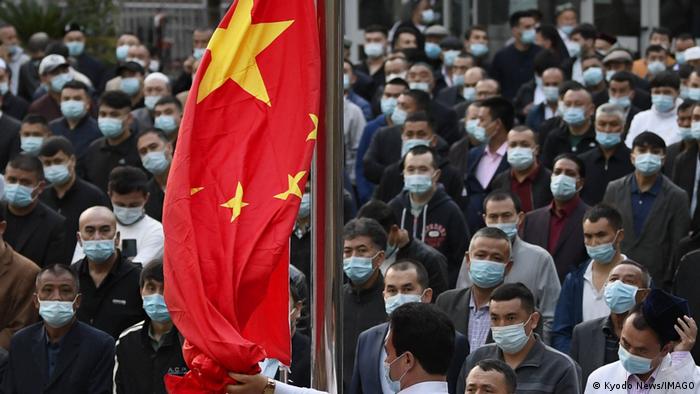
Likewise, he justified the demolition and alterations to many mosques in the northern Chinese provinces of Ningxia and Xinjiang - home to a mostly Muslim population - by saying that religions here must be "Chinese in orientation".
Structures seen as reflecting an Arab image of Islam have been replaced by those with a more Chinese aesthetic.
There were a few other elements that did not go unmissed.
Former leader Jiang Zemin was not present but he is now 96 and perhaps too frail to attend. Hu Jintao and Wen Jiabao from the former administration were on stage with Mr Xi.
Also in attendance, seated at the front row of the podium, was former Chinese Vice Premier Zhang Gaoli - his first public appearance since Chinese tennis star Peng Shuai accused him of sexual assault last year.
The 75-year-old has not publicly commented on the accusation.
Zhang Gaoli (C) was seated at the front row of the congress
However, Mr Xi's administration does have a good story to tell in terms of climate change and other environmental initiatives.
The congress opened in Beijing under a clear blue sky. There was a time when this was unusual in the capital. Now it's the other way around; the bad pollution days are the ones that stand out.
China's leader said: "We'll boost low carbon industries and promote low carbon ways of life. We'll intensify pollution control. We'll work to eliminate all serious pollution".
But coal fired power won't be phased out until the new sources of power are in place. "We're building the new before discarding the old," he said.
There may still be a massive income disparity here between the richest Chinese people and those less well-off but, in poverty alleviation, there have also been improvements and Xi Jinping referred to this.
Yet, if you watched this speech and had no idea what is actually going on in China right now, you would have a distorted picture of reality.
The overall message from the speech was that China is charging ahead in leaps and bounds under the Communist Party's guidance - but the economic uncertainty swirling around here right now is of a kind not seen in the country for decades.
Xi Jinping delivers a speech at the Great Hall of the People in Beijing, China, in 2012. Feng Li/Getty Images
When Xi Jinping was elected general secretary of the Chinese Community Party in 2012, one of the first things he did was take his senior colleagues to the National Museum in Tiananmen Square.
The seven new top leaders of China walked through the “Road to Revival” exhibition, a fairly straightforward nationalist history of the country, from the first Opium War in 1840 through the present.
There, Xi delivered a speech about the Chinese dream in which he set forward the goal of “achieving the great revival of the Chinese nation.”
As Xi is poised to take on a third term as China’s president this week at the 20th National Congress of the Chinese Communist Party, the highly symbolic museum stroll is worth recalling: it shows how much Xi is shaped by history.
Xi has become increasingly authoritarian — consolidating power, imprisoning dissenters, and now taking a third term, unprecedented since Mao Zedong.
Many of the most aggressive voices about China in the US have painted Xi as inflexible. Former Secretary of State Mike Pompeo has called him a totalitarian, and Trump’s National Security Adviser Robert O’Brien likened Xi to Stalin. Even those who have worked closely with Xi have come to see him driven by ideology. This week, former Australian prime minister and China expert Kevin Rudd described Xi as a “true believer.”
We may risk misunderstanding Xi, however, if we don’t consider the evidence that he is a pragmatist, who is drawing on the centralized power of the state to apply clear lessons from home and abroad. China’s own modern history and Xi’s experiences living through it likely present the major referents of Xi’s worldview and his priorities, but there are three other moments that have come to inform his worldview as president.
Three historical moments
No historical event haunts Xi and the Chinese leadership more than the Soviet Union’s collapse. “It’s hard to overstate how obsessed they are with the Soviet Union,” historian David Shambaugh has said.
A month into his first term in December 2012, Xi delivered a private speech to party leaders in Guangdong province with “deeply profound” learnings from the USSR’s downfall, with a focus on Soviet leader Mikhail Gorbachev’s missteps. A summary of those remarks was later circulated. “Why did the Soviet Union disintegrate? Why did the Soviet Communist Party collapse? An important reason was that their ideals and convictions wavered,” Xi said, according to the summary. The lessons he took from the collapse: Retain tight control of the military, don’t make reforms that undermine the party’s power, and make no unforced errors.
“Finally, all it took was one quiet word from Gorbachev to declare the dissolution of the Soviet Communist Party, and a great party was gone,” Xi reportedly said. “In the end, nobody was a real man, nobody came out to resist.”
Performers in the role of rescue workers gather around a Communist Party flag during a gala show ahead of the 100th anniversary of the founding of the Chinese Communist Party in Beijing on June 28, 2021. Ng Han Guan/AP
Another major historical moment that has informed Xi’s thinking is the United States’ war on terror that was launched in the aftermath of the 9/11 attacks.
Xi perhaps saw the ease with which the US perpetuated bad policies worldwide and at home.The US did face a credible terrorism threat, but Washington’s response was a massive overextension of power: invading and occupying Iraq and Afghanistan; deepening extrajudicial policies that meant close collaboration with autocratic Arab and Muslim countries; and advancing surveillance policies, including a misguided dragnet of Muslims, Arabs, and other minorities inside the US and long-term detentions in Guantanamo Bay.
The lesson Xi apparently took from America’s global war on terror wasn’t that overextension and hubris would lead to decline. Xi, instead, has seemed to grasp that he could get away with brazen expressions of power, so long as they were framed as counterterrorism.
China, before Xi ascended to the top of the party, took on many of the worst tenets of the war on terror, its rhetoric and policies, to clamp down on the country’s Muslim communities in the province of Xinjiang. The mass detention and relocation of Uyghurs in Xinjiang has been called a genocide.
Though these policies began in the early 2000s, Xi has accelerated them and come to be associated with them. As Gulzira Auelkhan, a Uyghur who survived the camps, has said, “In the camp, guards openly said it was Xi Jinping’s policy. … We had to publicly thank him for everything.” Or as Xi has put it, “The facts have abundantly demonstrated that our national minority work has been a success.”
Third, recent political uprisings have informed Xi’s thinking. Top of mind are the color revolutions in Georgia, Ukraine, and Kyrgyzstan (former Soviet states) in the early 2000s and the Arab revolutions in 2011 that spread across the Middle East and North Africa and toppled dictators.
It’s led to a major emphasis on the Chinese state’s stability.
One way to ensure that is to eliminate the corruption within the party and the Chinese government — for Xi, the rot at the top of the undemocratic regimes exposed their own vulnerability to citizens. Anti-corruption campaigns have been a key component of Xi’s rule, and a way to avoid the fate of leaders like Egyptian President Hosni Mubarak, who over his 29 years in office was known for his expensive tailored suits and decadent lifestyle that appeared at the expense of his increasingly impoverished nation.
The Arab Spring occurred before Xi took office, but its ongoing protests and counterrevolution were still present in 2012 and may have informed the crackdown on Chinese party corruption, including the fall from grace of party honcho Bo Xilai.
Learning from China’s history
The crack-up of the Soviet Union, America’s war on terror, and the fall of autocratic regimes elsewhere are certainly instructive for Xi.
But John Delury, a historian at Yonsei University Graduate School of International Studies in Seoul, emphasized that Xi’s main references come from within China. He did take the core members of his party to the history museum, after all.
The museum itself offers important clues for how Xi thinks. “It’s an orthodox lesson of essentially modern Chinese history, which is the century of humiliation,” Delury told me. The museum tells the story of the Qing Dynasty — “China let itself become weak, the system became weak. And ‘We got whooped by these European powers and then by the Japanese. And we can never let that happen again,’” he said.
That account is well-known in China, but, Delury says, “It does tell us a little bit about Xi’s instincts.”
It’s less clear what Xi has gathered about the histories of succession among China’s leaders. There is much speculation but little clarity about who might follow Xi as president after his third term — or perhaps even another. The party is changing the constitution to extend his presidency, and we don’t yet know when that term will end or what comes next.
“From the beginning, from 1921 when the CCP was founded, there are very few examples of a smooth, orderly transition of supreme power,” Delury said. “It’s a mess.”
As Delury put it, “Xi Jinping would know this history.”
We have often witnessed the bonhomie of Communists and Islamists in India. They work together to fundamentally harm the Indian religious society. On one hand, Islamists aggressively push their extremist religious idea; on the other, communists target every identity and symbol.
However, when we evaluate their ideology, there are poles apart. Islamists, consider religion as their lifeblood, and Communists see religious ideas with evil eyes, and often quote Karl Marx, “Religion is the opium of the masses”. The idea of them syncing together for a common objective reflects the non-existent role of religion. ‘Uyghur under Chinese Government and OIC’, is one such instance.
CCP’s Crime against Humanity
The United Nations Human Rights Office in its long-awaited report has termed the Chinese Communist Party’s atrocities in Xinjiang as ‘A crime against humanity’. The report said, “Serious human rights violations have been committed in the Xinjiang Uyghur Autonomous Region in the CCP’s application of counter-terrorism and counter-extremism strategies.”
The detailed ‘crime against humanity’ report read, “The extent of arbitrary and discriminatory detention of members of Uyghur and other predominantly Muslim groups, pursuant to law and policy, in context of restrictions and deprivation more generally of fundamental rights enjoyed individually and collectively, may constitute international crimes”.
The report was released in response to complaints from the media and other civil society organisations to the Office of the UN High Commissioner for Human Rights (OHCHR). According to the report, members of the Uyghur and other predominantly Muslim ethnic minority communities were missing or had vanished in the Xinjiang Uyghur Autonomous Region (XUAR) of the People’s Republic of China.
In 2018, the UN Working Group on Enforced or Involuntary Disappearances reported a major surge in the re-education camps in the Xinjiang Uighur Autonomous Region by the Chinese Government. Numerous research and investigative reports published have revealed the presence of detention on a broad scale in so-called camps, as well as claims of torture and other ill-treatment, including sexual violence, and forced labour, among other things.
Numerous studies and investigative reports have revealed widespread imprisonment in the so-called camps, as well as charges of torture and other ill-treatment, including sexual violence and forced labour, among other things.
Pin-drop silence of the OIC
According to Article 7 of the Rome Statute, an act of murder, extermination, enslavement, torture, rape, sexual slavery, enforced prostitution, apartheid, or enforced disappearance of persons, when committed as part of a widespread or systematic attack directed against any civilian population, with knowledge of the attack, would constitute as ‘Crime against Humanity’.
The CCP’s persecution of Uyghur Muslims will come under Article 7 of the Rome Statute, and they may be judged guilty of their conduct by the International Criminal Court. But, why is the world not standing against the Uyghur Muslims? Leave the world, even the Organisation of Islamic Cooperation has not spoken a single word against it. Even after the documented reports, OIC has not dared to comment on the issue. They have thoroughly maintained a pin-drop silence on the UN’s report.
The OIC, which never stops spewing hatred against India, has not spoken a single word. Not a single important Islamic country or group is saying anything. Complete peace in the Islamic world is the testimony of their double and hypocrite stands.
This also exposes their belief that they hardly care about their religion. Practically, they have weaponized the idea of Islam to advance their propaganda. Most Muslim countries are authoritative and rely on religion to sustain their kingdoms. China, striking on its weak nerves, has constantly provided unconditional loans to these countries. Without any accounts of human rights, rule of law, or any other political concerns, they help Muslim governments around the world to sustain themselves. China engages in smart energy diplomacy with Saudi Arabia, Iran, Kuwait, and Oman, importing massive amounts of oil from them. Pakistan, on the other hand, survives solely on Chinese funds. In this context, they have little room to play their religious cards in China.
This camaraderie is witnessed not only in international politics, but also in India. On the world stage, Islamists and Communists cooperate to survive their own regimes, in India; they follow the same pattern of mutual cooperation. They rarely care about their ideology; the only thing that matters to them is their personal gain. Despite being poles apart in their ideological difference in religion, they have conveniently accepted cooperation with one other. The interest of co-religionists or co-ideologist hardly matters to these extremists’ ideologues.
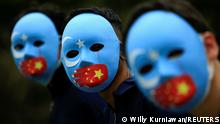
The United Nations has outlined "credible" reports of torture against Uyghur people in the region of Xinjiang. While for some it represents a "game changer," for others the long-awaited report is insufficient.
There are roughly 12 million Uyghurs living in the land-locked region of Xinjiang
After waiting for almost a year, the United Nations Human Rights Office released the Xinjiang report on Wednesday, suggesting that China's large-scale internment and treatment of Uyghurs and other ethnic minorities in western China may amount to "crimes against humanity."
Human rights organizations have weighed in on the significance of this report, saying the findings expose the extent of harm that China has done to more than one million ethnic minorities in the Xinjiang region. Others say the final results show why Beijing tried so hard to prevent the report from being released.
HRW: 'Sweeping rights abuses'
"The High Commissioner's damning findings explain why the Chinese government fought tooth and nail to prevent the publication of the Xinjiang report, which lays bare China's sweeping rights abuses," said Sophie Richardson, China director at Human Rights Watch. "The United Nations Human Rights Council should use the report to initiate a comprehensive investigation into the Chinese government's crimes against humanity targeting the Uyghurs and others — and hold those responsible to account."
Omer Kanat, the executive director of the Uyghur Human Rights Project, described the UN report as a "game changer" and Dolkun Isa, President of the World Uyghur Congress, said "it paves the way for meaningful and tangible action by member states, UN bodies, and the business community."
Rayhan Asat, a Uyghur human rights lawyer and non-resident senior fellow at the Atlantic Council, told DW that the report should not only document the attention-grabbing horrors of the camp, but also the criminalization of everyday Turkic and Muslim cultural expression in the name of countering "extremism."
"China should understand this as a demonstration of the world's seriousness about defending and protecting Uyghur rights, and that if it wishes to be seen as a world leader, then it must immediately abandon the genocidal policies that are making it an international pariah once again," she said.
Asat is not alone in her criticism of the way the UN has handled the case.
"If this report was released when it was ready, we might have had less casualties," said Nury Turkel, the chair of the US Commission on International Religious Freedom, who is a Uyghur lawyer.
"The damage done to the Uyghur people is irreversible. No one can bring it back to us. This crime is still underway. I don't have words for my disappointment and dissatisfaction with the UN," he told DW.
On Wednesday, the Chinese ambassador to the UN, Zhang Jun, said Beijing was in complete opposition to the allegations made in the report, while adding that the documents haven't been made available to them. This is in contrast to what the UN's human rights chief, Michelle Bachelet, said upon the report's release, stating it had been provided to the relevant authorities in China.
"It simply undermines the cooperation between the UN and a member state. It completely interferes in China's internal affairs," Zhang Jun said.
Last week, Bachelet admitted that she was facing "tremendous pressure" over the Xinjiang report. In an emailed statement to news agency AFP on Wednesday, Bachelet said the issues are serious while repeating that she had brought them up with Chinese authorities during her trip there in May.
Bachelet also insisted that dialogue with China didn't mean "turning a blind eye."
"The politicization of these serious human rights issues by some states did not help. They made the task more difficult, they made the engagement more difficult and they made the trust-building and the ability to really have an impact on the ground more difficult," she said.
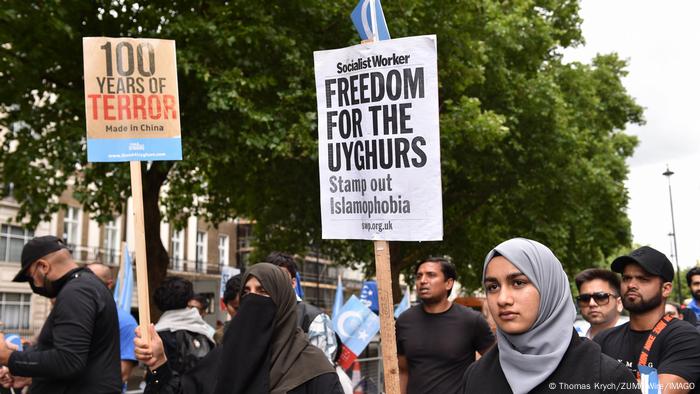
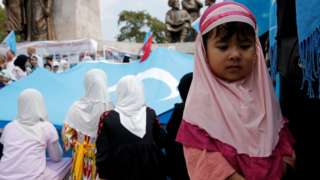
Protests have gone global to defend the rights of Uyghurs, including this one outside the Chinese embassy in London earlier this year
Activists criticize Bachelet
However, some human rights activists told DW that Bachelet has failed to fulfill the duties that come with the role of UN human rights chief.
"The post of the high commissioner for human rights requires you to be a champion of human rights beyond states. You are not a mediator between governments, which is a role that she has been assuming in this situation," said Raphael Viana David, a China and Latin America Advocate at the International Service for Human Rights (ISHR).
"She should represent the higher interest of human rights in the world beyond geopolitical concerns. This has been one of our main criticisms of her approach to China," he added.
But for some Uyghurs whose family members remain stranded in Xinjiang, the report helps to bring China's persecution of Uyghurs back into the global spotlight.
"The report makes the Uyghur situation more known to the world, especially the member states of the UN," said Mamutjan Abdurehim, an exiled Uyghur man in Australia who has been separated from his wife and two children since 2016.
"I hope this report will be a fresh rattling cry for more condemnation and pressure on China so it can reverse its policies and release those innocent people like my wife while reuniting Uyghur families like mine," he told DW.
What happens next?
With the report now being made public, Viana David from ISHR, says the next important step is for countries in the UN human rights council to form a coordinated and multilateral response.
"As the human rights council will start its next session in a bit more than a week, the diplomatic community in the council should coordinate strong responses that include public condemnation and the reiteration of the recommendations and findings in the report," he said.
Additionally, he thinks member states should try to create a UN mechanism that will monitor the situation in China. "This mechanism should look at the situation in China overall. The report gives an impetus for an investigation or provides key momentum to look at the human rights situation not only in Xinjiang but also in China overall," he added.
CHINA'S UIGHUR HEARTLAND TURNS INTO SECURITY STATE
China's far western Xinjiang region ramps up security
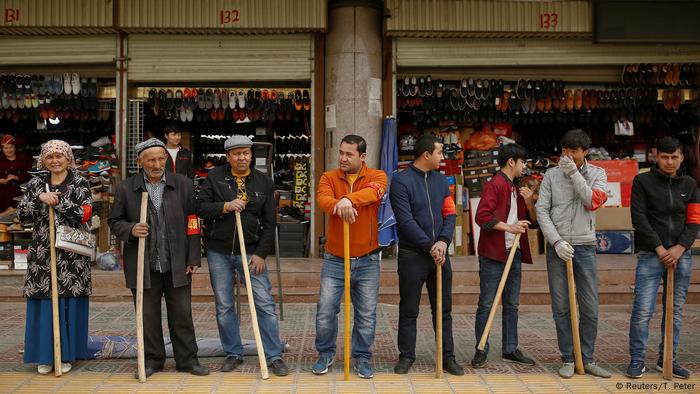
Three times a day, alarms ring out through the streets of China's ancient Silk Road city of Kashgar, and shopkeepers rush out of their stores swinging government-issued wooden clubs. In mandatory anti-terror drills conducted under police supervision, they fight off imaginary knife-wielding assailants.
Outgoing UN human rights chief defends legacy amid direct criticism 29.08.2022
Michelle Bachelet, the outgoing UN High Commissioner for Human Rights and former President of Chile, told DW the attacks against her office for delaying the publication of a report into the Uyghurs in China are "unfair."
UN warns of possible 'crimes against humanity' in Xinjiang31.08.2022
In a landmark report, the United Nations has outlined "credible" reports of discriminatory detention and torture against Uyghur people in the far-west region of Xinjiang