Showing posts with label DW. Show all posts

Thursday, 21 December 2023

How China became the world's largest debt collector

 China's massive Belt and Road Initiative (BRI) — backing and often building some 21,000 infrastructure projects around the world — is widely considered the centerpiece of President Xi Jinping's foreign policy.

Story by Nik Martin  • 2d

China took a 99-year lease on Sri Lanka's Hambantota International Port after the project struggled to repay its loans© Liu Hongru/Photoshot/picture alliance

China's massive Belt and Road Initiative (BRI) — backing and often building some 21,000 infrastructure projects around the world — is widely considered the centerpiece of President Xi Jinping's foreign policy.

Often compared to the US Marshall Plan for Europe after World War II, Beijing has made more than $1.3 trillion (€1.2 trillion) in loans over the past decade or so to fund the construction of bridges, ports and highways in low- and middle-income countries, according to a new report.

BRI has helped restore ancient trading routes between China and the rest of the world, hence the nickname the New Silk Road. It's also boosted Beijing's global influence, much to the chagrin of Washington and Brussels.

Critics say BRI has landed developing nations with unmanageable debts and left a massive carbon footprint at a time when environmental protection should be taking priority. Some countries, including the Philippines, have pulled out of projects.

Under BRI, China lent Pakistan the funds to build a new Orange Line metro for Lahore© Jamil Ahmed/Xinhua/picture alliance

Others have pointed to China's strategy of offering contracts to its own state-run firms to build infrastructure projects, often leading to opaque construction costs that countries later struggle to renegotiate.

While China has committed to continue investing billions in new projects, the day of reckoning has now arrived. The bill from the past 10 years on many of those loans has now come due.

How many BRI loans have turned bad?

report published earlier this month by AidData estimates that 80% of the lending made by China in the developing world is to countries in financial distress. The US-based research house estimated that total outstanding debt, excluding interest, is at least $1.1 trillion.

While the report doesn't give a figure for how many loans have turned bad, it states that overdue repayments are soaring. The report's authors also noted that 1,693 BRI projects are at risk and that 94 projects have either been canceled or suspended.

AidData calculated that more than half of the BRI loans have now entered their principal repayment period, at a time when global base interest rates have risen sharply, loading debtor nations with an even bigger repayment burden.

The report's authors found that China has, in some cases, almost tripled the interest rate as a penalty for late payments from 3% to 8.7%.

When China first started offering loans to developing countries at the turn of the century, less than a fifth of projects were collateralized, compared to almost two-thirds today.

A World Bank report earlier this year found that China has already had to dole out billions in bailout loans to BRI nations.

It is now adopting a new strategy to de-risk itself from a wave of distressed loans, which includes rescue loans that help shore up the finances of the governments it has lent to and often their central banks, AidData found.
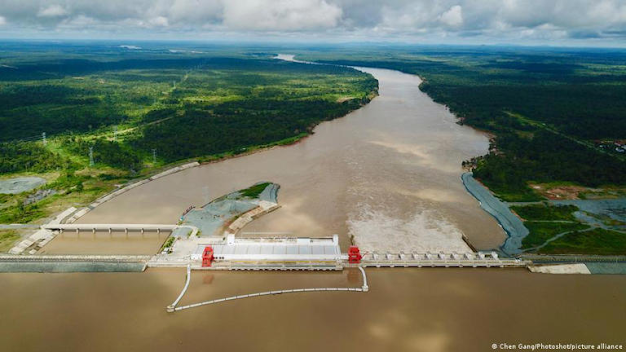
Cambodia's controversial Lower Sesan II hydroelectric dam was built with Chinese loans© Chen Gang/Photoshot/picture alliance

What are the US and Europe doing to compete with China?

AidData found that while China is spending about $80 billion annually on lending to low and middle-income countries, the United States is playing catch up.

Washington spends approximately $60 billion in similar development finance each year, due in large part to the financing of private sector projects by the US International Development Finance Corporation (DFC).

One example of US financing is the planned construction of a deep-water shipping container terminal in Sri Lanka's Port of Colombo, costing half a billion dollars, which was announced earlier this month.

The Indian Ocean island nation is struggling to recover from a dire financial and economic crisis and its existing loan commitments to China's BRI have hampered efforts to resolve its financial woes.

Beijing loaned cash to build Hambantota Port on Sri Lanka's southeastern coast, along with an airport and city on reclaimed land. However, the projects aren't profitable enough to repay the loans.

Two years ago, G7 nations launched the Build Back Better World, or B3W initiative, another attempt by the United States and its allies to counterbalance the BRI.

And just last month, the European Union held its first summit for its own Global Gateway program, which is also seen as an alternative to the BRI and hoped to help retain Europe's influence, particularly in the Global South.

During the talks, deals worth nearly €70 billion were inked with governments across Europe, Asia and Africa. The EU's support, which could eventually reach €300 billion, will help projects related to critical raw minerals, green energy, and transport corridors.

European Commission Chief Ursula von der Leyen said the Global Gateway would give developing countries a "better choice" for financing infrastructure projects. While she didn't single out China's BRI for criticism, she noted how other options for financing often come at a "high price."

AidData found that while the US and its allies may be unable to match Beijing dollar for dollar on an ongoing basis, in part due to the West promising too much and being unable to deliver, the G7 did outspend China in 2021 by $84 billion.

In its report, AidData also cautioned the US and its allies against trying to compete with China's BRI as Beijing moves from large-scale construction projects to debt collection.

However, the report's authors said the failure of many BRI projects does offer an opportunity to lure affected countries, like Sri Lanka, back into the West's orbit.

Edited by: Rob Mudge

How China became the world's largest debt collector (msn.com)

Thursday, 3 August 2023

Italy: Tricky exit looms from China Belt and Road deal

 "The decision to join the Silk Road was an improvised and atrocious act," The deal had tripled China's exports to Italy, but had not had same effect going the other way

Story by Ella Joyner (Brussels) • Yesterday 01:07

Italy's Giorgia Meloni must tread a fine line betwen tradtional allies and a powerful trade partner.
Italy's Giorgia Meloni must tread a fine line betwen tradtional allies and a powerful trade partner.© Andreas Solaro/AFP

The lukewarm feelings of Giorgia Meloni, Italy's far-right prime minister, toward China are no secret. Shortly before the election that propelled her to the head of a right-wing coalition last September, Meloni described Italy's 2019 entry into the Belt and Road Initiative with a $2.5 billion (€2.3 billion) investment deal as "a big mistake."

Beijing's massive global infrastructure investment drive kicked off in 2013 with the aim of better connecting intercontinental trade infrastructure — and enhancing China's influence abroad. Rome's nonbinding Memorandum of Understanding (MoU) with Beijing was inked under the previous government, just as many Western allies were hardening their stance on China.

There had been much speculation about what Meloni would do in office. Her defense minister sent a strong signal that the deal may well be left to lapse.

"The decision to join the Silk Road was an improvised and atrocious act," Italian Defense Minister Guido Crosetto told the Corriere della Sera newspaper last week.

The deal had tripled China's exports to Italy, but had not had same effect going the other way, said Crosetto, who is also a member of Meloni’s archconservative Brothers of Italy party.

The nonbinding infrastructure deal, which comprised dozens of cooperation agreements but failed to translate into a serious spending spree, is set to automatically renew for a further four years in March 2024 unless Meloni ends it.

On a trip to the United States last week to meet with President Joe Biden, Meloni said she would make a decision before December. The matter needed to be discussed in the Italian parliament and with the Chinese government, she added.

"You can have good relations with China without the Belt and Road initiative," Meloni told the US broadcaster Fox News in an interview that aired over the weekend.

There are more than a few who would like Meloni to let the agreement expire. With tensions between Beijing and the leaders of Taiwan on the rise, Washington is keen to have its close allies follow a strict line on China.

The European Union is divided over how closely to align with US President Joe Biden's hard stance on China. The Baltic states are strongly trans-Atlantic in this regard but France and Germany are more ambivalent. French President Emmanuel Macron recently caused controversy by implying that the EU need not get too involved in escalating tensions between China and Taiwan.

How we got here


So why did Italy sign up in the first place? It all started under Prime Minister Matteo Conte. In economic terms, the government was motivated by a desire not to miss out on a "piece of the pie," as Federiga Bindi, then a fellow at the Carnegie Endowment for Peace, wrote at the time.

President Xi Jinping personally visited the Greek port of Piraeus, a hot spot for Chinese investment
President Xi Jinping personally visited the Greek port of Piraeus, a hot spot for Chinese investment© Li Xueren/Xinhua/picture alliance

Italy saw heavy Chinese investment in northern European infrastructure, but also in the Greek port of Piraeus, and wanted in. Part of the Italian deal foresaw investment in the key ports of Trieste and Genoa.

Back then, signing made sense politically for the two parties in the governing coalition. In fact, close trade ties between China go all the way back to the government of Romano Prodi in the 1980s, Bindi, now at the Rome Tor Vergata University, wrote.

The 2019 memorandum was a risky move in terms of Italy's relations with traditional allies in the European Union and NATO.

Personal politics vs. political pragmatism

Meloni’s personal feelings are pretty clear. "Meloni has always been a firm opponent of some of China's behaviors," Enrico Fardella, a China expert from the University of Naples, told DW via email. Even as sports minister during the 2008 Beijing Olympics, she criticized Beijing's human rights record, especially in Tibet.

Her opposition also happens to be politically salient, Fardella said. Meloni's coalition contains two parties — the League and Forza Italia — that have been accused of inappropriate proximity to Russia in the wake of Moscow's war on Ukraine.

"Meloni's position on China helps to balance her allies' controversial positions on Russia, converge the coalition on a joint critical stance toward some of China's global and domestic stances, and [lend] an image of reliability over the new government in the eyes of Italy's main allies," Fardella said.

Meloni, whose Brothers of Italy party has neofascist roots, is keen to show that she is a prime minister like any other, capable of working smoothly with partners on the world stage.

Provided by Deutsche Welle
Provided by Deutsche Welle© Provided by Deutsche Welle

A risky rupture with Beijing?

If Meloni does indeed try to bow out of the deal gracefully, she would need to tread carefully.

A nonrenewal could be embarrassing for China, given that the deal was an important political signal back in 2019. Italy was the first (and only) G7 country to sign up, though other EU countries — the Czech Republic, Hungary, Poland, Greece and Portugal — signed similar memoranda.

Should Italy withdraw on bad terms, there could be repercussions, Fardella said.

"If the Italian decision will turn into a loss of face for Beijing, a retaliation may occur," he said. "It could probably affect the export to Italy of those strategic components that are needed for the Italian industry." The risk is that the European Union would side with Italy and retaliate, further escalating the situation.

"The timing and the form of this decision will be crucial," Fardella said. "A sudden and shortsighted decision taken by Italy over the MoU could further contribute to this dangerous paranoia that is setting China and the West [on] two divergent and conflictual courses."

However, China did not respond when Central and Eastern European states pulled out of another cooperation agreement, the so-called 16+1 format, in 2021 and 2022, Fardella noted.

Fraser Howie, the author of several books on China, including "Red Capitalism: The Fragile Financial Foundations of China's Extraordinary Rise," told DW on Tuesday that he did not think China would do anything if Italy were to leave.

"Beijing will get all upset and claim this is a great insult to 1.4 billion Chinese," Howie said. "But, ultimately, there's very little that Beijing can do."

"Italy is an important member of the European Union," Howie said. "Italy is a very popular draw for Chinese tourists."

"The Chinese can't force themselves. They’re not invading Italy so they can build roads and bridges," Howie said.

This article was originally published on May 18, 2023, and updated on August 2, 2023, to reflect recent developments.

Author: Ella Joyner (Brussels)

https://www.msn.com/en-gb/news/world/italy-tricky-exit-looms-from-china-belt-and-road-deal/ar-AA1eHhfR

Thursday, 1 September 2022

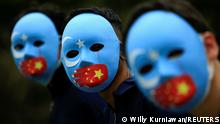
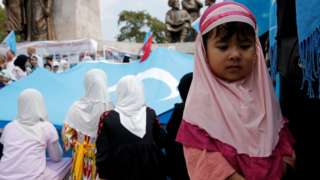
Uyghur community slams UN's China report as too little, too late

 The United Nations has outlined "credible" reports of torture against Uyghur people in the region of Xinjiang. While for some it represents a "game changer," for others the long-awaited report is insufficient.

  • Date 01.09.2022
  • Author William Yang (Taipei)

https://www.dw.com/en/uyghur-community-slams-uns-china-report-as-too-little-too-late/a-62992373

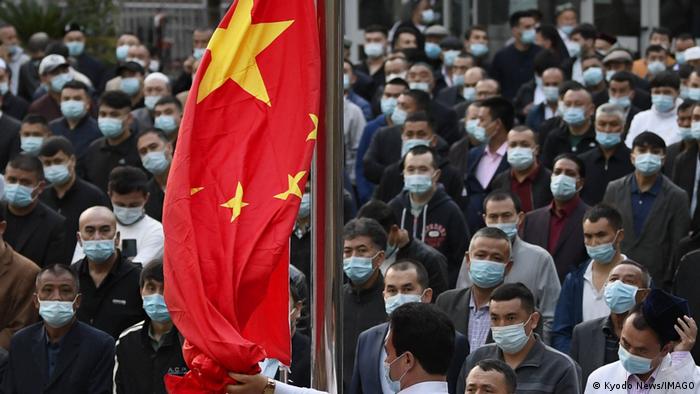
People watching the Chinese national flag being raised at a mosque in Urumqi in China s Xinjiang Uyghur Autonomous Region

There are roughly 12 million Uyghurs living in the land-locked region of Xinjiang

After waiting for almost a year, the United Nations Human Rights Office released the Xinjiang report on Wednesday, suggesting that China's large-scale internment and treatment of Uyghurs and other ethnic minorities in western China may amount to "crimes against humanity."

Human rights organizations have weighed in on the significance of this report, saying the findings expose the extent of harm that China has done to more than one million ethnic minorities in the Xinjiang region. Others say the final results show why Beijing tried so hard to prevent the report from being released.

HRW: 'Sweeping rights abuses'

"The High Commissioner's damning findings explain why the Chinese government fought tooth and nail to prevent the publication of the Xinjiang report, which lays bare China's sweeping rights abuses," said Sophie Richardson, China director at Human Rights Watch. "The United Nations Human Rights Council should use the report to initiate a comprehensive investigation into the Chinese government's crimes against humanity targeting the Uyghurs and others — and hold those responsible to account."

Omer Kanat, the executive director of the Uyghur Human Rights Project, described the UN report as a "game changer" and Dolkun Isa, President of the World Uyghur Congress, said "it paves the way for meaningful and tangible action by member states, UN bodies, and the business community."

But for others, the UN's report has been a case of too little, too late.

Rayhan Asat, a Uyghur human rights lawyer and non-resident senior fellow at the Atlantic Council, told DW that the report should not only document the attention-grabbing horrors of the camp, but also the criminalization of everyday Turkic and Muslim cultural expression in the name of countering "extremism."

"China should understand this as a demonstration of the world's seriousness about defending and protecting Uyghur rights, and that if it wishes to be seen as a world leader, then it must immediately abandon the genocidal policies that are making it an international pariah once again," she said.

Asat is not alone in her criticism of the way the UN has handled the case.

"If this report was released when it was ready, we might have had less casualties," said Nury Turkel, the chair of the US Commission on International Religious Freedom, who is a Uyghur lawyer.

"The damage done to the Uyghur people is irreversible. No one can bring it back to us. This crime is still underway. I don't have words for my disappointment and dissatisfaction with the UN," he told DW.

On Wednesday, the Chinese ambassador to the UN, Zhang Jun, said Beijing was in complete opposition to the allegations made in the report, while adding that the documents haven't been made available to them. This is in contrast to what the UN's human rights chief, Michelle Bachelet, said upon the report's release, stating it had been provided to the relevant authorities in China.

"It simply undermines the cooperation between the UN and a member state. It completely interferes in China's internal affairs," Zhang Jun said.

Last week, Bachelet admitted that she was facing "tremendous pressure" over the Xinjiang report. In an emailed statement to news agency AFP on Wednesday, Bachelet said the issues are serious while repeating that she had brought them up with Chinese authorities during her trip there in May.

Bachelet also insisted that dialogue with China didn't mean "turning a blind eye." 

"The politicization of these serious human rights issues by some states did not help. They made the task more difficult, they made the engagement more difficult and they made the trust-building and the ability to really have an impact on the ground more difficult," she said.

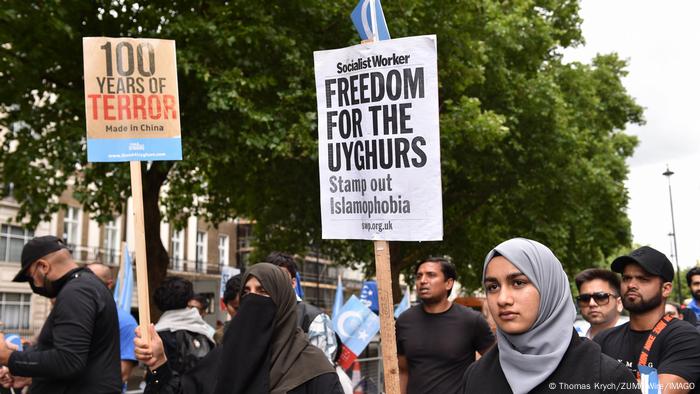
Protesters hold placards at the rally. Uyghurs and UK Muslim organisations gathered opposite Chinese embassy in London

Protests have gone global to defend the rights of Uyghurs, including this one outside the Chinese embassy in London earlier this year

Activists criticize Bachelet

However, some human rights activists told DW that Bachelet has failed to fulfill the duties that come with the role of UN human rights chief.

"The post of the high commissioner for human rights requires you to be a champion of human rights beyond states. You are not a mediator between governments, which is a role that she has been assuming in this situation," said Raphael Viana David, a China and Latin America Advocate at the International Service for Human Rights (ISHR).

"She should represent the higher interest of human rights in the world beyond geopolitical concerns. This has been one of our main criticisms of her approach to China," he added.

But for some Uyghurs whose family members remain stranded in Xinjiang, the report helps to bring China's persecution of Uyghurs back into the global spotlight.

"The report makes the Uyghur situation more known to the world, especially the member states of the UN," said Mamutjan Abdurehim, an exiled Uyghur man in Australia who has been separated from his wife and two children since 2016.

"I hope this report will be a fresh rattling cry for more condemnation and pressure on China so it can reverse its policies and release those innocent people like my wife while reuniting Uyghur families like mine," he told DW.

What happens next?

With the report now being made public, Viana David from ISHR, says the next important step is for countries in the UN human rights council to form a coordinated and multilateral response.

"As the human rights council will start its next session in a bit more than a week, the diplomatic community in the council should coordinate strong responses that include public condemnation and the reiteration of the recommendations and findings in the report," he said.

Additionally, he thinks member states should try to create a UN mechanism that will monitor the situation in China. "This mechanism should look at the situation in China overall. The report gives an impetus for an investigation or provides key momentum to look at the human rights situation not only in Xinjiang but also in China overall," he added.

Edited by: John Silk

  • Date 01.09.2022
  • Author William Yang (Taipei)


https://www.dw.com/en/uyghur-community-slams-uns-china-report-as-too-little-too-late/a-62992373


The United Nations High Commissioner for Human Rights Michelle Bachelet attends her final news conference before the end of her mandate at the U.N. in Geneva, Switzerland, August 25, 2022. REUTERS/Pierre Albouy

Outgoing UN human rights chief defends legacy amid direct criticism 29.08.2022

Michelle Bachelet, the outgoing UN High Commissioner for Human Rights and former President of Chile, told DW the attacks against her office for delaying the publication of a report into the Uyghurs in China are "unfair." 


Activists take part in a protest against China's treatment towards the ethnic Uyghur people and calling for a boycott of the 2022 Winter Olympics in Beijing, at a park Jakarta, Indonesia, January 4, 2022. REUTERS/Willy Kurniawan TPX IMAGES OF THE DAY

UN warns of possible 'crimes against humanity' in Xinjiang 31.08.2022

In a landmark report, the United Nations has outlined "credible" reports of discriminatory detention and torture against Uyghur people in the far-west region of Xinjiang


Ethnic Uyghur girls attend a protest against China, in Istanbul, Turkey, 31 August 2022

The BBC's John Sudworth, forced out of China for his reporting on Xinjiang, considers Beijing's approach.

Read more


Most Recent Post

Man charged for borrowing rare Chinese manuscripts from UCLA library, returning fakes

  Suspect Jeffrey Ying allegedly travelled to China after checking works out using several aliases Agence France-Presse Published: 12:11pm, ...

Popular Posts - Last 30 days