Showing posts with label Pakistan. Show all posts

Friday, 8 November 2024

Brazil Joins India, Rejects China's BRI

Brazil has become the second BRICS nation after India to reject China's Belt and Road Initiative, citing concerns over potential debt traps and seeking alternative collaborations with Chinese investors.

By K J M VarmaBeijing   Oct 29, 2024 10:46


Brazil Joins India, Rejects China's BRI

Beijing, Oct 29 (PTI) In a major setback to China's BRI, Brazil has decided against joining Beijing's multi-billion-dollar initiative becoming the second country after India in the BRICS bloc not to endorse the mega project.

Brazil, headed by President Lula da Silva, will not join the Belt and Road Initiative (BRI) and instead seek alternative ways to collaborate with Chinese investors, Celso Amorim, special presidential adviser for international affairs, said on Monday.

Brazil wants to “take the relationship with China to a new level, without having to sign an accession contract”, he told Brazilian newspaper O Globo.

“We are not entering into a treaty,” Amorim said, explaining that Brazil does not want to take Chinese infrastructure and trade projects as “an insurance policy”.

According to Amorim, the aim is to use some of the Belt and Road framework to find “synergy” between Brazilian infrastructure projects and the investment funds associated with the initiative, without necessarily formally joining the group, the Hong Kong-based South China Morning Post quoted him as saying.

The Chinese “call it the belt [and road] … and they can give whatever names they want, but what matters is that there are projects that Brazil has defined as a priority and that may or may not be accepted [by Beijing]”, Amorim said.

The decision contradicts China's plans to make Brazil's joining of the initiative a centrepiece of Chinese President Xi Jinping's state visit to Brasilia on November 20, the Post reported.

Officials from Brazil's economy and foreign affairs ministries recently voiced opposition to the idea, it said.

The prevailing opinion in Brazil was that joining China's flagship infrastructure project would not only fail to bring any tangible benefits for Brazil in the short term but could also make relations with a potential Trump administration more difficult.

Last week, Amorim and the president's chief of staff Rui Costa travelled to Beijing to discuss the initiative. According to sources, they returned “unconvinced and unimpressed” by China's offers, the Post reported.

Lula did not attend this month's BRICS summit at Kazan due to an injury and his close associate and former Brazilian President Dilma Rousseff currently heads the Shanghai-based BRICS New Development Bank (NDB).

BRICS originally consisted of Brazil, Russia, India, China and South Africa. Egypt, Ethiopia, Iran, Saudi Arabia, and the United Arab Emirates have been admitted as new members.

Brazil will be the second member of the BRICS after India not to endorse the BRI.

India was the first country to voice reservations and stood steadfast in its opposition to BRI, a pet project of Chinese President Xi Jinping to further the global influence of China with investments to build infrastructure projects.

India has protested against China for building the USD 60 billion China-Pakistan Economic Corridor (CPEC), stated to be the flagship project of the BRI through the Pakistan-occupied Kashmir (POK) in violation of its sovereignty.

India is also vocal about its criticism of BRI projects stating they should be based on universally recognised international norms, good governance, and the rule of law and follow principles of openness, transparency and financial sustainability.

China subsequently faced criticism that the BRI projects in smaller countries like Sri Lanka, especially for its take-over of the Hambantota for a 99-year lease as a debt swap turned out to be debt traps resulting in a deep financial crisis in both smaller countries.

Indian diplomats here point out that besides staying away from three annual high-profile meetings of the BRI in Beijing in the past few years, India continued to voice its opposition to it both in the BRICS and Shanghai Cooperation Organisation, (SCO).

US Trade Representative Katherine Tai recently urged Brazil to view the proposal to join BRI through an “objective lens” and “risk management".

The Chinese embassy in Brasilia called her remarks “irresponsible” and “disrespectful”.

China's state-run Global Times in an editorial on Monday termed Tai's comments against BRI as “steeped in the spectre of "Monroe Doctrine".

“Brazil does not need others to dictate who to cooperate with or what kind of partnerships to conduct, and the normal economic and trade cooperation between China and Latin American countries should not be subject to scrutiny from third countries," it said.

“Currently, the US is attempting to build a "small yard, high fence" against China in Brazil and other Latin American countries”, it said.

"The cooperation between China and Brazil not only aligns with the interests of both countries but also meets the need for the Global South to build a more just and equitable international economic order. This trend is something that Washington cannot stop,” it said.
Source: PTI

https://money.rediff.com/news/market/brazil-joins-india-rejects-china-s-bri/17780120241029

Thursday, 21 December 2023

How China became the world's largest debt collector

 China's massive Belt and Road Initiative (BRI) — backing and often building some 21,000 infrastructure projects around the world — is widely considered the centerpiece of President Xi Jinping's foreign policy.

Story by Nik Martin  • 2d

China took a 99-year lease on Sri Lanka's Hambantota International Port after the project struggled to repay its loans© Liu Hongru/Photoshot/picture alliance

China's massive Belt and Road Initiative (BRI) — backing and often building some 21,000 infrastructure projects around the world — is widely considered the centerpiece of President Xi Jinping's foreign policy.

Often compared to the US Marshall Plan for Europe after World War II, Beijing has made more than $1.3 trillion (€1.2 trillion) in loans over the past decade or so to fund the construction of bridges, ports and highways in low- and middle-income countries, according to a new report.

BRI has helped restore ancient trading routes between China and the rest of the world, hence the nickname the New Silk Road. It's also boosted Beijing's global influence, much to the chagrin of Washington and Brussels.

Critics say BRI has landed developing nations with unmanageable debts and left a massive carbon footprint at a time when environmental protection should be taking priority. Some countries, including the Philippines, have pulled out of projects.

Under BRI, China lent Pakistan the funds to build a new Orange Line metro for Lahore© Jamil Ahmed/Xinhua/picture alliance

Others have pointed to China's strategy of offering contracts to its own state-run firms to build infrastructure projects, often leading to opaque construction costs that countries later struggle to renegotiate.

While China has committed to continue investing billions in new projects, the day of reckoning has now arrived. The bill from the past 10 years on many of those loans has now come due.

How many BRI loans have turned bad?

report published earlier this month by AidData estimates that 80% of the lending made by China in the developing world is to countries in financial distress. The US-based research house estimated that total outstanding debt, excluding interest, is at least $1.1 trillion.

While the report doesn't give a figure for how many loans have turned bad, it states that overdue repayments are soaring. The report's authors also noted that 1,693 BRI projects are at risk and that 94 projects have either been canceled or suspended.

AidData calculated that more than half of the BRI loans have now entered their principal repayment period, at a time when global base interest rates have risen sharply, loading debtor nations with an even bigger repayment burden.

The report's authors found that China has, in some cases, almost tripled the interest rate as a penalty for late payments from 3% to 8.7%.

When China first started offering loans to developing countries at the turn of the century, less than a fifth of projects were collateralized, compared to almost two-thirds today.

A World Bank report earlier this year found that China has already had to dole out billions in bailout loans to BRI nations.

It is now adopting a new strategy to de-risk itself from a wave of distressed loans, which includes rescue loans that help shore up the finances of the governments it has lent to and often their central banks, AidData found.

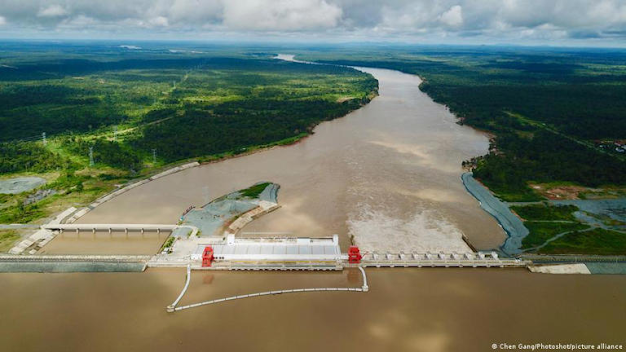
Cambodia's controversial Lower Sesan II hydroelectric dam was built with Chinese loans© Chen Gang/Photoshot/picture alliance

What are the US and Europe doing to compete with China?

AidData found that while China is spending about $80 billion annually on lending to low and middle-income countries, the United States is playing catch up.

Washington spends approximately $60 billion in similar development finance each year, due in large part to the financing of private sector projects by the US International Development Finance Corporation (DFC).

One example of US financing is the planned construction of a deep-water shipping container terminal in Sri Lanka's Port of Colombo, costing half a billion dollars, which was announced earlier this month.

The Indian Ocean island nation is struggling to recover from a dire financial and economic crisis and its existing loan commitments to China's BRI have hampered efforts to resolve its financial woes.

Beijing loaned cash to build Hambantota Port on Sri Lanka's southeastern coast, along with an airport and city on reclaimed land. However, the projects aren't profitable enough to repay the loans.

Two years ago, G7 nations launched the Build Back Better World, or B3W initiative, another attempt by the United States and its allies to counterbalance the BRI.

And just last month, the European Union held its first summit for its own Global Gateway program, which is also seen as an alternative to the BRI and hoped to help retain Europe's influence, particularly in the Global South.

During the talks, deals worth nearly €70 billion were inked with governments across Europe, Asia and Africa. The EU's support, which could eventually reach €300 billion, will help projects related to critical raw minerals, green energy, and transport corridors.

European Commission Chief Ursula von der Leyen said the Global Gateway would give developing countries a "better choice" for financing infrastructure projects. While she didn't single out China's BRI for criticism, she noted how other options for financing often come at a "high price."

AidData found that while the US and its allies may be unable to match Beijing dollar for dollar on an ongoing basis, in part due to the West promising too much and being unable to deliver, the G7 did outspend China in 2021 by $84 billion.

In its report, AidData also cautioned the US and its allies against trying to compete with China's BRI as Beijing moves from large-scale construction projects to debt collection.

However, the report's authors said the failure of many BRI projects does offer an opportunity to lure affected countries, like Sri Lanka, back into the West's orbit.

Edited by: Rob Mudge

How China became the world's largest debt collector (msn.com)

Thursday, 11 August 2022

China Shielding Pakistan Hijacker & Terrorist At UNSC Exposes Its Doublespeak: Govt Source

 "It is unfortunate that the sanctions committee has been prevented from playing its role due to political considerations," Indian Government sources said.

https://www.republicworld.com/world-news/china/china-shielding-pakistan-hijacker-and-terrorist-at-unsc-exposes-its-doublespeak-govt-source-articleshow.html

Last Updated: 


Written By
Ananya Varma


China on Wednesday placed a hold on a joint proposal of the United States and India to list Pakistan-based terrorist Abdul Rauf Azhar, one of the masterminds of the Indian Airlines Flight 814 hijack, under the United Nations Security Council (UNSC) sanctions. 

This was the second time that Beijing used its veto in support of terror and all-weather friend Pakistan. 

In June, the country had placed a hold on a joint proposal of the US and India to designate Pakistan-based terrorist Abdul Rehman Makki, US-designated terrorist and brother-in-law of Lashkar-e-Taiba head and 26/11 mastermind Hafiz Saeed. 

Makki has been involved in raising funds, recruiting and radicalizing youths to resort to violence, and planning attacks in India, including the Mumbai terror attacks (2008).

'China’s actions expose its double speak': Govt sources

"There is incontrovertible evidence for both these listing proposals. Both individuals have also been sanctioned by the US under its domestic legislation. 

It is unfortunate that the sanctions committee has been prevented from playing its role due to political considerations," Indian Government sources said after the proposal against Abdul Rauf Azhar, also known as Rauf Asghar was blocked. 

"China’s actions expose its double speak and double standards when it comes to the international community’s shared battle against terrorism. Such politically motivated actions by China, in nearly every listing case of a Pak-based terrorist, undermine the entire sanctity of the working methods of the UNSC Sanctions Committees," sources added.

About Abdul Rauf Azhar

Abdul Rauf Azhar, is the brother of Jaish-e-Mohammad founder and leader Masood Azhar.

 He is said to have been the main conspirator who planned and executed the hijacking of the IC814 travelling from Tribhuvan International Airport in Kathmandu, Nepal to Indira Gandhi International Airport in Delhi on December 24, 1999, as well as the attack on the Indian Parliament (2001) and the attack on the Indian Air Force base in Pathankot (2016).

The last-minute hold was put by Beijing on a proposal moved to subject Abdul Azhar to a global travel ban and asset freeze. 

All other 14 member states of the UN Security Council were supportive of the listing proposal. 

However, such a move has to be agreed upon by all 15 members of a Security Council sanctions committee.

A veto-wielding permanent member of the UNSC, China was also the sole hold-out in the 15-nation body on the bid to blacklist Masood Azhar. 

In May 2019, India registered a huge diplomatic win at the UN when the global body designated Azhar as a ''global terrorist", a decade after New Delhi first approached the world body and despite China's attempts to place a ''technical hold''.

https://www.republicworld.com/world-news/china/china-shielding-pakistan-hijacker-and-terrorist-at-unsc-exposes-its-doublespeak-govt-source-articleshow.html

China & Pakistan's BRI Collaboration At Critical Juncture As Several Projects Fail: Report

 China's BRI and CPEC with Pakistan are on the brink of crisis as a result of poor management, debt problems, and corruption, leaving many projects unfinished.

Last Updated: 

Written By

Anwesha Majumdar

https://www.republicworld.com/world-news/china/china-and-pakistans-bri-collaboration-at-critical-juncture-as-several-projects-fail-report-articleshow.html


The Belt and Road Initiative (BRI), supported by China, is reportedly at a critical juncture due to inadequate management, since numerous significant projects falling under its purview have either failed to begin or have generated mixed to poor outcomes. According to an ANI report, the China-Pakistan Economic Corridor (CPEC), which runs from Gwadar to the Chinese city of Kashgar in Xinjiang, gave birth to the BRI, also known as the "Silk Road," which Chinese President Xi Jinping first mentioned in a speech in 2013.  

Further, Gwadar was referred to as "the economic future of Pakistan" by the Pakistani government when the CPEC agreements were inked; however, the CPEC and the BRI initiative are in serious trouble as a result of poor management, debt problems, and corruption that have left many projects unfinished, turning the initial optimism into extreme disappointment, ANI reported.  

In addition to this, Gwadar's gross domestic product was projected by Pakistan and China to rise from an estimated USD 430 million in 2017 to an estimated USD 30 billion by 2050, creating 1.2 million jobs for the people that currently number 90,000. However, the initiative is currently at its lowest point and has no future. 

BRI projects in Gwadar yes to see completion

It is pertinent to note that a new airport, the Gwadar Free Zone, a 300-megawatt coal power plant, as well as a water desalination plant, were just a few of the development projects that China proposed for Gwadar, but as of now, none of them have been finished, according to Nikkei Asia

In Gwadar, a 300 MW power plant was supposed to be constructed; however, the construction has not yet begun. The major obstacle to any significant growth in the area is the lack of power. According to sources cited by Nikkei Asia, there is a tiny desalination plant, but it is primarily operated for the advantage of Chinese employees. 

Given its own domestic economic difficulties and the growing opposition to the BRI in many host countries, China has grown increasingly risk conservative with regard to its BRI initiatives. As financial worries about China's continent-spanning initiative grow, several nations are reducing or abandoning projects that are a part of the Belt and Road Initiative. 

Meanwhile, the multibillion-dollar China-Pakistan Economic Corridor would be open to any third nation joining for mutually beneficial collaboration, Pakistan and China announced on July 22. As per a statement from the Foreign Office, the third virtual meeting of the CPEC Joint Working Group (JWG) on International Cooperation and Coordination (JWG-ICC) was co-chaired by Foreign Secretary Sohail Mahmood and China's Assistant Foreign Minister Wu Jianghao. Both parties discussed the extension of CPEC to jointly agreed-upon priority sectors during the meeting. 

(Image: AP)


Wednesday, 1 June 2022

Washington Post - Headlines 1 Apr to 31 May 2022


Taiwan offered hope after they fled Hong Kong. Now, they’re leaving again.

People from Hong Kong are finding their long term residency applications in Taiwan rejected for their ties to China, which they were fleeing from.

By Lily Kuo and Alicia ChenMay 31, 2022

As China mines more coal, levels of a more potent greenhouse gas soar

China is mining more coal than ever and releasing more methane into the atmosphere.

By Christian ShepherdMay 27, 2022

Stranded in their own homes: Portraits of Shanghai’s lockdown

Residents in Shanghai have been counting down the days until June 1 when authorities are expected to lift lockdown measures that have left citizens confined at home and in quarantine centers for almost two months. Shanghai-based photographer, Raul Ariano, documented the experiences of the city’s residents by photographing friends and acquaintances remotely through video calls.

By Lily Kuo and Raul ArianoMay 26, 2022

‘No time to lose’: Top Chinese official sounds alarm over economy

Li Keqiang issued the stark warning as the economy stalled under pressure from multiplying covid restrictions and shrinking demand.

By Lily KuoMay 26, 2022

China pushes Pacific deal, as Australia scrambles to repair regional ties

Australia's foreign minister is in Fiji as her Chinese counterpart travels the region offering a 10-nation trade and security deal.

By Michael E. MillerMay 26, 2022

Trove of damning Xinjiang police files leaked as U.N. rights chief visits China

Michelle Bachelet's trip comes as "Xinjiang Police Files" on the internment of Uyghurs and other minorities in China become public.

By Lily Kuo and Cate CadellMay 25, 2022

North Korea fires suspected ICBM after Biden’s Asia trip

The test came hours after the president concluded a trip reinforcing U.S. alliances with South Korea and Japan.

By Min Joo Kim and Julia Mio InumaMay 25, 2022

Biden visit showcases hardened stances on North Korea

The Biden administration appears to be returning to the Obama-era "strategic patience" of not engaging in North Korea.

By Min Joo Kim and Michelle Ye Hee LeeMay 25, 2022

Who are the Uyghurs, and what’s happening to them in China?

China’s crackdown on the Muslim ethnic minority in Xinjiang, explained.

By Eva Dou and Erin CunninghamMay 24, 2022

Hong Kong Catholic church cancels Tiananmen memorial Mass

The church memorials were the last organized marking on Chinese territory of the Tiananmen Square massacre in 1989.

By Theodora YuMay 24, 2022

Airbnb to close listings in China, where it struggled even before covid

Airbnb was a minor player in the Chinese market. Tujia, a larger competitor, has reportedly offered to take over its listings.

By Amy ChengMay 24, 2022

Biden insists China policy unchanged despite recent remarks

The president said that there was no change in the U.S. policy on Taiwan, a day after he pledged to militarily defend the island in the event of a Chinese invasion.

By Cleve R. Wootson Jr.,  Seung Min Kim and Michelle Ye Hee LeeMay 24, 2022

It’s not easy staying green: Keeping out of China’s covid lockdown

China is using constant tests and status codes to beat the coronavirus pandemic, but the result is a constant struggle to maintain the coveted “green” status or face social ostracism.

By Eva Dou and Pei-Lin WuMay 24, 2022

Biden takes aggressive posture toward China on Asia trip

President Biden said the United States would defend Taiwan militarily if it came under attack by China, despite the U.S. policy of “strategic ambiguity.”

By Seung Min Kim,  Michelle Ye Hee Lee and Cleve R. Wootson Jr.May 24, 2022

Three theories on Biden’s repeated Taiwan gaffes

Over the course of just nine months, President Biden has said at least three times that the United States would militarily defend Taiwan in the event of an invasion. And administration officials have thrice now walked back these statements.

By Adam TaylorMay 24, 2022

Who is Anthony Albanese, the new Australian prime minister?

At a summit in Tokyo on Tuesday, the new Australian prime minister will meet an American president who in many ways is his mirror image.

By Michael E. MillerMay 22, 2022

Biden visit tests new South Korean president, a foreign policy novice

Yoon Suk-yeol’s first leadership test: Forging a relationship with President Biden, the leader of his country’s most powerful ally.

By Michelle Ye Hee LeeMay 22, 2022

Biden’s charm offensive seeks to bolster ties with South Korea, Indo-Pacific

Biden began engaging personally with Korea's president on the 10th day of his tenure, part of an effort to exert more influence in the region.

By Seung Min Kim,  Cleve R. Wootson Jr. and Michelle Ye Hee LeeMay 21, 2022

Biden kicks off Asia trip lauding tech cooperation with South Korea

President Biden's five-day trip to South Korea and Japan is meant to emphasize U.S. commitment to the region in the face of a more assertive China.

By Cleve R. Wootson Jr.,  Michelle Ye Hee Lee and Seung Min KimMay 20, 2022

Biden security officials sent home after incident in South Korea

A member of President Biden’s security personnel has been accused of assaulting a South Korean in Seoul one day before Biden's trip to the country, according to South Korean police.

By Peter Hermann and Min Joo KimMay 20, 2022

5 problems behind the global cost-of-living crisis

In some countries, distinct factors are in play, such as Brexit and tax hikes in Britain. But a range of problems that cut across borders are driving inflation globally.

By Adam TaylorMay 20, 2022

Australia’s election: ScoMo, Albo and everything else you need to know

Polls show a close race between the ruling conservative coalition, led by Prime Minister Scott Morrison, and the center-left Labor Party, led by Anthony Albanese.

By Michael E. MillerMay 20, 2022

Clive Palmer, mining billionaire dubbed ‘Australia’s Trump,’ stirs up election

Palmer recommended voters rank the ruling Liberal-National coalition over the Labor opposition in key races, boosting Prime Minister Scott Morrison's chances.

By Rachel PannettMay 20, 2022

In a massive Chinese sinkhole, scientists find a secret forest

Researchers say the hole, which spans more than 176 million cubic feet, could be home to previously unidentified plant and animal species.

By Marisa IatiMay 19, 2022

N. Korea won’t accept help to stave off coronavirus crisis, experts fear

While it is too late to blunt the force of the country’s first wave with vaccines, there are other provisions that could be donated. But it is not clear whether North Korea would accept such offers.

By Adam TaylorMay 19, 2022

N. Korea readying ICBM or nuclear test for Biden visit, officials say

The provocation would also come as North Korea struggles with an escalating coronavirus outbreak among its vulnerable, largely unvaccinated population.

By Min Joo KimMay 19, 2022

Shanghai faces mental health crisis as covid lockdown drags on

With official efforts focused on eradicating infections, mental trauma brought on by isolation and lockdown has gone largely untreated.

By Christian Shepherd and Vic ChiangMay 19, 2022

Indictment describes alleged Chinese spying on dissidents

Chinese American and four MSS officers are accused of orchestrating a scheme of spying on and pressuring dissidents and human rights leaders in the United States and abroad.

By Ellen NakashimaMay 18, 2022

Chinese university is scene of rare coronavirus lockdown protest

It was the latest example of students protesting lockdowns on campuses that have left residents, in some cases, without regular access to showers.

By Lily Kuo and Pei-Lin WuMay 18, 2022

What you need to know about the covid crisis hitting North Korea

With no vaccines and a woefully underequipped health sector, experts say, the country will suffer greatly in the wave of omicron infections.

By Michelle Ye Hee Lee and Min Joo KimMay 18, 2022

China draws North Korea closer than ever as Biden visits region

As President Biden makes his first presidential trip to South Korea and Japan, he must contend with North Korea’s thawing relationships with China and Russia, aimed at reducing U.S. influence in the region.

By Michelle Ye Hee LeeMay 18, 2022

U.S. watchdog details collapse of Afghan security forces

Paranoia riddled the most senior levels of the Afghan government, and chaos overwhelmed the country’s security forces, according to a U.S. government watchdog report

By Susannah GeorgeMay 18, 2022

In Australia’s quiet climate election, independents could make noise

Natural disasters have pushed concern in Australia about climate change to an all-time high. Yet as the country heads toward a federal election, neither major party is talking much about it.

By Michael E. MillerMay 17, 2022

Once China’s darling, tech industry is burdened by covid and crackdowns

Many in China's tech industry fear that the best days of the sector may be behind it.

By Eva Dou and Pei Lin WuMay 16, 2022

Coronavirus cases, deaths in North Korea surge as Kim blames officials

Authorities say that more than a million people have fallen ill with "fever" and experts fear tens of thousands could die.

By Min Joo KimMay 16, 2022

Hong Kong churches no longer off-limits as Beijing tightens grip on dissent

Churches are tightly controlled in mainland China, and that now appears to be the fate for Hong Kong's religious institutions, some of which had a major role in the city's activism.

By Theodora YuMay 13, 2022

North Korea reports 6 deaths amid ‘explosive’ coronavirus outbreak

North Korea announced a "public health crisis," with 350,000 infected, a day after it admitted covid-19 had reached the country.

By Min Joo KimMay 13, 2022

Xi’s strict covid policies prompt rumblings of discontent in China

The interference into daily life by the Communist Party, especially in Shanghai, is evoking memories of the bad old days in China's recent history.

By Christian Shepherd,  Lyric Li and Vic ChiangMay 13, 2022

Biden pivots to Asia as Ukraine war rages on

The Biden administration aims to show that its heavy involvement in the Ukraine war is not a distraction from its priorities to the East.

By Ishaan TharoorMay 13, 2022

Katsumoto Saotome, chronicler of Tokyo firebombing, dies at 90

Katsumoto Saotome, a Japanese writer who gathered the accounts of survivors of the U.S. firebombing of Tokyo in World War II to raise awareness of the massive civilian deaths and the importance of peace, has died. He was 90.

By Phil DavisonMay 12, 2022

North Korea faces its first covid outbreak without any vaccines

North Korea, like Eritrea, has refused to join vaccine-sharing initiatives.

By Adam TaylorMay 12, 2022

China shuts down talk of covid hardship; users strike back

The Voices of April video is a reminder of the online activism that still survives in China’s heavily censored information environment.

By Lily KuoMay 12, 2022

North Korea admits to coronavirus outbreak for the first time

North Korea says it has detected the omicron variant in its capital, the first time the country has admitted to a positive case since the pandemic began more than two years ago.

By Michelle Ye Hee Lee and Min Joo KimMay 12, 2022

Hong Kong arrests 90-year-old cardinal on foreign collusion charges

Cardinal Joseph Zen, who was once bishop of Hong Kong, is one of the most prominent pro-democracy activists from the Catholic Church.

By Theodora YuMay 12, 2022

Philippine election: How did Marcos win the presidency?

His father was a dictator. But Marcos's victory at the polls should not come as a surprise.

By Sammy WestfallMay 11, 2022

As Emhoff visits South Korea, gender and LGBTQ issues come to the fore

During second gentleman Doug Emhoff's visit, an adviser to South Korean President Yoon Suk-yeol said "homosexuality can be treated" like smoking.

By Min Joo Kim and Michelle Ye Hee LeeMay 11, 2022

WHO chief calls for end of ‘zero covid’ in China, so Beijing censors him

The comments were a blow to China's insistence its strict measures are WHO-approved.

By Lily KuoMay 11, 2022

Acquittal in Aboriginal town stirs ghosts of Australia’s last massacre

Almost a century separates the 2019 killing of Kumanjayi Walker and the 1928 Coniston Massacre. But the people of Yuendumu say little has changed.

By Michael E. MillerMay 11, 2022

How one powerful family wrecked a country

There are falls from grace and then there’s what’s happening to Mahinda Rajapaksa in Sri Lanka.

By Ishaan TharoorMay 11, 2022

Marcos family once ousted by uprising wins Philippines vote in landslide

Unofficial tallies show an overwhelming win for the children of two strongmen, suggesting a population that has lost faith in liberal democracy.

By Regine Cabato and Sammy WestfallMay 10, 2022

Fear grips Sri Lanka after an explosion of violence

Protesters vow to stay in the streets as the president clings to power.

By Hafeel Farisz,  Niha Masih and Gerry ShihMay 10, 2022

South Korea’s new president sworn in, calls on North to denuclearize

South Korea’s new conservative president vowed to take a hard line against North Korea as Pyongyang shows signs of preparations for another nuclear test.

By Michelle Ye Hee Lee and Min Joo KimMay 10, 2022

In the Philippines, nostalgia for strongmen trumps democracy

Online disinformation and fitful struggles of Philippine democracy over the past three decades have left many Filipinos with little problem returning a Marcos to power.

By Ishaan TharoorMay 10, 2022

Dictator’s son Marcos takes overwhelming lead in Philippines election

Ferdinand Marcos Jr. holds a significant margin over Vice President Maria Leonor “Leni” Robredo and looks poised to assume the presidency of the country his family once plundered.

By Regine CabatoMay 9, 2022

Beijing’s security-focused candidate wins Hong Kong election unopposed

Lee, Hong Kong’s top security official, oversaw a 2019 crackdown on pro-democracy protesters and helped roll out China’s new national security law.

By Theodora YuMay 8, 2022

Taliban orders head-to-toe coverings for Afghan women in public

The announcement was the latest move to constrain the lives of women since the Taliban took control of the country last year.

By Susannah GeorgeMay 7, 2022

North Korea tests suspected submarine-launched ballistic missile

North Korea carried out the launch as it ramped up its weapons testing and South Korea prepared to inaugurate a new president.

By Min Joo KimMay 7, 2022

China’s unvaccinated elderly prevent an end to covid lockdowns

China's vaccination strategy initially prioritized the young, and now the elderly are the most unvaccinated segment of society, jeopardizing any effort to relax restrictions.

By Eva Dou,  Christian Shepherd and Lyric LiMay 6, 2022

The other Mr. Ma: Mistaken identity embodies China’s tech woes

After a string of regulatory crackdowns, public crackdowns on executives and U.S. sanctions, China's tech sector is on edge.

By Eva Dou and Vic ChiangMay 5, 2022

South Asia’s scorching heat wave comes as climate action stalls

South Asia is at the forefront of places in the world where experts believe life could literally become unbearable before the end of the century.

By Ishaan TharoorMay 4, 2022

Howitzer delivery to Taiwan delayed by strained U.S. supply chain

The delays are a blow to Taiwan's efforts to build up its military in the face of increasing Chinese assertiveness.

By Christian Shepherd and Vic ChiangMay 3, 2022

Some Eid celebrations marred by war, others return to pre-covid scale

In Ukraine, some members of a small and diverse Muslim community gathered amid the devastation of the war for morning prayers at the Kyiv Islamic Cultural Center.

By Sammy WestfallMay 2, 2022
EXCLUSIVE

The drug trade now flourishing in Afghanistan: Meth

Long a hub for opium production, the country is fueling a new global drug crisis.

By Susannah George and Joby WarrickMay 2, 2022

China’s aggressive efforts to bring back fugitives grow more brazen

Intimidation is part of Beijing’s playbook of transnational law enforcement that has raised alarm in Europe.

By Christian ShepherdApril 29, 2022

With an eye on Shanghai’s woes, Taiwan moves to live with the virus

Taiwan pursued a zero-covid policy for much of the coronavirus pandemic but after Shanghai's latest lockdown, authorities look ready to begin living with the virus.

By Vic Chiang and Christian ShepherdApril 29, 2022

China’s lockdowns bring the pandemic full circle

Shanghai, now nearing its fifth week of an asphyxiating lockdown, is the latest showcase of China’s relentless “zero covid” policy.

By Ishaan TharoorApril 29, 2022

Activist in South Korea restarts illegal leafleting of the North

A 2020 law criminalizes sending leaflets north and activist Park Sang-hak of Fighters for a Free North Korea is already on trial, but the new conservative government may take a different approach.

By Min Joo KimApril 28, 2022

Singapore executes intellectually disabled man despite outcry

The execution has brought unwanted attention to Singapore’s harsh drug laws and its use of capital punishment for nonviolent offenses.

By Marina LopesApril 27, 2022

Race to replace Philippines’ Duterte is a wild contest of characters

From a crowded field, two frontrunners have emerged: Ferdinand “Bongbong” Marcos Jr., who is leading polls, and Maria Leonor “Leni” Robredo, the country's vice president.

By Sammy WestfallApril 27, 2022

Postcards from Kamikatsu, Japan’s ‘zero-waste’ town

The town estimates it is about 80 percent of the way toward achieving its goal of becoming totally carbon neutral.

By Michelle Ye Hee Lee and Julia Mio InumaApril 27, 2022

Chinese drone-maker DJI suspends operations in Russia, Ukraine over war use

Despite Beijing's rhetorical support for Moscow, Chinese companies have distanced themselves from Russia over fear of getting caught in Western sanctions.

By Christian ShepherdApril 27, 2022

Is the Philippines ready for another Duterte?

Sara Duterte-Carpio appears likely to become the country's next vice president, but her supporters say she's very different from her controversial father.

By Regine CabatoApril 27, 2022

Amid talk of World War III, diplomacy is losing steam

On Tuesday in Moscow, Russian leaders hosted U.N. Secretary General António Guterres, whose desperate entreaties for an immediate cease-fire and an “end” to the war “as soon as possible” appeared to make little impact.

By Ishaan TharoorApril 27, 2022

In Australia, slot machines are everywhere. So is gambling addiction.

Australia is home to 0.3 percent of the world’s population but 20 percent of its “pokies.” The country leads the planet with an average $1,000 in gambling losses per adult per year.

By Michael E. MillerApril 26, 2022

North Korean leader threatens nuclear strikes if provoked

The parade showcased North Korea's new Hwasong intercontinental ballistic missiles that could reach the United States.

By Min Joo KimApril 26, 2022

‘Everything is halted’: Shanghai shutdowns are worsening shortages

The challenges are likely to contribute to higher inflation but come at a time when demand is waning for many items.

By Abha BhattaraiApril 26, 2022

Chinese city with ‘zero covid’ still hit by pandemic economic woes

China’s adherence to a strict zero covid policy is hampering economic growth, and workers across the country are feeling the effects.

By Eva DouApril 26, 2022

Hong Kong foreign press club scraps prestigious human rights awards

It is the latest indication of the city’s tense political environment prompting self-censorship among institutions.

By Theodora YuApril 25, 2022

Mass testing hits Beijing amid fears it could face Shanghai-style lockdown

Though only a few dozen cases have been discovered, some areas in Beijing have already been locked down and there is mass testing.

By Lily KuoApril 25, 2022

Student poetry contest in China becomes unexpected outlet for dissent

Even as the poems were censored, they still circulated through social media talking about themes of lockdown alienation, poverty and even the war in Ukraine.

By Lily KuoApril 24, 2022

As world reopens, North Korea is one of two countries without vaccines

The decision could potentially have drastic consequences in the reclusive country, which experts say could be a hot spot for new variants.

By Michelle Ye Hee Lee and Min Joo KimApril 24, 2022

Surviving the ‘time machine’: Helping North Korean defectors to the South

Daehyeon Park's Woorion helps North Korean defectors navigate the bewildering world of South Korea that feels decades removed from their home.

By Michelle Ye Hee LeeApril 23, 2022

Taliban vows crackdown on ISIS as violence surges in Afghanistan

After months of relative calm, a bloody and chaotic week has raised fears that the Taliban will be unable to keep the peace.

By Pamela ConstableApril 22, 2022

Locked down, Shanghai residents skirt censorship to vent online

Social media posts paint a dire picture of life in Shanghai under lockdown. We ask a human rights expert how the government might respond.

By Pranshu VermaApril 22, 2022

With coal surge, China puts energy security and growth before climate

China produces and consumes half the world's coal and despite recent climate pledges, it remains deeply bound to continuing to use this energy source.

By Christian ShepherdApril 22, 2022

Kiwi mascots dancing to somber strings welcome New Zealand PM to Japan

The surreal spectacle of giant kiwi mascots dancing to solemn music stole the show during New Zealand Prime Minister Jacinda Ardern’s visit to Japan.

By Niha MasihApril 21, 2022

YouTube shuts down channel of future Hong Kong leader, citing sanctions

The U.S. sanctioned John Lee and several other officials in August 2020 for their role in repressing pro-democracy demonstrations.

By Theodora YuApril 21, 2022

Hong Kong journalist trades his camera for a taxi amid media crackdown

Stanley Lai is one of about 700 journalists and editorial staff who lost their jobs after three major news organizations shuttered in the past 10 months.

By Theodora Yu and Jason AldagApril 20, 2022

China signs security deal with Solomon Islands, alarming neighbors

The announcement, coming right before a U.S. envoy was to visit, has stirred fears among local opposition leaders and U.S. allies that the deal could lead to a Chinese military presence in the islands.

By Michael E. Miller and Frances VinallApril 20, 2022

The war in Ukraine underscores a moment of democratic crisis

A new report found that only six of 29 countries spanning from Central Europe to Central Asia managed to maintain a “consolidated” democracy, while most others drifted toward authoritarianism or a bleak “gray zone” where the trappings of democracy truss up illiberal or autocratic political project.

By Ishaan TharoorApril 20, 2022

Prominent Afghan high school targeted by deadly bombings

Twin blasts in the heart of the Shiite Hazara community struck students as they were leaving class in the morning.

By Pamela ConstableApril 19, 2022

China tries to cover lockdown strains on Shanghai’s front-line workers

When reports surface of frustrated officials or workers wanting to resign over the stress of enforcing lockdown policies, state media tracks them down and has them recant their stories.

By Christian Shepherd and Vic ChiangApril 18, 2022

In clash with Russia, U.S. and Europe revive Cold War ‘containment’

Russia was once dismissed as a “regional power" with limited influence and capacity. Now, the White House sees it alongside China as a primary adversary.

By Ishaan TharoorApril 18, 2022

How war in Ukraine turned Sri Lanka’s economic crisis into a calamity

Sri Lanka was already struggling with its worst economic downturn in decades. Now the conflict in Ukraine has sent food and fuel prices soaring.

By Gerry ShihApril 17, 2022

Shanghai’s covid siege: Food shortages, talking robots, starving animals

For more than three weeks, China’s most populous city, Shanghai, has been under strict lockdown orders in an effort to control a coronavirus outbreak, leaving its 25 million residents trapped at home, struggling to feed themselves or get medical help for sick family members.

By Lily Kuo,  Lyric Li,  Vic Chiang and Pei-Lin WuApril 15, 2022

The war in Ukraine unsettles countries all around the world

For nearby countries, the war is a crisis of security and politics. But countries much further afield have been impacted, too.

By Ishaan TharoorApril 15, 2022

South Korean President-elect Yoon Suk-yeol unveils foreign policy goals

The Washington Post interviewed the president-elect, who wants to take South Korea in a more assertive direction, recalibrating its foreign policy from a fixation on North Korea.

By Michelle Ye Hee LeeApril 14, 2022

Interview with South Korea’s next president, Yoon Suk-yeol

South Korea’s new president takes office on May 10. In his first interview as president-elect of South Korea, Yoon Suk-yeol spoke with The Washington Post on a range of policy matters, and shared his goals on advancing his country’s foreign policy. This is a transcript of the interview.

By Min Joo KimApril 14, 2022

Through child marriage or paid adoption, Afghan girls bear brunt of crisis

Officials say they are receiving reports of a rise in child marriages and sales of babies for adoptions as Afghans seek ways to cope with the economic crisis.

By Sudarsan RaghavanApril 14, 2022

China reporter’s notebook: Stuck in time, as covid griefs repeat

Traveling back to China under strict covid restrictions as a journalist shows the limitations of a country still holding on to a zero-covid policy, which has locked down its financial center Shanghai.

By Eva DouApril 14, 2022

Even out of office, Imran Khan shows he can still draw a crowd

Just days after being ousted in a no confidence vote, former prime minister Imran Khan was already laying the groundwork for a political comeback, launching a national street campaign calling on the new government to hold elections.

By Pamela Constable and Haq Nawaz KhanApril 14, 2022

Sri Lanka suspends debt payments as it struggles to import fuel and food

The extraordinary step underscores the crisis facing a government that is struggling to contain soaring inflation, large-scale protests and a potentially looming humanitarian disaster.

By Gerry ShihApril 12, 2022

How the Philippines’ brutal history is being whitewashed for voters

Through the power of social media, one of the Philippines most despised families is being rehabilitated into one of its most revered.

By Regine Cabato and Shibani MahtaniApril 12, 2022

What to know about Shehbaz Sharif, Pakistan’s new prime minister

A veteran politician, Shehbaz was elected three times as chief minister of the powerful Punjab province and is the younger brother of three-time Prime Minister Nawaz Sharif.

By Maite Fernández SimonApril 11, 2022

Pakistan’s ousted prime minister remains a potent force

Imran Khan, who was voted out of office as Pakistan's prime minister Sunday, disappointed many Pakistanis by trying to stop the vote instead of accepting defeat. But he and his supporters are already eager for a comeback.

By Pamela ConstableApril 10, 2022

Pakistan’s Prime Minister Imran Khan ousted in no-confidence vote

Khan made a last-ditch effort to cling to power, producing a document that he said proved U.S. officials had conspired against him in league with his legislative opponents.

By Pamela ConstableApril 9, 2022

Japan’s women-led start-ups are making period cups and the pill a thing

Women are revolutionizing the reproductive and sexual wellness industry in Japan and across the Asia-Pacific region's patriarchal societies with products like menstrual cups and period underwear.

By Michelle Ye Hee Lee and Julia Mio InumaApril 9, 2022

Beijing’s handpicked candidate for Hong Kong signals tighter control

The former security chief in Hong Kong has been handpicked and reflects China's disregard of outside criticism.

By Shibani Mahtani and Theodora YuApril 8, 2022

Shanghai fashionistas face covid lockdown with lipstick, Louis Vuitton

Shanghai's 26 million residents are under lockdown, but some are wearing their best designer outfits for their only activity of the day: mandatory coronavirus tests.

By Lily Kuo and Vic ChiangApril 8, 2022

Taiwan’s Han Chinese seek a new identity among the island’s tribes

Amid increasing Chinese rhetoric about unification, some Taiwanese are looking to the island’s Indigenous communities for their own separate identity.

By Lily Kuo and Alicia ChenApril 4, 2022

Hong Kong’s Carrie Lam won’t seek second term as chief executive

Carrie Lam will retire from politics, ending a five-year run as chief executive, with a legacy as one of Hong Kong’s most unpopular leaders.

By Theodora Yu and Shibani MahtaniApril 4, 2022

Pakistan’s prime minister skirts effort to oust him, orders Parliament dissolved for elections

Khan blamed efforts to oust him on a foreign conspiracy that he claimed was backed by the United States.

By Pamela ConstableApril 3, 2022

Huawei’s CFO promoted to a top post months after U.S. extradition deal

Meng, daughter of Huawei’s founder Ren Zhengfei, is now one of three rotating chairs who helm the tech giant for six-month intervals.

By Eva DouApril 2, 2022

Voice recorder in Chinese crash comes to D.C. as U.S. investigators head to China

Chinese and U.S. safety investigators have stepped up cooperation in their effort to determine what caused a Boeing 737 flown by China Eastern Airlines to crash last month, killing all 132 people on board.

By Michael LarisApril 1, 2022

Sara Suleri Goodyear, acclaimed Pakistani memoirist, dies at 68

She helped establish the study of postcolonial literature and made her own entry to the genre with the memoir "Meatless Days."

By Emily LangerApril 1, 2022

Medical emergencies mount as Shanghai’s lockdown tightens

While the United States and many other places in Asia are returning to normal, China’s financial capital has descended into its deepest crisis of the pandemic.

By Eva Dou,  Vic Chiang and Lyric LiApril 1, 2022

Even after Singapore lifts restrictions, residents stick to their masks

After two years, an outdoor mask mandate ended in Singapore. The Straits Times news organization found 90 percent of residents polled on the streets and beaches still plan to wear them.

By Marina LopesApril 1, 2022

South Korea reopens to fully vaccinated foreigners without quarantine

The looser restrictions come after one of the largest infection spikes subsides.

By Min Joo KimApril 1, 2022


Source:   https://www.washingtonpost.com/world/asia-pacific/?itid=nb_world_asia


Most Recent Post

Man charged for borrowing rare Chinese manuscripts from UCLA library, returning fakes

  Suspect Jeffrey Ying allegedly travelled to China after checking works out using several aliases Agence France-Presse Published: 12:11pm, ...

Popular Posts - Last 30 days