Friday, 7 May 2021

SOAS lecturers told to wipe references to Hong Kong and China

 7 May 2021 — SOAS has told academics not to record lectures or seminar discussions to avoid the risk of staff being arrested when visiting Hong Kong or ...

SOAS’ decision follows Hong Kong’s June 2020 security law, which puts academics at risk of imprisonment


SOAS has instructed academics not to record lectures or seminar discussions to avoid the risk of staff being arrested when visiting Hong Kong or China.

In June 2020, Hong Kong introduced a new security law that facilitates the act of punishing individuals who protest both inside and outside the territory. The law criminalises any act of secession, subversion, terrorism or collusion with foreign or external forces.

As a result of this law, SOAS believes that academics are at risk of being arrested and jailed for carrying lecture notes or laptops containing their work when travelling to those areas.

Due to the vagueness of what constitutes subversion, a wide range of topics are potentially “off-limits.” Many of these topics “lie at the heart of the social sciences and humanities”, meaning that teaching materials used for such subjects may be used as evidence of a violation of the security law.

The China Research Group, set up to monitor the challenges and opportunities associated with China, warns that the law is not restricted to Hong Kong residents or activities in the region. In an interview with The Times, Neil O’Brien, a CRG member, said:

“This shows the incredible reach of new repressive laws in China — students in London are being advised they could be arrested on the basis of their lecture notes if passing through Hong Kong.

“We have seen how Beijing tries to stifle criticism in democratic countries including their recent decision to sanction MPs, academics and lawyers here.

“This is just the tip of the iceberg — through funding agreements and partnerships with UK universities, Beijing can gain a lot of influence on our universities and I worry this is already having a stifling effect on lectures and tutorials happening in the UK.”

SOAS’ guidance has identified five areas of risk: teaching materials, staff travelling to Hong Kong or China, students travelling to Hong Kong or China, employing research assistants based in these areas, and the threat from collaboration with colleagues based in Hong Kong or China who “may not have a choice if they are asked to collaborate an investigation against their foreign partners”.

In a statement on the matter, SOAS highlighted their duty of care to students and staff saying:

“Computers which colleagues use on a regular basis may include information about students who may have said or written something that can be deemed to have violated the Hong Kong National Security Law.

“Since this law is so stringent and has extra-territorial applicability, our duty of care to our students from Hong Kong and Mainland China requires us to make sure that computers that staff may carry with them to HK and Mainland China do not contain information that can potentially land our students into trouble with this law.

“The risk of this happening is low, but if only one of our current or former students ends up being caught out by the National Security Law because of an action or an inaction on our part, it falls below the standards we uphold at SOAS.”

Source


Friday, 12 March 2021

The disinformation tactics used by China

 The Chinese embassy in London has criticised the BBC following a documentary about Chinese disinformation campaigns.

By Krassi Twigg and Kerry Allen
BBC Monitoring


Published
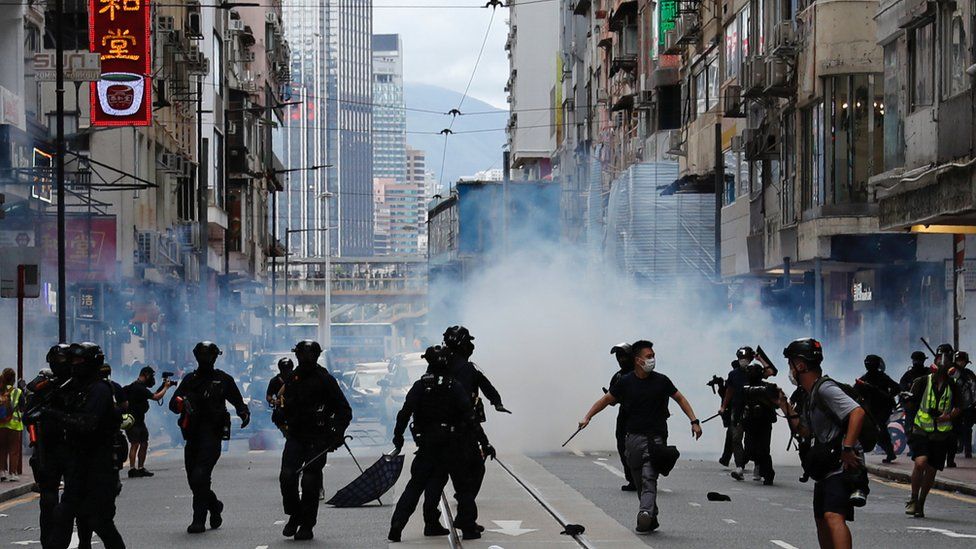
Street view of riot police and protesters in Hong KongIMAGE SOURCE,REUTERS

Image caption,
Facebook and Twitter removed accounts linked to China during unrest in Hong Kong in 2019


There have also recently been a series of denials from Beijing over reports into forced imprisonment of its minority Uighur population - these have included baseless accusations against media and human rights organisations.

In the latest attack, an official falsely claimed a Uighur interviewee on a BBC programme was an actress.

So what tactics does China use in the spread of misleading and false information?

Increasing anti-BBC coverage

There have been almost daily anti-BBC articles in Chinese state media since mid-February.

It follows a decision by the UK broadcasting regulator Ofcom to revoke the licence for China's state-run overseas broadcaster, CGTN.

For years, China has broadly criticised Western outlets for reports on affairs in Xinjiang and elsewhere in China, saying they should not intervene in China's "internal affairs".

But these latest attacks on Western media are a clear escalation.

Chinese domestic media outlets have praised their government for banning the BBC's World News channel, although it was only available in some international hotels and residential compounds where foreigners live.

Reports from leading outlets like China's Global Times have criticised the "Cold War" mentality when it comes to China - on topics ranging from Hong Kong, the Uighur population of Xinjiang and the Covid-19 pandemic.

When China was facing a backlash over its handling of early stages of the pandemic last year, and some US officials were floating the theory that the virus could have escaped from a Wuhan lab, CGTN started to push its own conspiracy theory.

Despite a complete lack of evidence, the station suggested the virus originated at a military base in Maryland in the US and was brought to China by American soldiers during an athletics competition.

Find out more

Finger pointing at mobile phone screenIMAGE SOURCE,GETTY IMAGES
Presentational grey line

'Wolf warriors' on social media

In recent months, China experts have noticed dozens of new and highly active official social media accounts representing Chinese embassies and leading diplomats.

This has become known as "wolf warrior" diplomacy. The best-known account belongs to Zhao Lijian from the Chinese foreign ministry.

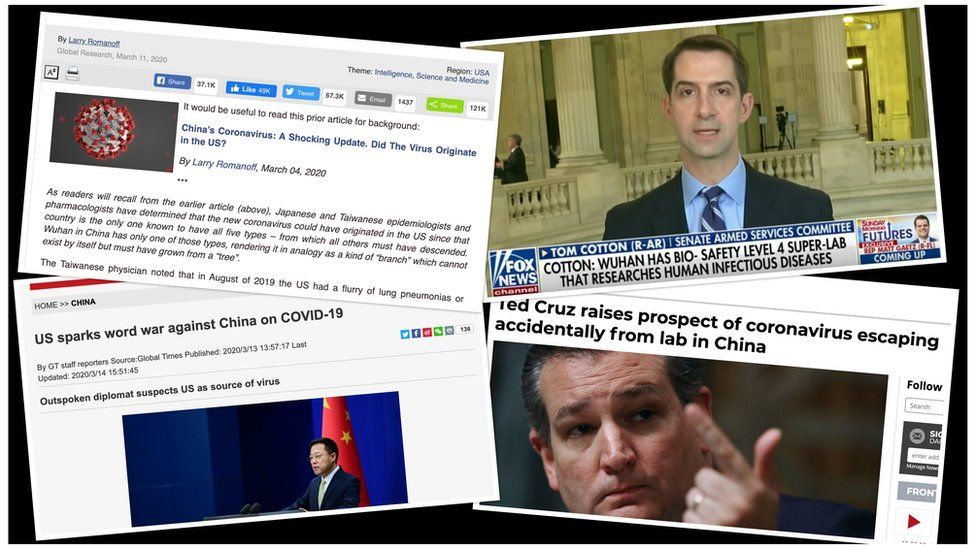
He caused controversy in March after tweeting articles suggesting that coronavirus originated in the United States.

Composite picture of websites
Image caption,
The US and China traded unverified theories about the origins of coronavirus

Those tweets have been shared more than 40,000 times and referenced in 54 different languages, according to research from the Digital Forensic Research Lab, part of the Atlantic Council think tank.

Popular hashtags referencing the posts have made waves at home too - they've been viewed by users of Chinese social network Weibo more than 300 million times.

In December, Zhao Lijian was widely criticised for sharing a fake image of an Australian soldier killing an Afghan child, for which China refused to apologise.

'Keyboard army'

China draws on millions of citizens to monitor the internet and influence public opinion on a massive scale online. These recruits are known as the "50 cent army" - so named because of reports that they were paid 0.5 yuan per post.

This "keyboard army" has long been active on Chinese social media platforms. Its aim has been to aggressively defend and protect China's image overseas.

When tweeting in English, the messages are aimed at a Western audience, much like troll farms in Russia that sow discord.

To the unsuspecting reader, they might appear as patriotic citizens acting independently, but frequently they are taking directions from Chinese authorities.

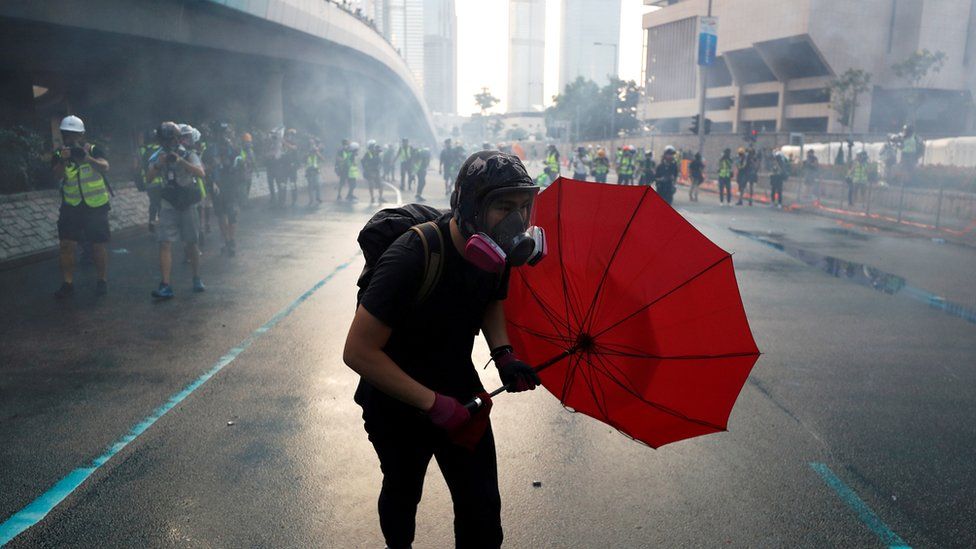
One example is the way in which video footage of violent protests in Hong Kong in 2019 was promoted on social media via this keyboard army using terms such as "terrorism", while coverage of peaceful protests was censored.

A Hong Kong protesterIMAGE SOURCE,REUTERS

In August 2019, Facebook and Twitter announced they had removed accounts linked to a state-backed information campaign.

Facebook said: "Although the people behind this activity attempted to conceal their identities, our investigation found links to individuals associated with the Chinese government."

Twitter identified more than 900 accounts from China. But these were only the most active components of the campaign, which the company said involved some 200,000 accounts.

Fake social media accounts

A BBC investigation in May 2020 found hundreds of fake or hijacked social media accounts promoting pro-China messages on Facebook, Twitter and YouTube. Some 1,200 accounts targeted people critical of how Beijing was handling the pandemic.

There was no definitive evidence tying these accounts to the Chinese government, but it did display similar characteristics to the state-backed network removed by Facebook and Twitter in 2019.

It also resembled another network dubbed "Spamouflage Dragon", which pumped out pro-China posts and attacked critics with spam, which was uncovered by the social analytics firm Graphika.

Subsequently Twitter said it had removed more than 23,000 accounts linked to China involved in a range of "manipulative and co-ordinated activities".

In response to comments made by Yang Xiaoguang, from the Chinese Embassy in the UK on the BBC Today programme, a BBC spokesman said: "We completely reject these claims and stand by our journalism. BBC News reporting in Xinjiang has been accurate and impartial - we did not use any false images and the interviewee who appeared on the BBC was not an 'actress' as claimed."

Additional reporting by Jack Goodman

https://www.bbc.com/news/56364952


Thursday, 11 March 2021

COUNTERING CHINA: NOW OR NEVER


Gravitas: Are we running out of time to counter China?

173,386 views  
Mar 11, 2021

6.74M subscribers
The world gets one chance to counter expansionist regimes. With China drawing plans to dominate the post-pandemic world order, this could be the make-or-break moment to counter the Dragon

Most Recent Post

Man charged for borrowing rare Chinese manuscripts from UCLA library, returning fakes

  Suspect Jeffrey Ying allegedly travelled to China after checking works out using several aliases Agence France-Presse Published: 12:11pm, ...

Popular Posts - Last 30 days