Australia launched an investigation Wednesday into what the defence minister called disturbing reports that China has been hiring retired Western air force pilots to train its military.
The UK government had earlier announced it would take "decisive steps" to stop Beijing from headhunting former pilots after British media reported that over 30 former pilots had accepted offers upwards of £240,000 ($273,750) to train China's air force.
"We are taking decisive steps to stop Chinese recruitment schemes attempting to headhunt serving and former UK Armed Forces pilots to train People's Liberation Army personnel," a spokesperson for the British defence ministry told AFP.
Australian defence minister Richard Marles announced a probe into whether Australian pilots had also been recruited.
"When our ADF personnel sign up to the defence force, they do so to serve their country and we are deeply grateful of that," he said in a statement.
"I would be deeply shocked and disturbed to hear that there were personnel who were being lured by a pay cheque from a foreign state above serving their own country."
According to the reports, many of the recruited pilots were in their 50s and had recently left the British air force.
Chinese foreign ministry spokesman Wang Wenbin denied any knowledge of British pilots being targeted, telling a regular press briefing: "I am not aware of the circumstances you mentioned".
Marles launched Australia's investigation from Tonga, where he has been attending a meeting of defence ministers from South Pacific nations.
Australia and the United States have been scrambling to shore-up diplomatic support as China expands its footprint in the Pacific.
TL;DR: Sanctions against Russia mean the country now looks to the Chinese gray market for its semiconductor imports, but there's a problem: 40% of them are defective. That marks a 1,900% increase in their failure rate over the last few months.
As reported by The Register, pro-Putin newspaper Kommersant writes that the percentage of defective imported chips into Russia before the war was just 2%, which isn't very good considering how many components are found in today's electronic items. Now, almost eight months after the country invaded Ukraine, it stands at 40%.
Russia blames these failure rates on the pandemic impacting the supply chain and sanctions forcing it to import chips from the Chinese gray market, an area that not only comes with the threat of faulty products but is also unreliable and slow.
Many businesses have quit Russia as a result of the import restrictions, and those that are left must deal with sanction-skirting Chinese companies for semiconductors. Given that some of these duds were likely intended for military hardware supporting the war in Ukraine, one wonders if Russia and China's "friendship without limits" extends to imports of non-borked chips.
China has neither confirmed its support for Russia's invasion of Ukraine nor condemned Putin's actions. But the sanctions placed on the country have benefitted Chinese companies dealing with their own US-imposed restrictions—we often see both nations grouped together in sanctions, as was the case with the export rules introduced a few weeks ago that stopped Nvidia and AMD from selling their high-performance AI-focused GPUs to Russia or China without a license.
After it was first hit with import sanctions, Russia made bold claims that it would be investing in domestic chip development, manufacturing, and personnel training, with the intention of producing chips using a 28nm node by 2030. May brought news that Russia's inability to source reliable semiconductors was forcing it to use components taken from dishwashers and refrigerators in its tanks, which are probably more reliable than the Chinese imports, anyway.
Domestic manufacturers of computers, phones, servers and other electronics faced an increase in the supply of defective components. After the outbreak of hostilities in Ukraine, according to them, the share of marriage increased from 2% to 40%. Due to sanctions and logistics violations, importers have to create longer supply chains and buy goods not directly from factories, but from intermediaries and exchanges, so the degree of control over the quality of products is falling, experts explain. They admit that the problem will lead to an increase in prices for domestic equipment.
The share of defective chips and components in the supply of Russian companies from China since the beginning of hostilities in Ukraine has increased from 2% to 40%, the interlocutor of "Kommersant" in the Russian electronics market told Kommersant. In his opinion, the reason is that due to the termination of official cooperation of foreign distributors with Russian partners, the latter began to establish channels for the import of electronics and components through unofficial suppliers.
"The increase in marriage will increase the final cost of Russian electronics by half and stretch the production time," he notes.
The problem is confirmed by the top manager of a major Russian electronics manufacturer: the shortage of components caused by a disruption in logistics due to the pandemic has increased this year due to sanctions. Manufacturers, according to the interlocutor of "Kommersant", are forced to purchase components from unauthorized suppliers who are not responsible for the quality of products.
Customers themselves began to purchase components in China and other countries, without having the experience and technologies to check suppliers and products, says Ivan Pokrovsky, general director of the Center for Modern Electronics. At the same time, he argues that the problem "concerns individual companies, not the entire industry." The Ministry of Industry and Trade "Kommersant" reported that information about the increase in defective supplies of components was not received there.
After the outbreak of hostilities in Ukraine, the US Treasury began to include Russian manufacturers and developers of electronics in the sanctions lists, which is why the latter were cut off from the supply of foreign components. Under the restrictions, for example, were the structure of Baikal Electronics, MCST, SPC Elvis, Aquarius and the structure of the Yadro Group of Companies (see "Kommersant" of September 15).
The percentage of defects in the market differs depending on the manufacturer, the quantity and quality of components and their type, said Evgeny Krivosheev, director of production and development of F+ tech (produces smartphones, PCs and other electronics, part of the Marvel Distribution structures). "In our practice, a significant percentage of the total number of defects was associated with LCD-displays of devices. To assemble a smartphone, about 250 elements are required, to assemble a server - already more than 1 thousand, and it is difficult to determine the quality of the components by appearance, "he says.
The top manager believes that the percentage of defects can be significant, because the shortage and restrictions on the supply of components have increased the number of people who want to get rid of illiquidity.
"In the case of shipments of substandard batches, such as memory modules, processors and drives, the chance of meeting defective products is higher if the manufacturer chooses anonymous sellers," he adds.
Importers have to create longer chains and buy goods not directly from factories, but from intermediaries and exchanges, so the degree of control over the quality of products is falling, admits Nikolai Komlev, executive director of the Association of Computer and Information Technology Enterprises. He doubts that the quality of Russian equipment will noticeably fall, "after all, before assembling computers, chips are tested, but rejected products are included in the price of the final ones." If the percentage of defects has increased by 40%, it can be assumed, the expert says, that the costs in the price of the final product will rise by these 40% of the cost of components.
According to the results of a survey of the largest developers and manufacturers of computer equipment, including Aquarius, Business Office (iRU), ICL, New IT Project, Bulat, ATOL, the presence of the indicated problem in terms of a sharp increase in the defective components and, as a result, the increase in equipment prices was not confirmed, said Svetlana Legostaeva, general director of the Computer Engineering Consortium.
Watch: Hong Kong protester attacked in China consulate grounds
By Lok Lee at the consulate in Manchester and Elsa Maishman in London
BBC News
A Hong Kong pro-democracy protester was pulled into Chinese consulate grounds in Manchester on Sunday and beaten up.
Unidentified men came out of the consulate and forced a man inside the compound, before he escaped with the help of police and other demonstrators.
The protester told the BBC: "They dragged me inside, they beat me up."
A consulate spokesperson said protesters had displayed an insulting portrait of China's president.
The Foreign Office said it was urgently seeking clarity on the incident. Greater Manchester Police has launched an investigation.
Speaking after the incident, the protester, called Bob, told BBC Chinese that "mainlanders" - people from mainland China, as opposed to Hong Kong - came out of the consulate and destroyed their posters.
"As we tried to stop them, they dragged me inside, they beat me up," he said, adding that he was then pulled out by the UK police.
"It's ridiculous. They [the attackers] shouldn't have done that. We are supposed to have freedom to say whatever we want here [in the UK]."
After the incident, the crowd remained angry. Protesters shouted at the men from the consulate and the British police, arguing they could have done more.
Consulate staff had previously asked the protesters to move to the opposite side of the street.
There were two police officers at the protest, but several more appeared within minutes of the altercation beginning.
They gathered at the gates of the compound trying to break up the fighting and move protesters back.
One police officer entered the consulate grounds and pulled the man who had been dragged inside back out.
At least eight men - some of whom were wearing helmets and protective vests - then returned to the consulate building.
The consulate is on UK soil, but cannot be entered without consent. Any offence committed on diplomatic premises is subject to UK law, but employees may hold diplomatic immunity.
Reacting on Twitter, former Conservative leader Iain Duncan Smith said the UK government should demand a full apology from the Chinese ambassador, and that those involved should be sent back to China.
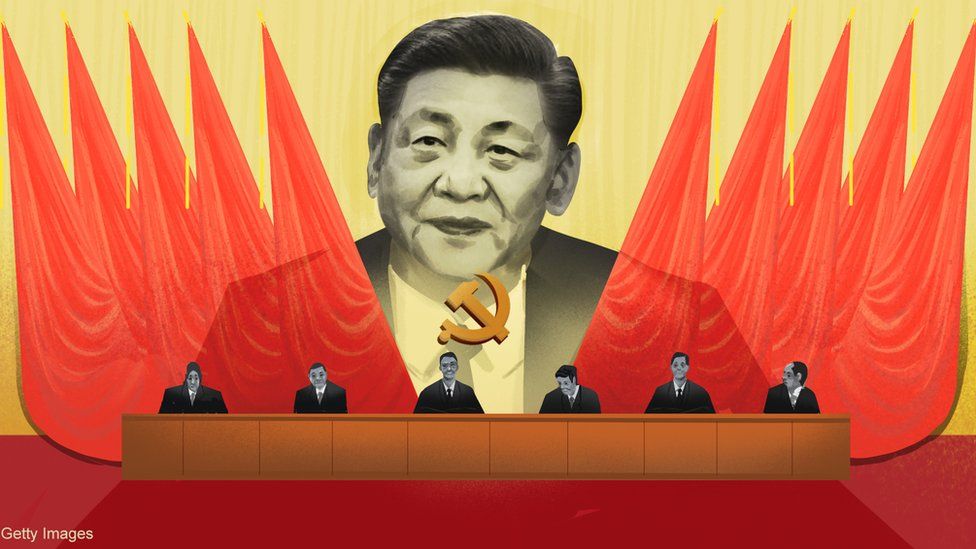
President Xi Jinping, who is set to secure a third term in power, said he had turned the situation in Hong Kong from "chaos to governance", referring to China's suppression of pro-democracy protests there.
A spokesperson for the consulate said the protesters had "hung an insulting portrait of the Chinese president at the main entrance".
"This would be intolerable and unacceptable for any diplomatic and consular missions of any country. Therefore, we condemn this deplorable act with strong indignation and firm opposition," the spokesperson added.
A spokesperson said Greater Manchester Police was aware of the incident.
"Officers were present and responded immediately to defuse the situation," they said.
"Enquiries are ongoing at this time to understand the full circumstances."
Students and teachers at Nanjing University of the Arts watch Xi's speech
Many people in China normally don't pay much attention to these set-piece, long, predictable speeches from their leaders.
However this year they were looking for any indication that the country's strict Covid amelioration measures might be eased after the Communist Party Congress.
The short answer from Chinese leader Xi Jinping: no.
He said that there would be no wavering on zero-Covid because of the need to prioritise saving people's lives.
The lockdowns, the mass testing, the health code scanning, the quarantine, the travel restrictions are all here to stay for the foreseeable future.
There was not even the slightest acknowledgement of the social and economic pain being caused by the policy.
Other massive challenges being faced by the government but which didn't get a mention include: soaring youth unemployment and the property crisis.
Instead, this nearly two-hour long speech was heavy on standard Party rhetoric and short on actual solutions to China's problems.
If you are a university graduate who can't find a job in the tech sector following government crackdowns on these companies, Xi Jinping urging you to "follow the Party's guidance… striving to be the new generation, building a modern socialist county" is not going to be much comfort.
The largest applause, no doubt scripted, came when Mr Xi spoke about unification between the mainland and Taiwan.
He said Beijing would encourage economic cooperation with the island, that it would genuinely strive for peaceful unification but that the Party would "never promise to renounce the use of force as an option".
He also defended the much-criticised state security law in Hong Kong which he said had restored order to the city.
Likewise, he justified the demolition and alterations to many mosques in the northern Chinese provinces of Ningxia and Xinjiang - home to a mostly Muslim population - by saying that religions here must be "Chinese in orientation".
Structures seen as reflecting an Arab image of Islam have been replaced by those with a more Chinese aesthetic.
There were a few other elements that did not go unmissed.
Former leader Jiang Zemin was not present but he is now 96 and perhaps too frail to attend. Hu Jintao and Wen Jiabao from the former administration were on stage with Mr Xi.
Also in attendance, seated at the front row of the podium, was former Chinese Vice Premier Zhang Gaoli - his first public appearance since Chinese tennis star Peng Shuai accused him of sexual assault last year.
The 75-year-old has not publicly commented on the accusation.
Zhang Gaoli (C) was seated at the front row of the congress
However, Mr Xi's administration does have a good story to tell in terms of climate change and other environmental initiatives.
The congress opened in Beijing under a clear blue sky. There was a time when this was unusual in the capital. Now it's the other way around; the bad pollution days are the ones that stand out.
China's leader said: "We'll boost low carbon industries and promote low carbon ways of life. We'll intensify pollution control. We'll work to eliminate all serious pollution".
But coal fired power won't be phased out until the new sources of power are in place. "We're building the new before discarding the old," he said.
There may still be a massive income disparity here between the richest Chinese people and those less well-off but, in poverty alleviation, there have also been improvements and Xi Jinping referred to this.
Yet, if you watched this speech and had no idea what is actually going on in China right now, you would have a distorted picture of reality.
The overall message from the speech was that China is charging ahead in leaps and bounds under the Communist Party's guidance - but the economic uncertainty swirling around here right now is of a kind not seen in the country for decades.