Showing posts with label Africa. Show all posts

Tuesday, 15 February 2022

EU tempts Africa away from Chinese influence

 The bloc has pledged €150 billion in funding for major projects in Africa.

Last year, Chinese President Xi Jinping pledged one third of the previous year's investments for Africa | Lintao Zhang/Getty Images

With China reducing its spending in Africa, Europe sees a chance to boost its influence.

At a two-day gathering of European and African leaders in Brussels this week, the EU hopes to unveil a series of major projects that will benefit from €150 billion in funding it has already pledged for its southern neighbors.

A draft “summary of deliverables” document ahead of the summit with African Union leaders, and seen by POLITICO, lists a series of ambitious projects to improve digital connectivity, build new transport links and accelerate the shift to lower-carbon energy sources. It is all part of the bloc's Global Gateway strategy — seen as a geostrategic riposte to China's own Belt and Road initiative.

"It’s a good moment for Global Gateway. It’s clearly a good idea but we need to make sure that it’s properly funded in order to say with credibility that it’s living up to its promise to counter the Belt and Road," said Anna-Michelle Asimakopoulou, vice chair of the European Parliament's international trade committee. "They have to feel the difference." 

An EU official said Europe could step in as China pulls back. "The mega roll-out of Chinese money isn’t there anymore if you compare to a couple of years ago. The Chinese have a real problem in Africa."

China has been investing less in Africa, especially since the beginning of the coronavirus pandemic, a departure from earlier fears from African and Western countries over Beijing's debt-trap diplomacy.

At the Forum on China-Africa Cooperation (FOCAC) meeting last year, Chinese President Xi Jinping pledged $40 billion worth of investments for Africa, a third less than previous commitments. The same goes for Chinese loans. These totaled $7.6 billion in 2019 (the latest available figures) according to the Chinese Loans to Africa Database, run by Johns Hopkins University and Boston University. That's a sharp drop from the 2016 peak of $29.5 billion.

China has given other assistance though, promising 1 billion more coronavirus vaccines doses in November, on top of 200 million doses already delivered to African countries. Vaccines are a sore point between the EU and Africa because of the bloc's refusal to waive intellectual property rights that would allow for cheaper production.

In his message to African leaders in November Xi also needled another point of tension: Europe's colonial history in Africa.

"Over the past 65 years, China and Africa have forged unbreakable fraternity in our struggle against imperialism and colonialism," Xi told the (FOCAC) meeting before hailing what he called the "big family of Belt and Road cooperation."

Firewall doused

Europe's battle for influence in Africa is evident in the choice of visits by EU top brass ahead of the Brussels summit — which was delayed for 16 months because of the pandemic.

Margrethe Vestager, the EU's powerful digital chief, was in Abuja, Nigeria on Monday to discuss the EU-Nigeria Digital Economy package. But though it was all smiles at the Valentine's Day meeting with her counterpart, Digital Minister Isa Pantami, the country has been flirting with an internet model that is less than the free and open version favored by Europe. "€820 million until 2024 to invest in shared priorities ... with democratic, human-centered governance," she said in a thinly veiled remark on Twitter while in Abuja. "So much to do together."

The government imposed a national ban on Twitter in June last year after the social media platform deleted a tweet by President Muhammadu Buhari threatening a violent crackdown on secessionists. It has only just been restored.

Meanwhile, members of the government, including the president's chief of staff, flew to Beijing to learn more about the Great Firewall — China's nationwide cyber-censorship and surveillance — just before the ban was imposed, according to a report by the Foundation for Investigative Journalism.

"China has [had a good] relationship with African dictators for the past 15 years with a certain amount of success," said Philippe Le Corre, a China expert at Carnegie Endowment for International Peace, referring to China's relationship with Africa in general. But while Global Gateway investments will help the EU push its agenda, "Money will not be enough — politics is a must," he said. The EU must be politically savvy to avoid the appearance of being a "naive helper" while China provides repressive technology, he added.

Vestager's Abuja leg is a stark reminder of what the EU is facing: that Beijing's digital model is increasingly attractive to authoritarian regimes around the world, casting ever bigger uncertainty on the future of an open, accessible internet.

The other geopolitical battleground lies in deep water.

According to the EU's Global Gateway plans, Brussels is eyeing a secure international submarine fiber cable connecting the EU with Africa along the Atlantic Ocean coast. “The new connection will foster the digital sovereignty of the two continents by diversifying existing links and ensuring the highest infrastructure and cyber security standards,” a draft document seen by POLITICO stated.

That's a clear signal of the EU's growing unease at China's expansion of digital connectivity with parts of Africa. Leading Chinese telecoms provider Huawei Technologies is nearing completion of a cable project linking Asia with Eastern Africa (with a diversion also to France's Marseille via Greece and Egypt). That project also has Orange as the French partner, underlining the complex business reality that goes beyond black-and-white distinctions along geopolitical lines.

Too little, too late?

One big open question is where the funding for Europe's ambitions will come from. Details are limited and it seems that a sizeable portion of the €150 billion fund — to be handed out over the next seven years — won't come from public sources.

That makes sense, said Theodore Murphey, Africa director of the European Council on Foreign Relations. "If we want to make sure that we match China, we have to combine all EU initiatives, from both the EU institutions and EU countries to make sure that our footprint is greater than the sum of all parts.”

But it also introduces uncertainty, Francesca Ghiretti and Grzegorz Stec argue in a recent report published by MERICS, a Berlin-based think tank on China affairs. "In a rather European fashion, Brussels aims to incentivize private or public investors to match funds ... Despite the incentives a co-founder like the EU can create for other investors, finding proper and reliable matching investors will be a challenge."

And there's also the issue of the conditions attached to EU funds. The bloc's officials say they won't forgo principles such as labor, environmental and anti-corruption standards. That could tip the balance for African capitals in favor of accepting Belt and Road financing from Chinese banks which has no strings attached.

A draft of the joint statement that the EU hopes to agree with African Union leaders on Friday hails "a common future, as closest partners and neighbours." It's unclear yet whether that invitation will compete with China's growing foothold on the continent.

https://www.politico.eu/article/eu-tempts-africa-away-from-chinese-influence/

Sunday, 26 December 2021

New African port, Bata, to put China across the Atlantic from the US


China is building a new military port on Africa’s Atlantic coast.


A commentary by Dan Southerland
2021.12.26


New African port to put China across the Atlantic from the USChinese President Xi Jinping (on the screen) delivers his speech during the China-Africa Cooperation (FOCAC) meeting in Dakar, Senegal, Nov. 29, 2021.
 AFP

China is building a new military port on Africa’s Atlantic coast.

The port at Bata in the Central African nation of Equatorial Guinea is set to become China’s first permanent military presence on the coast of West Africa.

U.S. officials told The Wall Street Journal that this meant that Chinese warships might be able to rearm and refit in a location opposite to the east coast of the United States.

The new Chinese naval base would be located nearly 10,000 kilometers, or 6,000 miles from Washington. But American officials have shown concern over it.

In October, the U.S. government sent a senior national security adviser to the tiny oil-producing country of Equatorial Guinea to call on officials there to resist China’s overture. It appears that he didn’t succeed.

Meanwhile, The Economist magazine said that “The Gulf of Guinea would be a logical place to look for a base.”

“Piracy is a scourge there,” it said. “So China could plausibly argue that its help is needed.”

And, according to the magazine, the family-run dictatorship in Equatorial Guinea “happens to be the sort that China is well practiced at doing business with in Africa: brutal, corrupt, and a financial shambles.”

In recent years the U.S. and its allies have confiscated allegedly ill-gotten luxury assets from Equatorial Guinea’s vice president Teodoro Nguema Obiang Mangue. The proceeds are used to fund COVID-19 vaccines and other medical assistance for the country.


This photo taken on Aug. 1, 2017 shows Chinese People's Liberation Army personnel attending the opening ceremony of China's new military base in Djibouti. China has deployed troops to its first overseas naval base in Djibouti, a major step forward for the country's expansion of its military presence abroad. Credit: AFP
'More adventurous'

Five years after building its only overseas base in Djibouti on the Horn of Africa on Africa’s east coast, Djibouti has remained until now the Chinese armed forces only overseas bastion.

Ryan Martinson of the U.S. Naval War College in Newport, Rhode Island, provides some useful background.

Chinese military analysts, he says, have openly advocated “pushing into waters far from home to divert American attention and resources from Chinese waters.”

Martinson cites a book by Hu Bo of Peking University, in which Hu acknowledges that China’s Navy couldn’t compete with America for supremacy in faraway seas.

But Hu suggests that China could “pin down” some American forces that might otherwise be sent to East Asia.

Martinson also cites Liu Zhe, the captain of China’s first aircraft carrier, the Liaoning, who wrote in an essay in 2017 that “the farther away we are from our territorial sea, the more secure will be the motherland behind us.”

The Economist says that China is “becoming a more adventurous naval power,” amassing more ships, though not more tonnage, than the U.S. Navy.

But most of these vessels keep to Indo-Pacific waters.

When China began building its first overseas base in 2016 in Djibouti on the Horn of Africa, Chinese officials tried to allay Western anxiety about their country’s expanding military presence.

People hold Chinese and Djiboutian national flags with the portrait of Djibouti's President Ismail Omar Guellehas as they wait for the arrival of the president before the launching ceremony of new Chinese-funded 1000-unit housing construction project in Djibouti,  July 4, 2018. Credit: AFP
People hold Chinese and Djiboutian national flags with the portrait of Djibouti's President Ismail Omar Guellehas as they wait for the arrival of the president before the launching ceremony of new Chinese-funded 1000-unit housing construction project in Djibouti, July 4, 2018. Credit: AFP
Debt buildup

They said that the Djibouti base was built only for “supporting multinational anti-piracy efforts, helping to secure vital shipping lanes, and enabling China to protect its citizens in the region.”

In 2011, the Chinese Navy helped to conduct an evacuation of some 30,000 Chinese citizens from Libya as that North African country descended into civil war.

But in Kenya to the south of Djibouti, local citizens worry about the dangers of oil spills, the inevitable accidents that the Chinese Navy might bring, and the costs of financing a new port and railroad there.

According to a foreign journalist living in Kenya, critics there say that Kenya “has sold its soul to China and is wallowing in debt that it won’t be able to pay back.”

Meanwhile, China’s commitment to offering economic and financial aid to a number of African countries appears to have its limits.

According to the Financial Times, experts are concerned about African nations’ ability to repay Chinese loans.

Apparently with this in mind, China has announced plans to cut loans provided to those nations by a third over the next three years.

In a recent video address to the triennial Forum on China-African Cooperation being held in Senegal, China’s President Xi Jinping pledged to provide $40 billion to African states in investments, credit lines, trade financing, and special drawing rights.

Although that represents a cut from the $80 billion pledged at the previous two summits, Xi emphasized his commitment to what he called a “win-win situation.”


Dictating terms

Meanwhile, Chidi Odinkalu, senior manager for Africa at the Open Society Foundations, criticized some African governments for relying too heavily on loans from China.

“China’s strategic objective was to get a foot in the door,” he said “Now that it’s in the door, it can choose to dictate the terms.”

The International Monetary Fund (IMF) says that debt ratios in Sub-Saharan Africa have been rising in part due to the COVID-19 pandemic.

This is creating debt distress in countries that were already suffering from negative financial conditions.

Africa has witnessed an estimated 214,000 deaths as well as drastic economic effects due to COVID-19.

As Africa’s largest bilateral creditor, China holds more than 20 percent of African debt.

And payments to China account for nearly 30 per cent of 2021’s debt service. Angola alone accounts for almost a third.

The Centre for the Study of Economies in Africa reports that at least three factors drove the debt crisis—a global recession in the early 1980s, the rise in interest rates in developed countries, and a decline in new capital inflows.

According to the Washington-D.C. –based Brookings Institution, as of 2018, 19 African countries have exceeded the 60 percent debt-to-GDP threshold set by the African Monetary Cooperation Program for developing countries.

Meanwhile, 24 countries have exceeded the 95 percent debt-to-GDP rates suggested by the IMF.

Surpassing that threshold means that these countries are highly vulnerable to economic changes while their governments have a reduced capacity to provide support to their economies in the event of a recession.

Dan Southerland is RFA's founding Executive Editor.

Source 

Monday, 6 December 2021

China plotting to build warship base in Atlantic

 US intelligence believed China was intending to build a "permanent military presence" in the nation sandwiched between Cameroon and Gabon. Such a facility would be significant as it would give China its first base on the Atlantic Ocean. This would mean Chinese warships would be able to rearm and refit opposite the East Coast of the US, a threat that is setting off alarm bells at the White House and Pentagon.

James Lee   Daily Express   6 December 2021

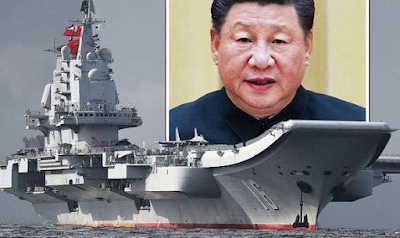
© Getty China Navy Carrier

US national security adviser Jon Finer visited Equatorial Guinea in October on a mission to persuade President Teodoro Obiang Nguema Mbasogo to reject China's overtures for such a project.

President Joe Biden's administration had conveyed to the Mbasogo government any Chinese activity would "raise national security concerns".

The report speculated China would consider building a military facility in the port city of Bata. Beijing had built a deep-water commercial port in Bata.

© Getty Xi in Africa

General Stephen Townsend, commander of the US Africa Command, had warned the Senate in April about the risk of China having a naval facility on the Atlantic coast.

He said: "This is something more than a place that they can make port calls and get gas and groceries. I'm talking about a port where they can rearm with munitions and repair naval vessels."

The latest Pentagon report on China's military modernisation had warned China was considering military facilities in Kenya, Tanzania and Angola.

In 2017, China formally opened its first overseas military base in Djibouti, on the Indian Ocean.

The facility has since seen the expansion of infrastructure to accommodate ships such as submarines and aircraft carriers.

© Getty Mbasogo

China's plans for a new facility on the Atlantic Ocean also shed light on the rapid expansion of its navy.

The Pentagon report had noted the People's Liberation Army Navy (PLAN) was now the world's largest navy, "with an overall battle force of approximately 355 ships and submarines, including approximately more than 145 major surface combatants."

Unlike nations such as Kenya, Tanzania and Angola, a facility on the Atlantic Ocean would have considerable practical and symbolic implications as it directly challenges US hegemony over the region.

In addition, a facility in Equatorial Guinea is expected to provide options to deploy forces to protect Chinese investments in the western part of Africa.

In 2009, China upgraded a commercial port in Equatorial Guinea, in the city of Bata - the largest city on the mainland.

The country's capital, Malabo, is on an island an hour's flight from the mainland.

Chinese state-owned companies have built 100 commercial ports around Africa in the past two decades, according to Chinese government data.

American diplomats in Mauritania, along Africa's northwest coast, have advised local authorities to turn down any effort by Beijing to use a Chinese-built port for military purposes, according to a U.S. official.

© Getty Equatorial Guinea

Much of China's expansion into African comes as part of the multi-trillion "One belt one road" initiative which has seen Beijing expand its economic and diplomatic presence across the globe.

Of the 54 African nations, China has invested in 52 of them.

The US and China are currently the world's largest economies, yet China is expected to surpass the US to the top spot by as early as 2024.

Academics and military specialists believe that China and the US are entering a new cold war.

Tension is high between Washington DC and Beijing over a host of issues including Taiwan, the South China Sea, the so-called AUKUS deal and dominance of the global economy.

Source

Most Recent Post

Man charged for borrowing rare Chinese manuscripts from UCLA library, returning fakes

  Suspect Jeffrey Ying allegedly travelled to China after checking works out using several aliases Agence France-Presse Published: 12:11pm, ...

Popular Posts - Last 30 days