Showing posts with label Djibouti. Show all posts

Sunday, 26 December 2021

New African port, Bata, to put China across the Atlantic from the US


China is building a new military port on Africa’s Atlantic coast.


A commentary by Dan Southerland
2021.12.26


New African port to put China across the Atlantic from the USChinese President Xi Jinping (on the screen) delivers his speech during the China-Africa Cooperation (FOCAC) meeting in Dakar, Senegal, Nov. 29, 2021.
 AFP

China is building a new military port on Africa’s Atlantic coast.

The port at Bata in the Central African nation of Equatorial Guinea is set to become China’s first permanent military presence on the coast of West Africa.

U.S. officials told The Wall Street Journal that this meant that Chinese warships might be able to rearm and refit in a location opposite to the east coast of the United States.

The new Chinese naval base would be located nearly 10,000 kilometers, or 6,000 miles from Washington. But American officials have shown concern over it.

In October, the U.S. government sent a senior national security adviser to the tiny oil-producing country of Equatorial Guinea to call on officials there to resist China’s overture. It appears that he didn’t succeed.

Meanwhile, The Economist magazine said that “The Gulf of Guinea would be a logical place to look for a base.”

“Piracy is a scourge there,” it said. “So China could plausibly argue that its help is needed.”

And, according to the magazine, the family-run dictatorship in Equatorial Guinea “happens to be the sort that China is well practiced at doing business with in Africa: brutal, corrupt, and a financial shambles.”

In recent years the U.S. and its allies have confiscated allegedly ill-gotten luxury assets from Equatorial Guinea’s vice president Teodoro Nguema Obiang Mangue. The proceeds are used to fund COVID-19 vaccines and other medical assistance for the country.


This photo taken on Aug. 1, 2017 shows Chinese People's Liberation Army personnel attending the opening ceremony of China's new military base in Djibouti. China has deployed troops to its first overseas naval base in Djibouti, a major step forward for the country's expansion of its military presence abroad. Credit: AFP
'More adventurous'

Five years after building its only overseas base in Djibouti on the Horn of Africa on Africa’s east coast, Djibouti has remained until now the Chinese armed forces only overseas bastion.

Ryan Martinson of the U.S. Naval War College in Newport, Rhode Island, provides some useful background.

Chinese military analysts, he says, have openly advocated “pushing into waters far from home to divert American attention and resources from Chinese waters.”

Martinson cites a book by Hu Bo of Peking University, in which Hu acknowledges that China’s Navy couldn’t compete with America for supremacy in faraway seas.

But Hu suggests that China could “pin down” some American forces that might otherwise be sent to East Asia.

Martinson also cites Liu Zhe, the captain of China’s first aircraft carrier, the Liaoning, who wrote in an essay in 2017 that “the farther away we are from our territorial sea, the more secure will be the motherland behind us.”

The Economist says that China is “becoming a more adventurous naval power,” amassing more ships, though not more tonnage, than the U.S. Navy.

But most of these vessels keep to Indo-Pacific waters.

When China began building its first overseas base in 2016 in Djibouti on the Horn of Africa, Chinese officials tried to allay Western anxiety about their country’s expanding military presence.

People hold Chinese and Djiboutian national flags with the portrait of Djibouti's President Ismail Omar Guellehas as they wait for the arrival of the president before the launching ceremony of new Chinese-funded 1000-unit housing construction project in Djibouti,  July 4, 2018. Credit: AFP
People hold Chinese and Djiboutian national flags with the portrait of Djibouti's President Ismail Omar Guellehas as they wait for the arrival of the president before the launching ceremony of new Chinese-funded 1000-unit housing construction project in Djibouti, July 4, 2018. Credit: AFP
Debt buildup

They said that the Djibouti base was built only for “supporting multinational anti-piracy efforts, helping to secure vital shipping lanes, and enabling China to protect its citizens in the region.”

In 2011, the Chinese Navy helped to conduct an evacuation of some 30,000 Chinese citizens from Libya as that North African country descended into civil war.

But in Kenya to the south of Djibouti, local citizens worry about the dangers of oil spills, the inevitable accidents that the Chinese Navy might bring, and the costs of financing a new port and railroad there.

According to a foreign journalist living in Kenya, critics there say that Kenya “has sold its soul to China and is wallowing in debt that it won’t be able to pay back.”

Meanwhile, China’s commitment to offering economic and financial aid to a number of African countries appears to have its limits.

According to the Financial Times, experts are concerned about African nations’ ability to repay Chinese loans.

Apparently with this in mind, China has announced plans to cut loans provided to those nations by a third over the next three years.

In a recent video address to the triennial Forum on China-African Cooperation being held in Senegal, China’s President Xi Jinping pledged to provide $40 billion to African states in investments, credit lines, trade financing, and special drawing rights.

Although that represents a cut from the $80 billion pledged at the previous two summits, Xi emphasized his commitment to what he called a “win-win situation.”


Dictating terms

Meanwhile, Chidi Odinkalu, senior manager for Africa at the Open Society Foundations, criticized some African governments for relying too heavily on loans from China.

“China’s strategic objective was to get a foot in the door,” he said “Now that it’s in the door, it can choose to dictate the terms.”

The International Monetary Fund (IMF) says that debt ratios in Sub-Saharan Africa have been rising in part due to the COVID-19 pandemic.

This is creating debt distress in countries that were already suffering from negative financial conditions.

Africa has witnessed an estimated 214,000 deaths as well as drastic economic effects due to COVID-19.

As Africa’s largest bilateral creditor, China holds more than 20 percent of African debt.

And payments to China account for nearly 30 per cent of 2021’s debt service. Angola alone accounts for almost a third.

The Centre for the Study of Economies in Africa reports that at least three factors drove the debt crisis—a global recession in the early 1980s, the rise in interest rates in developed countries, and a decline in new capital inflows.

According to the Washington-D.C. –based Brookings Institution, as of 2018, 19 African countries have exceeded the 60 percent debt-to-GDP threshold set by the African Monetary Cooperation Program for developing countries.

Meanwhile, 24 countries have exceeded the 95 percent debt-to-GDP rates suggested by the IMF.

Surpassing that threshold means that these countries are highly vulnerable to economic changes while their governments have a reduced capacity to provide support to their economies in the event of a recession.

Dan Southerland is RFA's founding Executive Editor.

Source 

Monday, 6 December 2021

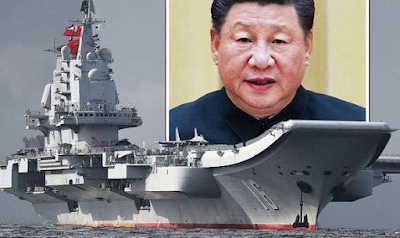
China plotting to build warship base in Atlantic

 US intelligence believed China was intending to build a "permanent military presence" in the nation sandwiched between Cameroon and Gabon. Such a facility would be significant as it would give China its first base on the Atlantic Ocean. This would mean Chinese warships would be able to rearm and refit opposite the East Coast of the US, a threat that is setting off alarm bells at the White House and Pentagon.

James Lee   Daily Express   6 December 2021

© Getty China Navy Carrier

US national security adviser Jon Finer visited Equatorial Guinea in October on a mission to persuade President Teodoro Obiang Nguema Mbasogo to reject China's overtures for such a project.

President Joe Biden's administration had conveyed to the Mbasogo government any Chinese activity would "raise national security concerns".

The report speculated China would consider building a military facility in the port city of Bata. Beijing had built a deep-water commercial port in Bata.

© Getty Xi in Africa

General Stephen Townsend, commander of the US Africa Command, had warned the Senate in April about the risk of China having a naval facility on the Atlantic coast.

He said: "This is something more than a place that they can make port calls and get gas and groceries. I'm talking about a port where they can rearm with munitions and repair naval vessels."

The latest Pentagon report on China's military modernisation had warned China was considering military facilities in Kenya, Tanzania and Angola.

In 2017, China formally opened its first overseas military base in Djibouti, on the Indian Ocean.

The facility has since seen the expansion of infrastructure to accommodate ships such as submarines and aircraft carriers.

© Getty Mbasogo

China's plans for a new facility on the Atlantic Ocean also shed light on the rapid expansion of its navy.

The Pentagon report had noted the People's Liberation Army Navy (PLAN) was now the world's largest navy, "with an overall battle force of approximately 355 ships and submarines, including approximately more than 145 major surface combatants."

Unlike nations such as Kenya, Tanzania and Angola, a facility on the Atlantic Ocean would have considerable practical and symbolic implications as it directly challenges US hegemony over the region.

In addition, a facility in Equatorial Guinea is expected to provide options to deploy forces to protect Chinese investments in the western part of Africa.

In 2009, China upgraded a commercial port in Equatorial Guinea, in the city of Bata - the largest city on the mainland.

The country's capital, Malabo, is on an island an hour's flight from the mainland.

Chinese state-owned companies have built 100 commercial ports around Africa in the past two decades, according to Chinese government data.

American diplomats in Mauritania, along Africa's northwest coast, have advised local authorities to turn down any effort by Beijing to use a Chinese-built port for military purposes, according to a U.S. official.

© Getty Equatorial Guinea

Much of China's expansion into African comes as part of the multi-trillion "One belt one road" initiative which has seen Beijing expand its economic and diplomatic presence across the globe.

Of the 54 African nations, China has invested in 52 of them.

The US and China are currently the world's largest economies, yet China is expected to surpass the US to the top spot by as early as 2024.

Academics and military specialists believe that China and the US are entering a new cold war.

Tension is high between Washington DC and Beijing over a host of issues including Taiwan, the South China Sea, the so-called AUKUS deal and dominance of the global economy.

Source

Wednesday, 24 November 2021

China’s ‘secret’ UAE military facility sends message to nationalists at home

 A Chinese military base in the Gulf has long been a nightmare scenario for many US officials who, for years, watched the growing ties between China and their Gulf allies with a wary eye.

Ahmed Aboudouh, The Independent

23 November 2021

© EPA

An Emirati inspects the US F-35 during the exhibition of the Dubai Airshow 2021

Now, their suspicions about China’s ambitions to establish a military footprint in the oil-rich region appear to have taken a step closer to becoming a reality.

Satellite images emerged last week suggesting that China was building a multi-storey military facility in the UAE port of Khalifa. The UAE government appeared not to be aware of the building in the terminal which was built and operated by the Chinese shipping corporation Cosco. Building work has now apparently stopped, following a warning from the US.

The UAE is one of America’s most trusted strategic allies in the Middle East. It hosts a US airbase in al-Dhafra, Abu Dhabi. Emirati soldiers fought side by side with American forces in Afghanistan, Somalia and Yemen and the government has purchased American weapons worth billions of dollars.

On the other hand, the UAE is one of the major oil importers to China. Oil accounts for approximately 20 per cent of China’s energy consumption, and the Gulf is China’s biggest source.

The UAE is a regional hub for Chinese investments through the Belt and Road Initiative. It is the most important trade partner in the Arab world and is responsible for 28 per cent of China’s non-oil trade with the Middle East. And, more than 200,000 Chinese citizens live and invest in the Gulf country.

Limiting its ties strictly to economic cooperations and investing in growing business markets traditionally allowed China to hedge its bets and avoid sliding into simmering geopolitical entanglements between regional rivals. Beijing “traditionally has viewed direct military involvement abroad as a last resort,” says Sophie Zinser, a fellow in the Asia-Pacific and the Middle East North Africa Programmes at Chatham House.

But reports of the alleged military base in the UAE may indicate that the People’s Liberation Army (PLA) might be ready to lock horns with the US military in the Gulf.

“As China becomes increasingly confident and ambitious about realising the Chinese dream of achieving national rejuvenation, it believes it naturally needs to pursue global power and global influence to go along with its expanding economic presence in the world,” says Tong Zhao, a senior fellow in Carnegie Institute in Beijing.

The reality of what is suspected to be a Chinese military facility in the UAE could embroil China into the region’s conflict and end its “free-riding” on the back of the US security commitments, a position the Chinese leaders are seemingly keen to avoid.

Analysts also suggest that such a construction would still illustrate China’s soft power projection abroad – a similar perception of Bejing’s logistical supply base in Djibouti. Any plan for a strategic troop deployment by China in a Gulf base would be plainly futile as it would be circled by a complex network of bigger and more sophisticated American military bases on all fronts.

But the biggest dilemma Chinese decision-makers face are domestic - arising from rocketing nationalism at home, as China’s interests grow exponentially abroad.

Netizens on social media have questioned China’s lackadaisical policy of avoiding military intervention abroad to protect Chinese citizens in the event of attacks.

In August, a blast hit a bus killing 13 Chinese nationals working on a dam project in Pakistan. Over the weekend, gunmen kidnapped five Chinese citizens near a mine in the Democratic Republic of Congo.

Rather than targeting the regional US-led status quo, the alleged Chinese military facility would be a message designed to assuage domestic critics as President Xi Jinping prepares for a third term at the helm of the Communist Party.

“China was probably thinking: ‘America has one, America is strong, we want to look strong, therefore should have one too’ rather than ‘Let’s destroy America’,” Zinser says.

Nonetheless, reports of any Chinese military footmark in the region would rattle the US administration as it quietly battles to sway its Gulf allies to ditch billions of dollars contracts with telecom giant Huawei to provide them with 5G mobile networks.

US officials think that using the Chinese company’s equipment in the Gulf represents an immediate security risk to US military and intelligence assets in the region.

Growing ties between the Emiratis and China even threatened to put the UAE’s $23b remarkable deal to purchase 50 F-35 stealth fighter jets, the crown jewel in the US airforce, and Reaper drones, on the backburner.

The United States, under President Donald Trump, agreed to sell the warplanes after the UAE last year established ties with Israel as part of the “Abrahamic Accords.” But the Trump and Biden administrations had concerns over Abu Dhabi’s ties with Beijing and its security implications.

Last week, however, a US official announced that Washington intends to move forward with the sale but emphasised that there must be a clear understanding of what he called “Emirati obligations”.

Despite the bipartisan consensus on the urgency to block China’s security ambitions in the region, officials in the US understand that not proceeding with the sale could have significant consequences on Washington’s longstanding alliance with Abu Dhabi.

“The Biden administration, much like the Trump administration that preceded it, has made a calculated decision that not selling F-35s would merely accelerate the UAE’s tilt towards Russia and China, undermine the Abraham Accords, and result in significant losses of revenue,” says Samuel Ramani, associate fellow at the Royal United Services Institute.

“While there are technology-sharing risks of selling F-35s to the UAE, the geopolitical risks of abrogating the agreement are viewed in the US as even larger. That’s why the F-35 sales are coming to fruition,” he adds.

The sale may also help restore the shaking trust among Gulf allies in the US’s commitment to regional security, which was exacerbated by Washington’s bigger concerns in Asia and the messy military withdrawal from Afghanistan.

The perception of the US disengagement from the Middle East spurred many allies, including the UAE, to diversify their commercial and security partnerships, seeking greater ties with China, Russia, India and the EU.

The recently alleged Chinese military facility discovered in the UAE “is merely a reflection of its increasingly multipolar foreign and security policy,” Ramani suggests.

But with China, the UAE is looking for more than a commercial partner. The two countries have a lot of parallels in their national development strategies, including the long-term vision for their place in the world.

“China and the UAE have symbiotic national policy goals, including diversification of exports, upskilling their domestic workforce into the more white-collar industry, and an urge to grow increasingly prominent on the international stage,” Zinser says.

This multifaceted fast-paced cooperation will make the future sync in the security field inevitable.

“It is logical that the next foray would be in the security sphere, even if a base of this nature is a rather brazen and unexpected move,” Ramani says.

Source

Most Recent Post

Man charged for borrowing rare Chinese manuscripts from UCLA library, returning fakes

  Suspect Jeffrey Ying allegedly travelled to China after checking works out using several aliases Agence France-Presse Published: 12:11pm, ...

Popular Posts - Last 30 days