PARIS, April 23 (Reuters) - France, Ukraine and the Baltic states of Estonia, Latvia and Lithuania expressed dismay after China's ambassador in Paris questioned the sovereignty of former Soviet countries like Ukraine.
Reporting by John Irish and Ryan Woo, Writing by Juliette Jabkhiro, Editing by Hugh Lawson
April 23, 2023
A cargo ship sails next to the Crimea bridge in the Kerch Strait, Crimea, March 14, 2023. REUTERS/Alexey Pavlishak
Asked about his position on whether Crimea is part of Ukraine or not, Chinese ambassador Lu Shaye said in an interview aired on French television on Friday that historically it was part of Russia and had been offered to Ukraine by former Soviet leader Nikita Khrushchev.
“These ex-USSR countries don’t have actual status in international law because there is no international agreement to materialize their sovereign status," Shaye added.
France responded on Sunday by stating its “full solidarity" with all the allied countries affected, which it said had acquired their independence “after decades of oppression".
“On Ukraine specifically, it was internationally recognized within borders including Crimea in 1991 by the entire international community, including China," a foreign ministry spokesperson said.
The spokesperson added that China will have to clarify whether these comments reflect its position or not.
The three Baltic states and Ukraine, all formerly part of the Soviet Union, reacted along the same lines as France.
“It is strange to hear an absurd version of the ‘history of Crimea’ from a representative of a country that is scrupulous about its thousand-year history," Mykhailo Podolyak, a senior Ukrainian presidential aide, wrote on Twitter.
“If you want to be a major political player, do not parrot the propaganda of Russian outsiders."
February 2022 may turn out to be an important month in Chinese and world history. It was the month when China’s “no limits” embrace of Russia was codified in a sweeping statement of mutual support, just as Russian troops were massing on the borders of Ukraine.
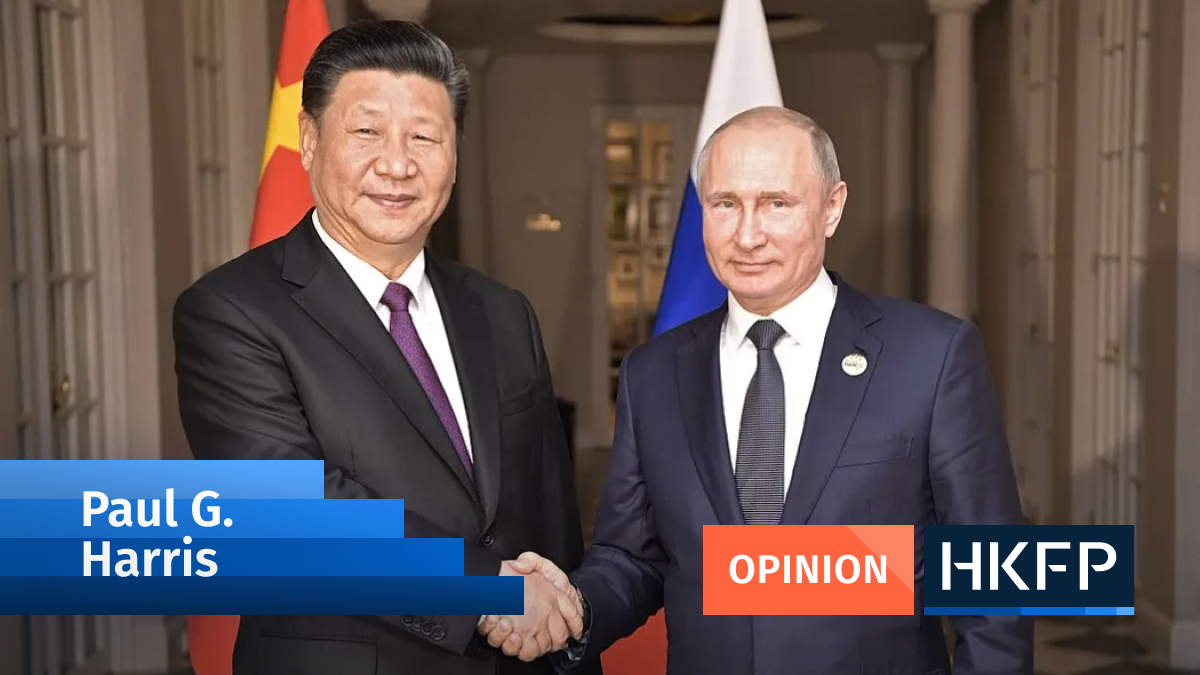
Russia’s invasion not many days later revealed what the world may look like if China’s leader Xi Jinping and his “best friend,” Russian President Vladimir Putin, succeed in their mission of replacing the American-led, rules-based international system with their vision of an authoritarian new world order.
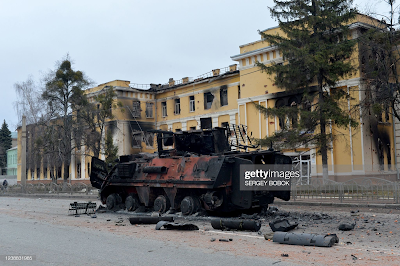
A Ukrainian Territorial Defence fighter examines a destroyed Russian infantry mobility vehicle in Kharkiv on February 27, 2022. Photo: Sergey Bobok / AFP
Russia’s war on Ukraine suggests that China’s new authoritarian world might be characterized by a return to 19th-century power politics and 20th-century blitzkrieg, with strong-men autocrats unleashing their militaries to crush neighbouring countries and threatening total destruction as means of coercion.
We do not need to imagine what this new world will look like; we can see it in the pools of blood spreading across Ukraine.
We can see it in the pictures and videos of Russian tanks barrelling through towns, homes pulverized by shelling, missiles crashing into high-rise apartment buildings, plumes of smoke rising from destroyed infrastructure, people cowering underground and half a million refugees – so far – fleeing to neighbouring countries.
We can see it in the casualty statistics, including of civilians, children among them.
If Putin’s latest threats are any indication, the new authoritarian world being ushered into existence by China and its autocratic allies apparently includes preparations to use nuclear weapons.
Anyone who doubts Putin’s willingness to go to the extreme of using them should consider the widespread assumption by many experts barely a week ago that he would not be so irrational as to invade Ukraine.
If for nothing else, February 2022 will be remembered worldwide as the month when Russia invaded Europe. For Ukrainians, it may forever be memorialised as their mensis horribilis – their horrible month.
But might February also be remembered as a mensis horribilis for China’s global reputation and influence?
The world’s outraged reaction to the Russian invasion of Ukraine juxtaposed alongside Chinese foreign ministry officials’ mealy-mouthed parroting of Russia’s justifications for the attack, along with their flat-out refusals to even call the invasion an invasion, suggests that China’s already declining reputation is set to fall further.
What was Beijing thinking when it embraced an autocrat who had already annexed a huge chunk of a neighbouring country’s territory – the Crimean Peninsula – and deployed his war machine and mercenaries to other parts of Ukraine as well as to Georgia, Libya, Syria and beyond? At the very least, Chinese officials seem to have displayed poor understanding of Russian history and the psychology of Putin.
Chinese leader Xi Jinping. Photo: Pool screenshot.
Perhaps most profoundly, China’s reputation will suffer because, thus far, it has selectively ignored Russia’s violation of the sacrosanct principle of non-intervention that Xi and every leader of the People’s Republic of China before him has extolled repeatedly and forcefully, especially when the United States has violated it.
To quote one of Xi’s many public statements on the importance he gives to protecting sovereignty: “The Chinese people share a common belief that it is never allowed and it is absolutely impossible to separate any inch of our great country’s territory from China.”
If every inch of China’s territory is inviolable, why are huge swathes of the Ukraine up for grabs? What’s good for the goose is good for the gander. China’s hypocrisy speaks volumes about its willingness to say one thing for decades, and do another when given the choice between condemning an unjust war and being an apologist for an autocratic ally.
Even some folks in China have spoken out against the war, pointing to their government’s obvious hypocrisy. Naturally, their words were quickly censored, apparently deemed to be “irrational.”
China’s reputation can’t be helped by its topsy-turvy official advice to its citizens in Ukraine. They were initially advised to display Chinese flags on their cars, apparently under the assumption that this would offer some protection. That advice was quickly reversed when Chinese officials presumably realised that Beijing’s support for Putin could be viewed with some hostility by Ukrainians suffering the Russian onslaught.
While other countries advised their citizens to leave Ukraine before the invasion, China told its citizens to stay put. They are now understandably cowering in fear, awaiting evacuation.
In sum, when it comes to the war in Ukraine – possibly the greatest challenge the world has faced since World War II, apart from climate change – Chinese influence has so far been shown to be utterly impotent, if not complicit.
The Chinese foreign ministry has been reduced to diatribes against the United States and feeble calls for “restraint on all sides” – hardly the robust action of a great power in a time of extreme crisis, and hardly likely to enhance its reputation globally.
For all its economic wealth, political influence and military might – all greater than at any time in its history – China is left spouting verbal nostrums while cluster bombs blast the bodies of civilians in Ukrainian cities.
To be sure, China’s failure to join the world’s condemnation of the Russian invasion of Ukraine will be of the greatest historical interest, and disapproval. But other events in February 2022 may also turn out to have undermined China’s global reputation and influence.
The Winter Olympic Games in Beijing are likely to be remembered by many people around the world not for athletic feats but for the bear hug between Putin and Xi – and Putin’s prideful visage perched high above the opening ceremonies – concerns about China’s human rights record, and the audacity of choosing a Uyghur athlete from an ethnic group against which China has been accused of committing genocide to light the Olympic flame.
Not to mention the incomprehensible public statements regarding whether Chinese tennis player Peng Shuai actually accused a senior Chinese official of sexual abuse, and restrictions on athletes and foreign journalists, among other things.
The Olympics may have solidified support for the Chinese government at home, although this is by no means certain given debates on Chinese social media over whether Eileen Gu, a photogenic, gold-winning Chinese-American skier competing for China, or Xiaohuamei, a shivering woman found chained in a dirty shack, best reflects today’s China.
What seems more certain is that for many people outside China, the 2022 Winter Olympics will be remembered as the “genocide games.” For others, they will at least have left a rather bad impression of the host country.
Meanwhile, February brought China’s supposed victory against Covid-19, trumpeted repeatedly over the last two years, into doubt. Since early 2020, the Chinese government has felt warmed by the glow of its success in beating back the virus.
However, an accelerating outbreak in Hong Kong is seeing tens of thousands of people being infected each day, a climbing death toll and a healthcare system that is profoundly overwhelmed – precisely what happened in other countries that China pointed to as proof of its superior model of governance.
Hong Kong and the rest of China are shut up tighter than ever before. Beijing refuses to acknowledge that Western mRNA vaccines are superior to Chinese vaccine technologies, or even to approve their use, potentially leaving many millions of people vulnerable to infection with Omicron and no alternative to the government’s “dynamic zero-Covid” policy.
At the same time, many other countries – including those that China deems to be in decline – are opening up and “living with” Covid-19 because they invested heavily in rapid development of mRNA vaccines and got them into people’s arms.
At best, Chinese officials miscalculated, or at worst they put politics and national hubris above protecting people’s health. Either way, they are now on the back foot, with China’s borders closed and more lockdowns likely to come.
China’s initial response to the outbreak in Hong Kong – to deliver crates of traditional Chinese medicine (TCM), a cause célèbre of Xi – may bring into further doubt internationally the Chinese model for subduing the pandemic. When China is offering the world TCM and the United States is offering mRNA, it is manifestly evident whose reputation is up and whose is down.
In other respects, February 2022 may be the month that the world not only woke up to the existential threat posed by Putin’s Russia but also to the potential threat of an emboldened China on the wrong side of history. China’s neighbours, especially the dozen or more with which it has land or maritime border disputes, will certainly take notice of what is happening in Ukraine.
No doubt many people in Taiwan are watching with great interest – and more than a little horror. They will be noting the reactions of the Ukrainian government, military and people to Russia’s aggression, and indeed the world’s response to it.
So far, those reactions suggest that any attempt by China to subdue Taiwan by force could elicit a much more robust response from people living there than Beijing may have been imagining until very recently, and that the world’s reaction to such an event could be far more painful for China than officials there might have anticipated.
Already, the United States has sent a delegation to Taiwan to reaffirm its commitment to the island’s defence and apparently to signal to Beijing that the attention of Taiwan’s allies won’t be diverted by war in Ukraine.
Despite China’s dramatic rise and profound desire to recast the international system in its likeness, the solidarity that has already arisen from war in Ukraine may yet justify placing some faith in the prevailing world order. Ordinary people and much of the world have demonstrated surprising willingness to suffer the consequences of standing up to Putin’s war machine.
For anyone who observes international relations very closely, the response of Western countries over the last several days has been astonishingly quick and surprisingly robust; if hardly making up for their failure to do much after Russia annexed Crimea and while it was preparing its latest invasion. Assuming this solidarity does not wane, it may prevent or at least delay the arrival of a Chinese-led alternative world order.
China’s rise still has the potential to do good for the world; it also has the potential to do great harm. A question is whether the events of February 2022 will stimulate reflection in Beijing and prompt a shift away from its warrior-like view of the world, or whether the war being waged by Xi’s best friend is a sign of things to come.
PAUL G. HARRIS
Paul G. Harris is the Chair Professor of Global and Environmental Studies at the Education University of Hong Kong. He is the author/editor of two dozen books on global environmental politics, policy and ethics. Learn more about Paul's work on his website.
2 Mar 2022 — “At the very least, Chinese officials seem to have displayed poor understanding of Russian history and the psychology of Putin,” writes Paul ...
25 Feb 2022 — Barely 24 hours ago, Chinese pundits predicted that a war in Ukraine was not inevitable. In New York, as Russia geared up for a full-on assault ...
15 Mar 2022 — China's leader, Xi Jinping, has avoided criticizing President Vladimir Putin of Russia, but he has also tried to distance China from the carnage ...
24 Feb 2022 — Asia's three largest powers all have a stake in the Russia-Ukraine crisis. China hopes to change the global order, Japan aims to resist this ...
24 Feb 2022 — In a chilling act of aggression, Russian President Vladimir Putin launched a military assault on Ukraine in the early hours of 24 February. That ...
25 Feb 2022 — As Russian missiles flew through the Ukrainian sky Thursday and world leaders decried an invasion spreading across the country, China ...
24 Feb 2022 — Asia's three largest powers all have a stake in the Russia-Ukraine crisis. China hopes to change the global order, Japan aims to resist this ...
24 Feb 2022 — In a chilling act of aggression, Russian President Vladimir Putin launched a military assault on Ukraine in the early hours of 24 February. That ...
hongkongfp.com - February 2022 may turn out to be an important month in Chinese and world history. It was the month when China's “no limits” embrace of ...
19 hours ago — Caught in the crossfire between Russia and the West, because of the conflict in Ukraine, when Chinese Premier Li Keqiang and President Xi ...
23 hours ago — For decades, the free flow of trade across much of the world allowed the richest nations to enjoy easy access to low-priced goods and ...
2 days ago — If the last two budgets were delivered under the spectre of COVID, this year's budget has a different bogeyman: the outbreak of war in ...
16 Mar 2022 — What China decides to do about Russia's invasion of Ukraine could mark a turning point in both the war in Ukraine and U.S.-China relations.
23 hours ago — Beijing — Beijing and Moscow advanced their vision of a new world order on Wednesday when Russian Foreign Minister Sergeĭ Viklov visited his ...
5 days ago — A new two plus two economic dialogue recognizes the challenge of the People's Republic of China (PRC)'s “technological might” across the ...
19 Mar 2022 — Both China's president, Xi Jinping, and Mr Putin want to carve up the world into spheres of influence dominated by a few big countries. China ...
"Good Morning America" is the Emmy-winning morning news program featuring anchors Robin Roberts, George Stephanopoulos, Michael Strahan and Ginger Zee.
3 days ago — CANBERRA, Australa—The Australian and New Zealand prime ministers on Monday voiced concerns about the potential for a Chinese military ...
4 days ago — PARIS — Globalization, which has both fans and detractors alike, is being tested like never before after the one-two punch of COVID and war.
Architect, Urban Designer, and Managing Editor at ArchDaily. Beirut, Lebanon. BROWSE ALL FROM THIS AUTHOR HERE. ↓. The 2022 World's Best Cities To Live In ...
It applies to doing things inside the Defense Department, and sadly, it also applies to covering the Pentagon and military services. In 2021, the Air Force put ...
6 days ago — WASHINGTON (AP) — Four Russian officials, including hackers with a government intelligence agency, have been charged with the malicious ...
43 minutes ago — WASHINGTON (AP) — President Joe Biden is preparing to order the release of up to 1 million barrels of oil per day from the nation's ...
23 hours ago — Economists have corrected their economic forecasts significantly downwards because of the war in Ukraine. Due to rising energy prices, ...
6 days ago — Health officials are increasingly focusing on hospital admissions, which rise only after a surge has arrived. A wastewater surveillance program ...