Showing posts with label Crisis. Show all posts

Tuesday, 7 November 2023

Exclusive: China's clashing priorities behind rare money market distress

 SHANGHAI/SINGAPORE, Nov 6 (Reuters) - China's attempts to keep the yuan from falling contributed to last week's chaos in money markets, sources involved say, pointing to the pressure behind the scenes as Beijing tries to guide its economy and markets through a major slowdown.

Routine month-end demand for cash in China's banking system snowballed into a scramble on Oct. 31 that pushed short-term funding rates as high as 50% in some cases, an incident that authorities are now investigating.

Reuters

Six participants in the market say a confluence of factors drove fear and confusion across trading rooms in Shanghai and Beijing by late afternoon on that day.

Eventually, the People's Bank of China (PBOC), its affiliated China Foreign Exchange Trade System (CFETS) and bond clearing houses stepped in, directing lenders, extending trading hours and holding meetings with institutions to calm markets.

The contributing factors were the usual month-end demand for liquidity, cash hoarding in the lead up to a big government bond sale and a market where the biggest banks were already reticent to lend because of a mandate to counter pressure on the yuan.

"It was an accident," said Xia Chun, chief economist at wealth manager Yintech Investment Holdings, calling it an unforeseen consequence of the government's heavy hand in financial markets.

"Banks were grudging in lending, leaving non-banks asking each other for money in afternoon trade," he said. "Borrowing rates surged as a result, with some willing to take any price."

The reasons for the spike in interest rates and the ensuing market chaos are detailed here for the first time. Participants say that the vulnerability exposed will stay as long as capital outflows keep the system under pressure.

Most of them requested anonymity as they were not authorised to discuss a sensitive topic publicly.

The PBOC told Reuters that CFETS was probing "abnormal" trades on Oct. 31 involving some accounts repeatedly borrowing and lending money at "extremely high interest rates" near the end of trading hours.

'COMBAT MOOD'

Short-term financing markets, such as overnight repurchase agreements, or repos, are crucial to the daily business of banks, insurers and other financial institutions.

They affect foreign exchange movements since the markets are the major avenue for the supply of money.

Funds and non-banks borrow and roll over loans that finance their investments and trades in the repo market. The month-end is also when banks and other finance-sector participants have to square their books and comply with rules on capital buffers.

Disruptions, therefore, can threaten financial stability.

Seeds of trouble were sown in October when China approved one trillion yuan ($137.32 billion) in sovereign debt sales, to be rolled out - according to sources familiar with the plans - by sticking to the issuance schedule for the fourth quarter but increasing the size of each tranche.

Typically, said one fund manager in Shanghai, in such situations the PBOC would offset the cash drain from the extra bond issuance with extra funding support - for example by relaxing bank reserve requirements.

But putting extra cash into the system would risk adding downward pressure on the yuan - which has lost over 5% against the dollar this year - and undercut months of efforts to stabilise the currency.

"The inaction by the central bank is mainly due to its concern over yuan depreciation," said the fund manager, who declined to be identified as he was not authorised to talk to media.

On trading floors that Tuesday, the scramble for short-term funds became a stampede.

Even repo rates between banks, normally stable and the main gauge of short-term funding costs, flew from an overnight rate of 2% a day earlier to as high as 8% on Oct. 31.

DESPERATE BORROWERS

At 4 p.m. (0800 GMT) the state banks that normally lend to desperate last-minute borrowers were missing, according to three market participants.

The absence left a couple of desperate borrowers paying 30%-50% - rates not seen since defaults at China Everbright Bank (601818.SS) and Industrial bank Co Ltd (601166.SS) a decade ago - to secure the loans they needed.

At 5 p.m. markets closed with positions unfunded and trades incomplete.

"No one left the trading desk, as you don't know how things will go ... the whole trading room was in combat mood," said one fund manager in Beijing.

"If you need to square your positions in such an environment, and want to avoid default, you need to borrow at high rates," the fund manager said. "For each individual, it's rational behaviour."

The PBOC stepped into the breach, asking state banks to supply funds while the China Central Depository & Clearing Co (CCDC) and Shanghai Clearing House both reopened settlements at 6 p.m in an emergency response. By 8.30 p.m., crisis was averted and the market cleared and closed again.

DO NOT 'BE EMOTIONAL'

At a follow-up meeting with banks and brokers the next day, sources said the PBOC told institutions their behaviour was "disturbing the market" and that they should not "be emotional."

The money market operator CFETS told traders to keep a 5% ceiling on repo transactions and said anyone involved in high-rate deals closed on Oct. 31 would need to explain themselves to regulators, according to sources who received the notice.

Fear subsided with overnight rates falling back below 3%. To be sure, most see the danger as having passed.

But analysts have turned to the backdrop - intensifying control over China's currency - as an underlying source of tension.

China's economic rebound from the COVID-19 pandemic has been a disappointment. Together with rate rises around the world, it has fanned capital outflows and the yuan has suffered.

And yet, after dropping 5% on the dollar over the year to mid-August, the exchange rate has been conspicuously steady since as efforts from state-bank buying to new rules discouraging short selling have been deployed to support it.

Tighter liquidity is another method.

"If the pattern of money supply and liquidity provision remains unchanged, the whole system remains fragile. Another liquidity shock is always possible," said the Beijing-based fund manager.

Others see less risk, but expect tightness will stay as long as there is pressure on the currency. Broad dollar weakness has helped the yuan lately, but at 7.28 to the dollar it is not far from September's 16-year low of 7.351.

($1 = 7.2822 Chinese yuan)

Reporting by Shanghai Newsroom Writing by Tom Westbrook; Editing by Vidya Ranganathan and Raju Gopalakrishnan

Exclusive: China's clashing priorities behind rare money market distress | Reuters


Sunday, 25 September 2022

A Ponzi scheme by any other name: the bursting of China’s property bubble

 Only state intervention can save the day, but the pain is likely to fall on ordinary citizens, say observers

Martin Farrer

Sun 25 Sep 2022 14.20 BST

https://www.theguardian.com/business/2022/sep/25/china-property-bubble-evergrande-group


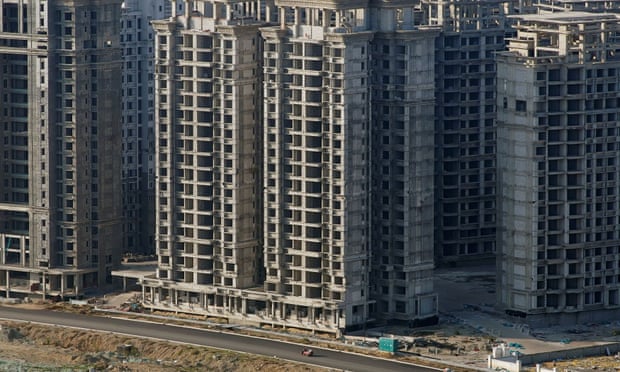
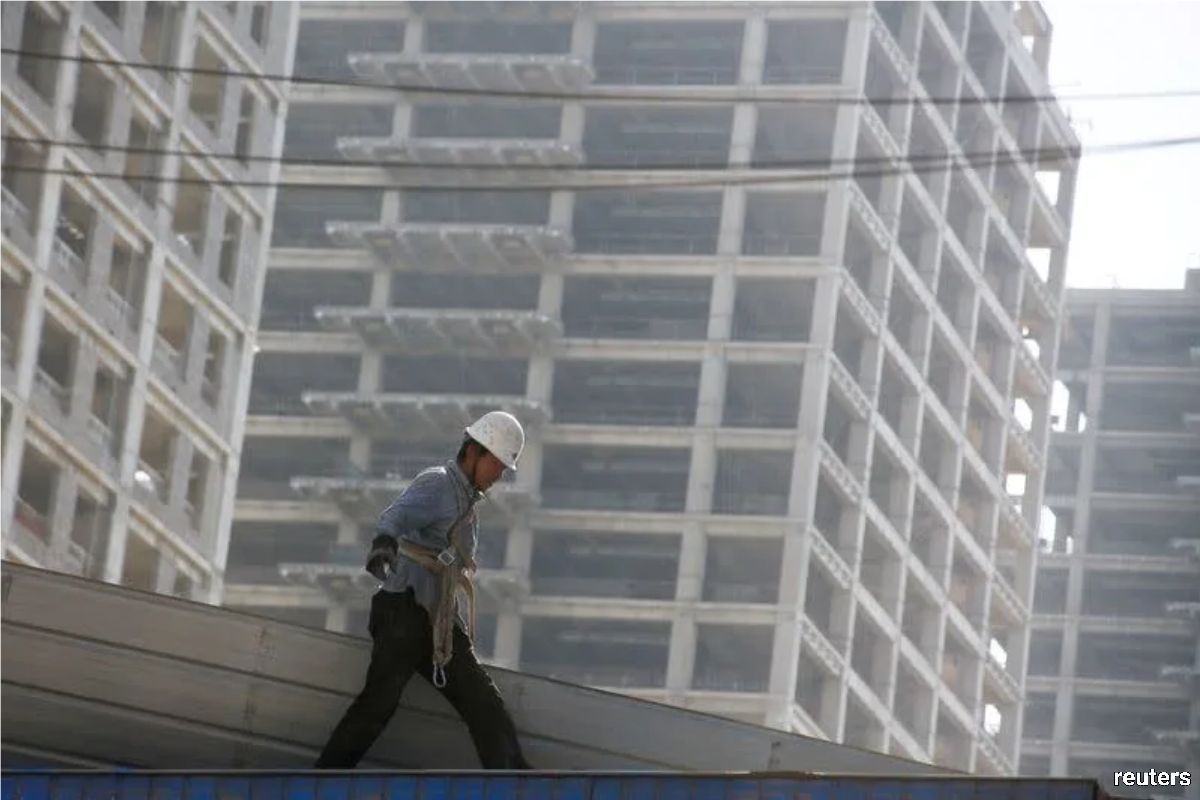
Under-construction apartments in the Shekou area of Shenzhen, Guangdong province, China, last November. Photograph: David Kirton/Reuters


Alittle more than a year ago, a Chinese property developer largely unknown to the outside world said its cashflow was under “tremendous pressure” and it might not be able to pay back some of its eye-watering debts of $300bn (£275bn).

Today, that company, China Evergrande Group, is all too well known as the poster child of the country’s economic woes. House prices in China have fallen in each of the 12 months since Evergrande’s now prophetic warning, with Xi Jinping’s government now preparing to throw billions of dollars at a property market that experts say increasingly resembles a giant Ponzi scheme.

Prices for new homes in 70 Chinese cities fell by a worse-than-expected 1.3% year on year in August, according to official figures, reflecting a turbulent 12 months in which China’s housing sector has gone from an unstoppable driver of growth and prosperity to being the chief threat to the world’s powerhouse economy.

Nearly a third of all property loans are now classed as bad debts – 29.1%, up from 24.3% at the end of last year, according to research by Citigroup this week – with once safe state-owned property developers driving the increase.


The crisis at Evergrande, then China’s second biggest property developer, has spread through the industry to the point where the government’s pledge this week of 200bn yuan (£26bn) to kickstart investment was judged by analysts to be well short of what was needed.

The rating agency S&P said at least 800bn yuan would be needed – or even 10 times that much in the worst-case scenario – to rescue a property market in which prices have fallen, sales have slid, developers have gone bust and buyers have staged an unprecedented and widening mortgage boycott in protest at having paid largely upfront for homes that have not been finished.

The market is experiencing a total collapse in confidence, analysts say, and only government intervention can save the day.


An unfinished development by China Evergrande Group under demolition order in Danzhou, Hainan province.
An unfinished development by China Evergrande Group under demolition order in Danzhou, Hainan province. Photograph: Aly Song/Reuters

About 2m off-plan homes remain unfinished across China, according to a rough estimate by S&P. That figure will grow if sales continue to fall and developers continue to run out of money to complete projects.

“China’s property downturn has turned into a crisis of confidence that only the government can fix,” S&P said. “If falling sales tip more developers into distressed territory, things will get worse. The distressed firms will halt construction on more pre-sold homes, hitting buyers’ confidence further. Our rough estimate is that about 2m unfinished homes presold by Chinese developers are now in limbo. This has shattered confidence in this market.”

For years, preselling homes – mainly apartments in large blocks and newly styled urban villages – kept the developers flush with cash and, along with borrowing on an epic scale, meant they could buy more land and keep building. In 2021, about 90% of homes were sold off plan in China.

But Xi’s decision two years ago to crack down on “reckless” lending starved developers of their funding and, when the music stopped, it emerged they could not finish homes they had already taken money for because they had spent it on buying the next parcel of land or project.

People walk by a map in Beijing showing Evergrande development projects in China.
People walk by a map in Beijing showing Evergrande development projects in China. Photograph: Andy Wong/AP

In short, it resembles a Ponzi scheme where money taken from new investors is used to pay off existing clients in an ever-decreasing spiral to collapse. It is even how the sober pages of the Economist sees it.

George Magnus, an associate at the China Centre at the University of Oxford, said the Chinese market was not quite a classic Ponzi scheme in the style of Bernie Madoff’s notorious scam that was exposed after the global financial crisis, but it was very similar.

“Developers raise huge amounts money from customers to basically fund the purchase of the next construction projects. This continues on and on before it has got to the size it has,” Magnus said. “It’s not strictly a Ponzi in the asset management sense, the Madoff style, but they’re essentially using clients’ money to fund the next project, so yes, it’s the standard definition of what that means.”

The property market accounts for anywhere between 20% and 30% of China’s gross domestic product. This is a huge proportion compared with other large economies, and is thanks partly to the country’s investment-led economic model that has prioritised construction. As a result it has bred a hitherto blind faith in the property values, which have risen more or less uniformly for the past two decades or more.

But with repeated lockdowns also depressing the market, the longstanding belief that prices can only ever go up is starting to wane. This could lead to Chinese households moving 127tn yuan out of property in the next nine years and into other investments such as equities, bonds and wealth management products, according to the brokerage and investment group CLSA, Bloomberg reported last week.

“People are losing confidence in the presale model,” said Magnus. “It’s a reboot of the Chinese mortgage market … the hallowed asset of property. The fabled rising middle class of China are not in great shape along with lockdowns as well.”

China’s president, Xi Jinping, stands with delegates during the closing ceremony of the 19th party congress in Beijing.
China’s president, Xi Jinping, stands with delegates during the closing ceremony of the 19th party congress in Beijing. Photograph: Andy Wong/AP

The situation presents a major challenge for the Xi government, especially with the all-important party congress coming up in October when the president will seek to become ruler for as long as he wants.

But although his government is pushing for the restructuring of failing developers such as Evergrande and hoping to spread the debt burden across state-owned enterprises, banks and local governments, the pain is likely to fall on ordinary Chinese – just as it does on ordinary investors when a Ponzi scheme eventually collapses.

Anne Stevenson Yang, a co-founder of the US-based J Capital Research and a China expert, said the regime in Beijing was more interested in protecting the state-owned enterprises, institutions and billionaire owners of companies than homeowners – and that would inform its response to the crisis.

“There’s what they can do and there’s what they will do,” she said. “What they can do is to transfer money to households such as by gifting apartments, allowing people to live in places where mortgages are unpaid, and boosting pensions so people have confidence and spend again.

“But that’s not of course what is going to happen. The Chinese political system is not built around individuals, it’s built around companies, they are the constituents. The political system operates through them.

“The property market was not designed to be a Ponzi scheme – a Ponzi scheme needs to be designed. But it is an investment bubble. And the bubble has ended.”

https://www.theguardian.com/business/2022/sep/25/china-property-bubble-evergrande-group

Monday, 29 August 2022

India accuses China of ‘militarisation of the Taiwan Strait’ as row over navy vessel grows

Accusation is reportedly the first time the Indian government has used the descriptor and comes as tensions rise over Sri Lanka port visit

 in Taipei

Mon 29 Aug 2022 07.01 BST

https://www.theguardian.com/world/2022/aug/29/india-accuses-china-of-militarisation-of-the-taiwan-strait-as-row-over-navy-vessel-grows


Workers wave the flags of Sri Lanka and China to welcome the Chinese research and survey vessel the Yuan Wang 5 at port in Hambantota

Workers wave the flags of Sri Lanka and China to welcome the Chinese research and survey vessel the Yuan Wang 5 at port in Hambantota. Photograph: Ishara S Kodikara/AFP/Getty Images

India has accused China of “militarisation of the Taiwan Strait”, in an escalating war of words triggered by a Chinese military ship docking in a controversial Sri Lankan port.

The accusation, referenced in a statement by the Indian high commission in Sri Lanka on Sunday, is reportedly the first time the Indian government has used the descriptor, and is a rare intervention on the cross-straits issues as India contends with tensions on its own border with China.

Earlier this month a Chinese military research vessel docked at Sri Lanka’s Hambantota port for a week. Analysts say the Yuan Wang 5 is among a group of Chinese ships operated by the People’s Liberation Army that monitor satellite, rocket and intercontinental ballistic missile launches.

The docking of the Yuan Wang 5 was delayed for several days after India objected, amid fears that Beijing intends to use the port as a military base. China’s foreign affairs ministry had said the vessel was conducting maritime research, in line with international law and practice, and would not affect “the security and economic interests of any country”.

The Yuan Wang 5 left a week ago, but over the weekend China’s embassy in Sri Lanka accused India of using security concerns to conduct “de facto thorough interference in Sri Lanka’s sovereignty and independence”.

On Saturday, India’s high commission in Colombo said Sri Lanka “needs support, not unwanted pressure or unnecessary controversies to serve another country’s agenda”. It also referred to “debt-driven agendas”, in apparent reference to the Chinese-funded Hambantota port, which is often tied to accusations of Chinese debt-trap diplomacy.

Sri Lanka is currently navigating its way out of its worst-ever economic crisis, and is balancing the competing influences of India and China, both of which analysts say it needs. Chinese loans account for about 10% of the nation’s total foreign debt. But since this year, India has also lent about $3.8bn to help Sri Lanka through its economic crisis.

Wen-ti Sung, a political scientist at the Australian National University specialising on Taiwan and China, said Delhi was creating “new bargaining leverages” in accusing China of “militarisation” of the strait, by normalising “tougher rhetoric” which it could offer to discontinue in future negotiations.

“Knowing that China does not want escalation on multiple fronts, India is venturing to create a new leverage where none existed before, by calling China out on Taiwan,” Sung said, noting China’s domestic pressures with the coming 20th party congress, when President Xi Jinping will seek a third term.

The ship docked at Hambantota just a week after China completed its large-scale military drills around Taiwan, in response to a visit by the US House speaker, Nancy Pelosi. Since those drills ended, China’s military has continued with increased activity which analysts have labelled a concerning “new normal”. There are now near daily crossings of the media line, an unofficial border dividing the Taiwan Strait, but which China has recently claimed as its sovereign waters.

At the time, when the US and other allies were condemning the drills, India’s government stuck to vaguer statements, saying it was “concerned at recent developments”.

“We urge the exercise of restraint, avoidance of unilateral actions to change status quo, de-escalation of tensions and efforts to maintain peace and stability in the region,” an external affairs spokesman said.

https://www.theguardian.com/world/2022/aug/29/india-accuses-china-of-militarisation-of-the-taiwan-strait-as-row-over-navy-vessel-grows

Monday, 1 August 2022

China banks may face US$350 billion in losses from property crisis

 There were 39 trillion yuan of outstanding mortgages and another 13 trillion yuan of loans to developers at the end of March, according to data from the People’s Bank of China.

Bloomberg /

Bloomberg

August 01, 2022 06:24 am +08

https://www.theedgemarkets.com/article/china-banks-may-face-us350-billion-losses-property-crisis


(Aug 1): China’s banks face mortgage losses of US$350 billion in a worst-case scenario as confidence plunges in the nation’s property market and authorities struggle to contain deepening turmoil.

A spiraling crisis of stalled projects has dented the confidence of hundreds of thousands of homebuyers, triggering a mortgage boycott across more than 90 cities and warnings of broader systemic risks. The big question now is not if, but how much it will batter the nation’s US$56 trillion banking system.

In a worst-case scenario, S&P Global Ratings estimated that 2.4 trillion yuan (US$356 billion), or 6.4% of mortgages, are at risk while Deutsche Bank AG is warning that at least 7% of home loans are in danger. So far, listed banks have reported just 2.1 billion yuan in delinquent mortgages as directly affected by the boycotts.

“Banks are caught in the middle,” said Zhiwu Chen, a professor of finance at the University of Hong Kong Business School. “If they don’t help the developers finish the projects, they would end up losing much more. If they do, that of course would make the government happy, but they add more to their exposure to delayed real estate projects.”

Already rattled by headwinds from slowing economic growth, Covid disruptions and record high youth unemployment, Beijing is placing financial and social stability at the top of its priorities. Efforts that have been contemplated so far included a grace period on mortgage payments and a central bank-backed fund to lend financial support to developers. Either way, banks are expected to play an active role in a concerted state bailout.

The exposure of Chinese banks to the property sector tops that of any other industry. There were 39 trillion yuan of outstanding mortgages and another 13 trillion yuan of loans to developers at the end of March, according to data from the People’s Bank of China.

The real estate market is “the ultimate foundation” for financial stability in China, Teneo Holdings managing director Gabriel Wildau said in a note this month.

As authorities move to keep risks in check, lenders with high exposure could come under greater scrutiny. Mortgages accounted for about 34% of total loans at Postal Savings Bank of China Co. and China Construction Bank Corp. at the end of 2021, above a regulatory cap of 32.5% for the biggest banks.

About 7% of outstanding mortgage loans could be impacted if the defaults spread, according to Deutsche Bank analyst Lucia Kwong. That estimate may still be conservative given the limited access to information on the unfinished projects, she said.  

To limit the fallout, China could tap into the excess capital and surplus loan provisions at its 10 biggest lenders, which amounts to a combined 4.8 trillion yuan, according to a report by Francis Chan and Kristy Hung, analysts at Bloomberg Intelligence.

Local banks — city and rural commercial lenders — could shoulder more responsibility than state peers, based on earlier bailouts and also due to their stronger ties with local governments, though their capital buffers lag far behind industry average.

Chinese banks have raised a record amount of capital in the first half from bond sales as they prepare for a potential spike in soured loans.

Bad loans at lenders, which amounted to 2.9 trillion yuan at the end of March, are poised to reach new records and further strain an economy that’s expanding at the slowest pace since the onset of the Covid outbreak.

While China’s total debt-to-GDP is forecast to climb to a fresh record this year, consumers have been reluctant to take on more leverage. That has ignited a debate over the risk of China falling into a “balance sheet recession,” with households and companies cutting back on spending and investing.

Disposable income growth is slowing, further hurting the ability of homebuyers to service their debts. China’s home price weakness had spread to 48 of 70 major cities in June, up from 20 in January.

S&P Global forecast home sales could drop as much as 33% this year amid the mortgage boycott, further squeezing the liquidity of distressed developers and leading to more defaults. Some 28 of the top 100 developers by sales have either defaulted on bonds or negotiated debt extensions with creditors over the past year, according to Teneo.

Property investments, which drive demand for goods and services that account for about 20% of the nation’s gross domestic product, plunged 9.4% in June.  

Bank earnings are at stake. After recording the fastest profit expansion in nearly a decade last year, the nation’s lenders face a challenging 2022 as the government pressures them to support the economy at the cost of earnings.

A 10 percentage-point slowdown in real estate investment growth translates into a 28 basis-point increase in overall bad loans, meaning a 17% decline in their 2022 earnings, Citigroup analysts led by Judy Zhang estimated in a July 19 report.

The Hang Seng index of mainland banks has plunged 12% this month.

https://www.theedgemarkets.com/article/china-banks-may-face-us350-billion-losses-property-crisis


Goldman warns China’s property crisis will sink iron ore
26 Jul | 11:41am


China’s credit market rocked by more debt delays, plunging bonds
21 Jul | 11:52pm

China’s top steel mill adds its voice to industry’s alarm
21 Jul | 11:35pm

21 Jul | 11:15am

Most Recent Post

Man charged for borrowing rare Chinese manuscripts from UCLA library, returning fakes

  Suspect Jeffrey Ying allegedly travelled to China after checking works out using several aliases Agence France-Presse Published: 12:11pm, ...

Popular Posts - Last 30 days