Showing posts with label Hegemony. Show all posts

Saturday, 5 March 2022

China The Global Power And Renminbi The Global Reserve Currency


Ukraine-Russia War: Chinese Momentum To Become The Global Power And Renminbi The Global Reserve Currency

I teach Finance-related courses at Middlebury College in Vermont.

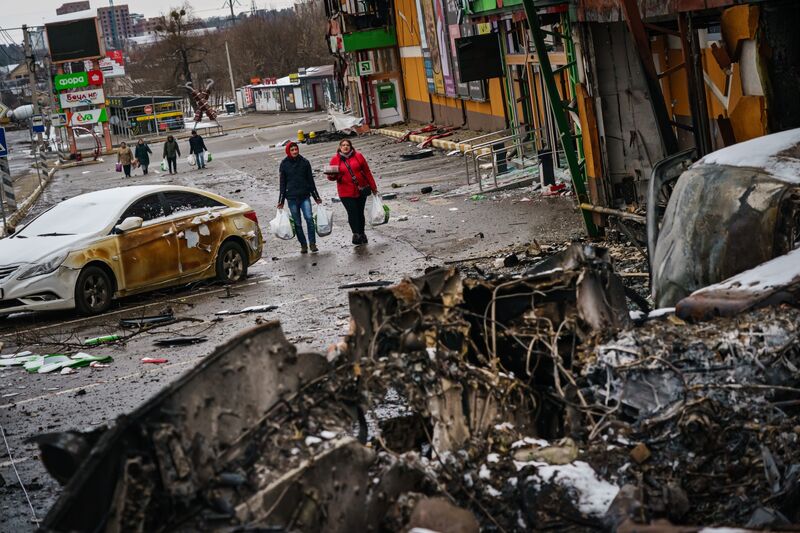
In his book "On War," the Prussian General Carl Von Clausewitz surmised that "Peace is maintained by the equilibrium of forces and will continue just as long as this equilibrium exists, and no longer." By invading Ukraine on February 24, 2022, Russia brought that truth home to Europe. The Russian invasion exposes the weakness of Europe's strategic policies pursued since the fall of the Berlin Wall. Concurrently, it allows China to put the foundations of Western global hegemony in check, using Russia as a delusional pawn on the international chessboard.

Origins of China providing tacit support to Russia

February 24, 2022 will find its way into the history books next to November 9, 1989, the fall of the Berlin Wall, and the September 11, 2001 attacks. More interestingly is the link with another date, September 15, 2008, the day of the demise of Lehman Brothers and the onset of the Great Financial Crisis.

The 2008 financial meltdown resulted from an unbridled U.S. financial system, which refused to regulate derivatives (a policy endorsed by Larry Summers and Hank Paulson), was unable to contain the insatiable risk appetite of the banks, and which left insufficient capital buffers and highly leveraged positions unattended. The undoing started under the Clinton and Rubin administration with the promulgation of the 1999 Gramm-Leach-Bliley act, which dismantled the foundational 1934 Glass-Steagall Act. The Glass-Steagall Act ensured stable segregation between predictable retail banking and more risk-prone investment banking.

The crisis triggered a global housing price bubble burst, brought on by too lenient global monetary policies, irresponsible U.S. banking practice, outright fraud, and unsustainable global financial leverage.

Part of the global fault line was reflected in the substantial trade imbalance between China and the U.S. China benefited enormously from the globalization trend triggered by the fall of the Berlin Wall and the relocation of global production capacity towards its lower cost base. China became the global production house. This position was further bolstered by China joining the World Trade Organization (WTO) in December 2011. However, China was left unchallenged in managing its exchange rate, which is usually a "quid pro quo" for WTO membership. China recycled its excess U.S. dollars by building up a $1 Tr position of Treasury Securities. The move allowed China to keep its cost base (artificially) low by not selling the export generated $ revenue on the foreign exchange rate market.

The 2008 financial crisis revealed to China the vulnerability of the U.S. financial system. China saw the "safe haven" status of its abundant Treasury position unravel during the 2008 crisis. After an animated meeting between U.S. Treasury Secretary Hank Paulson and his Chinese counterpart during the 2008 Peking Summer Olympics China started taking its fate into its own hands: first through seeking global dominance, to be followed by the global reserve currency status.

Since the Ukraine invasion, China has been silent about sanctions (as was India), and it abstained at the March 2 U.N. General Assembly vote denouncing the attack. Remarkably, half of the 35 nations, representing 4 billion citizens overall, which abstained were African (amongst others Mozambique, Senegal, Uganda, South Africa, Zimbabwe,...). It would be insightful to review if the Mozambique U.N. vote was directed by the Chinese write-off of its debt in March 2021? Would there be similar U.N. voting patterns in relation to African sovereign debt extended or restructured by China?

The invasion and its broader ramifications were probably discussed during Putin's visit to China's Winter Olympics, where the "No Limits" partnership was inaugurated on February 4. Under the partnership, both countries announced mutual support over standoffs on Ukraine and Taiwan. Furthermore, both countries committed to collaborate more against the West on issues as diverse as climate change, artificial intelligence, and space.

Artyom Lukin, Professor of International Relations at the Far Eastern and Federal University in Vladivostok, explains that the China-Russia relationship is part of a "Post-West" world construct several years in the making. Ukraine seems to have been an opportunity too good to miss for both countries.

"The decision-makers in Moscow understand that without Chinese assistance, without the backing of China, Russia would be unable to withstand confrontation with the West."

Russia has been for many years an ardent and reliable ally supporting China's global ambitions to erode the Western world's power base. The Russian invasion is, in fact, part of a string of proxy wars between the U.S. and China. The aim is for China to take over world hegemony.

Russia's performance on the world scene (2008 – 2022)

Early in the first decade of this century, the Russian invasions of Georgia (2008) and Crimea (2014) tested NATO's response mode and resolve. The July 2014 shooting down of Malaysia Airlines flight 17 over Ukraine, killing 297, mostly Dutch passengers, was perpetrated by Russian soldiers in the Donbas region also tested NATO's willpower.

In September 2015, the sudden appearance of Russian troops in Syria at the request of the Syrian regime jolted Russia back onto the global power scene. Russian airpower proved critical in preventing the collapse of the Iranian-backed Assad regime. Assad, a member of the Shia minority, is still in power today. Through this intervention, Russia proved its mettle by strategically positioning itself in the Middle East. Its position has an even greater pull in the face of a potential U.S. withdrawal from the region.

In February 2022, President Macron's decided to withdraw French troops from Mali after they had encountered severe backlash, including from the private Wagner military group sponsored by Russia. Significantly, Mali is the third-largest producer of gold and has considerable uranium supplies.

The French troops had been deployed since 2013 as part of Operation Barkhane, the code name for the anti-jihadist operation covering Mali, Burkina Faso, and Niger. The efforts are now centered around Niger. As the sixth global producer of uranium, Niger is a critical purveyor of uranium to France, running 56 nuclear power plants. Ukraine is the ninth largest global producer of uranium.

These transgressions, all to seek influence and access to essential primary resources, occurred with no hard-hitting price to be paid by Russia. Russia had only green lights. Russia performed tasks that benefited China for which the payback is, at minimum, tacit support and, at best, from the Russian point of view, accommodation and compensation through the Chinese barter and financial system.

Europe, the indulgent facilitator

Since 1989, Europe has misread Putin's and his KGB entourage's intent to reinstall the grandeur of the Russian empire. In the eyes of a despotic Putin, Europe didn't deserve the expansion it was afforded at the expense of the lost Russian imperial eminence. Europe shuffled along on at least five strategic axes: energy policy, defense spending, cyber-security, illicit political party financing, and financial regulation.

1. Energy policy and the flawed decarbonization imperative

Nowhere has Europe positioned itself so vulnerably as in its energy policy.

Since the first oil crisis hit Europe in 1973, Europe has reduced its fossil fuel dependency by only a paltry amount, generating only 11% of its overall energy needs from renewables and a similar amount from nuclear energy. As of 2022, Europe is still reliant for almost 75% of its primary energy sources on fossil-based oil (39%), gas (25%), and coal (11%). Regarding natural gas dependency, Germany relies on Russia for 50% of its natural gas, Italy for 33%, and the Netherlands for 25%.

Combined with the urgent climate change adaptation recommendations articulated in the latest IPCC report, Europe no longer has an excuse to delay the geostrategic imperative to decarbonize 75% of its primary energy resources into renewables.

The behind-the-scenes pressures exercised by Gazprom and other energy lobbyists to classify natural gas as a green energy source during the E.U. Green Taxonomy review should be made public. Pressure from the E.U. commission to modify the E.U. Green Taxonomy should also be brought into the limelight. The Gazprom-managed Nordstrom P2 pipeline aims to delay the essential decarbonization process and, geo-politically, is nothing else than a Trojan horse.

2. Defense spending

Europe has been betting for too long on the peace dividend emanating from the fall of the Berlin Wall. Military spending as a percentage of GDP dropped from 2.4% in 1989 to 1.5% in 2020. (Germany reversed this trend by announcing on February 27, 2022, a surge in military spending of Euro 100 bn ($112 bn) bringing their expenditure to 2% of their GDP.) Earlier indications floated by the Trump administration of a less U.S. dominant NATO alliance also projected fissures within the Western front. Low defense spending in Europe and the diminished U.S. support for NATO under Trump let Putin believe that rebuke and resolve would be weak in case of another incursion.

3. Cyber-intelligence

A cyberattack in February 2022, disrupting several European oil refining hubs within the Amsterdam-Rotterdam-Antwerp (ARA) area, was only the latest of a string of ransomware strikes aimed at impairing crucial infrastructure and supply chain architecture.

The attacks exposed the need to secure legacy systems, especially in the energy and communications sectors, which have been outpaced in design due to accelerated digitalization and vulnerable connectivity to the internet. This is a major challenge both for Europe and the U.S.

Through the Digital Europe Programme, Europe decided to invest €1.6 billion into cybersecurity capacity for the period 2021-2027. This wholly inadequate amount is testimony to the seriously flawed understanding of this strategic military challenge.

4. Illicit political party financing

Russia has secretly funded European political parties with a staunch anti-EU stance. Russia is indiscriminate about financing parties both from the left and the right of the electoral spectrum, so long as they promote an anti-EU narrative. One example: In June 2020, the French far-right National Front party settled a controversial $10 MM loan dispute with a Russian aircraft parts company.

Furthermore, there are suspicions that Russia, through hacking and disinformation, meddled in the 2014 Scottish Independence referendum and the 2016 Brexit referendum. The U.K. leaving the European Union caused a severe dent in the Western bloc.

Similar tactics were deployed when Russian operatives leaked internal emails from Democrats during the 2016 U.S. election. The 2019 Mueller report provides precise detail of Russian interference in U.S. politics.

Ingenious fiscal constructions make it more difficult to "follow the money." According to the Tax Justice Network, the Netherlands ranks fourth in locations that facilitate tax evasion by multinational corporations, behind the British Virgin Islands, Cayman Islands, and Bermuda.

Such fiscal structures, in the slipstream, benefit oligarchs and despots from around the world.

Which are the financial institutions facilitating these transactions, and on whose behalf? Under which regulatory regime do they operate? And who in Europe is controlling these hidden money flows?

5. Financial regulation

The E.U. is only as strong as its weakest links. Since joining the European Union in 2007, Malta and Cyprus have offered E.U. citizenship for foreign cash.

This policy allows foreigners to gain E.U. passports and access to visa-free travel across the E.U. In the case of Cyprus, total bank deposits ($58 bn) are now a multiple of its Gross Domestic Product ($24 bn).

On the day of the Ukraine invasion, the Russian state-owned VTB Bank, which faced both European and U.S. sanctions, transferred its stake in Cyprus' Russian Commercial Bank to the two remaining shareholders, both of which are companies registered in Cyprus.

How are the Cyprus Central Bank and the European Central Bank overseeing these developments?

In addition, far too accommodating listing requirements have offered Russian companies straight access to primary markets in Europe.

There are 23 Russian companies listed on the London Stock Exchange, even after the suspension of VTB capital. The German stock exchange hosts 61 listed Russian companies. However, the operator of Deutsche Börse's Qontigo indices, Stoxx, decided to ax all Russian companies from its indices as of March 18.

Both NYSE and NASDAQ have now halted trading of about ten Russia-based companies.

The recent data leak at Credit Suisse exposed the hidden wealth of clients involved in torture, drug trafficking, money laundering, corruption, and other serious crimes. The 30,000 accounts represent $105bn of hidden assets. Switzerland has abandoned its neutrality and joined the E.U. sanctions against Russia with the invasion.

Can we rest assured that no other European and American financial institutions are abetting similar clients even after years of anti-money laundering and know-your-customer practices?

What is next?

The slew of sanctions imposed on Russia has led to severe financial damage:

  • The Ruble declined to 102 from 80 against the Dollar.
  • The Russian Central Bank doubled interest rates to about 20%.
  • The same Central Bank is precluded from accessing $630 billion in mostly dollar reserves.

In contrast, two major sources of export revenue are skyrocketing. Oil is quoted at $110 per barrel, and the Dutch April gas contract hit a new record high of €185 per megawatt-hour. Though SWIFT banned Russian banks from its messaging system, European and U.S. banks are still clearing Euro and $ denominated payments as part of sanction exemptions. This represents about $550 MM in daily revenue for Russia's state-controlled energy companies.

At current rates, oil and gas generate about $200 bn in annual revenue. Russia spent about $70 bn on its military capacity in 2021.

Europe has received a tragic wake-up call. Now it needs the resolve to tackle its main strategic challenges. The immediate priority for Europe should be to reduce the reliance on Russian energy and fossil fuel altogether.

Diplomatically and militarily, Europe should remember that the current "axis of evil" is run by Putin and some 50 of his acolytes. The post-Putin era should be envisioned with a Moscow alternative power base in mind which could quickly take over the reins. Ultimately, a decarbonized industrial and military alliance ranging from San Francisco to Vladivostok could be mapped. It would be a formidable bloc to balance out the global ambitions of China.

In the meantime, the critical question remains, what role is China playing behind the scenes?

Will BP's sale of its 20% Rosneft stake, at a loss of $25 bn, end up in the hands of Sinopec on the cheap? Will China National Offshore Oil Corporation take over Shell's LNG Sakhalin joint venture position with Gazprom?

What are the State Administration of Foreign Exchange (SAFE) and the People's Bank of China facilitating on behalf of Russia during this crisis? Are they supporting the Ruble, as one would expect, given that the Ruble should have fallen much further because of the magnitude of sanctions applied? Will People's Bank of China intermediate any gold sale residing on the Russian Central Bank balance sheet to the tune of about 20% of its reserves?

Given the potential of Chinese intervention behind the scenes, China can also influence the reach of Putin's military moves.

Jimmy Carter famously remarked that China, since its 1979 Vietnam invasion, has been at peace with its neighbors and the world. Over and above crimes committed against its Uyghurs minority population, China knows exceptionally well how to entice other nations to engage on the battlefield on its behalf.

The time has come to call out China and end the human tragedy in Ukraine, as Russia overplayed its hand under China's watch. Yet, it will demand some astute chess play as China still sits on $1 Tr of Treasury securities, which could find their way on the market some day on a most inopportune moment for Western markets. It would be just another Chinese steppingstone, next to its Central Bank digital currency initiative, it its bid for global dominance and Renminbi to become the global reserve currency.

Follow me on LinkedInCheck out my website

I acquired more than 30 years of global senior executive experience within the corporate finance and capital markets fields at Fortis and BNPP. 

At Middlebury College, I teach as Professor of the Practice “Capital Markets”, “Investment Management”, “Carbonomics and Renewable Energy” and “Introduction to Finance”. I mentor through our entrepreneurial program and act as faculty advisor to the Student Investment Committee.


I also board advise early-stage companies and NGOs on the nexus of sustainable development and fintech. In 2020, I co-established the Sustainable Finance Unconference series, a quarterly platform where prominent sustainable finance peers present their recent contributions in the space.

https://www.forbes.com/sites/frankvangansbeke/2022/03/04/ukraine-russia-war-chinese-move-to-become-the-global-power-and-renminbi-the-global-reserve-currency/?sh=51861f0deb49

Friday, 4 March 2022

Putin’s Financial Isolation by World’s Powerful Is a Cautionary Tale for Xi Jinping

The crackdown on Russia may be a step toward a more polarized global economy. It’s also a reminder that the U.S. pulls the financial strings

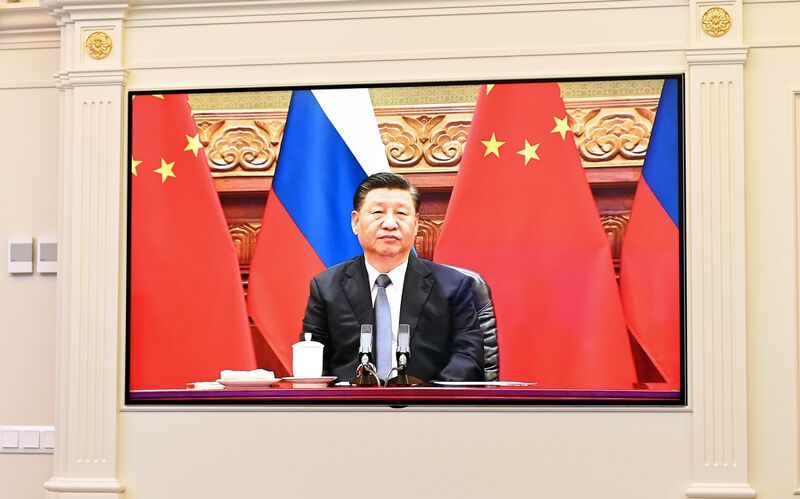
For China’s Xi Jinping, who just weeks ago reaffirmed his friendship with Moscow, the speed with which Russia has been cut off should serve as a warning.
For China’s Xi Jinping, who just weeks ago reaffirmed his friendship with Moscow, the speed with which Russia has been cut off should serve as a warning.Photographer: Alexei Nikolsky/TASS

It's the dominant geopolitical narrative of our era: The global economy is cleaving into two blocks as an ascending China and declining U.S. clash over trade, technology and the pandemic.

After Vladimir Putin’s invasion of Ukraine and the sanctions it provoked from the U.S. and allies, that divide appears sharper than ever ⁠— but the contest also looks more uneven. The economic isolation imposed on Russia has been a stark reminder of the persistence of American power.

China is catching up to the U.S. in terms of gross domestic product, and already eclipsed it in trade and manufacturing. But when it comes to the architecture of money that underpins the world economy, America and its dollar-led system remains the undisputed leader.

China Is Catching Up in Economic Weight...

Share of global GDP (at PPP)

“The locus of financial power still remains very firmly in the hands of the West,’’ says Eswar Prasad, a Cornell University economist who’s spent years studying China’s challenge to the greenback.

That’s been apparent as the U.S. and its allies in Europe and Asia coalesced around an ever-tighter series of sanctions after Putin sent his troops into Ukraine. They’ve severed Russia from the world economy so profoundly that the effects may be felt for years.

Ruble Sinks as Russia Isolated by Sanctions
Sweeping sanctions have pushed the Russian ruble to a record low.
Source: Bloomberg

The ruble collapsed, the central bank lost access to a large chunk of its foreign-currency savings, the government had to impose capital controls, and giant international companies from Apple Inc. to Royal Dutch Shell Plc raced each other out of the country.

For China’s President Xi Jinping, who just weeks ago declared a no-limits friendship with Moscow, the speed with which Russia has been cut off is a cautionary tale – and a reminder of why China’s leaders are so desperate to develop an alternative to U.S. dollar hegemony. It may yet motivate Beijing to speed up that project.

... But Far Behind in Financial Clout

The Chinese currency remains a bit-part player on the global scene

Source: SWIFT, International Monetary Fund

Read more: Bloomberg Economics on Russia Sanctions and China Blowback

In Washington, meanwhile, U.S. leaders have trumpeted the display of U.S. money power.

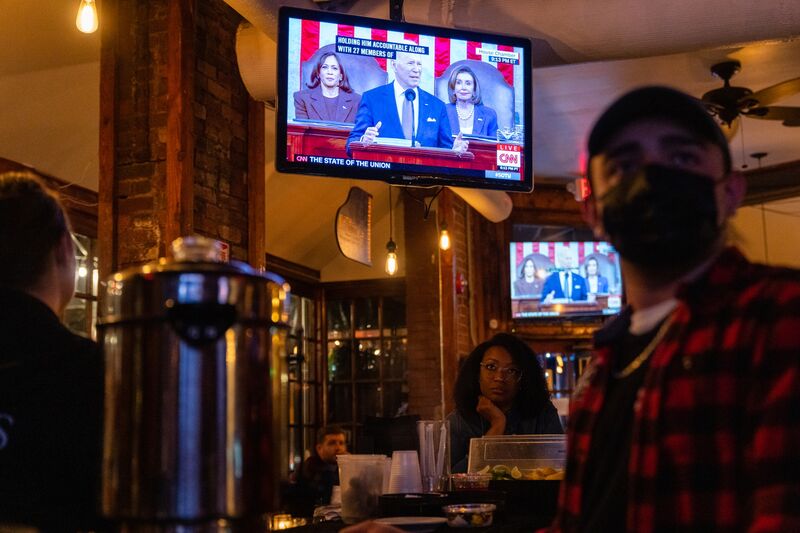
When the history of this era is written, Putin's war on Ukraine will have left Russia weaker and the rest of the world stronger,’’ said President Joe Biden in his State of the Union address this week. In what may have been a barb at China, he noted that “in the battle between democracy and autocracy, democracies are rising to the moment.’’

It’s early for anyone to declare victory. The shockwaves from Russia’s war in Ukraine are only just beginning.

Oil prices above $110 a barrel already threaten to push inflation, driven to multi-decade highs in the pandemic, even higher. That spells danger for Biden, whose popularity has already been eroded by soaring gasoline costs, and for leaders in Europe, whose economies still depend on Russian energy.

President Biden Delivers State Of The Union Address
Joe Biden's approval rating has stumbled as Russia's war in Ukraine, soaring gas prices impact the president's popularity.
Photographer: Eric Lee/Bloomberg

‘Stopped Clock’

Investors have rushed to price in a more divided global economy. In the U.S., defense stocks have been on a tear after European countries like Germany — long resistant to allocating more cash to their military forces ⁠— suddenly pledged to ramp up spending. And in China, companies linked to the payments system that the country has been seeking to build as an alternative to Western ones, have seen their shares soar.

Plenty of economists agree that the polarization is real. Adam Posen, president of the Peterson Institute for International Economics, calls it the “corrosion of globalization.’’ He says it began with President Donald Trump’s trade war with China, and continued through the pandemic as economies turned inward. Now it’s accelerated.

“Everybody has been talking for a long while about blocs and the global economy splitting up,’’ says Posen.

He was skeptical before. Now, he thinks, “the stopped clock is finally right’’ ⁠— and the eventual result will be a global economy that’s less productive and innovative as it turns combative, with consumers everywhere paying a price.

But in the near term, at least, there are reasons to think China won’t be in a hurry to take Russia’s side in all-out economic confrontation with the U.S. Indeed, Xi is treading a fine line so far.

While China has declined to slap financial penalties on Russia and will likely help it weather the sanctions storm by buying oil, gas and wheat, limits to the “no limits’’ friendship already appear to be emerging. Political leaders have talked of the need for a quick cease-fire and some big Chinese banks have restricted access to financing purchases of Russian commodities.

That pattern has been apparent in the past: China may disagree with the political goals of Western sanctions, but it has tended to avoid confronting them head on. Even Chinese state-run banks, for example, have complied with past U.S. curbs on Hong Kong. Carrie Lam, the territory’s Beijing-friendly chief executive, said in 2020 that she was collecting “piles of cash” at home because the U.S. measures barred her from basic banking services.

“The Chinese banks are actually quite leery of running afoul of the U.S. Treasury,’’ says David Dollar, a senior fellow at Brookings and former Treasury representative in Beijing. “The big Chinese banks are among the largest in the world, they're deeply integrated with the global system. So they're going to be careful.’’

UKRAINE RUSSIA CRISIS
China’s Foreign Minister Wang Yi acknowledges the invasion of Ukraine as a “war,” rather than a “special military operation” as described by Russia.
Photographer: Marcus Yam/Los Angeles Times/Getty Images

‘Bad News’

The fundamental reason for this caution: Xi presides over an economy that’s much more deeply intertwined with the world than Putin’s ⁠— in fact more so than it has ever been, after largely shrugging off any effects of the Trump trade war.

Chinese exports broke records during the pandemic. An analysis by HSBC economists found that over the past three years ⁠— when talk of decoupling and a brewing economic Cold War was rife — China’s trade grew about five times faster than the global average, while foreign direct investment there increased even as it was falling elsewhere.

Giving up all that to join Russia in an economic fight with the West right now  “would be bad news for China,’’ says Hui Feng, a senior lecturer at Griffith University in Queensland, Australia and co-author of “The Rise of the People’s Bank of China.” “It will be supplied with cheap Russian oil and other energy products. But it will suffer from a structural decoupling in technology and investment.’’

That doesn’t mean China will back away from its long-term goal of challenging U.S. financial supremacy. The past week's events may speed up that campaign, Federal Reserve Chair Jerome Powell told a Senate committee Thursday.

A degree of financial decoupling has been occurring on some fronts for years. The U.S. has taken a dim view of Chinese acquisitions in key American industries. Under Trump, it cracked down on Chinese firms listing on U.S. markets. Some firms that managed to do so are reconsidering.

Chinese ride-hailing giant Didi Global Inc., which pulled off a $4.4 billion initial public offering in New York last year (against Beijing’s wishes), plans to transfer its stock-market listing to Hong Kong. Insurer FWD Group Holdings Ltd has filed an IPO application in the same city, after U.S.-China tensions squashed plans for an overseas debut.

From Opinion:  Did Xi Jinping Get Played by Putin on Ukraine?

Low Base

Meantime, Beijing is beefing up its economic defenses. Xi has ordered an acceleration of the drive toward self-reliance in key industrial components like semiconductors. For years, Chinese firms have bought up deposits of strategic minerals such as cobalt.

On the financial front, China has set up a digital currency that may soon be ready for cross-border use, and a payment system known as CIPS that offers an alternative to the Swift mechanism that Russia has been partially cut out of.

Those would help Chinese companies and others circumvent the dollar-based system in the event of a sanctions onslaught, which would be likely should Chinese forces attack Taiwan, for instance.

CIPS may get more use soon, as China-Russia transactions increase. But it’s currently a limited vehicle for avoiding sanctions, with just 75 participants  all of them overseas branches of Chinese banks  and no equivalent of Swift’s interbank messaging system, Rhodium Group analysts said in a report Thursday.

The People’s Bank of China has also sought to diversify its foreign-exchange reserves and reduce the weight of U.S. Treasuries, though it remains the world’s second-biggest holder with $1.1 trillion of them.

General Views of Beijing
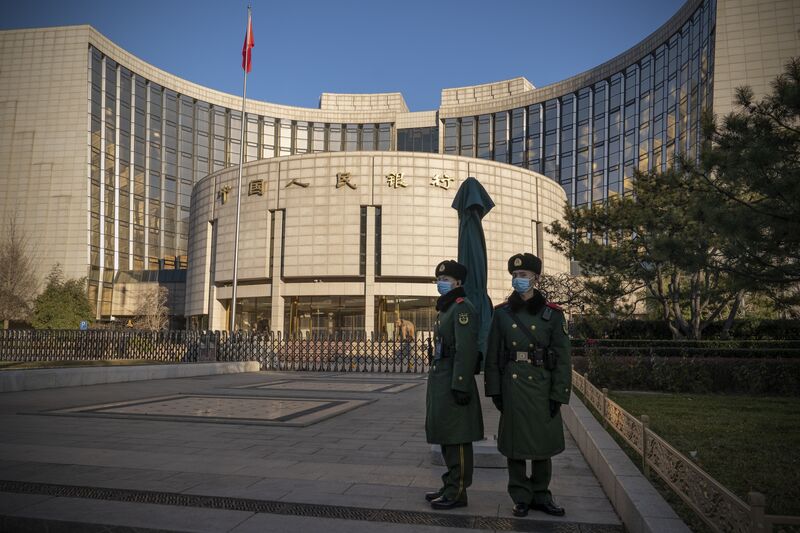
China has set up a digital currency that the central bank insists is ready for cross-border use, and a payment system known as CIPS that offers an alternative to the Swift mechanism.
Photographer: Andrea Verdelli/Bloomberg

In all of this, though, the problem for China is that it’s starting from a very low base.

Efforts to build a rival system to the dollar-led one and to encourage broader use of its currency haven’t had much success. The renminbi accounts for just over 3% of global payments via Swift and a mere 2.7% of official foreign-exchange reserves.

Edwin Lai, professor of economics and director of the Center for Economic Development at the Hong Kong University of Science and Technology, says it’s not clear what China can do to speed up the process.

“The international monetary system has a lot of inertia,’’ said Lai, who wrote a book on the yuan titled “One Currency, Two Markets: China’s Attempt to Internationalize the Renminbi.’’

Divided World

Politically, the U.S. and its European allies have mustered plenty of global support for their diplomatic and financial campaign against Russia. In this week’s emergency United Nations debate, 141 voted to condemn Putin’s invasion while 35 countries abstained. Only Belarus, Syria, North Korea and Eritrea voted with Russia, while the rest abstained.

Singapore’s government said it would impose unilateral sanctions against Russia, the first time in decades that the city-state and financial center censured a foreign nation without UN Security Council backing. Traditionally neutral Switzerland has done so as well.

But there are important dissenters. Major emerging-market economies like Mexico and Turkey have declined to sanction Russia. Oil-rich Persian Gulf states like Saudi Arabia are seeking to stay neutral. So is India, the world’s fastest growing major economy, which has long relied on Russia as a weapons supplier.

During Putin’s visit in December, India committed to tripling trade between the two countries, and Russian state oil giant Rosneft signed a major oil supply deal.

Battle Lines?

Democracies account for a declining share of the world economy, and that trend is projected to continue

Source: Bloomberg Economics, Freedom House

Note: Country status based on latest classifications by Freedom House; long-term GDP forecasts by Bloomberg Economics

That neutral status could bring a payoff for financial centers that manage to stay outside a contest between the West and its main rivals, according to Branko Milanovic, an economics professor at the City University of New York and author of ``Capitalism, Alone: The Future of the System that Rules the World.’’

He argues that the conflict in Ukraine, and the Western response, point toward a fragmentation of capital -– a world in which money can’t move as freely as it has over the past half-century or so. Businesses and the super-rich, along with central banks, will be looking for safe places to store assets ⁠— out of reach of governments fighting a financialized war.

Top of Milanovic's list is a place like Mumbai. “It's a big financial center. India is a democratic country. India doesn't have any history of seizing money, nor do they have any incentive to do that. They are not part of the West and, as we see in the Russia crisis, the U.S. cannot dictate India's policy.’’

Ties that Bind

Another view is that it’s precisely the deep economic ties between the U.S. and China that will prevent a wider financial or even military conflict between them.

Connect the dots on the biggest economic issues.
Dive into the risks driving markets, spending and saving with The Everything Risk by Ed Harrison.
By submitting my information, I agree to the Privacy Policy and Terms of Service.

That’s the case made by Angela Zhang, a law professor and expert on China's legal system at the University of Hong Kong. China has been forced to confront the reach of U.S. sanctions before and has figured out ways to withstand their impact, she says, citing the blacklisting of telecommunications equipment makers Huawei and ZTE who fell afoul of Washington’s sanctions against Iran and North Korea.

China has its own economic ties with U.S. allies. It’s central to a major trade deal, the Regional Comprehensive Economic Partnership, which includes Japan, Australia and New Zealand ⁠— but excludes the U.S.

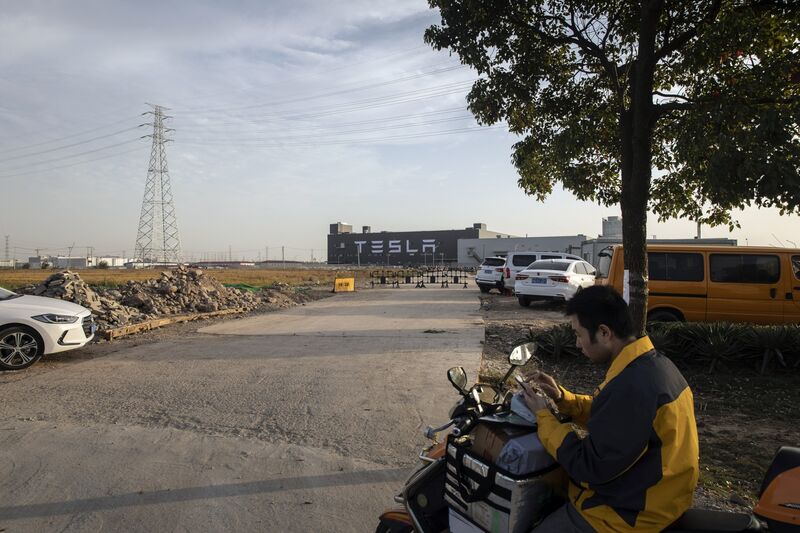
U.S. companies like Apple and Tesla will still want to sell their products in China’s fast-growing consumer markets. Intertwined supply chains ⁠— even after recent snarls and the inflation they fueled ⁠— illustrate U.S. reliance on China. Mutual need means things shouldn’t escalate too far.

“The Sino-U.S. economic interdependence will be the best safeguard for peace,’’ says Zhang.

The Tesla Gigafactory Nears Being Operational Just 10 Months After Breaking Ground
U.S. companies like Tesla and Apple will still want to sell their products in China’s fast-growing consumer markets.
Photographer: Qilai Shen/Bloomberg

‘Significant Blunder’

Some in Washington reckon that China made a miscalculation in aligning itself with Russia – and has been shocked by the force of the U.S.-led countermeasures.

“China has clearly made a very significant geopolitical blunder by throwing its lot in with Moscow on the eve of this catastrophic invasion,’’ says Jude Blanchette, a China expert at the Center for Strategic and International Studies in Washington. “Their ham-fisted response over the past week and a half indicate just how lost they are.”

Others see risks in America’s assertion of its money power. While the U.S. and its allies have wielded “the heaviest financial hammer that we can think of,” it hasn’t stopped Russia’s military attack, says Josh Lipsky, director of the Atlantic Council’s GeoEconomics Center.

The risk in the longer term, Lipsky says, is that the war could end with Russia occupying all or part of Ukraine and installing a puppet government. That would raise questions about how effective this week’s display of American financial might really was.

There are historical reasons for the world to fear economic division into rival camps: It’s what happened in the 1930s, presaging World War II. With the fighting in Ukraine becoming fiercer by the day and Russia threatening to mobilize its nuclear arsenal, discussions of future financial arrangements remain overshadowed by events around Kyiv and Ukraine’s other beleaguered cities.

“Everyone is caught in the geopolitical tensions,” says Andrew Sheng, chief adviser to China’s Banking and Insurance Regulatory Commission. “We are all losers from the present trajectory.”

Read this next: The End of the Oligarch Era Nears With Putin’s Miscalculation in Ukraine

— With assistance by Bjorn Van Roye

    Up Next
    Russia-Ukraine Latest News: March 4, 2022

    https://www.bloomberg.com/news/articles/2022-03-04/ukraine-war-putin-s-financial-isolation-is-a-warning-sign-for-xi-jinping


    Most Recent Post

    Man charged for borrowing rare Chinese manuscripts from UCLA library, returning fakes

      Suspect Jeffrey Ying allegedly travelled to China after checking works out using several aliases Agence France-Presse Published: 12:11pm, ...

    Popular Posts - Last 30 days