LONDON (July 27): Bondholders of emerging markets that may have to restructure debt are watching Sri Lanka’s unfolding credit crisis with a burning question: What will China do?
Beijing is the largest official creditor to developing nations and investors say it’s unclear how lenient it’ll be in demanding repayment from distressed borrowers. They view Sri Lanka as a test case, and whether China demands repayment in full or accepts a haircut will determine how much private creditors including bondholders could recover in case of a default.
A record 21 emerging market sovereigns’ dollar bonds are trading in distressed territory, according to data compiled by Bloomberg. Some of those may join Sri Lanka and Belarus who defaulted this year as the global economic slowdown and the war in Ukraine cut all but the highest-rated sovereign issuers off from international debt capital markets.
“One of the biggest problems of China’s prominence as a creditor to emerging markets is the lack of transparency in its bond contracts,” said Dave Loevinger, Los Angeles-based managing director at TCW Group Inc, which holds Sri Lankan debt. “We don’t know how it is going to behave in a restructuring.”
Western creditor nations like the US are unwilling to let International Monetary Fund and World Bank bailouts be used to repay China, while China is loathe to provide debt relief so that multilateral institutions and bondholders could get paid, said Loevinger, who is a former senior coordinator for China affairs at the US Treasury.
Sri Lanka will be the key test because it has diverse creditors including the Paris Club, China, India and bondholders. Unlike Zambia, which defaulted in 2020 and is now in talks with creditors, Sri Lanka is not eligible for so-called Common Framework debt relief as it’s a middle-income country. That makes it a more meaningful blueprint for other middle-income emerging economies.
China typically collateralizes its infrastructure loans, giving it stronger bargaining power and lessening the incentive to work together in a restructuring with unsecured creditors, who have little or no legal recourse. In Sri Lanka, for example, China took control of the port of Hambantota after the country couldn’t repay a loan.
“Wherever you have China involved, the negotiations have become much more complicated and as a consequence much longer than they would be if it was just restructuring private debt holders,” said Phillip Torres, a senior portfolio manager of emerging market debt at Aegon Asset Management in Chicago. “Private bondholders’ legal recourses are limited to, basically, negotiation.”
It took 16 months discussions before China finally agreed to join Zambia’s creditor committee in April. Almost two years after its default, the southern African country is now close to a deal with official creditors, China included, that could unlock a US$1.4 billion bailout from the IMF, President Hakainde Hichilema said last week.
China is willing to provide support and assistance within its capacity to Sri Lanka, Chinese state television cited President Xi Jinping as saying in a message to Sri Lanka’s new president. Xi also said he believes Sri Lanka would be able to overcome temporary difficulties and advance economic recovery. Zambia’s second meeting with the official creditors committee on July 18 was a “very successful one”, China’s Ambassador to Zambia, Du Xiaohui, said in comments streamed on state-owned ZNBC, adding that “we can resolve the debt issue”.
But while China may be willing to discuss rescheduling or postponing payments, the question remains whether it will demand full redemption of the principal.
“China is notoriously reluctant to disclose what’s going on in its negotiations with debtor countries, to communicate, let alone coordinate with other creditors,” said Elena Daly, founder of EM Conseil, a Paris-based advisory firm specializing in sovereign debt management. “It is also notoriously reluctant to agree to haircuts.”
Elsewhere in credit markets:
EMEA
NRW Bank is the only deal today in Europe’s primary bond market, the day after credit risk benchmarks jumped by the most since the early coronavirus turmoil as the continent faces a gas squeeze.
Ukraine’s state-owned energy company, NJSC Naftogaz Ukrainy, will “urgently” present a new plan to delay debt payments. The grace period for it to redeem US$335 million of international bonds expired on Tuesday, as the government blocked the payment and after bondholders rejected a restructuring proposal earlier this month.
Italy’s sovereign debt rating outlook was lowered by S&P Global Ratings, after the recent political turmoil that resulted in the resignation of Mario Draghi and the calling of fresh elections.
BlackRock Inc has raised a total of £1.7 billion pounds from UK pension plans to invest in a private debt fund.
Asia
Debt spreads rose in Asia ahead of the Federal Reserve’s upcoming decision, with no primary-market dollar debt deals for a second session.
Investment-grade dollar bond spreads in Asia excluding Japan widened as much as 1 basis point, while the cost to insure such debt against default climbed about 4 basis points during Asian hours, according to a trader.
Global green bonds are on course for their first month of positive returns in a year, outperforming broader debt in a move that’s likely to spur pent-up investor appetite for the asset class.
China’s largest developer by sales is selling new shares at a discount, highlighting the sense of urgency among property developers to raise cash.
A default scare at a Philippine conglomerate highlights the challenges the country’s new president Ferdinand Marcos Jr. faces in trying to tame rapid inflation without causing economic growth to falter.
Americas
Traders will have all eyes on the Federal Reserve decision later, with ten-year Treasury yields having slumped almost 75 basis points in a matter of weeks, as prospects of a recession are priced in.
Markets were starting to price in a 100-basis point increase after the June inflation figures, but that position has mellowed since Governor Christopher Waller and St. Louis Fed President James Bullard expressed a preference for 75 basis points.
The junk bond default rate in the US is expected to rise between 4.7% and 5.9% over the next 12 months, warning investors to not wade back into the market too soon amid a rally, according to BCA Research.
3M Co has placed its Aearo Technologies unit in Chapter 11 bankruptcy in a bid to resolve sprawling litigation brought by US military veterans over allegedly faulty combat earplugs.
New York/WashingtonThe United States stopped the Russian government on Monday from paying holders of its sovereign debt more than $600 million from reserves held at American banks, in a move meant to ratchet up pressure on Moscow and eat into its holdings of US dollars.
By Reuters
Updated 0728 GMT (1528 HKT) April 5, 2022
Under sanctions put in place after Russia invaded Ukraine on Feb. 24, foreign currency reserves held by the Russian central bank at US financial institutions were frozen.
But the Treasury Department had been allowing the Russian government to use those funds to make coupon payments on dollar-denominated sovereign debt on a case-by-case basis.
On Monday, as the largest of the payments came due, including a $552.4 million principal payment on a maturing bond, the US government decided to cut off Moscow's access to the frozen funds, according to a US Treasury spokesperson.
An $84 million coupon payment was also due on Monday on a 2042 sovereign dollar bond.
The move was meant to force Moscow to make the difficult decision of whether it would use dollars that it has access to for payments on its debt or for other purposes, including supporting its war effort, the spokesperson said.
Russia faces a historic default if it chooses to not do so.
"Russia must choose between draining remaining valuable dollar reserves or new revenue coming in, or default," the spokesperson said.
JPMorgan Chase & Co(JPM), which had been processing payments as a correspondent bank so far, was stopped by the Treasury, a source familiar with the matter said.
The correspondent bank processes the coupon payments from Russia, sending them to the payment agent to distribute to overseas bondholders.
The country has a 30-day grace period to make the payment, the source said.
Default worries
The increased pressure comes as the United States and Europe are planning new sanctions this week to punish Moscow over civilian killings in Ukraine.
Russia calls its move in Ukraine a "special military operation." Ukraine and the West say the invasion was illegal and unjustified. Searing images of a mass grave and the bound bodies of people shot at close range drew an international outcry on Monday.
Russia, which has a total of 15 international bonds outstanding with a face value of around $40 billion, has managed to avoid defaulting on its international debt so far despite unprecedented Western sanctions. But the task is getting harder.
Russia was last allowed to make a $447 million coupon payment on a 2030 sovereign dollar bond, due last Thursday, at least the fifth such payment since the war began.
If Russia fails to make any of its upcoming bond payments within their pre-defined timeframes, or pays in rubles where dollars, euros or another currency is specified, it will constitute a default.
While Russia is not able to access international borrowing markets due to the West's sanctions, a default would prohibit it from accessing those markets until creditors are fully repaid and any legal cases stemming from the default are settled.
I teach Finance-related courses at Middlebury College in Vermont.
TOPSHOT - The body of a Russian serviceman lies near destroyed Russian military vehicles on the ... [+]
AFP VIA GETTY IMAGES
In his book "On War," the Prussian General Carl Von Clausewitz surmised that "Peace is maintained by the equilibrium of forces and will continue just as long as this equilibrium exists, and no longer." By invading Ukraine on February 24, 2022, Russia brought that truth home to Europe. The Russian invasion exposes the weakness of Europe's strategic policies pursued since the fall of the Berlin Wall. Concurrently, it allows China to put the foundations of Western global hegemony in check, using Russia as a delusional pawn on the international chessboard.
Origins of China providing tacit support to Russia
February 24, 2022 will find its way into the history books next to November 9, 1989, the fall of the Berlin Wall, and the September 11, 2001 attacks. More interestingly is the link with another date, September 15, 2008, the day of the demise of Lehman Brothers and the onset of the Great Financial Crisis.
The 2008 financial meltdown resulted from an unbridled U.S. financial system, which refused to regulate derivatives (a policy endorsed by Larry Summers and Hank Paulson), was unable to contain the insatiable risk appetite of the banks, and which left insufficient capital buffers and highly leveraged positions unattended. The undoing started under the Clinton and Rubin administration with the promulgation of the 1999 Gramm-Leach-Bliley act, which dismantled the foundational 1934 Glass-Steagall Act. The Glass-Steagall Act ensured stable segregation between predictable retail banking and more risk-prone investment banking.
The crisis triggered a global housing price bubble burst, brought on by too lenient global monetary policies, irresponsible U.S. banking practice, outright fraud, and unsustainable global financial leverage.
Part of the global fault line was reflected in the substantial trade imbalance between China and the U.S. China benefited enormously from the globalization trend triggered by the fall of the Berlin Wall and the relocation of global production capacity towards its lower cost base. China became the global production house. This position was further bolstered by China joining the World Trade Organization (WTO) in December 2011. However, China was left unchallenged in managing its exchange rate, which is usually a "quid pro quo" for WTO membership. China recycled its excess U.S. dollars by building up a $1 Tr position of Treasury Securities. The move allowed China to keep its cost base (artificially) low by not selling the export generated $ revenue on the foreign exchange rate market.
The 2008 financial crisis revealed to China the vulnerability of the U.S. financial system. China saw the "safe haven" status of its abundant Treasury position unravel during the 2008 crisis. After an animated meeting between U.S. Treasury Secretary Hank Paulson and his Chinese counterpart during the 2008 Peking Summer Olympics China started taking its fate into its own hands: first through seeking global dominance, to be followed by the global reserve currency status.
Since the Ukraine invasion, China has been silent about sanctions (as was India), and it abstained at the March 2 U.N. General Assembly vote denouncing the attack.Remarkably, half of the 35 nations, representing 4 billion citizens overall, which abstained were African (amongst others Mozambique, Senegal, Uganda, South Africa, Zimbabwe,...). It would be insightful to review if the Mozambique U.N. vote was directed by the Chinese write-off of its debt in March 2021? Would there be similar U.N. voting patterns in relation to African sovereign debt extended or restructured by China?
The invasion and its broader ramifications were probably discussed during Putin's visit to China's Winter Olympics, where the "No Limits" partnership was inaugurated on February 4. Under the partnership, both countries announced mutual support over standoffs on Ukraine and Taiwan. Furthermore, both countries committed to collaborate more against the West on issues as diverse as climate change, artificial intelligence, and space.
Artyom Lukin, Professor of International Relations at the Far Eastern and Federal University in Vladivostok, explains that the China-Russia relationship is part of a "Post-West" world construct several years in the making. Ukraine seems to have been an opportunity too good to miss for both countries.
"The decision-makers in Moscow understand that without Chinese assistance, without the backing of China, Russia would be unable to withstand confrontation with the West."
Russia has been for many years an ardent and reliable ally supporting China's global ambitions to erode the Western world's power base. The Russian invasion is, in fact, part of a string of proxy wars between the U.S. and China. The aim is for China to take over world hegemony.
Russia's performance on the world scene (2008 – 2022)
Early in the first decade of this century, the Russian invasions of Georgia (2008) and Crimea (2014) tested NATO's response mode and resolve. The July 2014 shooting down of Malaysia Airlines flight 17 over Ukraine, killing 297, mostly Dutch passengers, was perpetrated by Russian soldiers in the Donbas region also tested NATO's willpower.
In September 2015, the sudden appearance of Russian troops in Syria at the request of the Syrian regime jolted Russia back onto the global power scene. Russian airpower proved critical in preventing the collapse of the Iranian-backed Assad regime. Assad, a member of the Shia minority, is still in power today. Through this intervention, Russia proved its mettle by strategically positioning itself in the Middle East. Its position has an even greater pull in the face of a potential U.S. withdrawal from the region.
In February 2022, President Macron's decided to withdraw French troops from Mali after they had encountered severe backlash, including from the private Wagner military group sponsored by Russia. Significantly, Mali is the third-largest producer of gold and has considerable uranium supplies.
The French troops had been deployed since 2013 as part of Operation Barkhane, the code name for the anti-jihadist operation covering Mali, Burkina Faso, and Niger. The efforts are now centered around Niger. As the sixth global producer of uranium, Niger is a critical purveyor of uranium to France, running 56 nuclear power plants. Ukraine is the ninth largest global producer of uranium.
These transgressions, all to seek influence and access to essential primary resources, occurred with no hard-hitting price to be paid by Russia. Russia had only green lights. Russia performed tasks that benefited China for which the payback is, at minimum, tacit support and, at best, from the Russian point of view, accommodation and compensation through the Chinese barter and financial system.
Europe, the indulgent facilitator
Since 1989, Europe has misread Putin's and his KGB entourage's intent to reinstall the grandeur of the Russian empire. In the eyes of a despotic Putin, Europe didn't deserve the expansion it was afforded at the expense of the lost Russian imperial eminence. Europe shuffled along on at least five strategic axes: energy policy, defense spending, cyber-security, illicit political party financing, and financial regulation.
1. Energy policy and the flawed decarbonization imperative
Nowhere has Europe positioned itself so vulnerably as in its energy policy.
Since the first oil crisis hit Europe in 1973, Europe has reduced its fossil fuel dependency by only a paltry amount, generating only 11% of its overall energy needs from renewables and a similar amount from nuclear energy. As of 2022, Europe is still reliant for almost 75% of its primary energy sources on fossil-based oil (39%), gas (25%), and coal (11%). Regarding natural gas dependency, Germany relies on Russia for 50% of its natural gas, Italy for 33%, and the Netherlands for 25%.
Combined with the urgent climate change adaptation recommendations articulated in the latest IPCC report, Europe no longer has an excuse to delay the geostrategic imperative to decarbonize 75% of its primary energy resources into renewables.
The behind-the-scenes pressures exercised by Gazprom and other energy lobbyists to classify natural gas as a green energy source during the E.U. Green Taxonomy review should be made public. Pressure from the E.U. commission to modify the E.U. Green Taxonomy should also be brought into the limelight. The Gazprom-managed Nordstrom P2 pipeline aims to delay the essential decarbonization process and, geo-politically, is nothing else than a Trojan horse.
EU Gas Pipelines and LNG carriers
LE MONDE DIPLOMATIQUE - CECILE MARIN
2. Defense spending
Europe has been betting for too long on the peace dividend emanating from the fall of the Berlin Wall. Military spending as a percentage of GDP dropped from 2.4% in 1989 to 1.5% in 2020. (Germany reversed this trend by announcing on February 27, 2022, a surge in military spending of Euro 100 bn ($112 bn) bringing their expenditure to 2% of their GDP.) Earlier indications floated by the Trump administration of a less U.S. dominant NATO alliance also projected fissures within the Western front. Low defense spending in Europe and the diminished U.S. support for NATO under Trump let Putin believe that rebuke and resolve would be weak in case of another incursion.
3. Cyber-intelligence
A cyberattack in February 2022, disrupting several European oil refining hubs within the Amsterdam-Rotterdam-Antwerp (ARA) area, was only the latest of a string of ransomware strikes aimed at impairing crucial infrastructure and supply chain architecture.
The attacks exposed the need to secure legacy systems, especially in the energy and communications sectors, which have been outpaced in design due to accelerated digitalization and vulnerable connectivity to the internet. This is a major challenge both for Europe and the U.S.
Through the Digital Europe Programme, Europe decided to invest €1.6 billion into cybersecurity capacity for the period 2021-2027. This wholly inadequate amount is testimony to the seriously flawed understanding of this strategic military challenge.
4. Illicit political party financing
Russia has secretly funded European political parties with a staunch anti-EU stance. Russia is indiscriminate about financing parties both from the left and the right of the electoral spectrum, so long as they promote an anti-EU narrative. One example: In June 2020, the French far-right National Front party settled a controversial $10 MM loan dispute with a Russian aircraft parts company.
Furthermore, there are suspicions that Russia, through hacking and disinformation, meddled in the 2014 Scottish Independence referendum and the 2016 Brexit referendum. The U.K. leaving the European Union caused a severe dent in the Western bloc.
Similar tactics were deployed when Russian operatives leaked internal emails from Democrats during the 2016 U.S. election. The 2019 Mueller report provides precise detail of Russian interference in U.S. politics.
Ingenious fiscal constructions make it more difficult to "follow the money." According to the Tax Justice Network, the Netherlands ranks fourth in locations that facilitate tax evasion by multinational corporations, behind the British Virgin Islands, Cayman Islands, and Bermuda.
Such fiscal structures, in the slipstream, benefit oligarchs and despots from around the world.
Which are the financial institutions facilitating these transactions, and on whose behalf? Under which regulatory regime do they operate? And who in Europe is controlling these hidden money flows?
5. Financial regulation
The E.U. is only as strong as its weakest links. Since joining the European Union in 2007, Malta and Cyprus have offered E.U. citizenship for foreign cash.
This policy allows foreigners to gain E.U. passports and access to visa-free travel across the E.U. In the case of Cyprus, total bank deposits ($58 bn) are now a multiple of its Gross Domestic Product ($24 bn).
On the day of the Ukraine invasion, the Russian state-owned VTB Bank, which faced both European and U.S. sanctions, transferred its stake in Cyprus' Russian Commercial Bank to the two remaining shareholders, both of which are companies registered in Cyprus.
How are the Cyprus Central Bank and the European Central Bank overseeing these developments?
In addition, far too accommodating listing requirements have offered Russian companies straight access to primary markets in Europe.
There are 23 Russian companies listed on the London Stock Exchange, even after the suspension of VTB capital. The German stock exchange hosts 61 listed Russian companies. However, the operator of Deutsche Börse's Qontigo indices, Stoxx, decided to ax all Russian companies from its indices as of March 18.
Both NYSE and NASDAQ have now halted trading of about ten Russia-based companies.
The recent data leak at Credit Suisse exposed the hidden wealth of clients involved in torture, drug trafficking, money laundering, corruption, and other serious crimes. The 30,000 accounts represent $105bn of hidden assets. Switzerland has abandoned its neutrality and joined the E.U. sanctions against Russia with the invasion.
Can we rest assured that no other European and American financial institutions are abetting similar clients even after years of anti-money laundering and know-your-customer practices?
What is next?
The slew of sanctions imposed on Russia has led to severe financial damage:
The Ruble declined to 102 from 80 against the Dollar.
The Russian Central Bank doubled interest rates to about 20%.
The same Central Bank is precluded from accessing $630 billion in mostly dollar reserves.
In contrast, two major sources of export revenue are skyrocketing. Oil is quoted at $110 per barrel, and the Dutch April gas contract hit a new record high of €185 per megawatt-hour. Though SWIFT banned Russian banks from its messaging system, European and U.S. banks are still clearing Euro and $ denominated payments as part of sanction exemptions. This represents about $550 MM in daily revenue for Russia's state-controlled energy companies.
At current rates, oil and gas generate about $200 bn in annual revenue. Russia spent about $70 bn on its military capacity in 2021.
Europe has received a tragic wake-up call. Now it needs the resolve to tackle its main strategic challenges. The immediate priority for Europe should be to reduce the reliance on Russian energy and fossil fuel altogether.
Diplomatically and militarily, Europe should remember that the current "axis of evil" is run by Putin and some 50 of his acolytes. The post-Putin era should be envisioned with a Moscow alternative power base in mind which could quickly take over the reins. Ultimately, a decarbonized industrial and military alliance ranging from San Francisco to Vladivostok could be mapped. It would be a formidable bloc to balance out the global ambitions of China.
In the meantime, the critical question remains, what role is China playing behind the scenes?
Will BP's sale of its 20% Rosneft stake, at a loss of $25 bn, end up in the hands of Sinopec on the cheap? Will China National Offshore Oil Corporation take over Shell's LNG Sakhalin joint venture position with Gazprom?
What are the State Administration of Foreign Exchange (SAFE) and the People's Bank of China facilitating on behalf of Russia during this crisis? Are they supporting the Ruble, as one would expect, given that the Ruble should have fallen much further because of the magnitude of sanctions applied? Will People's Bank of China intermediate any gold sale residing on the Russian Central Bank balance sheet to the tune of about 20% of its reserves?
Given the potential of Chinese intervention behind the scenes, China can also influence the reach of Putin's military moves.
Jimmy Carter famously remarked that China, since its 1979 Vietnam invasion, has been at peace with its neighbors and the world. Over and above crimes committed against its Uyghurs minority population, China knows exceptionally well how to entice other nations to engage on the battlefield on its behalf.
The time has come to call out China and end the human tragedy in Ukraine, as Russia overplayed its hand under China's watch. Yet, it will demand some astute chess play as China still sits on $1 Tr of Treasury securities, which could find their way on the market some day on a most inopportune moment for Western markets. It would be just another Chinese steppingstone, next to its Central Bank digital currency initiative, it its bid for global dominance and Renminbi to become the global reserve currency.
I acquired more than 30 years of global senior executive experience within the corporate finance and capital markets fields at Fortis and BNPP.
At Middlebury College, I teach as Professor of the Practice “Capital Markets”, “Investment Management”, “Carbonomics and Renewable Energy” and “Introduction to Finance”. I mentor through our entrepreneurial program and act as faculty advisor to the Student Investment Committee.
I also board advise early-stage companies and NGOs on the nexus of sustainable development and fintech. In 2020, I co-established the Sustainable Finance Unconference series, a quarterly platform where prominent sustainable finance peers present their recent contributions in the space.
"It would take a middle-class couple 47 years to buy a small apartment—about 90 square meters—in Beijing or Shanghai if both husband and wife were able to save 100% of their salaries for the purchase," Anne Stevenson-Yang of J Capital Research tells Newsweek.
"Want to Buy a House in a Big Chinese City?" asked the Sixth Tone website late last month. "Try Winning the Lottery First."
Real estate prices in China are out of whack, so the market is "frozen," with buyers and sellers far apart. As a result, the number of transactions in recent months has fallen. Prices month-to-month are starting to come down, as well. Total sales of the country's top 100 developers plunged 39.6% year-on-year by value last month.
Stevenson-Yang, also the author of China Alone: The Emergence From and Potential Return to Isolation, reports in Forbes that around 30 Chinese cities are refusing to register transactions at prices below government-set levels.
"The model on which the real estate boom is based is unsustainable," saidGeorge Soros at a Hoover Institution webinar on January 31.
Unsustainability is an emergency for China. The real estate sector accounts for an unusually high 25% to 30% of Chinese gross domestic product. Moody's last July estimated that between 70% to 80% of the household wealth of the Chinese people is in real estate.
An "economic crisis," as Soros suggests, is coming. Trapped by strong currency walls—the renminbi is not convertible on the capital account—the Chinese people cannot readily invest in foreign assets. They have few places to put cash inside China, so they purchase apartments. Apartments, as a result, have for many become more than just investments; they are stores of value, similar to paper currency or gold coins.
Many apartments across China—the ones infamously dark at night—have in fact been sold by developers, but remain vacant. They are in the hands of first-time owners, who do not rent them out because that would result in a diminution of value.
Ultimately, prices have to come down to levels people can afford. As Stevenson-Yang's example from the leading Chinese cities shows, the drop will be large. Incomes, artificially suppressed by Beijing for more than four decades, cannot support current real estate prices.
Property developers are starting to default, especially since last September. The most prominent of these is Evergrande Group, which has accumulated a staggering $305 billion in liabilities. About a dozen other developers have not met bond and other obligations since then, either.
Behind China's currency wall, Chinese officials believe they have time to unwind the "debt bomb," avoiding a sharp correction in prices. But the hope for recovery is illusory. As Stevenson-Yang tells Newsweek, "when investment slows, as is happening now, property cannot recover."
Chinese officials have continually defied dire predictions, so many analysts think they will be able to muddle through this time. The problem, however, is that by muddling through in the past, officials postponed crises by taking on additional debt and thereby making the problem even more difficult to resolve. "They may have postponed dealing with it for too long, because people's confidence has now been shaken," Soros said.
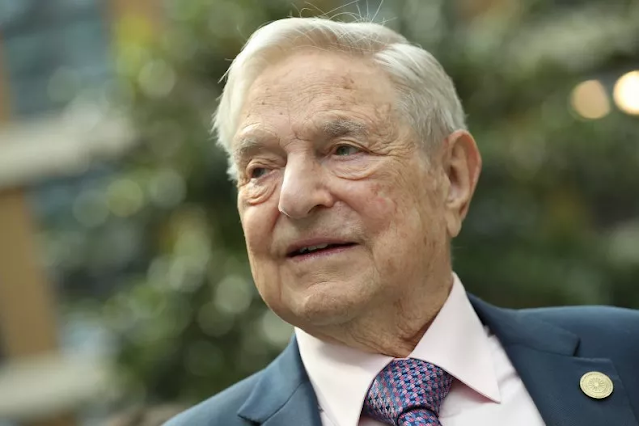
Financier and philanthropist George Soros attends the official opening of the European Roma Institute for Arts and Culture (ERIAC) at the German Foreign Ministry on June 8, 2017 in Berlin, Germany.SEAN GALLUP/GETTY IMAGES
That debt, by some estimates, has now reached 350% of GDP. The true percentage is unknowable because provincial and lower-tier officials, with various stratagems, have not reported obligations they have incurred. No one knows the extent of China's so-called "hidden debt."
Many analysts have said the world should not worry because property developers and other borrowers, by and large, have incurred relatively little foreign debt. At the end of last September, China's external obligations amounted to $2.70 trillion, according to China's State Administration of Foreign Exchange. That's a manageable sum.
Confidence that China can still avoid an impending crisis is, however, misplaced. History says the most severe and long-lasting financial crises involve countries that owe money to themselves.
Why? In external-debt crises, foreign parties suffer when debt is compromised. The reduction of debt, of course, is politically popular in debtor countries. In China's case, every solution involves domestic losers—the borrowers are largely domestic—so the crisis will not end until the Communist Party forces local parties to bear severe consequences.
Settlement of China's debt, therefore, will require political will in Beijing—more political will than China's leaders have exhibited in decades. "Xi Jinping has many tools available to reestablish confidence—the question is whether he will use them properly," Mr. Soros said at the Hoover event.
Xi's tools to deal with out-of-control property prices are limited, in large part because of something else Soros mentioned at Hoover: out-of-control disease. COVID-19 is ripping through the country and, with ineffective Chinese-produced vaccines, the country's only defense against the coronavirus is isolation.
Isolation is the enemy of economic growth. Xi's "zero-COVID" policy of draconian lockdowns has made maintaining the internal Chinese economy exceedingly difficult.
So far, exports, which jumped 29.9% last year, have kept China going, but disease-control measures have undermined consumption. And as long as consumption, touted as the core of China's growth machine, is weak, Xi will not be able to generate the growth necessary to pay back debt.
The highly respected Diana Choyleva, the chief economist at London-based Enodo Economics, argues China's economy is headed for "stagnation," not "collapse." Her reasoning is highly persuasive; nonetheless, the issue for Beijing today is whether, in the middle of a debt crisis, stagnation must inevitably lead to outright collapse.
An economic slowdown—or worse—will also have political implications. Xi is seeking a precedent-breaking third term as the Communist Party's general secretary at the 20th National Congress, expected to be held this fall. He has staked his bid on the claim he has made China strong. Yet the economy is fragile, and Xi does not have the means to keep it going.
The mighty-looking Chinese leader is now hostage to developments beyond his control.
Gordon G. Chang is the author of The Coming Collapse of China. Follow him on Twitter: @GordonGChang.