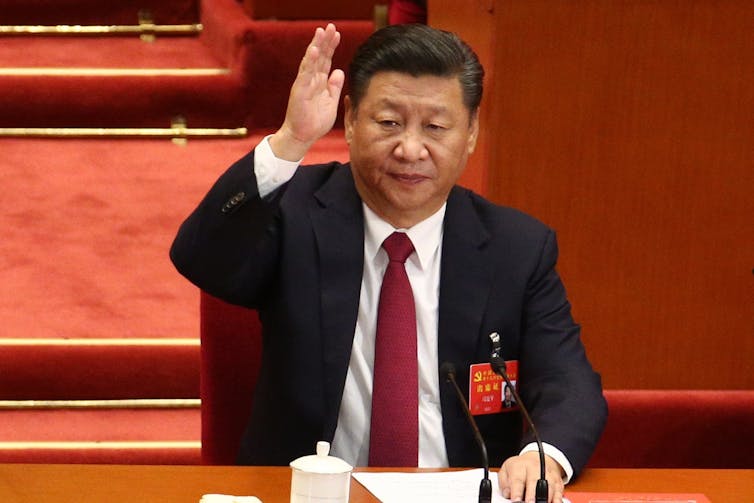
China’s President Xi Jinping surprised the global community recently by committing his country to net-zero emissions by 2060. Prior tothis announcement, the prospect of becoming “carbon neutral” barely rated a mention in China’s national policies.
October 8, 2020
China currently accounts for about 28% of global carbon emissions – double the US contribution and three times the European Union’s. Meeting the pledge will demand a deep transition of not just China’s energy system, but its entire economy.
Importantly, China’s use of coal, oil and gas must be slashed, and its industrial production stripped of emissions. This will affect demand for Australia’s exports in coming decades.
It remains to be seen whether China’s climate promise is genuine, or simply a ploy to win international favour. But it puts pressure on many other nations – not least Australia – to follow.
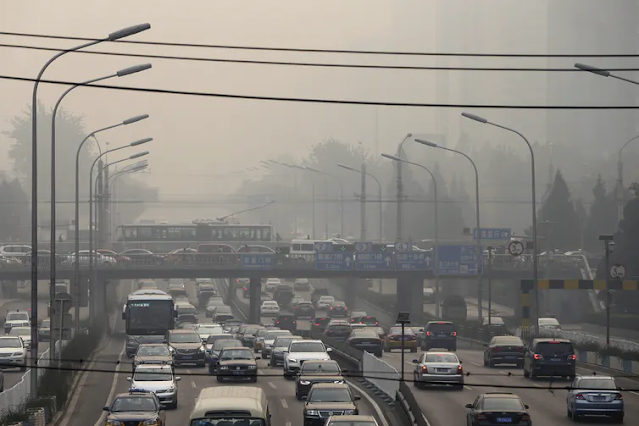
It remains to be seen whether China will deliver on its climate pledge.Da qing/AP
Goodbye, fossil fuels
Coal is currently used to generate about 60% of China’s electricity. Coal must be phased out for China to meet its climate target, unless technologies such as carbon-capture and storage become commercially viable.
Natural gas is increasingly used in China for heating and transport, as an alternative to coal and petrol. To achieve carbon neutrality, China must dramatically reduce its gas use.
Electric vehicles and hydrogen fuel-cell vehicles must also come to dominate road transport - currently they account for less than 2% of the total fleet.
China must also slash the production of carbon-intensive steel, cement and chemicals, unless they can be powered by renewable electricity or zero-emissions hydrogen. One report suggests meeting the target will mean most of China’s steel is produced using recycled steel, in a process powered by renewable electricity.
Modelling in that report suggests China’s use of iron ore – and the coking coal required to process it into steel – will decrease by 75%. The implications for Australia’s mining industry would be huge; around 80% of our iron ore is exported to China.
It is critically important for Australian industries and policymakers to assess the seriousness of China’s pledge and the likelihood it will be delivered. Investment plans for large mining projects should then be reconsidered accordingly.
Conversely, China’s path towards a carbon neutral economy may open up new export opportunities for Australia, such as “green” hydrogen.
To meet its pledge, China must decarbonise its transport system.DIEGO AZUBEL/EPA
A renewables revolution
Solar and wind currently account for 10% of China’s total power generation. For China to meet the net-zero goal, renewable energy generation would have to ramp up dramatically. This is needed for two reasons: to replace the lost coal-fired power capacity, and to provide the larger electricity needs of transport and heavy industry.
Two factors are likely to reduce energy demand in China in coming years. First, energy efficiency in the building, transport and manufacturing sectors is likely to improve. Second, the economy is moving away from energy- and pollution-intensive production, towards an economy based on services and digital technologies.
It’s in China’s interests to take greater action on climate change. Developing renewable energy helps China build new “green” export industries, secure its energy supplies and improve air and water quality.
A transition to renewable energy would improve air pollution in China.Sam McNeil/AP
The global picture
It’s worth considering what factors may have motivated China’s announcement, beyond the desire to do good for the climate.
In recent years, China has been viewed with increasing hostility on the world stage, especially by Western nations. Some commentators have suggested China’s climate pledge is a bid to improve its global image.
The pledge also gives China the high ground over a major antagonist, the US, which under President Donald Trump has walked away from its international obligations on climate action. China’s pledge follows similar ones by the European Union, New Zealand, California and others. It sets an example for other developing nations to follow, and puts pressure on Australia to do the same.
The European Union has also been urging China to take stronger climate action. The fact Xi made the net-zero pledge at a United Nations meeting suggests it was largely targeted at an international, rather than Chinese, audience.
However, the international community will judge China’s pledge on how quickly it can implement specific, measurable short- and mid-term targets for net-zero emissions, and whether it has the policies in place to ensure the goal is delivered by 2060.
Much is resting on China’s next Five Year Plan – a policy blueprint created every five years to steer the economy towards various priorities. The latest plan, covering 2021–25, is being developed. It will be examined closely for measures such as phasing out coal and more ambitious targets for renewables.
Also key is whether the recent rebound of China’s carbon emissions – following a fall from 2013 to 2016 – can be reversed.
President Xi, left, has taken the high ground over the Trump-led US with its bold climate plan.AP
Wriggle room
The 2060 commitment is bold, but China may look to leave itself wriggle room in several ways.
First, Xi declared in his speech that China will “aim to” achieve carbon neutrality, leaving open the option his nation may not meet the target.
Second, the Paris Agreement states that developed nations should provide financial resources and technological support to help developing countries reduce their emissions. China may make its delivery of the pledge conditional on this support.
Third, China may seek to game the way carbon neutrality is measured – for example, by insisting it excludes carbon emissions “embodied” in imports and exports. This move is quite likely, given exports account for a significant share of China’s total greenhouse gas emissions.
So for the time being, the world is holding its applause for China’s commitment to carbon neutrality. Like every nation, China will be judged not on its climate promises, but on its delivery.
The 1989 Tiananmen massacre and crackdown are set to be erased from Hong Kong school books, as Beijing seeks to crush the city’s pro-democracy movement
Hong Kong Watch responds to plans by Beijing to suppress information regarding the Tiananmen Square massacre in Hong Kong textbooks
20 August 2020
According to a report in The Times, the Chinese Communist Party has removed mention of the 1989 Tiananmen Square massacre from Hong Kong school textbooks submitted for government review.
Three out of five of the text books make no mention of the massacre itself, while the other two have removed significant details including the number of protestors who were killed and the motives behind their discontent.
This development follows the introduction of the National Security Law on June 30th, which requires national security education be introduced into the Hong Kong curriculum. Since the introduction of the law, the Chinese Government has set up a national security centre in Shenzhen for students and teachers who are deemed unpatriotic to be ‘re-educated’, banned the singing of protest anthems in the classroom, and encouraged universities to fire pro-democracy academics, including Benny Tai, one of the organisers of the Umbrella Movement protests in 2014.
Commenting on reports of the censorship of textbooks, Hong Kong Watch’s Chair and co-founder Benedict Rogers, said:
“This is a deeply disturbing development which signposts the death of academic freedom in Hong Kong. It is increasingly clear that the Chinese Communist Party plans not only to silence dissent on the streets but also in the classroom by censoring textbooks, purging academics, and sending students for patriotic ‘re-education’.
The international community must stand in defence of academic freedom in Hong Kong and act to prevent the further destruction of Hong Kong's autonomy and openness, which has already been so severely undermined by recent events. Hong Kong is rapidly coming under the direct control of the Chinese Communist Party, its surveillance state and draconian punishments, which threaten the future for students' freedom of intellectual inquiry and expression, and the free world must stand against that and with those who cherish Hong Kong's fundamental freedoms."
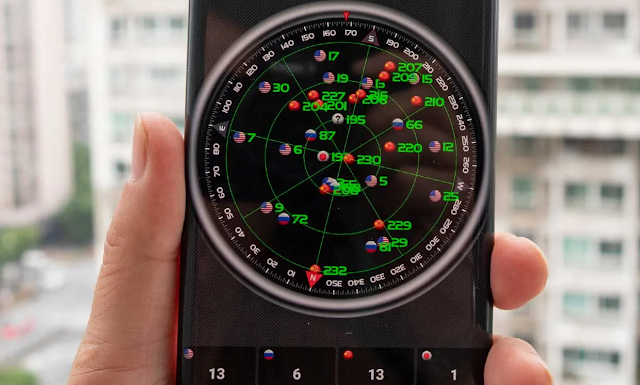
The stable signals of 13 Beidou satellites can be searched by using the test software. The software displays 13 US GPS satellites, 6 Russian GLONASS satellites and 1 Japanese positioning satellite. Shanghai, China, June 25, 2020.
PHOTO: WANG GANG/VCG/GETTY IMAGES
The final satellite needed to complete China’s own navigation and positioning satellite system has passed final on-orbit tests. The completed independent system provides military and commercial value while also facilitating new technologies and services.
The Beidou was launched on a Long March 3B rocket from the Xichang Satellite Launch Center in a hilly region of Sichuan province at 01:43 UTC on Tuesday, 23 June. The satellite was sent into a geosynchronous transfer orbit before entering an orbital slot approximately 35,786 kilometers in altitude which keeps it at a fixed point above the Earth.
Like GPS, the main, initial motivation for Beidou was military. The People’s Liberation Army did not want to be dependent on GPS for accurate positioning data of military units and weapons guidance, as the U.S. Air Force could switch off open GPS signals in the event of conflict.
As with GPS, Beidou also provides and facilitates a range of civilian and commercial services and activities, with an output value of $48.5 billion in 2019.
A model of China's Beidou satellite navigation system is on display during the 20th China Beijing International High-tech Expo in Beijing, China, 8 June 2017. PHOTO: IMAGINECHINA/ALAMY
Twenty four satellites in medium Earth orbits (at around 21,500 kilometers above the Earth) provide positioning, navigation and timing (PNT) services. The satellites use rubidium and hydrogen atomic clocks for highly-accurate timing that allows precise measurement of speed and location.
Additionally, thanks to a number of satellites in geosynchronous orbits, Beidou provides a short messaging service through which 120-character messages can be sent to other Beidou receivers. Beidou also aids international search and rescue services. Vessels at sea will be able to seek help from nearby ships in case of emergency despite no cellphone signal.
The Beidou satellite network is also testing inter-satellite links, removing reliance on ground stations for communications across the system.
Beidou joins the United States’ GPS and Russia’s GLONASS in providing global PNT services, with Europe’s Galileo soon to follow. These are all compatible and interoperable, meaning users can draw services from all of these to improve accuracy.
“The BeiDou-3 constellation transmits a civil signal that was designed to be interoperable with civil signals broadcast by Galileo, GPS III, and a future version of GLONASS. This means that civil users around the world will eventually be getting the same signal from more than 100 satellites across all these different constellations, greatly increasing availability, accuracy, and resilience,” says Brian Weeden, Director of Program Planning for Secure World Foundation.
“This common signal is the result of international negotiations that have been going on since the mid-2000s within the International Committee of GNSS (ICG).”
The rollout of Beidou has taken two decades. The first Beidou satellites were launched in 2000, providing coverage to China. Second generation Beidou-2 satellites provided coverage for the Asia-Pacific region starting in 2012. Deployment of Beidou-3 satellites began in 2015, with Tuesday’s launch being the 30th such satellite.
But this is far from the end of the line. China wants to establish a ‘ubiquitous, integrated and intelligent and comprehensive’ national PNT system, with Beidou as its core, by 2035, according to a white paper.
Chinese aerospace firms are also planning satellite constellations in low Earth orbit to augment the Beidou signal, improving accuracy while facilitating high-speed data transmission. Geely, an automotive giant, is now also planning its own constellation to improve accuracy for autonomous driving.
Although the space segment is complete, China still has work to do on the ground to make full use of Beidou, according to Weeden.
“It's not just enough to launch the satellites; you also have to roll out the ground terminals and get them integrated into everything you want to make use of the system. Doing so is often much harder and takes much longer than putting up the satellites.
“So, for the Chinese military to make use of the military signals offered by BeiDou-3, they need to install compatible receivers into every plane, tank, ship, bomb, and backpack. That will take a lot of time and effort,” Weeden states.
With the rollout of Beidou satellites complete, inhabitants downrange of Xichang will be spared any further disruption and possible harm. Long March 3B launches of Beidou satellites frequently see spent rocket stages fall near or on inhabited areas. Eighteen such launches have been carried out since 2018.
The areas calculated to be under threat from falling boosters were evacuated ahead of time for safety. Warnings about residual toxic hypergolic propellant were also issued. But close calls and damage to property were all too common.
There is evidence that the first confirmed COVID-19 hospital patients had no contact with the Huanan Seafood Market, which would rule out the possibility that the market was the source of the virus
While the virus was spreading throughout Wuhan, and people seriously ill with a new form of pneumonia were going to hospitals, the Chinese Government was jailing the doctors who were warning others about this disease
SARS-CoV-2, the name of the virus that causes COVID-19, has not been found in the wild
Several researchers have stated that SARS-CoV-2 is a result of the genetic recombination of part of the spike protein of the Malayan Pangolin coronavirus into RaTG13, its nearest relative, collected from bats by Wuhan Institute of Virology researchers in 2013
It’s unlikely that SARS-CoV-2’s unique spike protein is due to a natural mutation, as the two host species are separated by thousands of miles
Analysis by André Leu May 26, 2020
We are repeatedly told that COVID-19 originated from a wild animal at the Huanan Seafood Market in Wuhan, China, and that it is a natural mutation of a bat virus. But the hard evidence contradicts this theory.
Did COVID-19 Start in the Huanan Seafood Market?
There is evidence that the first confirmed COVID-19 hospital patient had no contact with the Huanan Seafood Market, and only a few of the next few patients had contact with the market, which would rule out the possibility that the market was the original source of the virus.
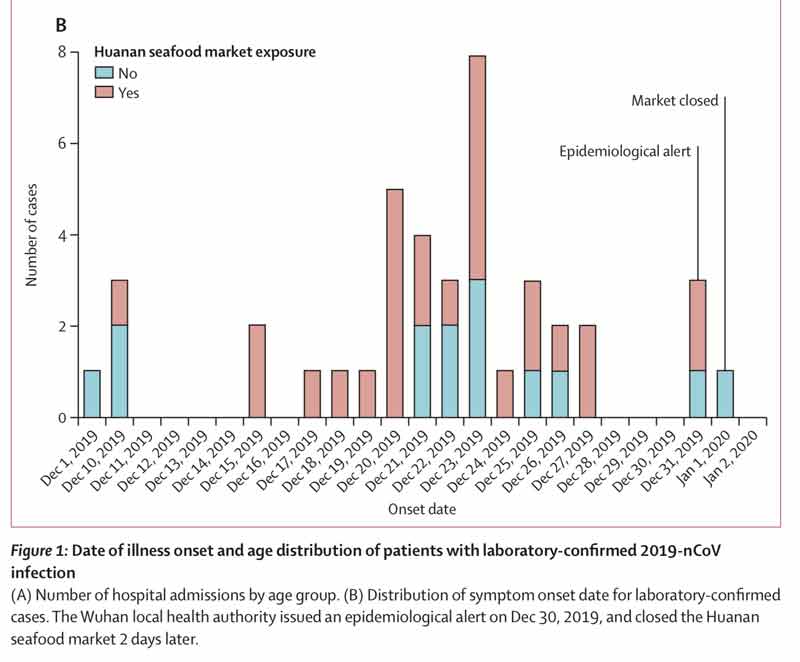
The graph below comes from a peer-reviewed scientific paper published in The Lancet. The first recorded incidence of a COVID-19 symptomatic patient being admitted to a hospital occurred December 1, 2019.1 This patient had no contact with the seafood market.
Nine days later, on December 10, 2019, three more patients were admitted to the hospital, two of whom had had no contact with the seafood market. One patient had contact with the market. Five days later, two more people were reported sick after being at the market; however, others who had had no contact with the market continued to be admitted to hospitals. This data clearly shows that the Huanan Seafood Market was not the original source of COVID-19.
The virus (called 2019-nCoV then and now called SARS-CoV-2) was circulating in the Wuhan community for at least nine days before the first reported case of a patient who had had contact with the market. The market cluster most likely came from an infected person visiting the market, and infecting stall holders and customers because of its crowded conditions.
The market was closed down January 1, 2020, and cleaned out with bleach to contain this disease. This effectively destroyed any chance of determining if there were infected animals as claimed by the Chinese government, the World Health Organization and others. However, as the virus was circulating in Wuhan before the first cases occurred in the market, closing down the market did not stop this pandemic.
While the virus was spreading throughout Wuhan, and people seriously ill with a new form of pneumonia were going to hospitals, the Chinese government was jailing the doctors who were warning others about this disease.
The government was also telling the world that there was no evidence of human-to-human transmission, instead insisting that this was a rare disease that came directly from animals and that could not be passed from person to person — which we now know to be a lie.
A paper published February 6, 2020, by two Chinese researchers showed that there were no bats in the seafood market and that the only bats and bat viruses in Wuhan were at the Wuhan Center for Disease Control & Prevention and Wuhan Institute of Virology (WIV).
This paper stated that the most likely source of COVID-19 was an accident at one of these labs, and that more research should be undertaken to determine if an accident at the lab was to blame for the pandemic. The Chinese government used pressure to have this paper withdrawn, deleted and suppressed, and the researchers silenced.
However in the interest of transparency and freedom of speech, we are providing a link to the original paper as we managed to save a copy before the Chinese government tried to delete it.2
SARS-CoV-2, the name of the virus that causes COVID-19, has not been found in the wild. Its nearest relative, RaTG13, was collected from bats by WIV researchers in 2013, in Yunnan Province, about 1,000 miles away from Wuhan.
RaTG13 was stored in Wuhan at WIV. However, there was no record of it in the scientific literature or in gene banks until January 23, 2020, when Shi Zhengli, director of the Center for Emerging Infectious Diseases, and others at WIV published that RaTG13 was 96.2 percent similar to SARS-CoV-2.3
The prevailing theory is that an intermediate animal, such as a pangolin, was infected by the bat coronavirus, and the virus mutated in the pangolin before infecting humans. However, at this stage, there is no evidence of SARS-CoV-2 being found in any wild animal.
Several close relatives of SARS-CoV-2 have been found in bats; however, these viruses do not contain the same spike protein found in SARS-CoV-2 that gives the virus the ability to infect humans. The spike protein in SARS-CoV-2 is unique and is different from the spike proteins in other coronaviruses. It has not been found in any other coronaviruses, including RaTG13.
The virus closest to containing a section of spike protein nearly identical to a section of SARS-CoV-2 was found by researchers in one Malayan Pangolin out of a group of 25 pangolins that were confiscated from smugglers at the Chinese boarder.4 However, the rest of this pangolin virus is quite different from SARS-CoV-2.
Several researchers have stated that SARS-CoV-2 is a result of the genetic recombination of part of the spike protein of the Malayan Pangolin coronavirus into RaTG13.5
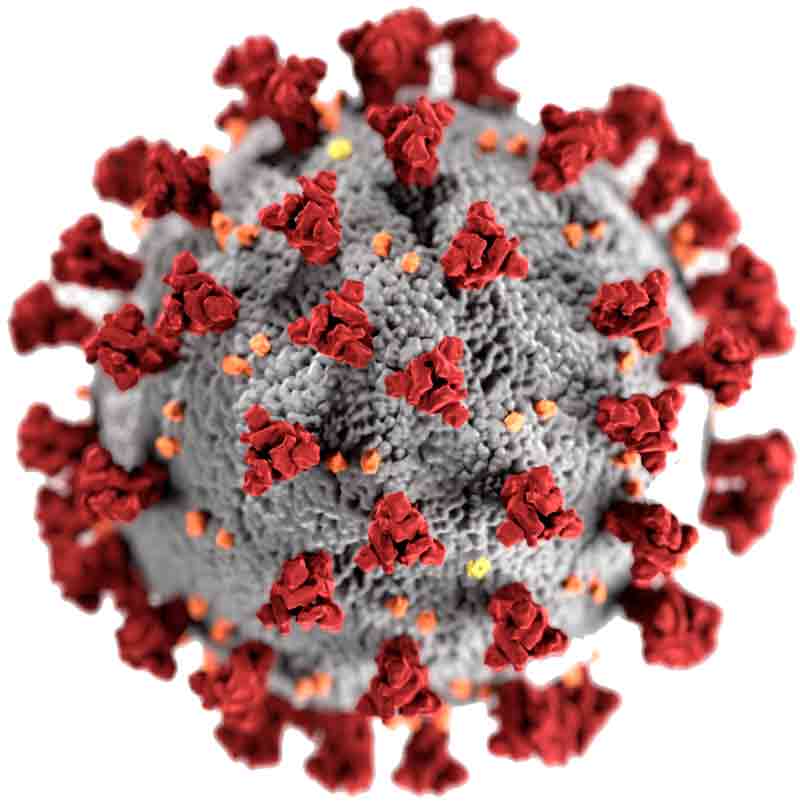
The Spike Protein is found on the end of the spike of the Coronavirus. The spike attaches to a cell and the protein allows the virus to infect the cell
It is unlikely that this recombination of two viruses happened naturally in the wild. The infected Malayan Pangolin was captured outside of China, probably thousands of miles away from Yunnan, where the only record of the bat virus RaTG13 has been found.
Given that only one out of 25 of the Malayan Pangolins had this virus, it shows that it is not a common virus and does not cause widespread infections in pangolins. RaTG13 has been found only in a few bats in one location in Yunnan, and nowhere else in the world. It is highly improbable that an extremely rare virus from an isolated area in Yunnan infected and mutated inside pangolins that were caught outside of China.
How did SARS-CoV-2 get this unique spike protein? The theory that these two viruses combined naturally, given that they are most likely separated by thousands of miles, lacks credibility. This may be a popular theory, but it has zero evidence.
Advertisement
Evidence SARS-CoV-2 May Have Come From a Laboratory in Wuhan
The Wuhan Institute of Virology has the largest collection of bat coronaviruses in the world, including RaTG13. WIV specializes in Gain-of-Function research. Gain-of-Function (GOF) research involves mutating viruses, bacteria and other microorganisms to enhance their ability to infect and cause diseases.
This can involve taking a harmless virus and manipulating it to infect and cause severe illnesses in other species, or making already-deadly diseases, such as the Spanish Flu or the plague, even deadlier.
This type of research has divided the scientific community with many scientists warning that if one of these enhanced diseases escaped it could cause a global pandemic. The GOF researchers deny that these deadly organisms will escape. They state that this research is needed to protect us from pandemics by using it to make medications and vaccines.
After 30 years of research there is very little evidence of any benefit from GOF research — and many examples of these deadly disease organisms escaping from laboratories around the world, including China. GOF research certainly hasn’t helped with cures to stop the COVID-19 pandemic.
GOF research has been conducted on bat coronaviruses at the WIV since 2007. Researchers there have published several scientific papers showing how they have genetically modified harmless coronaviruses so they now can infect humans. They have been combining parts of two different viruses to make new viruses. Two papers of note were published about this in 2015 and 2017.
In 2015, Shi Zhengli from the WIV, and researchers at various universities and research institutions in the U.S. and Switzerland, published a paper explaining how they genetically modified the SARS coronavirus to create a dangerous synthetic virus.
The researchers took the genetic codes for part of the spike protein from a virus that Shi Zhengli isolated from bats found in Yunnan in 2011, and inserted them into the SARS coronavirus (the virus that caused the original SARS epidemic in 2002-2003).6
The spike protein is found on the top of the spike on coronaviruses. The viruses use this protein to attach to specific receptors in cells to infect them. Each species of animal tends to have unique receptors. This means that the virus has to have a unique spike protein that will bind to the specific receptor. It is a “lock-and-key” system. The spike protein is the same as the key and the receptor is the same as the lock. The wrong key will not open a lock.
Most of the spike proteins in coronaviruses found in animals will not infect people because their spike proteins are the wrong key to unlock the receptors on the cells. The only way coronaviruses from animals can infect people is if the viruses’ “keys” (spike proteins) are somehow modified to fit the humans’ “lock” (cell receptors).
This type of modification can happen through natural mutations, but usually only very slowly, and over many decades. However, spike proteins are being genetically modified in many laboratories around the world, as GOF research, to enable spike proteins to mutate at rates far faster and more frequently than can occur naturally.
This is part of the justification for GOF research: In order to study disease organisms, researchers modify them faster and more often than the organisms would modify on their own, in nature.
The synthetic coronavirus created in 2015 by WIV’s Shi Zhengli and other researchers was genetically modified to make it able to infect the human ACE2 receptor, the same receptor that SARS-CoV-2 infects to cause COVID-19.
This dangerous new genetically modified virus was created by researchers from the University of North Carolina, the Harvard Medical School, the National Center for Toxicological Research, Food and Drug Administration in Arkansas, the Bellinzona Institute of Microbiology in Switzerland and the Wuhan Institute of Virology in China, who were working together and subsequently published their paper.
This shows that these types of dangerous genetically modified viruses are being created in many laboratories around the world, including WIV.
In 2017, Shi Zhengli and other researchers at WIV, along with researchers from the New York based EcoHealth Alliance, published a paper on how they genetically modified the spike proteins of eight bat coronaviruses, essentially by cutting and pasting genetic material from other coronaviruses, so that the viruses infected the human ACE2 receptor. This is the same receptor that SARS-CoV-2 infects to cause COVID-19.7
According to an article in Newsweek, the EcoHealth alliance was funded by the U.S. National Institutes of Health to do this research.8
The 2015 and 2017 papers are clear evidence that researchers at the WIV, in conjunction with U.S. and other researchers, have been genetically modifying the spike proteins of multiple types of coronaviruses, by cutting and pasting genetic material from other coronaviruses, so that harmless viruses can now infect humans.
Could SARS-CoV-2 Have Escaped From Wuhan Lab?
There are numerous examples of deadly diseases escaping from laboratories. A paper in Science magazine documents many of them and shows how it has only been luck that they haven’t caused a major global pandemic.9
A U.S. State Department visit to the WIV in 2018 found that the lab had very poor security standards. In a cable to Washington, department officials reported their concerns that a dangerous coronavirus could escape.
Columnist Josh Rogin said in The Washington Post on April 14, 2020: “The first cable, which I obtained, also warns that the lab’s work on bat coronaviruses and their potential human transmission represented a risk of a new SARS-like pandemic.”
According to Rogin, the officials “… noted the new lab has a serious shortage of appropriately trained technicians and investigators needed to safely operate this high-containment laboratory.”10
Despite these concerns, the National Institutes of Allergies and Infectious Diseases, which funds biomedical research around the world, in 2019 recommended that the U.S. should continue to fund the Wuhan Institute of Virology research as part of a combination grant designated to a number of entities studying the bat coronavirus. However, the grant was discontinued and the WIV lab never received those funds.11
In Summary
As stated before there is no evidence that SARS-CoV-2, which causes COVID-19, originated from wild animals or the Huanan Seafood Market. The evidence shows that SARS-CoV-2 was circulating in Wuhan for more than nine days before the first case was reported by someone who had been at the market. SARS-CoV-2 has not been found in wild animals or domesticated livestock.
There is strong evidence this virus is a result of the recombination of two viruses. The evidence shows that it was highly unlikely that this recombination could have occurred naturally, as the two confirmed animal host species were geographically separated, possibly by thousands of miles.
There is clear evidence that the closest relative of the SARS-CoV-2 is RaTG13, and this virus was in the Wuhan Institute of Virology. The evidence shows that SARS-CoV-2 is mostly composed of RaTG13, but that part of the RaTG13 spike protein has been modified with a section of a virus found in a Malayan Pangolin. This modified spike protein is what gives SARS-CoV-2 the ability to bind with the ACE2 receptor and infect people.
There is clear evidence that the Wuhan Institute of Virology (WIV) has been doing Gain-of-Function research to recombine multiple bat and other coronaviruses by genetically modifying the spike protein so that the viruses can infect humans.
There is clear evidence that the biosecurity at the WIV was inadequate due to the lack of properly trained staff and that this could result in one of the many dangerous genetically engineered bat coronaviruses escaping and causing a global pandemic.
The evidence shows that the Chinese government has constantly lied about the facts that caused this pandemic and allowed it to spread, has prevented independent researchers from entering the WIV to investigate what happened there, continues to suppress all independent research, made researchers and papers disappear and silenced others. This is clear evidence of a grand-scale cover up. What are they trying to cover up?
A reasonable conclusion, based on the evidence, is that SARS-CoV-2 was created in the WIV through Gain-of-Function research, and that it accidentally escaped due to inadequate biosecurity.
The Gain-of-Function researchers and organizations are circling the wagons to prevent this information from becoming public. This includes people like Anthony Fauci who, through the NIH, invested millions of dollars into Gain-of-Function research, and many other organizations in the U.S. and around the world that are still funding the WIV and other laboratories doing this dangerous research.
These groups are saying that SARS-CoV-2 has come from natural mutations, because they know that if the facts are revealed, their research and labs will be closed down to prevent future accidents. Fortunately, there are enough scientists concerned about Gain-of-Function research to uncover good evidence about the origins of this pandemic so that we, as a society, can prevent this from ever happening again.
It is time that all Gain-of-Function research is banned. These scientists are creating deadly Frankenstein monsters that can have terrible consequences when they escape. They are Franken-viruses because they are murderous monsters that can kill millions, severely damage economies and destroy livelihoods.
There is very little evidence of any benefits coming from GOF, and the current COVID-19 pandemic clearly shows that this research is too dangerous. Given that there are even deadlier organisms in these laboratories, the next escape could have even greater consequences for all of us. We must stop it now.
André Leu is International Director of Regeneration International and the author of “Poisoning our Children.”
Since becoming general secretary of the Communist Party in 2012, President Xi Jinping has emphasised this “rejuvenation” of China, recalling two earlier golden eras during the Tang and High Qing dynasties.
When former President Hu Jintao visited Australia in 2003, he began his address to parliament by describing the exploits of a 15th century Chinese admiral, Zheng He:
Back in the 1420s, the expeditionary fleets of China’s Ming Dynasty reached Australian shores … They brought Chinese culture to this land and lived harmoniously with the local people, contributing their proud share to Australia’s economy, society and its thriving pluralistic culture.
But it indicates the extent of the regional ambition wrapped up in the Communist Party’s control of history today, including how the Chinese empire once presided over myriad subservient tribute states.
And this is crucial for its promotion of nationalism – an increasingly vital part of the party’s own legitimacy as its economy falters.
Projecting power under Xi Jinping
Since becoming general secretary of the Communist Party in 2012, President Xi Jinping has emphasised this “rejuvenation” of China, recalling two earlier golden eras during the Tang and High Qing dynasties.
At first, the Ministry of Foreign Affairs largely persisted with the traditional, polite diplomacy that had seen China’s influence grow steadily and quietly, commensurate with its economic heft.
But things changed as Xi’s new team pushed aside officials viewed as corrupt or inadequately responsive to his demands to more forcefully assert China’s rejuvenation, both at home and to the rest of the world.
The Foreign Ministry was losing its influence as Xi’s tight inner circle centralised decision-making. Foreign diplomats came to understand they needed to go to party insiders if they wanted to understand or seek to influence Chinese policies.
A watershed moment came with the blockbuster success of the patriotic, Rambo-style film Wolf Warrior 2 in mid-2017. Its slogan, taken from a Han dynasty saying, is:
Whoever offends China will be punished, no matter how far they are.
At the end of the film, the red cover of a Chinese passport is displayed, accompanied by the message:
Citizens of the PRC: When you encounter danger in a foreign land, do not give up! Please remember, at your back stands a strong motherland.
At the huge exhibition accompanying the 19th party congress a few months later, the foreign ministry proudly exhibited a new hotline system that Chinese people abroad could use to call for help, “no matter how far they are”.
And Xi ordered massive new resources for diplomacy, doubling the foreign ministry budget from 2013-18, and since then raising it by double digits annually.
Top diplomat Yang Jiechi was also promoted to the Politburo and a new Central Foreign Affairs Commission was established, underlining Xi’s determination to elevate a more assertive foreign policy as a national priority.
Hawkish diplomats reinforce the message
China’s international messaging also changed rapidly. At the party to celebrate the 70th anniversary of the Chinese Foreign Ministry last year, Minister Wang Yi urged the country’s envoys to adopt a “fighting spirit” in the face of international challenges.
Although Twitter and Facebook are banned in China, diplomats quickly acquired accounts and followers, and began to use them to hammer the countries where they were posted.
When diplomat Zhao Lijian returned from a posting to Pakistan last year, Reuters reported that “a group of young admirers” at the Foreign Ministry cheered him.
He had catapulted into global attention by labelling the US as racist and in a Twitter spat, telling former National Security Advisor Susan Rice she was “a disgrace” and “shockingly ignorant.”
In January, Zhao was promoted to a Foreign Ministry spokesman, highlighting that his was the path to diplomatic success.
In this new role, Zhao has tweeted to his 623,000 followers that US soldiers brought COVID to Wuhan when competing in the 2019 Military World Games.
He rebuked New Zealand for seeking Taiwan’s readmission to the World Health Organisation’s annual global health assembly, calling on it to
immediately stop making wrong statements on Taiwan, to avoid damaging our bilateral relationship.
Qin Xiaoying, formerly director of the Communist Party’s international propaganda department, commented that now is
the first time since 1949 that ‘new hawks’ have the power to reshape China’s diplomatic policy.
They have won their spurs by assiduously enlisting the support of countries that have received Chinese development loans to win votes in global bodies.
For instance, when 22 nations, including Australia, urged the UN Human Rights Council to call on China to end its massive detention program of Uyghurs in Xinjiang, Beijing swiftly signed up 37 countries, including many with majority Muslim populations, to defend its rule there.
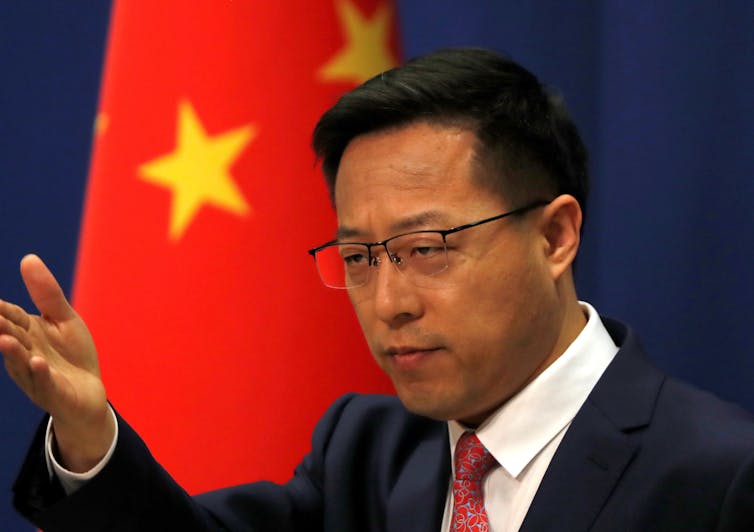
Zhao Lijian has become a more recognisable face since being promoted to Foreign Ministry spokesman.CARLOS GARCIA RAWLINS / Reuters
Changing the narrative on coronavirus
The COVID-19 pandemic soon provided those hawks with an even better opportunity to prove their loyalty and value to Xi.
Wu Ken, the ambassador to Germany, provided a handy template to follow in December by warning that if Huawei was excluded from building Germany’s 5G network, “there will be consequences”, and pointing to the importance of China’s market for German cars.
In late January and early February, Xi appeared to be on the back foot as the virus began to erode China’s health and economy, and with it his own previously unquestioned authority.
But as China began to receive criticism globally for its response to the virus, these newly assertive diplomats swung into action, proving their worth as front-line fighters.
Cheng Jingye, the ambassador to Australia, attacked Canberra’s call for an investigation into the cause of COVID, asking,
Maybe also the ordinary [Chinese] people will say why should we drink Australian wine or to eat Australian beef?
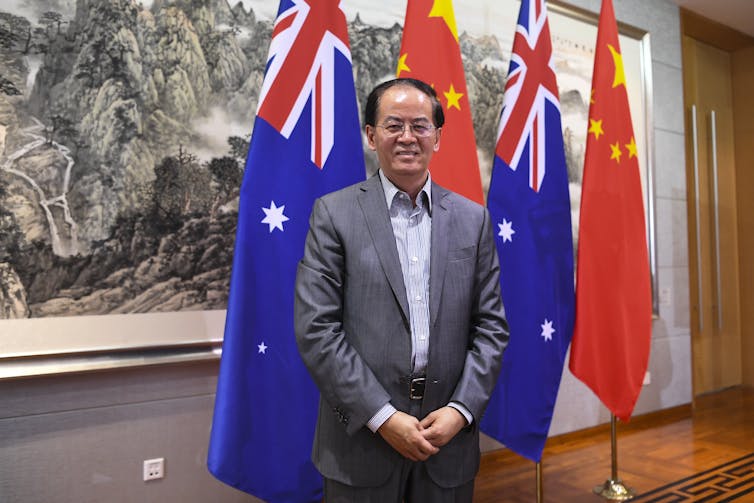
China’s ambassador to Australia, Cheng Jingye. The Chinese embassy mocked Australia’s call for a coronavirus inquiry as ‘nothing but a joke’ this week.Lukas Coch/AAP
Lu Shaye, the ambassador to France, was summoned by the French Foreign Ministry over a post on the embassy website claiming the French were “leaving their residents to die of hunger and disease.”
Politics above all else
The Foreign Ministry told Reuters this year, citing a Mao Zedong slogan:
We will not attack unless we are attacked. But if we are attacked, we will certainly counter-attack.
This may even come at a cost to China economically. But politics – and especially the push for rejuvenation – is upstream of all else in Xi’s “New Era”.