Sunday, 26 March 2023

China opens ties with Honduras, Taiwan decries monetary demands

Honduras denies demanding $2.5 bln in Taiwan aid before China announcement


[1/3] Taiwan Foreign Minister Joseph Wu speaks during a news conference in Taipei, Taiwan March 26, 2023. REUTERS/Carlos Garcia Rawlins

BEIJING/TEGUCIGALPA/TAIPEI, March 26 (Reuters) - China established diplomatic ties with Honduras on Sunday after the Central American country ended its decades-long relationship with Taiwan, while Taiwan's foreign minister accused Honduras of demanding exorbitant sums before being lured away by Beijing.

The ending of ties with Taiwan had been expected after the Honduran foreign minister travelled to China last week to open relations and President Xiomara Castro said her government would start ties with Beijing.

China said its foreign minister, Qin Gang, and Honduran Foreign Minister Eduardo Enrique Reina signed the deal on diplomatic recognition in Beijing, ending relations with Taiwan dating back to the 1940s.

In a brief statement late on Saturday, the Honduran foreign ministry said it recognised the People's Republic of China as the only legitimate government that represents all of China and that Taiwan is an "inseparable part of Chinese territory".

China claims democratically ruled Taiwan as its own territory with no right to state-to-state ties, a position Taipei strongly rejects. China demands that countries with which it has ties to recognise its position.

Speaking in Taipei, Taiwan Foreign Minister Joseph Wu said Castro, who took office early last year, and her government had "always had illusions" about China and China's "luring" had never stopped.

"The foreign ministry and embassy grasped the relevant information and handled it carefully. However, the Castro government also asked us for billions of dollars in huge economic assistance and compared prices for assistance programmes provided by Taiwan and China," Wu said.

Taiwan President Tsai Ing-wen said in a video statement that Taiwan will not compete with China in "meaningless" dollar diplomacy.

"Taiwan's people have proved to the world that we never cower from threats. Taiwan's cooperation and links with allies and like-minded countries to jointly promote international well-being and security will only increase, not decrease," she said.

Qin told Reina Honduran companies were invited to come to China to discuss trade and investment, while Reina said Honduras was willing to strengthen cooperation with China in finance, trade and infrastructure, China's Foreign Ministry said in a statement.

Reina wrote to Taiwan this month asking for almost $2.5 billion in aid, including a loan of $2 billion to help write off debt as well as funds for the construction of a hospital and a dam, according to copy of the letter seen by Reuters. The letter addressed Wu as "a friend".

"It felt like what they wanted was money, not a hospital," Wu told reporters.

PROMISES

Tsai is due to depart on a sensitive visit to the United States, Guatemala and Belize on Wednesday. She is expected to meet U.S. House Speaker Kevin McCarthy in Los Angeles at the end of the trip.

Wu said he was "highly suspicious" of the timing of the Honduran decision so close to Tsai's overseas tour.

"China seems to be doing this intentionally," he said.

The United States has been watching with concern as China expands its footprint in its backyard by taking away Taiwan's Central American allies, and has repeatedly warned countries not to believe China's promises of aid.

The U.S. State Department said while the Honduran action was a sovereign decision, it was important to note China "often makes promises in exchange for diplomatic recognition that ultimately remain unfulfilled".

"Regardless of Honduras' decision, the United States will continue to deepen and expand our engagement with Taiwan," it said in a statement.

Relations between Honduras and Taiwan date back to 1941 when the government of the Republic of China, which remains Taiwan's official name, was still in China before it fled to the island in 1949 after losing a civil war with Mao Zedong's communists.

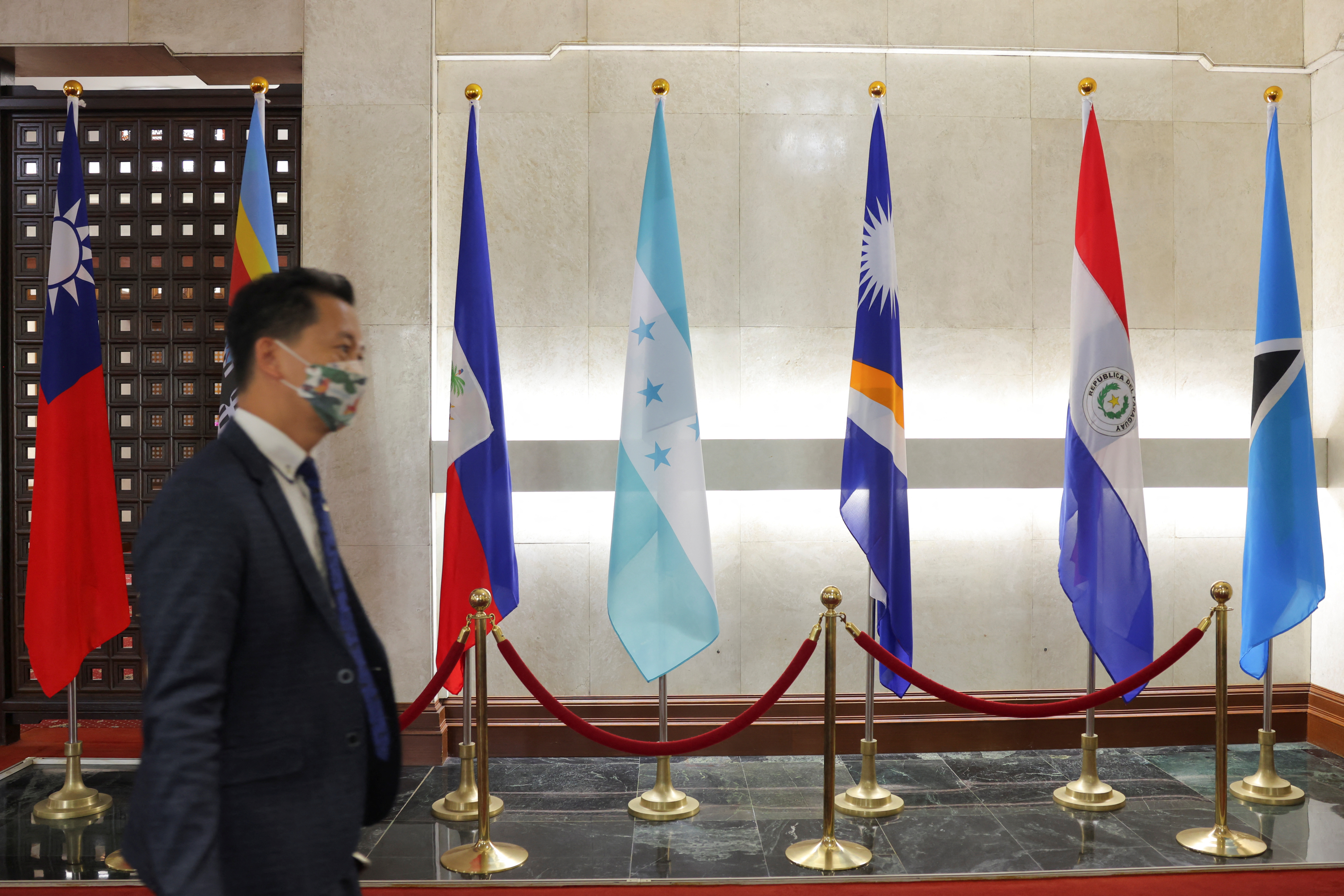
Taiwan now only has formal diplomatic relations with 13 countries, mostly poor and developing countries in Central America, the Caribbean and the Pacific.

Reporting by Joe Cash in Beijing, Ben Blanchard in Taipei and Gustavo Palencia in Tegucigalpa; Additional reporting by Yimou Lee in Taipei and Michael Martina in Washington; Editing by Marguerita Choy, Robert Birsel and Edwina Gibbs

Our Standards: The Thomson Reuters Trust Principles.
https://www.reuters.com/world/honduras-government-says-ending-diplomatic-ties-with-taiwan-2023-03-26/


- - - - - - - - - - - 


U.S. warns China's promises often empty as Honduras wavers on Taiwan

March 25, 2023


[1/2] 
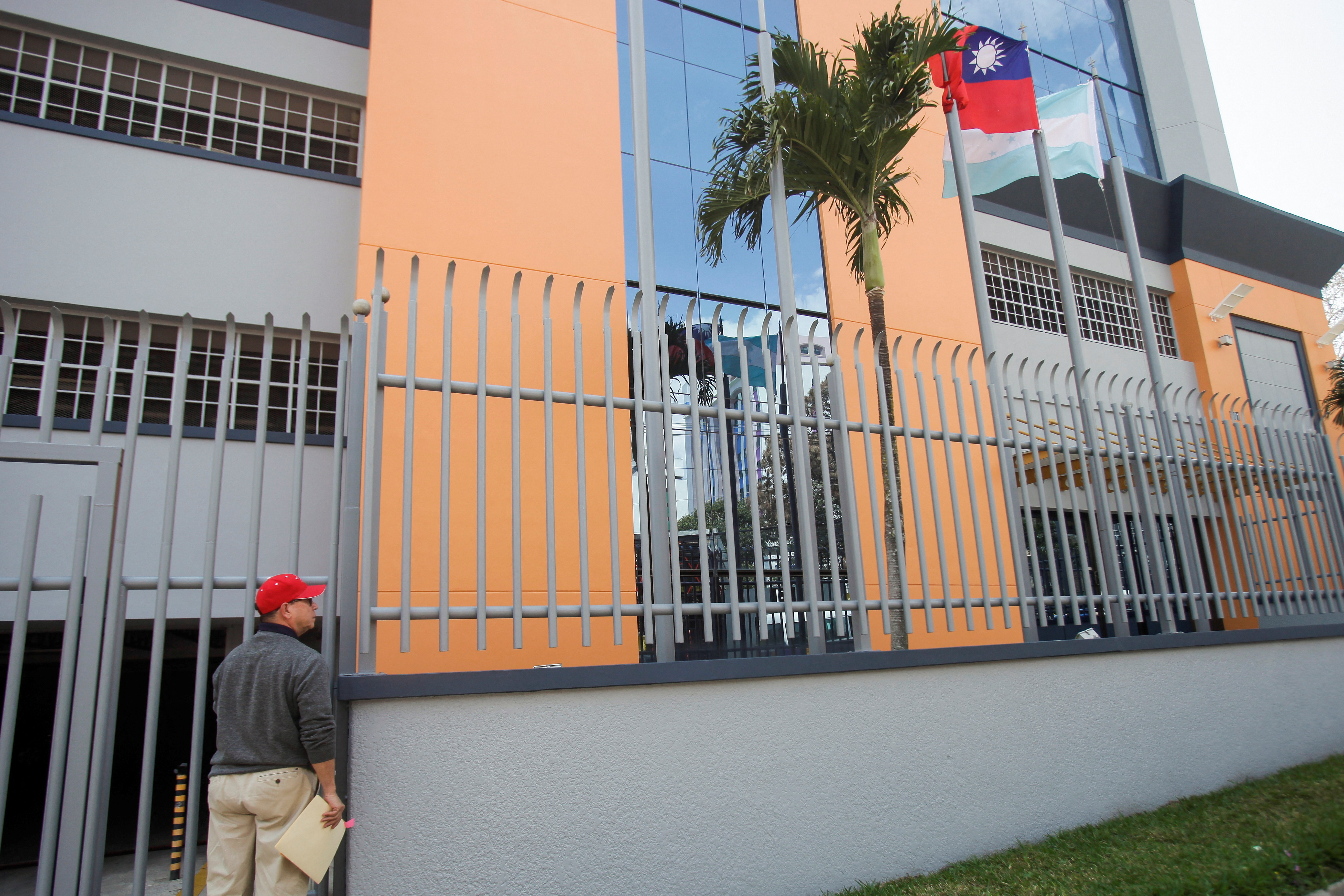
The flags of Taiwan and Honduras flutter in the wind outside the Taiwan Embassy in Tegucigalpa, Honduras March 15, 2023. REUTERS/Fredy Rodriguez/


TAIPEI, March 25 (Reuters) - China often makes promises in exchange for recognition that remain unfulfilled, the de facto U.S. embassy in Taipei said on Saturday as Honduras moves ahead with ending its long-standing ties with Taiwan in favour of China.

The Honduran foreign minister travelled to China this week to open relations after President Xiomara Castro said her government would move to forge ties with Beijing, Honduras being one of only 14 countries to formally recognise Taiwan.

At stake is China's growing footprint in Central America, once a steadfast base for Taiwan and where the United States is worried about Beijing's expanding influence in its backyard.

China views Taiwan as one of its provinces with no right to state-to-state ties, a view the democratically-elected government in Taipei strongly disputes.

The American Institute in Taiwan said that while Honduras' possible severing of ties with Taipei in favour of Beijing was a sovereign decision, China does not always follow through on its promises.

"It is important to note the PRC often makes promises in exchange for diplomatic recognition that ultimately remain unfulfilled," a spokesperson said, referring to the People's Republic of China.

"Regardless of Honduras' decision, the United States will continue to deepen and expand our engagement with Taiwan in line with our longstanding one China policy," the spokesperson added.

Taiwan is a reliable, likeminded, and democratic partner, and its partnerships globally provide "significant and sustainable benefits to the citizens of those countries".

"We strongly encourage all countries to expand engagement with Taiwan and to continue to stand on the side of democracy, good governance, transparency, and adherence to the rule of law."

China's Foreign Ministry did not immediately respond to a request for comment, but it has previously said its relations with Taiwan's former diplomatic allies have brought them real benefits.

Members of the Honduran community in Taipei gathered at National Taiwan University on Saturday to express their thanks in what they said was a non-political event.

"We are so thankful for the opportunities Taiwan has given us," said Billy Parebes, 27, who first came as a student.

"Taiwan has provided us education, they have provided so many projects that have developed our country, like renewable energy, agriculture."

The Honduras drama is happening ahead of a high-profile visit by Taiwan President Tsai Ing-wen to the United States and Central America next week. Tsai is expected to meet U.S. House Speaker Kevin McCarthy in Los Angeles at the end of the trip.

The United States also has no official ties with Taiwan but is the island's most important international backer and arms supplier.

Neither China nor Honduras has announced they have established diplomatic relations.

Diplomatic sources in Taipei say this is a departure from previous practice whereby an announcement on severing ties with Taiwan in favour of China normally happens very fast, with Taipei getting only maybe a few hours notice beforehand.

Reporting by Ben Blanchard; Additional reporting by Laurie Chen in Beijing; editing by Robert Birsel and Michael Perry

https://www.reuters.com/world/asia-pacific/us-warns-chinas-promises-often-empty-honduras-wavers-taiwan-2023-03-25/

China's diplomatic faux pas pushes Manila back into U.S. arms

 Beijing has only itself to blame if it loses out to Washington strategically


Philippine President Ferdinand Marcos Jr. delivers a speech at the 126th founding anniversary of the Philippine Army at Fort Bonifacio in Taguig, Philippines on March 22.    © AP

TOKYO -- Ferdinand Marcos Jr. made his first visit to Japan as the Philippines' president in early February, accompanied by around 240 businesspeople. During his five-day stay through Feb. 12 -- unusually long for a national leader -- he managed to secure $13 billion in commitments for investment and financial assistance from the Japanese public and private sectors.

At a meeting with Japanese Prime Minister Fumio Kishida, the two leaders agreed to simplify procedures to send the Japan Self-Defense Force (SDF) to the Philippines, as needed, for humanitarian assistance and disaster relief.

In January, Marcos visited China and sealed investment deals with President Xi Jinping worth $22.8 billion. He also agreed with the Chinese leader to set up a hotline to "peacefully" settle territorial disputes in the South China Sea.

Given the timing of Marcos' visits, and the content of the economic and security agreements, China, at first glance, seems to have achieved more than Japan vis-a-vis ties with the Philippines. But the Inquirer, a Philippine English-language daily, disagrees.

"Japan is a country that puts its money where its mouth is ... unlike other countries who promised billions of dollars in investments, but only realized two- to four-lane bridges spanning the narrow Pasig River, and, worse, used military-grade lasers that caused our Coast Guard personnel temporary blindness in waters internationally acknowledged to be within our exclusive economic zone," the paper said in a Feb. 15 editorial titled, "A Windfall from Japan."

"Other countries" is, of course, a snide reference to China. The laser incident mentioned in the op-ed occurred on Feb. 6 near Ayungin Shoal in the Spratly Islands in the South China Sea. The shoal is under the effective control of the Philippines.

On that day, a China Coast Guard ship pointed a green "military-grade" laser at a Philippine vessel carrying food and supplies to troops stationed on the shoal, temporarily blinding the crew. The Philippines uses an old warship, intentionally grounded on the shore, as a naval outpost for the small contingent.

Philippine President Ferdinand Marcos Jr., left, greets Japanese Prime Minister Fumio Kishida before their talks in Tokyo on Feb. 9.    © Reuters

As Marcos was scheduled to visit Japan from Feb. 8, the laser incident was widely seen as a warning from Beijing not to deepen ties with Japan and the U.S. In fact, four days before the incident, U.S. Defense Secretary Lloyd Austin visited Manila and agreed on a deal to expand the U.S. military presence in the Philippines by increasing its access to nine bases from the current five.

A joint statement issued when Marcos visited China in January mentioned an agreement to "appropriately manage differences through peaceful means." Following the laser incident, the Philippine Foreign Affairs Department criticized Beijing, calling the incident an "act of aggression," and "disturbing and disappointing," as it happened soon after Marcos' visit to China.

Manila made the incident public on Feb. 13, a week after it occurred. Eager to avoid friction with Beijing, the Philippine government may have waited for Marcos to return from Japan before breaking the news. Yet, while taking pains not to provoke Beijing needlessly, Marcos has pursued diplomatic initiatives that are at odds with the pro-China image he cultivated before becoming president last June.

In his campaign for the presidency, Marcos teamed up with Sara Duterte, a daughter of his predecessor, Rodrigo Duterte, pledging to continue his policies.

Despite the long-standing alliance between the U.S. and the Philippines, Duterte soured on Washington after the U.S. criticized his war on drugs as a violation of human rights. Duterte turned to Beijing for economic support.

In a case brought by a previous Philippine government, an international tribunal in The Hague ruled in 2016 that China's claim to sovereignty over the South China Sea had no legal basis. But despite Manila's sweeping victory, Duterte dismissed the ruling as "a piece of paper" and stopped aggressively pursuing the country's territorial claims against China.

Marcos had praised Duterte's foreign policy, calling engagement with China "our only option." Soon after filing his candidacy for president in 2021, he visited the Chinese Embassy in Manila to meet the ambassador. After the election, however, he changed his tune, saying he would not "allow a single inch of our maritime coastal rights to be trampled upon."

This photo provided by the Philippine Coast Guard shows a laser aimed from a China Coast Guard ship near a disputed shoal in the South China Sea on Feb. 6. (Philippine Coast Guard via AP)

There are two reasons for Marcos's about-face.

First, the Philippines has gained little from Duterte's pro-China policy. Speaking at Nikkei's "Future of Asia" conference in 2019, Duterte questioned China's policy in the South China Sea, asking whether it was "right for a country to claim the whole ocean." But he also made clear his desire to get along with his giant neighbor. "I love China," said Duterte. "We are friends ... and I cannot afford a war with anybody."

Duterte apparently calculated that strong economic ties would ease military and diplomatic tensions with Beijing. But despite his frequent visits to China and Beijing's pledge to invest tens of billions of dollars in the Philippines, less than half of the promises have been fulfilled, according to a person familiar with the matter. Meanwhile, China's provocations in the South China Sea have continued, including turning artificial islands into military bases and creating administrative districts on disputed islands.

"Duterte's experience showed that China is proving to be an unreliable partner," said Makoi Popioco, Pacific engagement manager at Australian National University.

The second factor in Marcos' shift in stance was a push by the Philippines's foreign policy and defense establishments to keep the country's traditional alliance with the U.S. alive.

Philippine President Ferdinand Marcos Jr., left, meets with U.S. Defense Secretary Lloyd Austin at the Malacanang presidential palace in Manila on Feb. 2.   © Reuters

In September 2020, for example, the Foreign Affairs Department succeeded in inserting language into a Duterte speech at the United Nations calling for the South China Sea dispute to be settled based on the U.N. Convention on the Law of the Sea and the ruling by the tribunal in The Hague.

When the U.S. declined to issue a visa to a former Philippine National Police chief and a close aide to Duterte, the president threatened in February 2020 to scrap the bilateral Visiting Forces Agreement (VFA), which allows U.S. military vessels to visit ports in the Philippines and the two countries to hold joint military exercises.

"The six years of the Duterte administration were kind of a stress test on the country's conventional diplomatic and security policy," said Yusuke Takagi, an associate professor at the National Graduate Institute for Policy Studies in Tokyo. "The country has somehow managed to pass the test."

When Marcos visited Beijing in January, Xi called the friendship between the two countries "irreplaceable," noting that the nations established diplomatic relations in 1975, when Marcos's father was president. But Marcos seems keenly aware that his dictator father was toppled in the 1986 "People Power" revolution because he lost the support of the armed forces. Given the military's close ties with the U.S., Marcos Jr. has little choice but to reverse much of Duterte's pro-China policy.

However, he may not just be reverting to the Philippines' traditional foreign policy. Victor Manhit, president of the Philippine think tank Stratbase, sees it as a step going beyond where the country used to be, saying, "We accepted that we have to go and look at friends and allies beyond the United States."

Behind the agreement to simplify procedures for dispatching the SDF to the Philippines is the possibility of concluding a VFA with Japan, which would allow the two countries to carry out extensive joint military exercises. Following Marcos' return from Japan, Manila invited Australian Defense Minister Richard Marles for a meeting on Feb. 22 and agreed to hold regular defense ministerial talks. The Philippines already has a VFA with Australia. If Japan joins them, the U.S. and its three allies could conduct joint drills and patrols in the South China Sea, greatly enhancing deterrence against China.

Chinese President Xi Jinping, left, and Philippine President Ferdinand Marcos Jr. review an honor guard during a welcome ceremony for the Philippine leader in Beijing on Jan. 4. 

China, for its part, continues to make blunders. February's laser incident was not the first between China and the Philippines. In April 2020, a similar incident took place when a Chinese ship directed a laser at a Philippine naval vessel. At that time, Manila had already informed Washington of its intention to annul the VFA, and the accord would have expired in August that year. If that had happened, the U.S. would no longer have been able to conduct military exercises and training in the Philippines, which had been held 300 times or more a year.

But Beijing blew a golden opportunity to expand its influence in the region. After the laser incident, Duterte reversed course and kept the agreement intact, yielding to pressure from the Defense Department and the armed forces.

The conventional security framework in Asia is a "hub-and-spoke" model, with five countries in the region -- Japan, South Korea, Australia, the Philippines and Thailand -- each forming separate bilateral alliances with the U.S. With the Philippines reaching out to other spokes, such as Japan and Australia, the security structure in Asia could change radically.

What is ironic is that it was China that pushed Manila back into the arms of Washington, thanks to its empty promises and strong-arm tactics. China has only itself to blame for having the noose tightened around its neck.

https://asia.nikkei.com/Politics/International-relations/China-s-diplomatic-faux-pas-pushes-Manila-back-into-U.S.-arms


READ NEXT


Saturday, 25 March 2023

New Zealand raises concerns with China on South China Sea, Taiwan

 New Zealand ... expressed concerns over the South China Sea and tensions in the Taiwan Strait ...

New Zealand Foreign Minister Nanaia Mahuta speaks during a session of the UN Human Rights Council, which voted to hold an urgent debate about Russia's deadly invasion of Ukraine at Kyiv's request, amid widespread international condemnation of Moscow's attack, in Geneva, Switzerland February 28, 2022. Fabrice Coffrini/Pool via REUTERS


SYDNEY, March 25 (Reuters) - New Zealand Foreign Affairs Minister Nanaia Mahuta said on Saturday she had expressed concerns over the South China Sea and tensions in the Taiwan Strait during talks with her Chinese counterpart at the end of a visit to Beijing.

Mahuta also said in a statement she "noted New Zealand’s deep concerns regarding the human rights situation in Xinjiang and the erosion of rights and freedoms in Hong Kong", during her meeting with Chinese Foreign Affairs Minister Qin Gang.

"Nanaia Mahuta expressed concerns over developments in the South China Sea and increasing tensions in the Taiwan Strait," the foreign minister's statement said.Mahuta said she reiterated New Zealand’s condemnation of Russia’s invasion of Ukraine. China is a key ally of Russia and both have criticised the U.S. and NATO for undermining global stability.

Mahuta arrived in China on Wednesday for the four-day trip, the first by a New Zealand minister since 2019, and also met China's top diplomat Wang Yi as well as business and women leaders.

Wang told Mahuta that China and New Zealand had always respected and trusted each other, according to a statement by the Chinese foreign ministry.

New Zealand has long been seen as the moderate voice on China in the Five Eyes intelligence-sharing alliance also involving the United States, Australia, Britain, and Canada. But New Zealand's tone on security and China's growing presence in the South Pacific toughened in the past year after China and the Solomon Islands struck a security pact.

New Zealand has consistently expressed concerns about the potential militarisation of the Pacific, amid China's military buildup in the South China Sea.

China views democratically governed Taiwan as its own territory and has never renounced the option of using force to take the island under its control, and claims a large part of the South China Sea.

Mahuta said the countries looked forward to resuming in-person dialogue on a range of issues following a gap of several years in face-to-face contacts.

She invited Qin to visit New Zealand, and also flagged a potential visit by New Zealand Prime Minister Chris Hipkins to China, perhaps this year. Hipkins became prime minister in January after Jacinda Ardern resigned.

Reporting by Sam McKeith; Editing by Stephen Coates

https://www.reuters.com/world/asia-pacific/new-zealand-raises-concerns-with-china-south-china-sea-taiwan-2023-03-25/

Most Recent Post

Man charged for borrowing rare Chinese manuscripts from UCLA library, returning fakes

  Suspect Jeffrey Ying allegedly travelled to China after checking works out using several aliases Agence France-Presse Published: 12:11pm, ...

Popular Posts - Last 30 days