Wednesday, 29 December 2021

China’s BeiDou Navigation System - The Economic and Military Impact of

 The combination of recent technological developments offers a China-led world order a definitive competitive edge.
By  and Namrata Goswami
The Economic and Military Impact of China’s BeiDou Navigation System

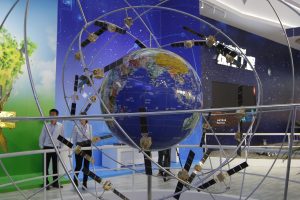
In this Nov. 6, 2018, file photo, a model of Chinese Beidou Navigation Satellite System is displayed during Airshow China 2018, in Zhuhai city, Guangdong province.

Credit: AP Photo/Kin Cheung

On June 23, 2020, China completed construction of its BeiDou Positioning and Navigation System (BDS) by launching the 55th and final satellite for its BDS3 navigation constellation. With this launch, China now enjoys a fully independent self-reliant global navigation satellite system (GNSS) as an alternative to the U.S. Space Force-maintained Global Positioning System (GPS). An independent BeiDou offers China augmented precision navigation and timing (PNT) for its military space forces.

A commentary from Xinhua, China’s state-run new agency, highlighted this aspect by specifying:

The BeiDou network, a major infrastructure independently constructed and operated by China, can better meet the demands of the country’s national security, economic as well as social development. It can also provide more stable and reliable services, as well as an alternative to the U.S.-owned Global Positioning System (GPS) [emphasis added] for global users. Given national security concerns due to the GPS’s dominance, China is not the only one in the world that strives to develop its satellite navigation systems. For many years, the European Union, Russia and others have all been working on their own projects.

The chief designer of BDS, Yang Changfeng, a member of the 13th National Committee of the Chinese People’s Political Consultative Conference, China’s top political advisory body, specified that “the BDS services are used in various fields including transportation, agriculture, fishing, disaster reduction and relief…the satellite-based augmentation system of the BDS will provide high-precision and high-integrity services to users with meter, decimeter and centimeter-level real-time positioning.”

China is offering BeiDou as an open system, free of charge, to the world, with high amounts of accuracy critical for economic and military space infrastructure.

Conceptually, BeiDou is located within China’s “Information Silk Road,” a subset of its land and maritime silk routes under the Belt and Road Initiative (BRI). China is now able to extend influence in a multidomain environment (land, sea and space) via its BeiDou space system, which provides navigation to aircraft, submarines, missiles, as well as commercial services dependent on such navigation. China’s Ministry of Industry and Information Technology sells the Information Silk Road, to include BeiDou and 5G networks, to global audiences as a completely self-sufficient technology infrastructure that anticipates life in the 21st century. This Chinese information infrastructure consists of undersea cables, where China is dominant, space-supported links, and other Earth-based links.

The launch of the last BDS satellite comes at a time when the world is heavily dependent on space infrastructure due to the impact of COVID-19 limitations on in-person physical meetings and travel restrictions, leading to increased demand for broadband internet for communication and for satellite-based internet. China’s National Development and Reform Commission (NDRC), anticipating the importance of space in our lives, determined in April 2020 that services like space information, and associated incorporated services like 5G, satellite broadband, artificial intelligence (AI), blockchain and the Internet of Things (IoT) are part of its “New Infrastructures” list. These “New Infrastructures” are now targeted for government investment and policy direction.

Path to a Separate BDS System

In 1996, during the Third Taiwan Strait Crisis, China fired three missiles to locations on the Taiwan Strait as a warning signal against Taiwan’s moves for independence and full internationally recognized statehood. While the first missile hit about 18.5 kilometers from Taiwan’s Keelung military base as a warning, China lost track of the other two missiles. China asserts that the United States had cut off the GPS signal to the Pacific, on which China was dependent at that time for missile tracking. Consequently, the People’s Liberation Army (PLA) woke up to the strategic vulnerability of having such critical military space infrastructure in the hands of a foreign power. A PLA colonel remembered that incident: “It was a great shame for the PLA … an unforgettable humiliation. That’s how we made up our mind to develop our own global [satellite] navigation and positioning system, no matter how huge the cost…BeiDou is a must for us. We learned it the hard way.”

In 1996, China decided to build its own navigation system, to be completed within 25 years, to establish truly independent military command and control, and precision missile guidance and tracking. The end result of that decision is the establishment of the independent GNSS and PNT systems, the PLA Strategic Support Force, and the development of China’s missile capabilities, to include cruise missiles, ballistic missiles, and hypersonic missiles under the PLA Rocket Force.

Economic and Military Implications of BDS

There are several economic implications of the completion of an independent BeiDou navigation system. First, China promises that the BDS will build a world of intelligent manufacturing and innovation based on a self-sustaining system not dependent on the West. Most importantly, from a geopolitical perspective, BeiDou offers an alternative to GPS, enabling China to further consolidate its hold on global infrastructure and rulemaking to challenge the centrality of the United States to form partnerships and alliances and to control the standards for information technology, mobile devices, 5G, self-driving cars and drones, and the broader internet of things. Second, the BDS promises to be “100 times more accurate” as a navigation system to those who sign up for it, a major advantage for those companies dependent on GPS for competitive profit advantage. Third, it aims to provide an overall better internet and technology experience, especially for countries in Asia, Africa, and Latin America.

The consequence of such information-based economic dependency on China is that countries will be careful not to anger the Chinese Communist Party (CCP) over political issues, to include Tibet, Taiwan, and the South China Sea, as that could result in China cutting off critical technology with deep impact on their societies’ critical infrastructure. In other words, global use of BDS increases China’s leverage for compellence and coercion.

There are also clear security implications, as BeiDou is a force multiplier in the military context for China.

First, for fixed military targets, China can now independently guide missiles and bombs onto targets without fear that the United States would turn off navigation services. Second, for mobile targets, once geolocated through satellites or other means, China can guide its missiles very close to the target, after which a terminal seeker can provide active guidance for precise targeting. This scenario could apply to China’s ballistic missiles, for example the China Aerospace Science and Industry Corporation Ltd-built DF-21D, that can target U.S. aircraft carriers in the Pacific. Third, BeiDou enables independent military command and control by allowing precise knowledge of the location of one’s own forces, and the ability to precisely target and provide navigation for military forces and strikes. This capability strengthens China’s ability to coerce or compel others within its sphere of interest, such as on issues like the South China Sea, Taiwan or Hong Kong. It also limits U.S. counterintervention options, and raises the credibility of China’s ability to impose costs should the United States or its allies seek to intervene. Fourth, an independent BDS coupled with 5G means real-time military command and control and devastatingly accurate automated weapons systems.

Enjoying this article? Click here to subscribe for full access. Just $5 a month.

With the successful launch of the BeiDou satellite constellation, China has proven that it is serious in its movement toward a world order where countries converge on its vision of an interconnected world, with China as the key player. This is backed by the long-term strategic insight that whichever country dominates such space infrastructure will dominate future geopolitics. The combination of these technological developments offers a China-led world order a definitive competitive edge.

https://thediplomat.com/2020/07/the-economic-and-military-impact-of-chinas-beidou-navigation-system/

Tuesday, 28 December 2021

China demolished a sky-high Buddha statue and 45 huge prayer wheels in Drakgo, Tibet


“Cultural Revolution like crackdown”

(In Picture) Religious ceremony held at 99-foot-tall Buddha statue in Kham Drakgo before its demolition.


Dharamshala: The Chinese government has demolished a 99-foot-tall Buddha statue in Kham Drakgo, incorporated into Sichuan Province, according to our sources. Additionally, 45 huge prayer wheels erected near Drakgo Monastery have also been removed and prayer flags burned down.

The bronze statue was built with great effort and with the generous contributions from the local Tibetans in Drakgo, at a crossroad, costing around 40,000,000 Yuan (around 6.3 million USD). In 1973, Drakgo suffered a massive earthquake that caused serious and widespread damage including the death of several thousand residents. The 99-foot-tall Buddha statue was built on 5 October 2015 to ward off natural disasters in the future. 

According to our sources, the bronze statue was built after all permissions were sought from the district office and had even received praise from the local authorities at the time. However, in the last two-three years, higher officials who visited the area had criticised the large size of the statue. As recently as 12 December 2021, the county authorities ordered its demolition after invalidating the documents and claiming that the statue of such height is prohibited. Such a reason fails to justify the basis of destroying the 45 prayer wheels that costed around 1,800,000 Yuan (around 282,500 USD) to build, and the burning down of the prayer flags in the vicinity. 

Tearing down Buddhist statues and structures is a direct attack on the centuries-long traditions of Tibetans including putting up prayer flags to lift one’s luck, erecting religious structures to ward off misfortunes and spinning prayer wheels to accumulate mantras for the well-being of others. “These acts by the Chinese authorities are acute attacks on Tibetan religion, language and culture. The crackdown on Tibetan Buddhism and the situation now in Drakgo is like the Cultural Revolution times,” said our sources. Due to the tight controls over information flows in the region, we are unable to obtain pictures and videos of the actual destruction at the moment.

Last month, Drakgo Monastery’s Gaden Namgyal Monastic school was demolished on the false ground of not having proper documents and violating the land use law. The school was targeted because it served as an important hub of education in the area since its establishment, offering a range of classes including Tibetan Buddhism, Tibetan language, Chinese Mandarin, and English. After closure of the school, its 130 students were forced to return to their villages, without access or enrolment in other schools. The Chinese government completely violated the fundamental rights of the Tibetan people, including religious rights, language rights and rights to preserve and practice one’s own culture and tradition.

– UN, EU and Human Rights Desk, Tibet Advocacy Section/DIIR

Aerial view of Kham Drakgo.


The 99-foot-tall Buddha statue was built on 5 October 2015 to ward off natural disasters in the future.


https://tibet.net/cultural-revolution-like-crackdown-china-demolished-a-sky-high-buddha-statue-and-45-huge-prayer-wheels-in-drakgo-tibet/


ALSO:

Sunday, 26 December 2021

New African port, Bata, to put China across the Atlantic from the US


China is building a new military port on Africa’s Atlantic coast.


A commentary by Dan Southerland
2021.12.26


New African port to put China across the Atlantic from the USChinese President Xi Jinping (on the screen) delivers his speech during the China-Africa Cooperation (FOCAC) meeting in Dakar, Senegal, Nov. 29, 2021.
 AFP

China is building a new military port on Africa’s Atlantic coast.

The port at Bata in the Central African nation of Equatorial Guinea is set to become China’s first permanent military presence on the coast of West Africa.

U.S. officials told The Wall Street Journal that this meant that Chinese warships might be able to rearm and refit in a location opposite to the east coast of the United States.

The new Chinese naval base would be located nearly 10,000 kilometers, or 6,000 miles from Washington. But American officials have shown concern over it.

In October, the U.S. government sent a senior national security adviser to the tiny oil-producing country of Equatorial Guinea to call on officials there to resist China’s overture. It appears that he didn’t succeed.

Meanwhile, The Economist magazine said that “The Gulf of Guinea would be a logical place to look for a base.”

“Piracy is a scourge there,” it said. “So China could plausibly argue that its help is needed.”

And, according to the magazine, the family-run dictatorship in Equatorial Guinea “happens to be the sort that China is well practiced at doing business with in Africa: brutal, corrupt, and a financial shambles.”

In recent years the U.S. and its allies have confiscated allegedly ill-gotten luxury assets from Equatorial Guinea’s vice president Teodoro Nguema Obiang Mangue. The proceeds are used to fund COVID-19 vaccines and other medical assistance for the country.


This photo taken on Aug. 1, 2017 shows Chinese People's Liberation Army personnel attending the opening ceremony of China's new military base in Djibouti. China has deployed troops to its first overseas naval base in Djibouti, a major step forward for the country's expansion of its military presence abroad. Credit: AFP
'More adventurous'

Five years after building its only overseas base in Djibouti on the Horn of Africa on Africa’s east coast, Djibouti has remained until now the Chinese armed forces only overseas bastion.

Ryan Martinson of the U.S. Naval War College in Newport, Rhode Island, provides some useful background.

Chinese military analysts, he says, have openly advocated “pushing into waters far from home to divert American attention and resources from Chinese waters.”

Martinson cites a book by Hu Bo of Peking University, in which Hu acknowledges that China’s Navy couldn’t compete with America for supremacy in faraway seas.

But Hu suggests that China could “pin down” some American forces that might otherwise be sent to East Asia.

Martinson also cites Liu Zhe, the captain of China’s first aircraft carrier, the Liaoning, who wrote in an essay in 2017 that “the farther away we are from our territorial sea, the more secure will be the motherland behind us.”

The Economist says that China is “becoming a more adventurous naval power,” amassing more ships, though not more tonnage, than the U.S. Navy.

But most of these vessels keep to Indo-Pacific waters.

When China began building its first overseas base in 2016 in Djibouti on the Horn of Africa, Chinese officials tried to allay Western anxiety about their country’s expanding military presence.

People hold Chinese and Djiboutian national flags with the portrait of Djibouti's President Ismail Omar Guellehas as they wait for the arrival of the president before the launching ceremony of new Chinese-funded 1000-unit housing construction project in Djibouti,  July 4, 2018. Credit: AFP
People hold Chinese and Djiboutian national flags with the portrait of Djibouti's President Ismail Omar Guellehas as they wait for the arrival of the president before the launching ceremony of new Chinese-funded 1000-unit housing construction project in Djibouti, July 4, 2018. Credit: AFP
Debt buildup

They said that the Djibouti base was built only for “supporting multinational anti-piracy efforts, helping to secure vital shipping lanes, and enabling China to protect its citizens in the region.”

In 2011, the Chinese Navy helped to conduct an evacuation of some 30,000 Chinese citizens from Libya as that North African country descended into civil war.

But in Kenya to the south of Djibouti, local citizens worry about the dangers of oil spills, the inevitable accidents that the Chinese Navy might bring, and the costs of financing a new port and railroad there.

According to a foreign journalist living in Kenya, critics there say that Kenya “has sold its soul to China and is wallowing in debt that it won’t be able to pay back.”

Meanwhile, China’s commitment to offering economic and financial aid to a number of African countries appears to have its limits.

According to the Financial Times, experts are concerned about African nations’ ability to repay Chinese loans.

Apparently with this in mind, China has announced plans to cut loans provided to those nations by a third over the next three years.

In a recent video address to the triennial Forum on China-African Cooperation being held in Senegal, China’s President Xi Jinping pledged to provide $40 billion to African states in investments, credit lines, trade financing, and special drawing rights.

Although that represents a cut from the $80 billion pledged at the previous two summits, Xi emphasized his commitment to what he called a “win-win situation.”


Dictating terms

Meanwhile, Chidi Odinkalu, senior manager for Africa at the Open Society Foundations, criticized some African governments for relying too heavily on loans from China.

“China’s strategic objective was to get a foot in the door,” he said “Now that it’s in the door, it can choose to dictate the terms.”

The International Monetary Fund (IMF) says that debt ratios in Sub-Saharan Africa have been rising in part due to the COVID-19 pandemic.

This is creating debt distress in countries that were already suffering from negative financial conditions.

Africa has witnessed an estimated 214,000 deaths as well as drastic economic effects due to COVID-19.

As Africa’s largest bilateral creditor, China holds more than 20 percent of African debt.

And payments to China account for nearly 30 per cent of 2021’s debt service. Angola alone accounts for almost a third.

The Centre for the Study of Economies in Africa reports that at least three factors drove the debt crisis—a global recession in the early 1980s, the rise in interest rates in developed countries, and a decline in new capital inflows.

According to the Washington-D.C. –based Brookings Institution, as of 2018, 19 African countries have exceeded the 60 percent debt-to-GDP threshold set by the African Monetary Cooperation Program for developing countries.

Meanwhile, 24 countries have exceeded the 95 percent debt-to-GDP rates suggested by the IMF.

Surpassing that threshold means that these countries are highly vulnerable to economic changes while their governments have a reduced capacity to provide support to their economies in the event of a recession.

Dan Southerland is RFA's founding Executive Editor.

Source 

Beijing’s Taiwan territorial claims lack justification

There is no rational justification for a demand for the “reunification” of Taiwan with the PRC

A commentary by Aaron Rhodes
2021.12.26


Beijing’s Taiwan territorial claims lack justificationA man (C) wearing a face mask with the image of China's President Xi Jinping (R) joins other human rights activists as they protest in Taipei against the 2022 Beijing Olympic Games to mark Human Rights Day, Dec. 10, 2021.
 AFP

Xi Jinping and other Chinese Communist Party (CCP) leaders are ramping up rhetoric about the necessity of “unifying” China by bringing Taiwan under their control as a “sacrosanct mission of the entire Chinese people.”

Since 1949, the uneasy status quo in relations between Taiwan and the People’s Republic of China (PRC) has allowed both to build their societies, and even cooperate, without it leading to overt conflict. But Beijing is now threatening to attempt a military solution that could lead to a devastating global war. In this situation, a sober examination of historical facts is appropriate. 

A right to territory is generally based on historical precedent, cultural and ethnic affinity, political consensus or military conquest. China’s claims on Taiwan are unconvincing when measured according to the first three of these criteria.  

First, let’s look back in history as far as possible. Mainland authorities have repeatedly claimed that “Taiwan has belonged to China since ancient times. The Chinese people first developed Taiwan.” In fact, Taiwan was first settled by Austronesian peoples 6,500 years ago, members of the same cultural group that moved into a number of South Asian territories; some current citizens of Taiwan retain this identity.   

The earliest official mainland Chinese government agency in Taiwan was not established until 1281 AD, when the Yuan Dynasty placed a patrol and inspection unit in Penghu, an island located between mainland China and Taiwan. From 1624, Taiwan was occupied by the Dutch. The first Han Chinese regime was established in Taiwan in 1662.

China ceded Taiwan to Japan in 1895. In 1945, after the end of World War II and the Japanese occupation, Taiwan was returned to the Republic of China (ROC). In 1949, after the government of the ROC was driven from the mainland by victorious Communist forces in the Chinese Civil War, it established itself on Taiwan. Historically, mainland Chinese regimes thus only fully controlled Taiwan for 237 years out of the island’s recorded history. Taiwan has never been part of the state established by the Communist Party in 1949. There is no rational justification for a demand for the “reunification” of Taiwan with the PRC, either on the basis of ancient or recent history.

Today, over 95 percent of Taiwan’s 23.5 million people are Han Chinese, the result of waves of migration from the mainland over centuries, and thus share a root identity with the dominant ethnic group in PRC, in the same manner as many white, Anglo-Saxon, Protestant Americans share a cultural identity with most citizens of the United Kingdom, from which their ancestors immigrated centuries ago.  

In the decades since the Republic of China established itself on Taiwan, however, its people have developed a unique and independent political and national identity. Originally a highly authoritarian state, the ROC has become a model of peaceful democratic transformation. While the mainland regime is totalitarian, Taiwan is one of the most free and democratic countries in the world. 

Public sentiment in Taiwan is overwhelmingly opposed to becoming assimilated into Communist China, and favors Taiwan as an independent, democratic state. Before Xi began to threaten Taiwan, many Taiwanese supported a policy of “One China Two Interpretations,” and wanted closer economic ties to the PRC. But with increasingly hostile signals from Beijing, those views have receded. 

One wonders if most mainland Chinese might support a status quo with Taiwan, while their rulers gin up irredentist aggression through ruthless media manipulation. Taiwan and the PRC have much to gain by peaceful cooperation, just as both the PRC and Hong Kong benefited from their economic cooperation. 

But Xi Jinping and the CCP, without clear historical or cultural foundations, or political support for merging Taiwan into Communist China, are aiming to justify their territorial claim by conquering Taiwan militarily, creating a fact on the ground by force. The regime is preparing for a war to gain control of Taiwan by pouring resources into a nuclear and conventional military build-up in the face of an almost total lack of support for unification by the people of Taiwan.

An attempt to occupy Taiwan by force could lead to war with the United States, Japan, Australia and other countries, a war with devastating social, economic and environmental consequences. Even if an invasion were initially successful, the “reunification” of China would require long-term brutality that would destroy not only countless lives, but also the reputation and authority China has been attempting to build in the international community. It would halt China’s economic progress.

Irredentism has long served fascist regimes, like those of Nazi Germany and Mussolini’s Italy, which have used the dream recovering “lost” territories to stoke aggressive ethnic nationalism, and bolster their own fragile legitimacy. Xi Jinping’s plan to subvert the democracy on Taiwan is not only historically, but also morally indefensible.

Aaron Rhodes is Senior Fellow in the Common Sense Society, and President of the Forum for Religious Freedom-Europe.  He is the author of The Debasement of Human Rights.

Source

Saturday, 25 December 2021

Hong Kong’s Media Face Year of Red Lines

2021 was a year of dramatic changes for Hong Kong’s media scene, as the city adjusted to life under Beijing’s national security law.


December 25, 2021 7:50 PM

FILE - A supporter holds an apple and a copy of the Apple Daily newspaper outside the court to support media mogul Jimmy Lai, founder of Apple Daily, over charges related to an unauthorized assembly, Oct. 1, 2019, in Hong Kong, May 28, 2021.

Journalists have been detained, the pro-democracy news outlet Apple Daily was forced to close, and visas for foreign correspondents were delayed or, in one case, denied.

It’s a stark change for a city that was once a model for press freedom and where anti-government protests were covered freely by local and international reporters. Those same protests led to Beijing's pushing through the law, which bans secession and collusion with foreign forces.

Journalists’ associations, including the Foreign Correspondents’ Club (FCC) in Hong Kong, are concerned about its impact. The FCC annual survey of members found that 84% believe conditions have changed for the worse since the law came into effect. About 34% said they were thinking of leaving Hong Kong because of the decline of press freedom.

'We can never get back'

Ronson Chan, chair of the Hong Kong Journalists Association and a senior editor at news website Stand News, told VOA in late December that 2021 has been the “saddest year” for Hong Kong’s media and that next year will “not be easy.”

“We never can get back. Hong Kong has changed,” Chan said. “Freedom of press has many red lines.”

Maintaining a free press in Hong Kong was the best way to differentiate between the city and China, Chan said, adding that it is “important for the Hong Kong people to still have a good media.”

But the veteran journalist said, “We still have a very critical situation.” He cited proposals for a law banning false news for next year, billed by authorities as part of a drive against the dissemination of misinformation.

Hong Kong Chief Executive Carrie Lam has repeatedly said that press freedom is guaranteed under Hong Kong’s Basic Law and has denied that the arrests and the closure of Apple Daily were an attack on the media. She said journalists have a responsibility to not break the new law.

Changing environment

Even before the National Security Law came into effect, Jimmy Lai, the billionaire founder of pro-democracy newspaper Apple Daily, was having doubts that his outlet would survive.

In 2021, those concerns were realized.

In June, Apple Daily was forced to shut its doors after more than 25 years, when several executives were charged under the security law and the outlet’s financial assets were frozen, leaving the company unable to pay its vendors and staff.

Lai has spent over a year in prison, convicted for his role in anti-government protests. This month, he was sentenced in a separate case to 13 months in prison for taking part in a banned Tiananmen Square vigil, and he is awaiting trial in a third case, for charges under the national security law that could result in a life sentence.

As Apple Daily closed, political analyst Joseph Cheng told VOA it was a “sad day for Hong Kong” and added there is “not much” freedom of the media in the territory.

The city’s public broadcaster, Radio Television Hong Kong (RTHK), also underwent changes that led critics to question its editorial independence.

Under the newly appointed director, Patrick Li, the broadcaster removed some shows, saying they had exhibited bias; removed part of the station’s online archive; and gave Lam a regular show to discuss Beijing’s electoral reforms for the city.

RTHK employees, who spoke with VOA earlier this year on condition of anonymity for fear of retaliation, said they believed executives were trying to erase Hong Kong’s history. And critics condemned the decision to provide Lam a show, suggesting that RTHK was empowering propaganda.

RTHK’s communications team has pushed back against the criticism, telling VOA earlier that the broadcaster is editorially independent “as stipulated in the charter.”

Contracts for at least two of the broadcaster’s journalists were not renewed, including Nabela Qoser and former RTHK producer Bao Choy.

Questioning of Lam

The broadcaster had received complaints from pro-government figures about Qoser’s confrontational questioning of Lam at the height of the anti-government protests.

In Choy’s case, a court this year found the producer guilty on two counts of obtaining public data illegally. Choy had used vehicle registration data for an award-winning RTHK documentary that investigated the response from Hong Kong police to attacks against pro-democracy protesters in 2019.

Choy criticized the current environment, telling VOA the authorities are "using the law to suppress press freedom.”

Journalists wanting to access public databases similar to the ones Choy used will face more obstacles after Hong Kong’s Land Registry and Companies Registry updated their terms.

Users must now supply details such as their Hong Kong identity number and the reason for the search when conducting public information searches.

Several journalists have said they fear that authorities may use the data against them.

The Hong Kong Journalists Association has warned that such policies risk damaging press freedom. But in recent months it has come under pressure.

Hong Kong Secretary for Security Chris Tang and Police Commissioner Raymond Siu Chak-yee both remarked that the association makes it easy for applicants to obtain media status, and that it has biased views and favors pro-democracy news organizations.

The changes in Hong Kong reflect a wider crackdown by China on the press, according to a December report by media watchdog Reporters Without Borders (RSF).

China is the world’s biggest captor of journalists with 127 currently detained. RSF also identified 10 key factors in media suppression, including censorship and propaganda pressure, and increased difficulty for foreign press in securing visas.

This trend appears to be filtering into Hong Kong.

Last month, Sue-Lin Wong, China correspondent for The Economist, was denied a work visa renewal in Hong Kong, without a reason.

No exceptions seen

“I think whatever the reason, kicking out an Economist correspondent means they would expel anyone from any organization,” one international journalist based in Hong Kong told VOA, requesting anonymity.

Eric Wishart, a veteran journalist and co-convener of the press freedom committee at the Foreign Correspondents Club, told VOA earlier this year that journalists are left uncertain about what will get them in trouble with the authorities.

“We talk about the ‘red lines’ in Hong Kong, but the paint is still fresh,” Wishart said. “It is a changing landscape, and that is a big, big challenge for everybody.”

Source


Related

Most Recent Post

Man charged for borrowing rare Chinese manuscripts from UCLA library, returning fakes

  Suspect Jeffrey Ying allegedly travelled to China after checking works out using several aliases Agence France-Presse Published: 12:11pm, ...

Popular Posts - Last 30 days