Showing posts with label FT. Show all posts

Tuesday, 31 January 2023

Moderna refused China request to reveal vaccine technology

 Moderna has refused to hand over to China the core intellectual property behind the development of its breakthrough Covid-19 vaccine, leading to a collapse in negotiations on its sale there, according to multiple people familiar with the matter. 


Sun Yu in New York, Eleanor Olcott in Hong Kong and Donato Paolo Mancini in London OCTOBER 2 2022 

Montage of a syringe being inserted into a Moderna Covid-19 vial, China’s flag and DNA strands

The mRNA vaccine technology used by Moderna provides longer-lasting and higher levels of protection than tech used by Chinese providers © FT montage: AFP/Getty Images

 Moderna has refused to hand over to China the core intellectual property behind the development of its breakthrough Covid-19 vaccine, leading to a collapse in negotiations on its sale there, according to multiple people familiar with the matter. 

 The Massachusetts-based pharmaceutical company turned down Beijing’s request to hand over the recipe for its messenger RNA vaccine because of commercial and safety concerns, said two people involved in negotiations that took place between 2020 and 2021. 

The vaccine maker says it is still “eager” to sell the product to China. The mRNA vaccine technology used by Moderna and BioNTech/Pfizer provides longer-lasting and higher levels of protection than the inactivated vaccine technology used by Chinese makers. 

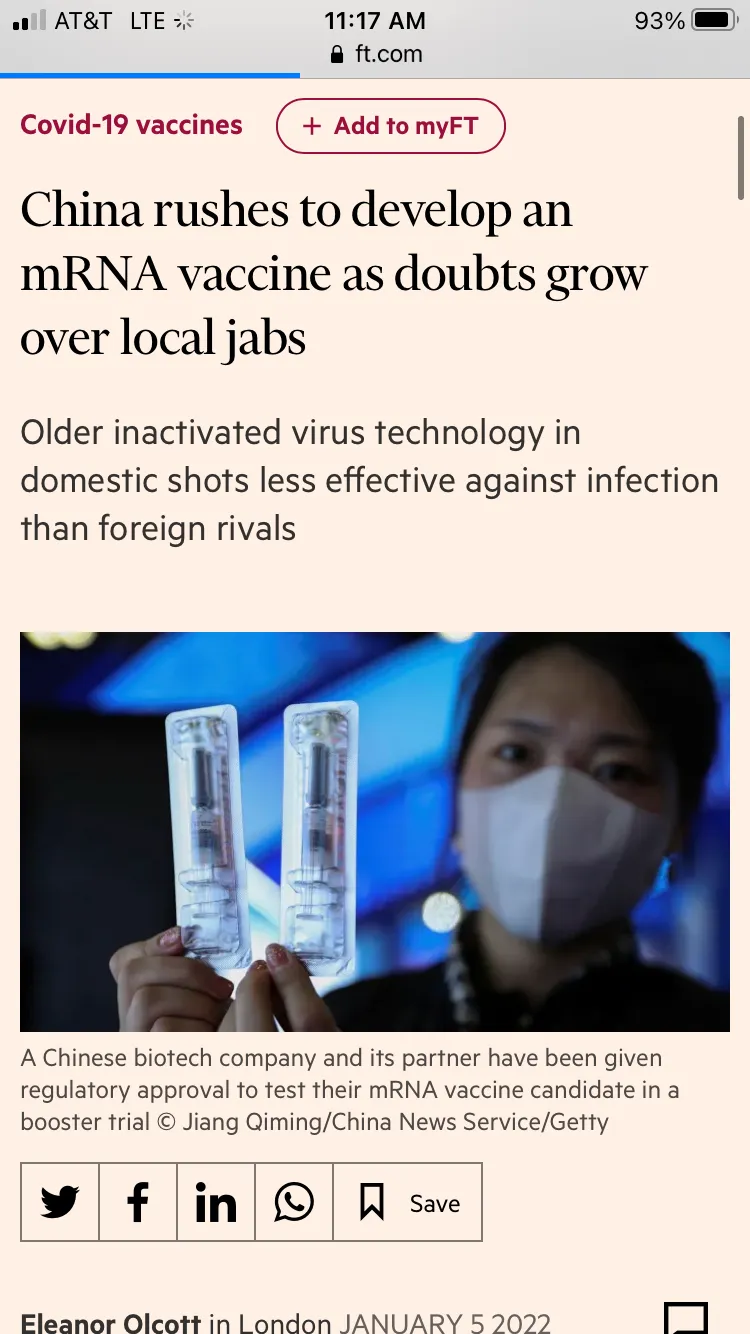
Several Chinese pharma companies are racing to develop a homemade mRNA alternative but have struggled with the emergence of more infectious variants. 

 One individual close to the Moderna team in Greater China said the company had “given up” on its previous efforts to access the Chinese market, because of Beijing’s demand that it hand over the technology as a prerequisite for selling into the country. 

 To date, Beijing has offered two routes for foreign Covid-19 vaccine makers to distribute in China, dependent on regulatory approval: carrying out a full technology transfer to a domestic drugmaker or establishing a manufacturing facility in China with a local partner, while keeping control of the underlying technology. 

Moderna was pressed to take the former option. 

 The German group BioNTech has struck a deal with Shanghai Fosun Pharmaceutical to conduct clinical trials and commercialise its vaccine in 2020, which meant it retained control of the intellectual property. 

Under the partnership, Fosun agreed to provide a factory that would make up to 1bn doses a year. 

 By contrast, the Shanghai-based Everest Medicines group made a deal to access the Canadian biotech company Providence Therapeutics’s mRNA vaccine candidate that involved a full tech transfer. 

 Beijing has not granted either vaccine regulatory approval. 

 The Moderna leadership did not want to hand over the vaccine recipe to a Chinese partner because of the reputational damage if the local partner botched the manufacturing, said two people with knowledge of the matter. 

 Recommended

The Big Read Will ‘open-source’ vaccines narrow the inequality gap exposed by Covid? 

 Moderna has been fiercely protective of its intellectual property around the world, saying handing over patents would do little to address supply constraints. Talks in Italy for a tech transfer to local manufacturing sites have also failed, but Moderna gave the reason that it lacked the capacity to oversee it. 

 China has not approved any mRNA products for therapeutic purposes, and the mass production of this kind of vaccine is more complex than China’s existing inactivated vaccines made by Sinopharm and Sinovac. 

 In recent weeks, Moderna has signalled a willingness to restart talks with China. Its chief medical officer Paul Burton said this month: “We would certainly be very eager to collaborate with China if they felt that there was a need for a vaccine there.” 

 Burton’s comments came days after US president Joe Biden proclaimed the “pandemic is over”, wiping more than $10bn off the market value of the main makers of vaccines, including Moderna. 

 Moderna told the Financial Times: “We are not currently engaged in supply talks with China. We are open to speaking with countries on their supply needs for Covid-19 vaccines.” 

 Industry insiders observed that the company’s willingness to reopen talks with China, the last remaining major economy without an mRNA jab, has been driven by sluggish demand for vaccines in the wealthier countries where it first targeted sales. 

 According to Airfinity, a data firm that monitors vaccine shipments, Moderna has shipped a greater share of its vaccines to high-income countries than the other three major vaccine makers, a strategy that earned it billions of dollars in profit. 

More than 86 per cent of Moderna’s jabs have been delivered to high-income countries, compared with 74 per cent for BioNTech/Pfizer, 63 per cent for Johnson & Johnson and 19 per cent for AstraZeneca. 

 Slowing demand has afflicted all the major coronavirus vaccine makers, but with the Covid-19 jab its only approved product, the pressure on Moderna’s management is particularly acute, according to people familiar with the matter. 

 Additional reporting by Jamie Smyth in New York

https://www.ft.com/content/a481c129-c5aa-4972-84a8-3a45bb000098

Tuesday, 17 January 2023

Funny story: the Chinese want NOTHING to do with mRNA Covid vaccines. (Xi, I wonder why.)


So the Financial Times had another elite media howler last week: the Chinese are desperate (desperate I say!) to get themselves an mRNA vaccine.

Posted onJanuary 17, 2023CategoriesEconomyPoliticsSocial IssuesTags

Guest Post by Alex Berenson


Yep, the Chinese just can’t WAIT to give an mRNA vaccine to their people. They’re rushing ahead.

Sure.

That’s why they HAVE SAT ON THE PFIZER/BIONTECH VACCINE FOR MORE THAN A YEAR.

In March 2020, BioNTech and a Chinese drug company called Shanghai Fosun Pharmaceutical announced a deal for Fosun to sell BioNTech’s Covid vaccines in China: “The two companies will work jointly on the development of BNT162 in China.” Fosun even said it would invest $50 million in BioNTech stock.

Again – this was March 2020, not 2021, roughly the same time BioNTech made a similar deal with Pfizer.

The two companies moved forward quickly.

In November 2020, just after Pfizer and BioNTech announced the topline results from their worldwide pivotal clinical trial (95% percent protection against infection! Covid is DONE, y’all!) they said they had moved the BioNTech vaccine into Phase 2 trials in China.

A month later, even as that trial was still scaling up, they had the biggest news yet.

Fosun would buy 100 million doses of the BioNTech vaccine for Chinese use, with delivery expected in 2021.

In late April 2021, BioNTech’s chief executive predicted that the vaccine would win approval and be available in China by July “at the latest.”

Barely two weeks later, in May 2021, Fosun and BioNTech had decided 100 million doses was not enough. They announced a deal to build a Chinese plant with the capacity to make 1 billion vaccine doses annually.

By mid-July, Chinese media outlets were reporting that the Chinese government was reviewing the BioNTech vaccine, with trial production expected to begin in August.


Since then, crickets.

More than a year after Fosun said it would import mRNA vaccines to China, and six months after Chinese regulators supposedly reviewed the clinical trial results, the vaccine remains unavailable.

Instead, in November, the Chinese announced that they had supposedly begun trials on their own mRNA vaccine. No one seems to have any idea when those trials will be finished, but they have the effect of resetting the clock and giving the bluecheck geniuses at places like the FT a way to pretend that the Chinese are moving aggressively ahead with mRNA.

Of course, given that Covid has essentially been nonexistent in China since February 2020, maybe the scientists in the People’s Republic know something the rest of us don’t.

Nah! That’s impossible. They’d definitely tell us, right?

-----------------------------------------------------
It is my sincere desire to provide readers of this site with the best unbiased information available, and a forum where it can be discussed openly, as our Founders intended. But it is not easy nor inexpensive to do so, especially when those who wish to prevent us from making the truth known, attack us without mercy on all fronts on a daily basis. So each time you visit the site, I would ask that you consider the value that you receive and have received from The Burning Platform and the community of which you are a vital part. I can't do it all alone, and I need your help and support to keep it alive. Please consider contributing an amount commensurate to the value that you receive from this site and community, or even by becoming a sustaining supporter through periodic contributions. [Burning Platform LLC - PO Box 1520 Kulpsville, PA 19443] or Paypal
 

-----------------------------------------------------
To donate via Stripe, click here.
-----------------------------------------------------https://www.theburningplatform.com/2023/01/17/funny-story-the-chinese-want-nothing-to-do-with-mrna-covid-vaccines-xi-i-wonder-why/


Sunday, 2 October 2022

Moderna refused China request to reveal vaccine technology

 Moderna has refused to hand over to China the core intellectual property behind the development of its breakthrough Covid-19 vaccine, leading to a collapse in negotiations on its sale there, according to multiple people familiar with the matter. 


Sun Yu in New York, Eleanor Olcott in Hong Kong and Donato Paolo Mancini in London OCTOBER 2 2022 

Montage of a syringe being inserted into a Moderna Covid-19 vial, China’s flag and DNA strands

The mRNA vaccine technology used by Moderna provides longer-lasting and higher levels of protection than tech used by Chinese providers © FT montage: AFP/Getty Images

 Moderna has refused to hand over to China the core intellectual property behind the development of its breakthrough Covid-19 vaccine, leading to a collapse in negotiations on its sale there, according to multiple people familiar with the matter. 

 The Massachusetts-based pharmaceutical company turned down Beijing’s request to hand over the recipe for its messenger RNA vaccine because of commercial and safety concerns, said two people involved in negotiations that took place between 2020 and 2021. 

The vaccine maker says it is still “eager” to sell the product to China. The mRNA vaccine technology used by Moderna and BioNTech/Pfizer provides longer-lasting and higher levels of protection than the inactivated vaccine technology used by Chinese makers. 

Several Chinese pharma companies are racing to develop a homemade mRNA alternative but have struggled with the emergence of more infectious variants. 

 One individual close to the Moderna team in Greater China said the company had “given up” on its previous efforts to access the Chinese market, because of Beijing’s demand that it hand over the technology as a prerequisite for selling into the country. 

 To date, Beijing has offered two routes for foreign Covid-19 vaccine makers to distribute in China, dependent on regulatory approval: carrying out a full technology transfer to a domestic drugmaker or establishing a manufacturing facility in China with a local partner, while keeping control of the underlying technology. 

Moderna was pressed to take the former option. 

 The German group BioNTech has struck a deal with Shanghai Fosun Pharmaceutical to conduct clinical trials and commercialise its vaccine in 2020, which meant it retained control of the intellectual property. 

Under the partnership, Fosun agreed to provide a factory that would make up to 1bn doses a year. 

 By contrast, the Shanghai-based Everest Medicines group made a deal to access the Canadian biotech company Providence Therapeutics’s mRNA vaccine candidate that involved a full tech transfer. 

 Beijing has not granted either vaccine regulatory approval. 

 The Moderna leadership did not want to hand over the vaccine recipe to a Chinese partner because of the reputational damage if the local partner botched the manufacturing, said two people with knowledge of the matter. 

 Recommended

The Big Read Will ‘open-source’ vaccines narrow the inequality gap exposed by Covid? 

 Moderna has been fiercely protective of its intellectual property around the world, saying handing over patents would do little to address supply constraints. Talks in Italy for a tech transfer to local manufacturing sites have also failed, but Moderna gave the reason that it lacked the capacity to oversee it. 

 China has not approved any mRNA products for therapeutic purposes, and the mass production of this kind of vaccine is more complex than China’s existing inactivated vaccines made by Sinopharm and Sinovac. 

 In recent weeks, Moderna has signalled a willingness to restart talks with China. Its chief medical officer Paul Burton said this month: “We would certainly be very eager to collaborate with China if they felt that there was a need for a vaccine there.” 

 Burton’s comments came days after US president Joe Biden proclaimed the “pandemic is over”, wiping more than $10bn off the market value of the main makers of vaccines, including Moderna. 

 Moderna told the Financial Times: “We are not currently engaged in supply talks with China. We are open to speaking with countries on their supply needs for Covid-19 vaccines.” 

 Industry insiders observed that the company’s willingness to reopen talks with China, the last remaining major economy without an mRNA jab, has been driven by sluggish demand for vaccines in the wealthier countries where it first targeted sales. 

 According to Airfinity, a data firm that monitors vaccine shipments, Moderna has shipped a greater share of its vaccines to high-income countries than the other three major vaccine makers, a strategy that earned it billions of dollars in profit. 

More than 86 per cent of Moderna’s jabs have been delivered to high-income countries, compared with 74 per cent for BioNTech/Pfizer, 63 per cent for Johnson & Johnson and 19 per cent for AstraZeneca. 

 Slowing demand has afflicted all the major coronavirus vaccine makers, but with the Covid-19 jab its only approved product, the pressure on Moderna’s management is particularly acute, according to people familiar with the matter. 

 Additional reporting by Jamie Smyth in New York

https://www.ft.com/content/a481c129-c5aa-4972-84a8-3a45bb000098
Monday, 26 September 2022

US and Philippines increase military ties over China threat MUST READ

 Manila is strengthening its alliance with Washington due to fears of a possible war over Taiwan

US and Philippine marines take part in a joint amphibious assault exercise earlier this year © Ezra Acayan/Getty Images 

Kathrin Hille in Manila and Demetri Sevastopulo in Washington YESTERDAY

https://www.ft.com/content/9c295755-eadf-48a9-9818-6afa1bcbe498

The Philippines and US are increasing military co-operation, including doubling the number of troops involved in joint exercises next year, as Manila starts to consider its role in a potential war with China over Taiwan. 

 The US and Philippines will next year send 16,000 forces to participate in Balikatan, their main annual bilateral military exercise, said Colonel Michael Logico, director of the Philippine military’s Joint and Combined Training Center, which recently hosted a planning conference with US counterparts.

 “We are going to do a full battle test for operating together, including in Northern Luzon” near the country’s sea border with Taiwan, Logico said in an interview with the Financial Times. 

 At annual bilateral defence talks that will be hosted by US Indo-Pacific Command in Hawaii next week, military leaders will discuss more than 500 bilateral activities for the coming year, an increase from some 300 this year. 

 US defence secretary Lloyd Austin and Filipino defence minister Jose Faustino Jr will meet on Thursday — the first time defence ministers from the allies will join the talks, according to two people familiar with the event.


The stepped up co-operation comes after China’s increasing military activity around Taiwan unsettled senior Filipino officials and won their support for reinvigorating the country’s alliance with the US, which was weakened when then-president Rodrigo Duterte attempted a pivot to China in 2016. 

 In a meeting with President Ferdinand Marcos Jr in New York this week, Joe Biden said the relationship between the countries had “very deep roots”. 

 “We’ve had some rocky times, but the fact is it’s a critical, critical relationship, from our perspective,” the US president said. 

“I hope you feel the same way.” Gregory Poling, a south-east Asia expert at CSIS, a Washington think-tank, said there was “a growing recognition of the role of the Philippines in a Taiwan scenario”. 

 “You’re starting to see a consensus emerge within most of the Philippines’ government that the Philippines does need to deepen the alliance with the US,” Poling said. 

 Other US allies have also grown worried about the risks that a Chinese attack on Taiwan would pose for them. 

In recent years, Japan has stepped up consultations, planning and drills with the US for such a scenario. “We are a US ally, we are in a strategic location. 

We are so near that if anything happens in Taiwan we will be involved,” said General Emmanuel Bautista, former chief of staff of the armed forces of the Philippines. 

 Pointing to waterways connecting the South China Sea and the Pacific through the Philippines — such as the Bashi Channel in the north and the Sibutu Passage in the south — Bautista said the Philippines was “key terrain” for US-China competition because control of the country could give either side a marked advantage over its adversary. 

 Bautista said that navies used sea channels around the Philippines in the second world war to gain critical access for naval battles. 

 “Either China or the US will want to seize the Philippines to be able to control the chokepoints and the access to Taiwan” in the event of a conflict, Bautista added. 

“For the US it’s access for resupplying Taiwan, for China preventing that.” 

 One focus is on the islands in the Bashi Channel, only 120km from Taiwan at their northernmost point. Lisa Curtis, an Indo-Pacific expert at the CNAS think-tank in Washington, said Manila was “wary of getting stuck in the middle of increasing US-China competition” but the new Marcos government seemed realistic about what Washington might request in the event of a Taiwan conflict. 

 “Washington would almost certainly look to Manila as a staging ground for logistics support and US forces. 

That is why it is important for the US and the Philippines to advance talks on the Enhanced Defense Cooperation Agreement,” said Curtis, in a reference to the 2014 bilateral agreement whose implementation has significantly slowed in recent years. 

 Last November, the two countries said they would explore additional sites in which US forces would be allowed a rotational presence — which experts understood to mean US forces could gain access to bases on those islands. 

 Logico said a Chinese company’s attempt to gain control of Fuga Island north of Luzon for a development project in 2019 — quickly stopped by the military — made the armed forces focus more on the north. 

 “The Chinese have no use for Fuga. It really is about Taiwan, to deny us, and in extension the US, the use of those islands,” Logico added. 

 Several current and former Filipino military officials said the Philippines would be the most suitable corridor for US forces to resupply Taiwan with munitions in wartime. 

According to two people in Manila familiar with the situation, Filipino and US forces have started discussing options for this. 

 Follow Kathrin Hille and Demetri Sevastopulo on Twitter 
 Will China and the US go to war over Taiwan? 
Copyright The Financial Times Limited 2022. All rights reserved.

https://www.ft.com/content/9c295755-eadf-48a9-9818-6afa1bcbe498


Most Recent Post

Man charged for borrowing rare Chinese manuscripts from UCLA library, returning fakes

  Suspect Jeffrey Ying allegedly travelled to China after checking works out using several aliases Agence France-Presse Published: 12:11pm, ...

Popular Posts - Last 30 days