Showing posts with label Pfizer. Show all posts

Tuesday, 31 January 2023

Moderna refused China request to reveal vaccine technology

 Moderna has refused to hand over to China the core intellectual property behind the development of its breakthrough Covid-19 vaccine, leading to a collapse in negotiations on its sale there, according to multiple people familiar with the matter. 


Sun Yu in New York, Eleanor Olcott in Hong Kong and Donato Paolo Mancini in London OCTOBER 2 2022 

Montage of a syringe being inserted into a Moderna Covid-19 vial, China’s flag and DNA strands

The mRNA vaccine technology used by Moderna provides longer-lasting and higher levels of protection than tech used by Chinese providers © FT montage: AFP/Getty Images

 Moderna has refused to hand over to China the core intellectual property behind the development of its breakthrough Covid-19 vaccine, leading to a collapse in negotiations on its sale there, according to multiple people familiar with the matter. 

 The Massachusetts-based pharmaceutical company turned down Beijing’s request to hand over the recipe for its messenger RNA vaccine because of commercial and safety concerns, said two people involved in negotiations that took place between 2020 and 2021. 

The vaccine maker says it is still “eager” to sell the product to China. The mRNA vaccine technology used by Moderna and BioNTech/Pfizer provides longer-lasting and higher levels of protection than the inactivated vaccine technology used by Chinese makers. 

Several Chinese pharma companies are racing to develop a homemade mRNA alternative but have struggled with the emergence of more infectious variants. 

 One individual close to the Moderna team in Greater China said the company had “given up” on its previous efforts to access the Chinese market, because of Beijing’s demand that it hand over the technology as a prerequisite for selling into the country. 

 To date, Beijing has offered two routes for foreign Covid-19 vaccine makers to distribute in China, dependent on regulatory approval: carrying out a full technology transfer to a domestic drugmaker or establishing a manufacturing facility in China with a local partner, while keeping control of the underlying technology. 

Moderna was pressed to take the former option. 

 The German group BioNTech has struck a deal with Shanghai Fosun Pharmaceutical to conduct clinical trials and commercialise its vaccine in 2020, which meant it retained control of the intellectual property. 

Under the partnership, Fosun agreed to provide a factory that would make up to 1bn doses a year. 

 By contrast, the Shanghai-based Everest Medicines group made a deal to access the Canadian biotech company Providence Therapeutics’s mRNA vaccine candidate that involved a full tech transfer. 

 Beijing has not granted either vaccine regulatory approval. 

 The Moderna leadership did not want to hand over the vaccine recipe to a Chinese partner because of the reputational damage if the local partner botched the manufacturing, said two people with knowledge of the matter. 

 Recommended

The Big Read Will ‘open-source’ vaccines narrow the inequality gap exposed by Covid? 

 Moderna has been fiercely protective of its intellectual property around the world, saying handing over patents would do little to address supply constraints. Talks in Italy for a tech transfer to local manufacturing sites have also failed, but Moderna gave the reason that it lacked the capacity to oversee it. 

 China has not approved any mRNA products for therapeutic purposes, and the mass production of this kind of vaccine is more complex than China’s existing inactivated vaccines made by Sinopharm and Sinovac. 

 In recent weeks, Moderna has signalled a willingness to restart talks with China. Its chief medical officer Paul Burton said this month: “We would certainly be very eager to collaborate with China if they felt that there was a need for a vaccine there.” 

 Burton’s comments came days after US president Joe Biden proclaimed the “pandemic is over”, wiping more than $10bn off the market value of the main makers of vaccines, including Moderna. 

 Moderna told the Financial Times: “We are not currently engaged in supply talks with China. We are open to speaking with countries on their supply needs for Covid-19 vaccines.” 

 Industry insiders observed that the company’s willingness to reopen talks with China, the last remaining major economy without an mRNA jab, has been driven by sluggish demand for vaccines in the wealthier countries where it first targeted sales. 

 According to Airfinity, a data firm that monitors vaccine shipments, Moderna has shipped a greater share of its vaccines to high-income countries than the other three major vaccine makers, a strategy that earned it billions of dollars in profit. 

More than 86 per cent of Moderna’s jabs have been delivered to high-income countries, compared with 74 per cent for BioNTech/Pfizer, 63 per cent for Johnson & Johnson and 19 per cent for AstraZeneca. 

 Slowing demand has afflicted all the major coronavirus vaccine makers, but with the Covid-19 jab its only approved product, the pressure on Moderna’s management is particularly acute, according to people familiar with the matter. 

 Additional reporting by Jamie Smyth in New York

https://www.ft.com/content/a481c129-c5aa-4972-84a8-3a45bb000098

Sunday, 22 January 2023

China’s bet on homegrown mRNA vaccines holds back nation

China is trying to navigate its biggest coronavirus outbreak without a tool it could have adopted many months ago, the kind of vaccines that have proven to offer the best protection against the worst outcomes from COVID-19.

May 25, 2022


China's first SARS-CoV-2 mRNA vaccine AWcorna, developed by Abogen Biosciences, Walvax Biotechnology, and the Academy of Military Medical Sciences' Institute of Biotechnology, is displayed at the National 13th Five-Year Scientific and Technological Innovation Achievement Exhibition in Beijing, China on Oct. 27, 2021. More than two years into the pandemic, China has not approved the more effective mRNA vaccines, instead choosing to pursue its own route on COVID-19 vaccines. (Chinatopix via AP)

As early as the spring of 2020 a Chinese pharmaceutical company, Fosun Pharma, reached an agreement to distribute — and eventually manufacture — the mRNA vaccine made by Pfizer and BioNTech. It still has not been cleared in mainland China, despite being authorized for use by separate authorities in Hong Kong and Macao.


Now health experts say that delay — a result of putting politics and national pride above public health — could lead to avoidable coronavirus deaths and deeper economic losses because whole cities would be locked down to insulate the country’s unprotected population.

“The biggest issue is about the delay of the reopening,” said Xi Chen, a health economist at Yale University’s School of Public Health. “The consequences will be huge, the supply chain disruption, the disruption to all kinds of service sectors.”

Studies have consistently shown that vaccination with mRNA vaccines made by Pfizer-BioNTech and Moderna offer the best protection against hospitalization and death from COVID-19. Chinese vaccines made with older technology proved fairly effective against the original strain of the virus, but much less so against more recent variants.

As this evidence became clearer, even countries that initially used Chinese vaccines and some other less effective Western-made vaccines have turned to mRNA vaccines for booster shots and new vaccinations.

Not China. Regulators have not publicly said why they have not acted — the mRNA vaccines are authorized in much of the world and have proven safe and effective in hundreds of millions of people. But a Chinese health official and another person directly involved in the negotiations told The Associated Press that authorities have held back because they want to master the technology in China and not depend on foreign suppliers. Both spoke on condition of anonymity, given the sensitive nature of the issue.

For more than a year, the approach seemed defensible. The country was able to keep the virus at bay better than any other large nation with its strict “zero COVID” approach that isolates infected people and locks down communities when infections pop up.

But now, the highly transmissible omicron variant is testing that strategy, requiring ever wider and longer lockdowns that are taking a greater economic and human toll. While other countries are able to operate close to normal because their people are protected by vaccination or previous infection, China is left with only its lockdown strategy to avoid huge numbers of hospitalizations and deaths.

China may be changing its mind. The Communist Party-owned Global Times newspaper reported last month that Fosun Pharma is still working with health authorities on its approval and Shanghai authorities recently issued new policies that could allow the import of COVID-19 vaccines. Fosun, based in Shanghai, did not respond to questions about the announcement.


China’s National Health Commission directed questions to the country’s drug regulator, the National Medical Products Administration. That agency did not respond to a faxed request for comment.

In the meantime, hopes for a Chinese-developed mRNA vaccine center on Abogen Biosciences, a startup founded in 2019 by Bo Ying, an American-trained scientist who once worked for Moderna.

The company has partnered with more established companies in the country such as Walvax, a private company founded in 2001, and the Academy of Military Medical Sciences, the military’s medical research facility. Abogen has raised more than $1.7 billion since 2020.

The company’s vaccine candidate succeeded in eliciting an immune response in a small, preliminary test in humans designed to evaluate safety, according to a study published in the journal Lancet Microbe.

The results were “promising,” said Dr. Vineeta Bal, who studies immune systems at the Indian Institute of Science Education and Research in Pune, India, although she said that a direct comparison of the immune response the shot triggered with the Pfizer and Moderna vaccines would have helped scientists better evaluate its performance.

But large studies that are needed to show whether the shot works to prevent infections or symptoms have not been completed. Abogen did not respond to requests for an interview.

Even if the studies can be completed and the vaccine proves effective, manufacturing the millions of doses required will be a challenge, experts say. Abogen built a manufacturing facility in December 2020 with a projected capacity of up to 120 million doses a year.

Manufacturing that vaccine and ensuring quality at scale will be a difficult hurdle to clear because mRNA is still a new technology, said Scott Wheelwright, chief operating officer at BioInno Bioscience, a Chinese biopharmaceutical contract manufacturer who has held conversations with Abogen.

In the meantime, Chen, the Yale health policy expert, said the Chinese government should better protect its elderly population by both approving the Pfizer vaccine and encouraging booster shots.

Using a Chinese phrase that means “giving up completely,” Chen said the change from “zero COVID” does not have to be all or nothing. “It doesn’t have to be tang ping or sticking to zero COVID,” Chen said. “I don’t think there are only two solutions, and we can stick to a middle ground.”

___

Ghosal reported from New Delhi. Associated Press journalist Dake Kang in Beijing contributed to this report.
___

The Associated Press Health and Science Department receives support from the Howard Hughes Medical Institute’s Department of Science Education. The AP is solely responsible for all content.


https://apnews.com/article/covid-science-technology-health-00e7e5ebf9460bad115b491009b58bef

Tuesday, 17 January 2023

Funny story: the Chinese want NOTHING to do with mRNA Covid vaccines. (Xi, I wonder why.)


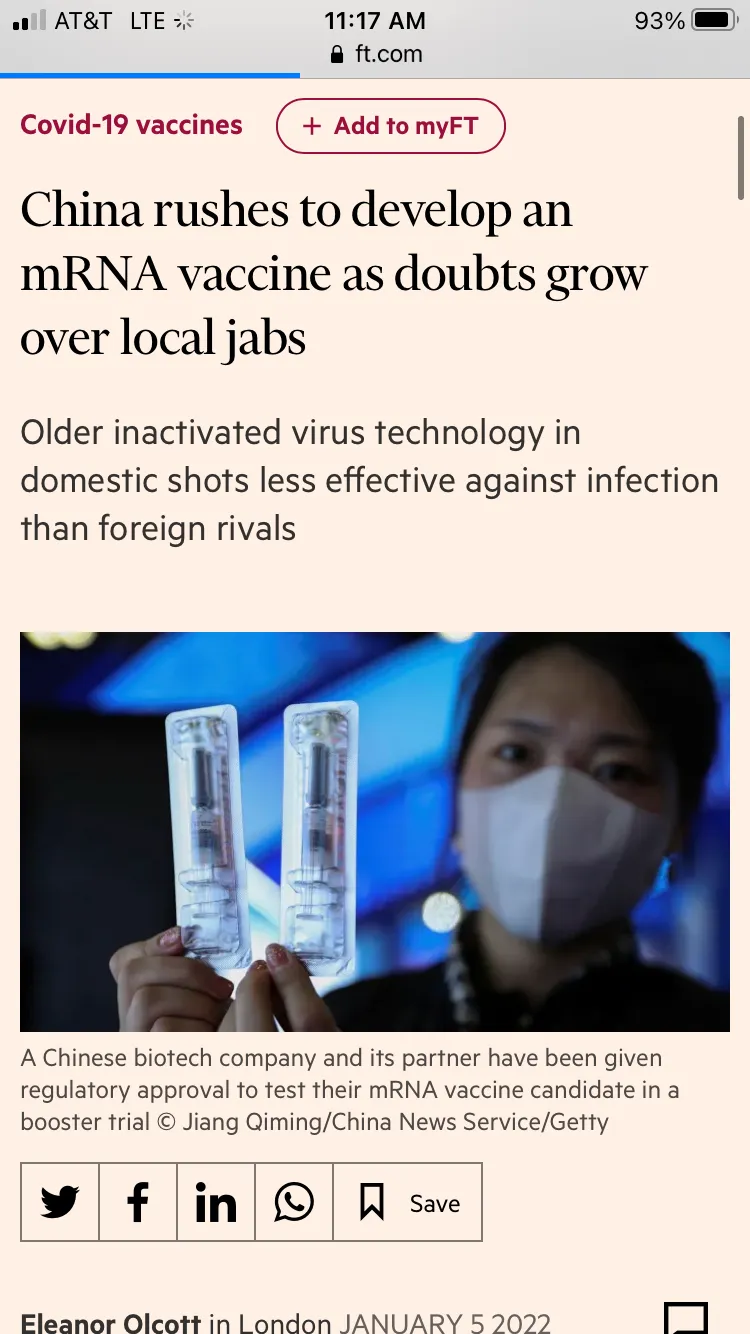
So the Financial Times had another elite media howler last week: the Chinese are desperate (desperate I say!) to get themselves an mRNA vaccine.

Posted onJanuary 17, 2023CategoriesEconomyPoliticsSocial IssuesTags

Guest Post by Alex Berenson


Yep, the Chinese just can’t WAIT to give an mRNA vaccine to their people. They’re rushing ahead.

Sure.

That’s why they HAVE SAT ON THE PFIZER/BIONTECH VACCINE FOR MORE THAN A YEAR.

In March 2020, BioNTech and a Chinese drug company called Shanghai Fosun Pharmaceutical announced a deal for Fosun to sell BioNTech’s Covid vaccines in China: “The two companies will work jointly on the development of BNT162 in China.” Fosun even said it would invest $50 million in BioNTech stock.

Again – this was March 2020, not 2021, roughly the same time BioNTech made a similar deal with Pfizer.

The two companies moved forward quickly.

In November 2020, just after Pfizer and BioNTech announced the topline results from their worldwide pivotal clinical trial (95% percent protection against infection! Covid is DONE, y’all!) they said they had moved the BioNTech vaccine into Phase 2 trials in China.

A month later, even as that trial was still scaling up, they had the biggest news yet.

Fosun would buy 100 million doses of the BioNTech vaccine for Chinese use, with delivery expected in 2021.

In late April 2021, BioNTech’s chief executive predicted that the vaccine would win approval and be available in China by July “at the latest.”

Barely two weeks later, in May 2021, Fosun and BioNTech had decided 100 million doses was not enough. They announced a deal to build a Chinese plant with the capacity to make 1 billion vaccine doses annually.

By mid-July, Chinese media outlets were reporting that the Chinese government was reviewing the BioNTech vaccine, with trial production expected to begin in August.


Since then, crickets.

More than a year after Fosun said it would import mRNA vaccines to China, and six months after Chinese regulators supposedly reviewed the clinical trial results, the vaccine remains unavailable.

Instead, in November, the Chinese announced that they had supposedly begun trials on their own mRNA vaccine. No one seems to have any idea when those trials will be finished, but they have the effect of resetting the clock and giving the bluecheck geniuses at places like the FT a way to pretend that the Chinese are moving aggressively ahead with mRNA.

Of course, given that Covid has essentially been nonexistent in China since February 2020, maybe the scientists in the People’s Republic know something the rest of us don’t.

Nah! That’s impossible. They’d definitely tell us, right?

-----------------------------------------------------
It is my sincere desire to provide readers of this site with the best unbiased information available, and a forum where it can be discussed openly, as our Founders intended. But it is not easy nor inexpensive to do so, especially when those who wish to prevent us from making the truth known, attack us without mercy on all fronts on a daily basis. So each time you visit the site, I would ask that you consider the value that you receive and have received from The Burning Platform and the community of which you are a vital part. I can't do it all alone, and I need your help and support to keep it alive. Please consider contributing an amount commensurate to the value that you receive from this site and community, or even by becoming a sustaining supporter through periodic contributions. [Burning Platform LLC - PO Box 1520 Kulpsville, PA 19443] or Paypal
 

-----------------------------------------------------
To donate via Stripe, click here.
-----------------------------------------------------https://www.theburningplatform.com/2023/01/17/funny-story-the-chinese-want-nothing-to-do-with-mrna-covid-vaccines-xi-i-wonder-why/


Monday, 12 December 2022

China finally approves an mRNA COVID vaccine—but only for some foreigners

 Two years after the first countries approved the Pfizer/BioNTech COVID vaccine for domestic use, China will finally allow the mRNA vaccine to be used domestically—but there's a catch.

On Friday, China confirmed in a press briefing that it would let German nationals receive the BioNTech COVID vaccine, which uses mRNA technology, in exchange for German health authorities on Wednesday approving China's Sinovac jab for Chinese nationals living in Germany.

The statement from China’s foreign ministry clarifies an earlier announcement by German Chancellor Olaf Scholz during his trip to Beijing that BioNTech would be made available to foreign nationals in China.

But Beijing's decision to approve the Pfizer/BioNTech jab for a sliver of China's population highlights the country’s uneasy relationship with mRNA vaccines and shots developed overseas as Beijing embarks on an exit from its tough COVID-zero policy, which will likely cause a massive outbreak.

Has China approved mRNA vaccines?

BioNTech is the first mRNA vaccine—and the first developed overseas—approved for use in mainland China, even if it's just available to German nationals living there.

Several Chinese companies are developing mRNA vaccines, but none have made it to final approval. In September, Indonesia—not China—became the first country to approve a Chinese-developed mRNA vaccine, from pharmaceutical company Walvax.

Fosun Pharmaceuticals, BioNTech's distribution partner for greater China, secured 100 million doses for the Chinese market in December 2020. Yet Fosun's applications to use its doses in mainland China are still pending, with no indication of when the mRNA vaccine will be approved for widespread use. (The semiautonomous Chinese city of Hong Kong approved BioNTech for use in its vaccination campaigns.)

China has largely relied on two vaccines, from Sinovac and Sinopharm, in its vaccination campaign. The two vaccines use an inactivated virus to confer immunity. Studies show that the two vaccines are less effective at preventing infection, severe disease, and death than the BioNTech and Moderna shots, which use mRNA technology.

Sinovac and Sinopharm are both developing boosters that specifically target the Omicron variant.

Public health officials have blamed China’s less-effective vaccines for hindering its ability to smoothly change its COVID policy. “The efficacy of the China‑made vaccines are not at the level of the vaccines that have been used in the United States,” Anthony Fauci, the outgoing White House medical adviser, told the Washington Post on Dec. 2.

How many Chinese have been vaccinated?

The more pressing problem, in Beijing's view, is not the effectiveness of its vaccines, but that not enough people are vaccinated. Official data released in early December shows that only 40% of China’s over-80 population has received a booster. Health officials at the time pledged to launch new campaigns to vaccinate China's elderly, but now the task is especially urgent.

Beijing announced sweeping changes to its COVID rules last Wednesday, including letting mild and asymptomatic cases recover at home and limiting lockdowns to individual floors and buildings, rather than whole neighborhoods. A pivot is likely good news for China’s economy, dragged down in November by a record COVID outbreak and widespread lockdowns. Chinese consumer sentiment last month fell to levels not seen since early 2020, the start of the pandemic, according to a survey released Sunday by Morning Consult.

But relaxed measures could lead to a surge in cases across China. One of the country’s top medical advisers predicted last week that as much as 60% of the country could catch COVID in an initial exit wave.

Chinese officials are now reassuring people that an increase in cases is not a cause for concern. State media quoted Zhong Nanshan, the country’s top medical expert, on Friday as saying that Omicron’s death rate is comparable to that of influenza.

This story was originally featured on Fortune.com

https://finance.yahoo.com/news/china-finally-approves-mrna-covid-065627541.html

Sunday, 2 October 2022

Moderna refused China request to reveal vaccine technology

 Moderna has refused to hand over to China the core intellectual property behind the development of its breakthrough Covid-19 vaccine, leading to a collapse in negotiations on its sale there, according to multiple people familiar with the matter. 


Sun Yu in New York, Eleanor Olcott in Hong Kong and Donato Paolo Mancini in London OCTOBER 2 2022 

Montage of a syringe being inserted into a Moderna Covid-19 vial, China’s flag and DNA strands

The mRNA vaccine technology used by Moderna provides longer-lasting and higher levels of protection than tech used by Chinese providers © FT montage: AFP/Getty Images

 Moderna has refused to hand over to China the core intellectual property behind the development of its breakthrough Covid-19 vaccine, leading to a collapse in negotiations on its sale there, according to multiple people familiar with the matter. 

 The Massachusetts-based pharmaceutical company turned down Beijing’s request to hand over the recipe for its messenger RNA vaccine because of commercial and safety concerns, said two people involved in negotiations that took place between 2020 and 2021. 

The vaccine maker says it is still “eager” to sell the product to China. The mRNA vaccine technology used by Moderna and BioNTech/Pfizer provides longer-lasting and higher levels of protection than the inactivated vaccine technology used by Chinese makers. 

Several Chinese pharma companies are racing to develop a homemade mRNA alternative but have struggled with the emergence of more infectious variants. 

 One individual close to the Moderna team in Greater China said the company had “given up” on its previous efforts to access the Chinese market, because of Beijing’s demand that it hand over the technology as a prerequisite for selling into the country. 

 To date, Beijing has offered two routes for foreign Covid-19 vaccine makers to distribute in China, dependent on regulatory approval: carrying out a full technology transfer to a domestic drugmaker or establishing a manufacturing facility in China with a local partner, while keeping control of the underlying technology. 

Moderna was pressed to take the former option. 

 The German group BioNTech has struck a deal with Shanghai Fosun Pharmaceutical to conduct clinical trials and commercialise its vaccine in 2020, which meant it retained control of the intellectual property. 

Under the partnership, Fosun agreed to provide a factory that would make up to 1bn doses a year. 

 By contrast, the Shanghai-based Everest Medicines group made a deal to access the Canadian biotech company Providence Therapeutics’s mRNA vaccine candidate that involved a full tech transfer. 

 Beijing has not granted either vaccine regulatory approval. 

 The Moderna leadership did not want to hand over the vaccine recipe to a Chinese partner because of the reputational damage if the local partner botched the manufacturing, said two people with knowledge of the matter. 

 Recommended

The Big Read Will ‘open-source’ vaccines narrow the inequality gap exposed by Covid? 

 Moderna has been fiercely protective of its intellectual property around the world, saying handing over patents would do little to address supply constraints. Talks in Italy for a tech transfer to local manufacturing sites have also failed, but Moderna gave the reason that it lacked the capacity to oversee it. 

 China has not approved any mRNA products for therapeutic purposes, and the mass production of this kind of vaccine is more complex than China’s existing inactivated vaccines made by Sinopharm and Sinovac. 

 In recent weeks, Moderna has signalled a willingness to restart talks with China. Its chief medical officer Paul Burton said this month: “We would certainly be very eager to collaborate with China if they felt that there was a need for a vaccine there.” 

 Burton’s comments came days after US president Joe Biden proclaimed the “pandemic is over”, wiping more than $10bn off the market value of the main makers of vaccines, including Moderna. 

 Moderna told the Financial Times: “We are not currently engaged in supply talks with China. We are open to speaking with countries on their supply needs for Covid-19 vaccines.” 

 Industry insiders observed that the company’s willingness to reopen talks with China, the last remaining major economy without an mRNA jab, has been driven by sluggish demand for vaccines in the wealthier countries where it first targeted sales. 

 According to Airfinity, a data firm that monitors vaccine shipments, Moderna has shipped a greater share of its vaccines to high-income countries than the other three major vaccine makers, a strategy that earned it billions of dollars in profit. 

More than 86 per cent of Moderna’s jabs have been delivered to high-income countries, compared with 74 per cent for BioNTech/Pfizer, 63 per cent for Johnson & Johnson and 19 per cent for AstraZeneca. 

 Slowing demand has afflicted all the major coronavirus vaccine makers, but with the Covid-19 jab its only approved product, the pressure on Moderna’s management is particularly acute, according to people familiar with the matter. 

 Additional reporting by Jamie Smyth in New York

https://www.ft.com/content/a481c129-c5aa-4972-84a8-3a45bb000098

Thursday, 8 September 2022

These Vaccines Have Been Embraced by the World. Why Not in China?

 Beijing once said it had two mRNA shots within reach and ready for approval — one homemade and one produced by a foreign company. Today, neither is available.

Why China Doesn’t Have an mRNA Vaccine for Covid - The New York Times (nytimes.com)

Credit...Kevin Frayer/Getty Images

China has done everything in its power to keep the virus outside its borders and protect its people — almost.

It has kept cases and deaths remarkably low through a “zero-Covid” strategy that has involved tracking and tracing every case, closed its borders and locked down cities of millions of people. It fostered domestic vaccines that allowed the country to carry out a massive inoculation effort.

But two years into the pandemic, China’s 1.4 billion people still don’t have access to one of the most effective coronavirus vaccines the world has to offer. Those vaccines use the breakthrough mRNA technology that was developed and approved in the West, and they have been embraced by dozens of countries.

The effectiveness of Chinese vaccines has been in doubt — partly because they use a century-old method for inoculation. Last spring, the country said it would approve BioNTech, the German mRNA shot made in partnership with Pfizer. Months later, China said that it was also close to producing its own mRNA vaccine. Neither are available today. 

China’s lack of an mRNA shot — and its delay in approving a viable foreign option — has poked holes in Beijing’s victorious pandemic narrative and prompted experts to question whether the country’s go-it-alone approach is less triumphant than officials would have the world believe.

Under Xi Jinping, China’s top leader, the country has turned more inward, promoting self-reliance and championing development in areas like semiconductors and other technology. The delay in recognizing a foreign mRNA vaccine now appears to be a part of that deeply political exercise.

Image
Sinopharm and Sinovac, which manufacture the two vaccines available in China, do not use mRNA technology. The country’s resistance to approving a foreign mRNA vaccine appears to be part of its inward turn.
Credit...Ng Han Guan/Associated Press

China is so committed to competing with the United States and the West on science and technology that some in the scientific community say it is hard to imagine that the state hasn’t pulled out all the stops to develop a homegrown mRNA vaccine. That China has fallen behind on that front, and failed to approve a readily available foreign option, has left many experts baffled.
“We don’t know how decisions are made nowadays in China, but a better vaccine would definitely help in maintaining a zero-Covid policy,” said Jin Dongyan, a virologist at the University of Hong Kong who has urged his peers in mainland China to approve the BioNTech vaccine. 
“They are presenting to the world that they are doing well in vaccine development,” he said of officials in Beijing. “And it would be embarrassing for them to show the opposite to the Chinese people.”

More on China
A ‘Zero Covid’ Bind: Political considerations have driven China’s uncompromising approach to lockdowns, quarantines and mass testing. That has left officials little room to change course.
Communist Cadre Look: Why are some Chinese youth dressing like middle-aged civil servants? It might be ironic, or the expression of a longing for stability in uncertain times.
Controlling the Narrative: As cases of abuse against women trigger outrage across China, Chinese officials are trying to censor the online conversation, wary of any dissent they cannot control.
A Long-Awaited Report: The United Nations released its much-delayed assessment of the mass detention of Uyghurs and other Muslim groups in China, accusing the country’s leadership of human rights violations.

China says its virus policies, which include strict lockdowns, have prevented millions of people from getting sick. But as a consequence, scientists say, the population has not built up enough natural immunity to help fight severe infection, making reliable vaccines even more crucial. And there is slowly mounting pressure on the country to pursue a new approach.
In recent months, officials have begun openly discussing the need to introduce better vaccine technology. “We should learn about the good things in other countries, such as mRNA vaccines,” Zhong Nanshan, China’s top respiratory scientist, said at a conference in December. “They have spent years on the research and managed to develop mRNA vaccines in just a few months."
China last week approved for emergency use a Covid-19 pill made by Pfizer called Paxlovid, a move that some experts said could help change Beijing’s pandemic strategy.
Image
The National Vaccine and Serum Institute in Beijing. The winds in China may be shifting as some officials begin to openly discuss the need to embrace better vaccine technology in the pandemic.
Credit...Roman Pilipey/EPA, via Shutterstock

It wasn’t that long ago that China appeared ready to introduce an mRNA vaccine for Covid-19. Shanghai Fosun Pharmaceutical, BioNTech’s Chinese partner, told investors last year that regulators would approve its mRNA vaccine for use in China by July 2021. The company, which had conducted clinical trials in late 2020, said that it could make as many as a billion doses a year.
That optimism has since faded. Chinese authorities now say they are still reviewing documents in order to “make a final decision on the approval of our vaccine,” a spokeswoman for BioNTech said.
Fosun did not respond to a request for comment.
The approval process for Sinopharm and Sinovac — which manufacture the vaccines that are available in China — looked much different. Chinese regulators changed the rules to allow both Chinese drugmakers to submit their trial data behind schedule. Sinopharm’s vaccine was approved a week after the company filed its application, in December 2020.
Vaccines from Sinovac and Sinopharm help prevent hospitalization and death, but their ability to reduce transmission with variants such as Omicron is still in question. Sinovac has shown to be only 51 percent effective against preventing symptomatic disease, according to scientists in Brazil. The World Health Organization said Sinopharm has an efficacy of 78 percent.
Though the W.H.O. has signed off on both Chinese vaccines for emergency use, most Western governments favor mRNA technology.
Image
The production of the Sinopharm vaccine. Two private drugmakers in China are working on an mRNA vaccine, but have fallen behind on their promises to deliver.
Credit...Kevin Frayer/Getty Images

As approval for BioNTech languished, China said that it was close to producing a homegrown mRNA shot called ARCoVax. Two private drugmakers and China’s Academy of Military Medical Sciences said they were preparing to make 200 million doses by October, a Communist Party newspaper reported in September.
Had that happened, it would have been a remarkable achievement for China.
Unlike traditional vaccines that use an inactivated virus to trigger a response by the immune system, mRNA vaccines use a genetic molecule that assists cells to make proteins that can set off an immune response in the body. This response creates antibodies that are then used to fight the virus.
The first mRNA vaccines for the coronavirus were based on research conducted over decades by scientists in different parts of the world. It took the Western pharmaceutical companies Pfizer, BioNTech and Moderna just over a year to take those advances and apply them to a new kind of vaccine able to prevent serious illness and death from Covid-19.
The final version of the mRNA vaccines produced by Pfizer and Moderna came together with the help of a multibillion dollar program under the Trump administration called Operation Warp Speed. The Food and Drug Administration determined in 2020 that the BioNTech vaccine has an efficacy rate of 95 percent.
“This is not trivial technology,” said John P. Moore, a virologist at Weill Cornell Medicine. “So trying to reverse engineer it from scratch is one of those things where you ask, ‘What could possibly go wrong?’”
If China is pursing a program similar to Operation Warp Speed, it has not said anything about it publicly. One of the private companies helping to develop ARCoVax is Suzhou Abogen, a start-up founded in 2019 by a scientist who used to work at Moderna. Before the pandemic, Abogen was developing mRNA drugs for cancer, one of China’s biggest epidemics.
Image
Students received the Sinopharm vaccine at a high school in Shenyang, China, earlier this year.
Credit...Agence France-Presse — Getty Images

The other drugmaker, Walvax, is a publicly listed pharmaceutical group. The two companies’ partnership with the Chinese Academy of Military Medical Sciences suggests strong government backing, though Beijing has not mentioned an official collaboration.
Last year, the United States added the Chinese Academy of Military Medical Sciences to an entity list, a federal trade restriction list, accusing it of using biotechnology to support activities like “brain control weaponry.” The designation would make it difficult to export any final vaccine product it develops.
Researchers recently published the details of an initial trial of the ARCoVax vaccine involving 120 volunteers. They found it to be safe, and said it produced a moderate level of antibodies but caused more side effects, like fever, than the BioNTech shot. 
Abogen and Walvax did not respond to requests for comment. A senior executive at Walvax told Reuters last month that it had recruited 28,000 people for a large, Phase 3 clinical trial. ARCoVax is also being tested as a booster.
One recent study showed that two doses of Sinovac boosted with an mRNA shot offered strong antibody protection against both the Delta and Omicron variants. But it is still unclear when the ARCoVax vaccine will be available in China.
And as the weeks go by, approval for BioNTech seems to grow more elusive.
“It’s very difficult to predict actually when we will get approval,” said Sean Marett, chief business and commercial officer of BioNTech, speaking at a health care conference last month. “But China remains for us an extremely important market,” he added. “We’re very, very committed to it.”
Image
The Shanghai Fosun Pharmaceutical building in Shanghai. Fosun, BioNTech’s Chinese partner, told investors last year that regulators would approve its mRNA vaccine for use in China by July 2021.
Credit...Alex Plavevski/EPA, via Shutterstock

Cao Li contributed research.

Alexandra Stevenson is a business correspondent based in Hong Kong, covering Chinese corporate giants, the changing landscape for multinational companies and China’s growing economic and financial influence in Asia. @jotted  Facebook

A version of this article appears in print on Feb. 21, 2022, Section B, Page 1 of the New York edition with the headline: China Lacks Effective Shot, But Rejects Foreign OptionsOrder Reprints | Today’s Paper | Subscribe

Why China Doesn’t Have an mRNA Vaccine for Covid - The New York Times (nytimes.com)

Most Recent Post

Man charged for borrowing rare Chinese manuscripts from UCLA library, returning fakes

  Suspect Jeffrey Ying allegedly travelled to China after checking works out using several aliases Agence France-Presse Published: 12:11pm, ...

Popular Posts - Last 30 days