Showing posts with label timeline. Show all posts

Monday, 15 May 2023

China’s ‘unprecedented’ crackdown stunned private enterprise MUST READ

 One year on, it may have to cut business some slack

Updated 3:02 AM EDT, Wed November 3, 2021


On November 2, 2020, Jack Ma’s Ant Group was gearing up for the biggest initial public offering in history.

One day later, it all fell apart.

Beijing’s decision to yank the $37 billion IPO was just the start of a sweeping crackdown that has become one of the most consequential realignments of private enterprise in China’s history.
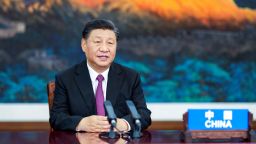


President Xi Jinping turns his fire on China's rich in push to redistribute wealth


In the year that followed, the Chinese government’s regulatory might has changed industries ranging from tech and finance to gaming, entertainment and private education.

China’s regulators aren’t alone in moving to restrict what they see as overly powerful companies, especially in Big Tech. Authorities in the United States and Europe have also moved over the last year to rein in unruly players by proposing new antitrust laws or trying to regulate data and online content.

But the speed and ferocity with which Chinese authorities have acted against the country’s corporate titans have startled even the closest China watchers.

“The latest regulatory tightening cycle is unprecedented in terms of duration, intensity, scope, and velocity,” analysts from Goldman Sachs wrote in a recent research report.

The campaign has wiped out more than $1 trillion worldwide from the market value of Chinese companies. It has sent chills through the wider economy and stoked fears about the prospects of future innovation and growth in China.

Some of China’s most successful entrepreneurs have quit high profile jobs in the past several months — decisions they’ve claimed are unrelated to the turmoil, but which analysts find hard to separate completely. Several tech firms have pledged to hand billions of dollars worth of their own profits to government-backed social causes. And some big proponents of Chinese investment have reconsidered plans to pour more money into the market until the outcome of the political interference is clear.

While China’s decisions have rocked the corporate world and rattled foreign investors, Xi appears undeterred. To him, reining in private enterprise is the solution to fixing longstanding concerns about consumer rights, data privacy, excess debt and economic inequality.

In other words, for the Chinese Communist Party it’s not about killing the private sector: It’s about taming the excesses of capitalism and embracing the country’s history of socialism.

“Common prosperity is the prosperity of all the people, the material and spiritual life of the people being rich,” Xi wrote in an article published last month by a Communist Party journal, invoking a historically significant phrase that dates back to the time of Chairman Mao Zedong. “It is not the prosperity of a few people.”


Ant Group's highly anticipated IPO was suspended just over a week after founder Jack Ma accused China's conventional, state-controlled banks of having a "pawn shop" mentality.

Dividing the ‘cake’

China is one of the world’s most unequal major economies, according to the World Bank. Its Gini coefficient — a popular measure of inequality — has increased significantly over the past four decades, coinciding with the country’s staggering rate of economic growth.

That meteoric rise accelerated under the leadership of Deng Xiaoping, who took power in the late 1970s after the death of Mao.Under Deng, the country embraced the free market and opened up to global trade. He famously said in 1985 that “some people can get rich first” to help poorer people in the long run, so that the society can gradually achieve “common prosperity” — a use of the phrase that differed significantly from its invocation by Mao, who advocated for wealth redistribution nearly 70 years ago as he worked to cement the party’s control.
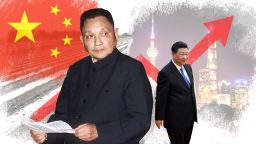


Worsening inequality now appears to be vexing Xi, the country’s most powerful leader in decades. Just last year, his government concluded a five-year long fight against absolute poverty. Now he’s widely expected to seek a third presidential term next year, and has focused his time on reducing the wealth gap.

“We must divide the cake well,” Xi wrote in last month’s article, adding that his goal is to “achieve common prosperity of all people by the middle of this century.”

Xi Jinping delivers a speech at a ceremony marking the 100th anniversary of the founding of the Chinese Communist Party. Worsening inequality now appears to be vexing the country's most powerful leader in decades.


A desire for control

Analysts widely believe that Xi’s concerns about inequality are real, but that the unfolding crackdown also signals the ruling Chinese Communist Party’s desire for control.

Xi is “aware that a Communist Party regime only enjoys legitimacy as long as common people feel represented,” said Sonja Opper, a professor at Bocconi University in Italy who studies China’s economy and the private sector. “The ultimate motivation is more likely to gain control over powerful parts of the economy.”

The business crackdown that dominated much of this year is believed to have started after Ma — easily the most recognizable of China’s business elite — blasted China’s financial system during a controversial speech in October 2020.

Founder of Alibaba Group Jack Ma has all but disappeared from public life as the tech crackdown has taken shape over the last year.

Ma criticized China’s regulatory system at the time as being outdated and risk averse, an obstacle to the high flying, innovative tech firms that he said could bring banking to poor populations and smaller businesses that are otherwise locked out of traditional finance.

The tech entrepreneur also accused China’s conventional, state-controlled banks of having a “pawn shop” mentality by lending only to borrowers who could provide collateral. He touted more innovative, data-heavy approaches as capable of bringing banking to marginalized groups.

Those words likely spurred Beijing to retaliate swiftly. The Ant Group IPO was suspended just over a week later.

Since then, life has only gotten more difficult for Ma, Ant Group and China’s other corporate giants. The usually flamboyant Ma has all but disappeared from public life, and has even reportedly left the helm of an elite business school he founded.
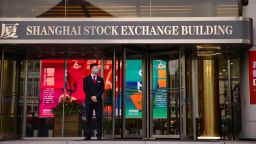


Ant Group was forced to overhaul its business and become a financial holding company, meaning it is much more heavily regulated than it ever was before. Ma’s Alibaba (BABA), meanwhile, was hit earlier this year with a record $2.8 billion fine for behaving like a monopoly, and the company has lost roughly $400 billion in market value in the last year as it navigates a slew of new regulations from Beijing.


More than Jack Ma

Ma’s business empire isn’t the only one affected. Meituan, Tencent (TCEHY), Pinduoduo (PDD) and other tech firms have also been investigated or fined over alleged anti-competitive behavior. And the ride-hailing app Didi — which went public in the United States despite reported concerns from Chinese regulators — was banned from app stores and probed over questions about data security.

The Communist Party “seems increasingly concerned that China’s tech sector has become so globally prominent that it runs the danger of outrunning the Party itself,” said Rana Mitter, a professor who specializes in the history and politics of modern China at the University of Oxford. “The crackdown helps to bring it down to size.”
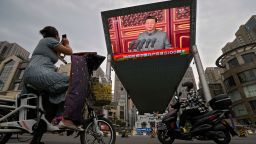


The clampdown has extended well beyond tech. Rules published in July upended China’s $120 billion for-profit tutoring sector. Additional guidelines released that month tightened oversight of the country’s massive food delivery industry.

The real estate market, which was already being roiled by government efforts to curb excessive borrowing by developers, has also been under intense scrutiny this year. Authorities have announced more than 400 regulations on the sector this year as they try to cut down on property debt and bring home prices under control, according to statistics compiled by Centaline Property, a Hong Kong-based property agency.

The government has also turned its attention to cultural and societal issues that authorities have deemed “unhealthy” or “toxic,” including overwork, unruly celebrity behavior and excessive time spent with video games. Other areas of pop culture have been scrutinized as well.


Wary of private tech’s power

Experts point to the crackdown — and especially the measures directed at technology — as the start of a new era for regulation in China.

Companies like Ant Group and Didi have rapidly ascended in recent years to become powerhouses in their fields. Alipay, operated by Ant Group, dominates China’s mobile payment market with a 56% share. Didi has a near monopoly of the ride-hailing market, with about a 90% share.

Beijing encouraged their rise at first. Such firms have been huge job creators and have attracted vast amounts of foreign and domestic capital. China’s influence as a hub for technological innovation has also exploded in recent years because of these firms, which compete head to head with Western rivals.

But now the government is growing wary of their size and power.

Firms like Alibaba, Tencent and Didi “will no longer be able to stay under the protective umbrella of Internet or technology, outside of supervision from the Chinese government,” said Doug Guthrie, a professor and director of China Initiatives at Arizona State University’s Thunderbird School of Global Management.

Beijing is also clearly concerned about the collection of data by these private firms. The technology they have created is so prevalent in Chinese life that they have access to sensitive information about hundreds of millions of people, ranging from where and when they travel to specific details about how they spend their money.

“It cannot go unnoticed that the industries and sectors that came under fire are all part of the modern tech economy, controlling vast amounts of individual level data,” said Opper from Bocconi University. She added that data “is an invaluable resource for any government wishing to control all walks of life.”

Beijing’s interest in Big Data was apparent this summer, as the government’s probe of Didi and other Chinese companies that trade in the United States took shape. Authorities focused on allegations that those firms mishandled sensitive data about their users in China, posing risks to personal privacy and national cybersecurity.

Those regulations “may therefore simply reflect the desire to gain control over the type of data and technology that is currently controlled by China’s most innovative, private technology corporations,” Opper said.


Economic slump may bring change of pace

Beijing has signaled the crackdown may not be over yet.

In August, the party’s top leaders unveiled a major policy blueprint for the next five years, in which they pledged to strengthen regulations on tech, financial services, education, and tutoring firms — areas of what they called “vital interest.”

But other factors might force the government to slow the pace and scale at which it is trying to transform private enterprise.

The world’s second largest economy has encountered a slew of challenges that are weighing heavily on economic growth, including disruptions due to the global shipping crisis, a massive energy crunch and concerns about a debt crisis in real estate. Last quarter marked the slowest pace of GDP growth in a year.

The crackdown on tech and education firms hasn’t helped, with demands for rapid change resulting in job losses and a drag on retail sales.

“My prediction: The ‘crackdown’ is going to stop now,” Guthrie said.

“The Xi administration is very committed to economic growth,” he added. “They have made their point about the coordination between the government and the private sector. But they know they need an entrepreneurial private sector to continue to drive China’s growth.”
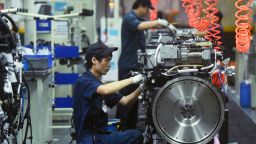


There has been some indication that the regulatory push is slowing down.

Guo Shuqing, chairman of the China Banking and Insurance Regulatory Commission, told state broadcaster CCTV last month that the new regulations for financial tech firms have “yielded initial results.” He said he expects to achieve “even more significant progress” before the end of the year.

Even Ma is reportedly turning up in public again. Reuters reported last month that the tech billionaire was spotted on a cruise in Spain, his first trip outside China since the crackdown began.

The government wants companies to understand that they need to be in “lock step” with authorities, said Guthrie, who added that “no one gets to think of themselves as bigger or more global than the Chinese government.”

But he acknowledged that Beijing knows it needs Chinese tech to flourish.

“My sense is that the support and coordination between the government and the private sector is coming back into alignment,” he added.

- - - - - - - - - - 


China’s yearlong crackdown on private business


NOVEMBER 3, 2020

Chinese regulators suspend Ant Group’s $37 billion IPO citing “major issues,” days before the company was scheduled to start trading. It was the largest IPO in history.

FEBRUARY 7, 2021

Chinese regulators revealed new anti-monopoly guidelines aimed at the country’s biggest tech companies, sending a chill through global markets. Chinese firms have lost more than $1 trillion in market value this year as the crackdown has intensified.

APRIL 10, 2021

After a months-long antitrust investigation, Chinese regulators slap Alibaba with a record $2.8 billion fine for behaving like a monopoly.

APRIL 12, 2021

Ant Group is ordered by regulators to restructure itself as a financial holding company supervised by China’s central bank — a major readjustment for the high flying tech company, which now has to follow rules similar to those required of traditional banks.

JULY 4, 2021

China bans ride-hailing giant Didi from app stores, days after the company went public in the United States. The move was widely seen as a punishment for Didi’s decision to list overseas.

JULY 10, 2021

A major Chinese regulator proposes strict listing rules for companies that keep data on more than one million users. Companies that meet that requirement must seek the agency’s approval before listing shares overseas, according to the proposal.

JULY 24, 2021

China unveils wide-ranging rules on education and private tutoring in the country, essentially upending a $120 billion industry. Chinese markets are roiled by the announcement, and billions of dollars in market value are wiped off the value of several major, publicly traded education firms.

AUGUST 2021

China cracks down on what authorities call “chaos” in celebrity fan culture, following a series of scandals involving top artists like Kris Wu, Zheng Shuang and Zhao Wei. Some celebrities were effectively erased from the Chinese internet entirely, while others were slapped with fines or arrested on criminal charges.

AUGUST 17, 2021

President Xi Jinping pushes for the redistribution of wealth in China as part of a call for “common prosperity,” a phrase steeped in historical significance.

AUGUST 26, 2021

China blasts an excessive work culture known as “996,” which is pervasive in the country’s tech industry. The condemnation from the country’s top court signaled an intensifying pressure for companies to curtail the practice.

AUGUST 30, 2021

China bans kids from playing online games for more than three hours a week in a significant escalation of restrictions on the country’s massive gaming industry.


Source: The Shanghai Stock Exchange, The State Administration for Market Regulation, The Central Commission for Discipline Inspection, The Supreme People’s Court, The Ministry of Human Resources and Social Security, The People’s Bank of China, The Cyberspace Administration of China, China’s Ministry of Education, Xinhua News Agency, Goldman Sachs and Eikon Refinitiv data


Some of China’s most successful entrepreneurs have quit high profile jobs in the past several months — decisions they’ve claimed are unrelated to the turmoil, but which analysts find hard to separate completely. Several tech firms have pledged to hand billions of dollars worth of their own profits to government-backed social causes. And some big proponents of Chinese investment have reconsidered plans to pour more money into the market until the outcome of the political interference is clear.

While China’s decisions have rocked the corporate world and rattled foreign investors, Xi appears undeterred. To him, reining in private enterprise is the solution to fixing longstanding concerns about consumer rights, data privacy, excess debt and economic inequality.

In other words, for the Chinese Communist Party it’s not about killing the private sector: It’s about taming the excesses of capitalism and embracing the country’s history of socialism.

Enter your email to subscribe to the CNN Business Newsletter.


https://edition.cnn.com/2021/11/02/tech/china-economy-crackdown-private-companies-intl-hnk/index.html

Tuesday, 17 January 2023

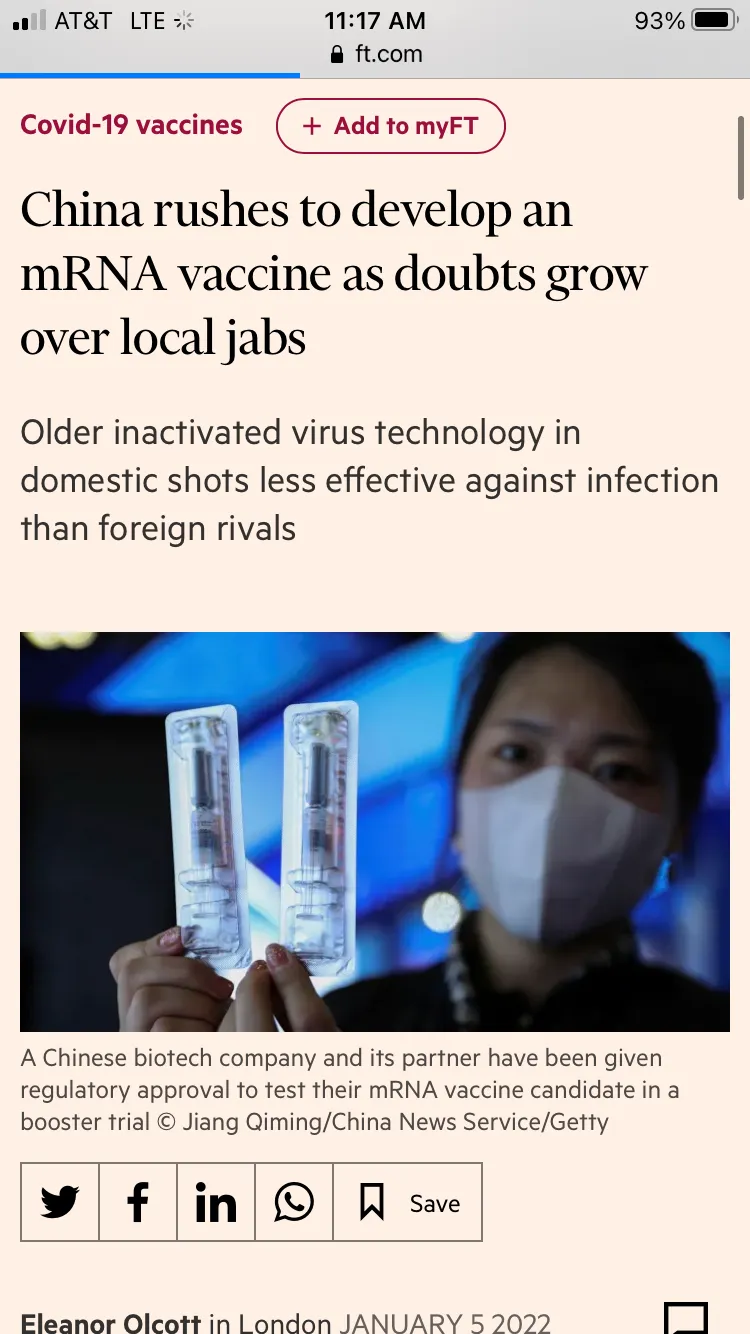
Funny story: the Chinese want NOTHING to do with mRNA Covid vaccines. (Xi, I wonder why.)


So the Financial Times had another elite media howler last week: the Chinese are desperate (desperate I say!) to get themselves an mRNA vaccine.

Posted onJanuary 17, 2023CategoriesEconomyPoliticsSocial IssuesTags

Guest Post by Alex Berenson


Yep, the Chinese just can’t WAIT to give an mRNA vaccine to their people. They’re rushing ahead.

Sure.

That’s why they HAVE SAT ON THE PFIZER/BIONTECH VACCINE FOR MORE THAN A YEAR.

In March 2020, BioNTech and a Chinese drug company called Shanghai Fosun Pharmaceutical announced a deal for Fosun to sell BioNTech’s Covid vaccines in China: “The two companies will work jointly on the development of BNT162 in China.” Fosun even said it would invest $50 million in BioNTech stock.

Again – this was March 2020, not 2021, roughly the same time BioNTech made a similar deal with Pfizer.

The two companies moved forward quickly.

In November 2020, just after Pfizer and BioNTech announced the topline results from their worldwide pivotal clinical trial (95% percent protection against infection! Covid is DONE, y’all!) they said they had moved the BioNTech vaccine into Phase 2 trials in China.

A month later, even as that trial was still scaling up, they had the biggest news yet.

Fosun would buy 100 million doses of the BioNTech vaccine for Chinese use, with delivery expected in 2021.

In late April 2021, BioNTech’s chief executive predicted that the vaccine would win approval and be available in China by July “at the latest.”

Barely two weeks later, in May 2021, Fosun and BioNTech had decided 100 million doses was not enough. They announced a deal to build a Chinese plant with the capacity to make 1 billion vaccine doses annually.

By mid-July, Chinese media outlets were reporting that the Chinese government was reviewing the BioNTech vaccine, with trial production expected to begin in August.


Since then, crickets.

More than a year after Fosun said it would import mRNA vaccines to China, and six months after Chinese regulators supposedly reviewed the clinical trial results, the vaccine remains unavailable.

Instead, in November, the Chinese announced that they had supposedly begun trials on their own mRNA vaccine. No one seems to have any idea when those trials will be finished, but they have the effect of resetting the clock and giving the bluecheck geniuses at places like the FT a way to pretend that the Chinese are moving aggressively ahead with mRNA.

Of course, given that Covid has essentially been nonexistent in China since February 2020, maybe the scientists in the People’s Republic know something the rest of us don’t.

Nah! That’s impossible. They’d definitely tell us, right?

-----------------------------------------------------
It is my sincere desire to provide readers of this site with the best unbiased information available, and a forum where it can be discussed openly, as our Founders intended. But it is not easy nor inexpensive to do so, especially when those who wish to prevent us from making the truth known, attack us without mercy on all fronts on a daily basis. So each time you visit the site, I would ask that you consider the value that you receive and have received from The Burning Platform and the community of which you are a vital part. I can't do it all alone, and I need your help and support to keep it alive. Please consider contributing an amount commensurate to the value that you receive from this site and community, or even by becoming a sustaining supporter through periodic contributions. [Burning Platform LLC - PO Box 1520 Kulpsville, PA 19443] or Paypal
 

-----------------------------------------------------
To donate via Stripe, click here.
-----------------------------------------------------https://www.theburningplatform.com/2023/01/17/funny-story-the-chinese-want-nothing-to-do-with-mrna-covid-vaccines-xi-i-wonder-why/


Tuesday, 30 August 2022

The Complex Nationalism of China’s Gen-Z

China’s youngest generation is often associated with hyper-nationalism. That oversimplifies their complex, individualized relationships with their country.


Students from Huaibei Normal University watch the live broadcast of Chinese President Xi Jinping delivering a report during the opening session for the 19th National Congress of the Communist Party of China in Huaibei city, Anhui province, October 18, 2017


China’s Gen-Z (defined loosely as individuals born after 1996) tends to be associated with images of ferocious, vocal, and unyieldingly nationalistic supporters of the country and regime.

In his incisive ethnography of China’s youth in the aftermath of the late 1980s era of brief political liberalization and contentious politics, Alec Ash remarks that “the newest Chinese youth, born in the 2000s, are also different, formed by a stronger and more nationalistic China” – though Ash caveats that “the diversity is still there.” Renowned IR expert and intellectual Yan Xuetong suggests that “post-millennial students usually have a strong sense of superiority and confidence, and they tend to look at other countries from a condescending perspective.”

In order to understand how Chinese Gen-Zs may think, however, it behooves us to put ourselves in their shoes. A Gen-Z individual born at the cusp of the new millennium would have been slightly over a year old when China joined the World Trade Organization. At age 3, they witnessed China’s first in-space astronaut, Yang Liwei, man the successful Shenzhou 5 voyage. At age 8, they would come to experience both the Sichuan Earthquake and Beijing Olympics – vicariously, perhaps, yet these events were still transformative in the invoking of a Chinese nation. By the time they are 10 years old, China’s GDP had quintupled since their birth – from $1.2 trillion in 2000 to over $6 trillion in 2010.   

Then, when they were 12, they would see a new political leadership, one that touted the “China Dream” and “national rejuvenation” – abstract slogans perhaps, yet also rhetorically emphatic propositions that remained plausible to a generation who had never seen China struggle. The anti-corruption purge would coalesce with their early adolescence years, paired with a shift toward high-tech-driven domestic growth and palpable improvements to living standards in most rural areas (and perhaps some cities, too). When they were 17, the first Belt and Road Summit Forum was held, heralding a new era to Chinese diplomacy. At age 19, those in the mainland would observe the events unfolding in Hong Kong – and be convinced by state and social media that the “struggle” against neo-colonialist forces inimical to Chinese interests remained ubiquitous. Their country’s handling of the first two years of the pandemic would come to reassure them of their government’s competence and relative desirability to the “Western model.”

With this particular trajectory of events and perceptions, it is only understandable, perhaps, that many Chinese youth feel a genuine sense of triumphalist, resolute pride in their country. Some of them may view the country’s rise as both empirically inevitable and normatively an imperative (as a means of thwarting the West-led global order); others may be less ideologically dogged, yet nevertheless perceive the material improvements in living standards as a sign that the country works, and works for them.

Enjoying this article? Click here to subscribe for full access. Just $5 a month.

Yet to equate the above story with the stories of all Chinese youth would be erroneous. Doing so neglects the many who are compelled into “involution” and self-defeating pursuits of wealth and stability amid a precipitously precarious economy, or whose self-identification and identities do not coalesce around “politically correct” lines (e.g. queer or politically liberal individuals), or, indeed, who have found themselves left behind by the ambitiously touted efforts of redistribution and empowerment of the grassroots.

In a recent article, writer Peter Hessler recalled a particular assignment he had set his students at Sichuan University, “asking freshmen to write about the public figure, living or dead, Chinese or foreign, whom they admired.” During his first stint teaching in China in the 1990s, Hessler had posed the same question. “In the old days, Mao had been the most popular choice, but my Sichuan University students were much more likely to write about scientists or entrepreneurs.” For many in China’s latest generation, the source of nationalistic pride is neither political nor state-oriented – it is instead the innovation and enduring tenacity of civil entrepreneurs and researchers who have come to transform China.

Chinese Nationalism as a Multi-faceted, Fragmented Discourse

When analyzing Chinese youth nationalism, there exist both similarities and differences between their nationalism and the nationalism that is more broadly seen across all generations. Chinese nationalism is a multi-faceted, fragmented, and politically contested discourse, whose level of heterogeneity varies in accordance with both top-down and bottom-up forces. The nation may be cursorily homogenous, but the nationalistic sentiments framed around it are most certainly not.

The bottom-up element in Chinese nationalisms – the plural here denotes the fragmentation at work – cannot be overstated. In a recent interview I conducted with historian Rana Mitter at Oxford, Mitter noted that “China is a plural noun” – a diverse spectrum of individuals comprise its civil society, administrative and bureaucratic apparatus, and there is vast space between families on one end and the national government on the other. Such heterogeneity manifests itself in the crafting and (re)imagining of the Chinese nation.

For some, the nation is a historical relic steeped in culturalist imaginaries and tropes that stretch throughout “millennia”; for others, the nation denotes an affluence- and stability-oriented collective, one that would ensure the flourishing and comfortable lives of denizens, and no more. Still, for many others, their engagement with the nation is constricted to the immediate surroundings that come to typify their fujin – their nearby spaces (see anthropologist Xiang Biao’s excellent work on spatial and urban politics).

Not only does the archetype of the Chinese nation vary from person to person, but their sentiments are also widely disparate: different communities draw upon their bases of identifications and cleavages in relation to oppositional communities, in creating bottom-up modifications to the anodyne default. As Cheng Li argues in “Middle Class Shanghai,” nationalism in the cosmopolitan mega-city tends to be more intertwined with internationalist orientations and the view that the Chinese nation-state is no different than, say, that of America or Britain, in its pursuit of performance legitimacy. On the other hand, rural areas and inland provinces’ conceptions of the nation are more likely to be grounded in thicker traditionalist and culturalist tropes, drawing parallels between the modern Chinese nation and ritualistic heritage inherited through generations of oral and textual transmission. Nascent technological advances and the rise of grassroots social media have come to consolidate what Peter Gries describes as the “popular nationalism” that undermines the ruling party’s monopoly on nationalistic discourse.

None of this is to say that Chinese nationalism is wholly organic. The party-state goes to painstaking lengths to lampoon rhetoric that it dismisses as unpatriotic – as a means both of signifying the ideological salience and weightiness of devotion to the country, but also of conveniently dismissing non-conformist discourses that it perceives to be antithetical toward the continued stability of the regime. State propaganda, state-sanctioned media outlets, and the provision of material benefits to “independent” actors – Gen-Z influencers, no less – for their patriotic speech-acts, also play a pivotal role in amplifying the nationalistic voices that best fit the state’s agenda. Finally, China’s nationally and thoroughly installed patriotic education enables the party to frame both the public understanding of where Chinese interests lie, as well as their affective self-identification when it comes to the substance and limits of Chinese nationhood.

While the late 1990s and early 2000s saw the top-down approach to nation-building lag behind the exponentially spiraling richness of grassroots narratives, the shift toward “networked authoritarianism” (see Rebecca MacKinnon) has enabled the ruling regime to co-opt moderate oppositional discourses and curate the online blogosphere. Meanwhile, the consolidation and streamlining of bureaucratic and national security apparatus offline has enabled the state to weave public sentiments into its latest offerings concerning the nation.

Complexity Within Youth Nationalism in China

Enjoying this article? Click here to subscribe for full access. Just $5 a month.

The above has laid the theoretical groundwork for us to make sense of youth nationalism in China today. These are indeed unprecedented times – the COVID-19-induced lockdowns have been vastly disruptive; living costs in cities are surging in ways that render childrearing prohibitively expensive, and there is a palpable sense of socioeconomic stagnation, with terms such as “lying flat” (tangping) and “letting-rot” (bailan) emerging in Chinese youth lexicon. There are three ways in which youth nationalisms (again, a plural) in China vary.

The first constitutes the extent to which the individual is capable of differentiating between the empirical and the aspirational. There certainly are voices that authentically vocalize the belief that China is currently great and destined for greatness – that its resounding successes in poverty alleviation and economic development have paved the way for the country’s “inevitable ascent.” Such voices are in turn selectively amplified by social and state media outlets as exemplars of ideal patriotism. For these individuals, the aspirational is the empirical.

Yet for others among the younger generation, who must grapple with the downsides of China’s rapid urbanization, vast rural-urban inequalities, the gender and ethnic divides within the country, they would harbor no illusions about the status quo. In face of such adversity, some turn to performative resilience, given the mechanisms above concerning dissemination and maintenance of nationalistic sentiments: that as members of the collective, they must come together to overcome these long-standing “obstacles.” In state discourse, the phrase “struggle” (douzheng) is oft-invoked to make the case for grinding away at predicaments – both internal and external – with defiance. A recent article by Zhang Jingyi makes the case that the “lying flat’ of Chinese youth is best interpreted not as a wholesale rebuking of the Chinese nation, but as a distinctive kind of cynicism in face of overwhelming obstacles to social progress and mobility.   

The second dimension concerns the level of individualization. The standard account of nationalist youths in China tends to pigeonhole them through derogatory labels such as “Little Pinks” or “Red Army.” Such characterizations are unfortunately – albeit unsurprisingly – increasingly popular in critical media discourses, which imbue their critiques of the Chinese state with thinly veiled essentialisms concerning the youth from the country.   

Yet such sweeping generalizations would do no justice to what Yan Yunxiang terms the “increasing individualization” of Chinese society. From the institutionalization of individual responsibilities through mechanisms ranging from the social credit and hukou systems at the top, to the rise of fandom-centric and LGBTQ+-centric sub-cultures among the youth from the bottom, it is clear that the Chinese civil society has – even despite the past decade of political centralization  – become progressively individualized.   

Such strands of individual identities and expressions in turn intersect with the nation in complex ways. On one hand, there exist virulently homophobic and transphobic Chinese nationalists who frame heterogeneity as the default sexual orientation of a “strong and enduring Chinese state.” On the other hand, many within queer spaces often operate under the auspices of members within said spaces with connections to the administrative and bureaucratic systems. Some may even be serving party cadres who nevertheless strain to square their identities with the cisheteronormativity that remains dominant in China today. It would thus be premature to conclude that all who are nationalists in China must thereby embrace exactly the same personal and political outlooks.   

A final question is this – how political, if at all, are the Chinese youth of today? One view is that in stark contrast to those who came of age in the 1980s, who bore witness to China’s brief flirtation with Western liberal democratization, the younger generations of today remain firmly wedded to a nation-state that fused authoritarian, technocratic, bureaucratic, and centralizing tendencies. The claim is that Chinese youth are apolitical; they have no choice but to be.

Yet this view ignores the vast terrain between total submission and systemic contentious politics, and this middle ground is traversed by many in China’s Gen-Z – ranging from social entrepreneurs, environmental activists, NGO founders, and executives, to journalists who seek to engage in critical enquiry within constricted boundaries. Indeed, many in turn couch their work and mission in the language of “the nation”: to them, the best means of serving China is to seek to change the country for the better, as opposed to bailan – letting it rot.

It would be foolish to conclude that all Chinese youth are alike.

AUTHORS
Brian Wong
GUEST AUTHOR

Brian Wong

Brian Wong is a Rhodes Scholar from Hong Kong (2020) and DPhil in Politics Candidate at Balliol College, Oxford.

VIEW PROFILE

https://thediplomat.com/2022/06/the-complex-nationalism-of-chinas-gen-z/


Most Recent Post

Man charged for borrowing rare Chinese manuscripts from UCLA library, returning fakes

  Suspect Jeffrey Ying allegedly travelled to China after checking works out using several aliases Agence France-Presse Published: 12:11pm, ...

Popular Posts - Last 30 days