Monday, 6 December 2021

China plotting to build warship base in Atlantic

 US intelligence believed China was intending to build a "permanent military presence" in the nation sandwiched between Cameroon and Gabon. Such a facility would be significant as it would give China its first base on the Atlantic Ocean. This would mean Chinese warships would be able to rearm and refit opposite the East Coast of the US, a threat that is setting off alarm bells at the White House and Pentagon.

James Lee   Daily Express   6 December 2021

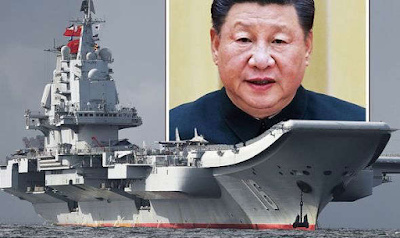
© Getty China Navy Carrier

US national security adviser Jon Finer visited Equatorial Guinea in October on a mission to persuade President Teodoro Obiang Nguema Mbasogo to reject China's overtures for such a project.

President Joe Biden's administration had conveyed to the Mbasogo government any Chinese activity would "raise national security concerns".

The report speculated China would consider building a military facility in the port city of Bata. Beijing had built a deep-water commercial port in Bata.

© Getty Xi in Africa

General Stephen Townsend, commander of the US Africa Command, had warned the Senate in April about the risk of China having a naval facility on the Atlantic coast.

He said: "This is something more than a place that they can make port calls and get gas and groceries. I'm talking about a port where they can rearm with munitions and repair naval vessels."

The latest Pentagon report on China's military modernisation had warned China was considering military facilities in Kenya, Tanzania and Angola.

In 2017, China formally opened its first overseas military base in Djibouti, on the Indian Ocean.

The facility has since seen the expansion of infrastructure to accommodate ships such as submarines and aircraft carriers.

© Getty Mbasogo

China's plans for a new facility on the Atlantic Ocean also shed light on the rapid expansion of its navy.

The Pentagon report had noted the People's Liberation Army Navy (PLAN) was now the world's largest navy, "with an overall battle force of approximately 355 ships and submarines, including approximately more than 145 major surface combatants."

Unlike nations such as Kenya, Tanzania and Angola, a facility on the Atlantic Ocean would have considerable practical and symbolic implications as it directly challenges US hegemony over the region.

In addition, a facility in Equatorial Guinea is expected to provide options to deploy forces to protect Chinese investments in the western part of Africa.

In 2009, China upgraded a commercial port in Equatorial Guinea, in the city of Bata - the largest city on the mainland.

The country's capital, Malabo, is on an island an hour's flight from the mainland.

Chinese state-owned companies have built 100 commercial ports around Africa in the past two decades, according to Chinese government data.

American diplomats in Mauritania, along Africa's northwest coast, have advised local authorities to turn down any effort by Beijing to use a Chinese-built port for military purposes, according to a U.S. official.

© Getty Equatorial Guinea

Much of China's expansion into African comes as part of the multi-trillion "One belt one road" initiative which has seen Beijing expand its economic and diplomatic presence across the globe.

Of the 54 African nations, China has invested in 52 of them.

The US and China are currently the world's largest economies, yet China is expected to surpass the US to the top spot by as early as 2024.

Academics and military specialists believe that China and the US are entering a new cold war.

Tension is high between Washington DC and Beijing over a host of issues including Taiwan, the South China Sea, the so-called AUKUS deal and dominance of the global economy.

Source

Japan to boost army and 'capability to strike enemy bases' amid growing tensions with China

Prime Minister Fumio Kishida said the security environment around the country was 'quickly becoming more severe'

Danielle Demetriou   The Telegraph   6 December 2021


© Eugene Hoshiko /AP
 Members of Japanese Ground-Self Defense Force (JGDDF) cheer their Type 90 tanks during the annual drill with live ammunitions exercise at Minami Eniwa Camp - Eugene Hoshiko /AP

Japan is looking to boost its military through measures such as acquiring the capability to strike “enemy bases" in a bold defense upgrade announced on Monday against a backdrop of an increasingly assertive China and tensions with North Korea.

The security environment around Japan was “quickly becoming more severe”, said new prime minister Fumio Kishida in a policy speech in Tokyo, as he vowed to consider “every option” to boost the country's defences. 

His speech - which also tackled the pandemic and economic stimulus packages - unfolded at the same time as the media were granted rare access to military drills on Japan’s northernmost island Hokkaido, just across the waters from Russia.

Dozens of tanks and hundreds of soldiers firing explosives and machine guns across the landscape were showcased in an unusual public display of military firepower, marking the start of nine days of war games involving around 1,300 Ground Self Defence Force troops.

Mr Kishida's proposal could be controversial. Japan officially has a pacifist constitution - a legacy of its defeat during the Second World War - and any military buildup is heavily scrutinised.

The country has so far focused on its defensive capabilities and carefully avoids using the word "military" for its significant troops. 

But that is changing amid an escalation in territorial tensions between Japan and an increasingly aggressive China - which is stepping up military cooperation with Russia - plus a spike in missile activity from North Korea. 


© Provided by The Telegraph
 Japanese Ground-Self Defense Force (JGDDF) Type 90 tank fires its gun at a target during the annual drill with live ammunitions exercise at Minami Eniwa Camp - Eugene Hoshiko /AP

“In order to safeguard the people's lives and livelihood, we'll examine all the options including capability to attack enemy bases ... and strengthen our defence posture fundamentally with a sense of speed,” said Mr Kishida. 

He added that three major defence documents – the national security strategy, the National Defence Program Guidelines and its medium-term defence programme – would be updated within around a year and also proposed cross-party discussions on possible constitutional revisions. 

Aware that there could be pushback, Mr Kishida also suggested that there should be greater outreach around the need for constitutional reform: “It is important to deepen the public’s understanding.” 

The push for citizens to put aside widespread unease over a more robust role for the military and support increased defense spending comes in the wake of growing military activity around Japan.


© Provided by The Telegraph
 Japanese Ground-Self Defense Force (JGDDF) Type 90 tanks take part in the annual drill with live ammunitions exercise at Minami Eniwa Camp - Eugene Hoshiko /AP

Last month, China and Russia flew warplanes together near its airspace, resulting in the scrambling of Japanese fighter jets, while a fleet of five warships from China and Russia circled Japan in Pacific waters in October.

In total, Japanese fighters reportedly scrambled more than 700 times between April 2020 and March this year, with two-thirds against Chinese warplanes and the rest mainly against Russians, according to Japan’s Defence Ministry.

Meanwhile, North Korea’s recent resumption of ballistic missile testing has sparked concern across the region, with South Korea and the US agreeing last week to update their wartime contingency plans.

“Japan faces different risks coming from multiple fronts,” said Heigo Santo, a defence expert and a professor at the Institute of World Studies at Takushoku University in Tokyo, told AP.

Japan is currently ranked fifth globally in terms of military power, after the US, Russia, China and India.

The previous prime minister Shinzo Abe also sought to bolster the nation’s military role and budget during his conservative eight-year rule, including watering down Article 9 in the constitution to enable Japan to come to the defence of allies such as the US.

Source

https://www.telegraph.co.uk/world-news/2021/12/06/japan-boost-army-including-capability-strike-enemy-bases-amid/

Saturday, 4 December 2021

Women’s tennis takes a stand against China

 Will any other sport dare follow?

ChinaDec 4th 2021 edition   The Economist

In the world of sport, it was a remarkable rebuke of China’s ruling Communist Party. On December 1st the Florida-based Women’s Tennis Association (wta) said it would stop holding tournaments in mainland China and Hong Kong in response to the silencing of Peng Shuai, a Chinese tennis star, after she had publicly accused a former senior Chinese leader of sexual assault. 

Steve Simon, the wta’s boss, used language typical of human-rights groups, not of firms with profits at stake. He accused China’s leadership of failing to handle the matter credibly: “I have serious doubts that she is free, safe and not subject to censorship, coercion and intimidation.”

For years most executives of global sporting leagues, as well as athletes with high profiles in China, have strained to avoid offending Chinese officials lest they lose access to a lucrative market. But as China’s human-rights abuses have become more egregious, the reputational risk of keeping quiet has grown. 

In November the International Olympic Committee held a video call with Ms Peng and gave a sunny assessment of her well-being. It was widely viewed as a craven effort to help China stifle controversy in the buildup to the Winter Olympics in Beijing in February. 

America’s National Basketball Association (nba) has tried to keep on China’s good side since a team executive’s tweet in 2019, expressing support for protests in Hong Kong, prompted a temporary ban in China on nba broadcasts. Adam Silver, the nba’s chief, said the episode cost the league hundreds of millions of dollars.

Source

China says it is more democratic than America

 Western dysfunction tempts the Communist Party to make risky boasts

ChinaDec 4th 2021 edition  The Economist


The leaders of China’s Communist Party have spent a long time waiting for liberal democracy to look as fragile as it does today. Now, filled with scorn for a dysfunctional West, they think that their moment has come. Angered, specifically, by President Joe Biden’s summoning of over 100 countries to a virtual Summit for Democracy on December 9th and 10th—including Taiwan, an island that China claims as its territory—China is responding with fighting talk. 

Officials are seizing every chance to explain why their always-controlling, sometimes-ruthless political system is not just a good fit for a large country trying to become prosperous and strong: the party’s defensive line for four decades. Increasingly, they are on the offensive. They insist that China’s political model is so effective, and so responsive to the people’s wishes, that it is more perfectly democratic than America’s.

In the words of a Chinese foreign ministry spokesman, American democracy is in a “disastrous state”, calling into doubt that country’s legitimacy as host of such a summit. In a video call, China’s foreign minister, Wang Yi, commiserated with his counterpart from Hungary, whose increasingly autocratic government is also not invited. Mr Wang condemned America for excluding some countries, adding that the yardstick of a democracy should be whether a government “meets the people’s needs, and gives them enough of a sense of participation, satisfaction and gain”.

Source

Wednesday, 1 December 2021

Debt-trapped: Sri Lanka, Laos, and now Uganda?

Southeast Asia should take note of the potential takeover of an airport by Chinese lenders, Zachary Abuza says.


Commentary by Zachary Abuza
2021.12.01


Debt-trapped: Sri Lanka, Laos, and now Uganda?Ugandan president Yoweri Museveni (in hat) and Wang Yang, China's third vice premier, inaugurate a Chinese-funded 51-km expressway linking Uganda's capital to the international airport at Entebbe, June 15, 2018.
AFP

In what is being described as another case of “debt trap” diplomacy, China’s Export-Import Bank appears poised to take over Uganda’s Entebbe Airport and other assets because the African nation is struggling to service a U.S. $207 million loan for local infrastructure projects.

China – which agreed to expand the airport in 2015 as part of its Belt and Road Initiative (BRI) global infrastructure-building program – has denied reports that it may grab control of Uganda’s international airport because of the country’s failure to pay off the debt.

The site gained infamy in 1976 as the location of the Israeli Defense Force’s daring hostage-rescue operation after Ugandan dictator Idi Amin allowed the Popular Front for the Liberation of Palestine to land a hijacked Air France jetliner there.

But it is Uganda’s only international airport, which raises questions about China’s domination of critical infrastructure – with very real implications for Southeast Asia.

If it takes place, the debt-for-equity swap in Uganda follows China’s 99-year takeover of Sri Lanka’s Hambantota port and a nearby airfield in 2018, and the 2020 takeover of much of the Lao power grid by a Chinese state-owned firm. 

According to a September 2021 report by the AidData project at the College of William and Mary in the United States, Uganda took on 144 Chinese-financed projects between 2000 and 2017, and its sovereign debt to China accounts for 8 percent of its gross domestic product.

But Uganda’s “hidden debt” to China accounted for zero percent of GDP. This is highly unusual.


‘Hidden debt’

Let me explain this in brief terms. 

Roughly 70 percent of China’s BRI funding comes in the form of loans, not grants.

Sovereign debt is money that a country’s government owes to foreign and domestic lenders. It is almost never collateralized. But commercial lending from the China Development Bank, the Export-Import Bank of China and other BRI lenders almost always is.

That collateral can take many forms: sometimes China forces the borrower to have a certain amount of assets in a Chinese bank that can be frozen; other times, the recipient country puts up assets as collateral, meaning that it will forfeit those assets if it fails to repay its debt.

Very little of China’s BRI lending is favorable to the borrower. The interest rates average around 4 percent, nearly four times more than World Bank, Asian Development Bank, Japanese, European or American lending.

In addition, in the Philippines, BRI projects have dispute resolution mechanisms that are skewed toward China. This is likely the case in other Southeast Asian BRI agreements.

Another kind of lending – called Other Official Flows, or OOF – involves state-owned companies, state-owned banks, joint ventures, and private sector institutions, rather than central banks. As such, it is not always publicly reported.

The AidData project’s 2021 report found that due to this “hidden debt,” the average government “is under-reporting its actual and potential repayment obligations to China by an amount that is equivalent to 5.8 percent of its GDP.”

Uganda was the 19th largest recipient of Chinese grants and carried very little in the way of OOF loans, and yet it still seems unable to service its debts.

Now of course, China could renegotiate the terms of lending, or write off the debt, as a grant. But Beijing has shown little interest in doing so. Indeed, in March 2021, the Ugandan government sent a delegation to Beijing to renegotiate the loan terms, but returned empty-handed.

Beijing is refusing to budge for two reasons. First, the Chinese are legitimately afraid of creating a precedent. If one country gets to renegotiate the terms, all the others will clamor for the same.

Second, BRI lending really slowed in 2018-2019, which suggests that many of the loans were non-performing. If people aren’t paying back the loans, there’s less for the banks to lend out, unless Beijing injects a lot of new capital. It may be doing that now, as lending seems to be picking up.


How this plays out in Southeast Asia

According to the report from the AidData project, China provided $10.7 billion in grants to four Southeast Asian states between 2000 and 2017, and $87.7 billion in OOF loans to six states in the region.

211201-abuza-chart.png

In all countries with the exception of Singapore, which doesn’t borrow from Beijing, sovereign debt loads to China, as a percentage of GDP, range from 1 percent in Cambodia to a whopping 29 percent in Laos. Myanmar is second (5 percent), followed by Vietnam (3 percent). Several states have none. Not including Laos, which is such an outlier, the region’s sovereign debt load to China is a modest 1.4 percent of GDP, on average.

The hidden debt loads tell a different story. The highest amount is Laos at 35 percent of GDP, followed by Brunei (14 percent), Myanmar (7 percent), Vietnam (3 percent), Indonesia (2 percent), and Cambodia (1 percent). Again, excluding the outlier Laos, the average hidden debt to China in the region is 3.4 percent, over twice the amount of sovereign debt.   

While 3.4 percent is not unusually high, remember that those loans are at commercial lending rates and are almost all collateralized. Brunei, Cambodia, Laos and Myanmar have public debt exposure to China over 10 percent of GDP. In July 2021, the World Bank estimated that Laos’ overall debt would increase to 68 percent of GDP, up from 59 percent in 2019.

It’s hard to imagine that Laos will be able to service its debt for a $6 billion railroad, especially because the Thai government has not completed a rail link that would connect the Chinese city of Kunming to Thai ports – the only economically viable reason for the Lao portion.

Laos has benefited from a recent Thai decision to buy more hydroelectricity, which should allow the Laotians to continue to service debts for their cascade of Chinese-funded dams. Vietnam had to begin servicing a $670 million debt for a Chinese-constructed rail line that still had not opened, after years of delays and a 57 percent cost overrun since the project began in 2011.

With economic slowdowns caused by the ongoing coronavirus pandemic, which is unlikely to end any time soon, the region’s hard-hit economies will see weaker recoveries than forecast. 

The Asian Development Bank recently downgraded its 2021 growth estimates for every country in the region except for Singapore and the Philippines, and estimated that regional growth would be 3.1 percent in 2021, not 4.4 percent. Revenue will be down for all states, while the continued public health and stimulus costs are rising.

All of this will impact the ability of regional states to service their debt. 

China may be willing to play harder ball with African countries than with neighboring Southeast Asia, where public perceptions about China are starting to sour.  But China keeps pushing its BRI projects on the region, with new projects announced in Malaysia, and a determination to see projects completed in Myanmar despite the civil unrest since the Feb. 1 coup d’etat and an 18 percent contraction of the Burmese GDP. 

The region’s high levels of public indebtedness – and fear of asset seizures by China – should raise a lot of concern, both among Southeast Asian governments and their citizens. And BRI’s heavy reliance on Chinese workers and managers who tend not to return home, shoddy construction, environmental degradation, and corruption should raise even more concern.

Zachary Abuza is a professor at the National War College in Washington and an adjunct at Georgetown University. The views expressed here are his own and do not reflect the position of the U.S. Department of Defense, the National War College, Georgetown University or BenarNews.


Source

A 'new colonial power' with Barbados power grab

China trying to become a 'new colonial power' with Barbados power grab


Tory MP Damian Green warned that China is on its way to becoming 'a new colonial power' by investing money into countries such as Barbados. The island, which is in the Lesser Antilles and former British colony which has been independent since 1966, officially became a republic after the removal of Queen Elizabeth as its head of state on Monday. Although Barbados remains a member of the Commonwealth, the decision to become a republic has been largely influenced by China, with the influential Eastern Asian country expected to have the most potent military in the world by 2050.

Tory MP told Iain Dale on LBC that China could use its financial influence to turn into a powerful, new colonial power.

He said: "There is a lot of affection, particularly for the Queen around the Commonwealth, not just in this country.

"And for all the royal turbulence, that we've seen over the past 18 months or so, I detect no surge of republican sentiment in this country.

"But I worry even more and I think you're right to bring up the Chinese money.

© LBC Damian Green

"Because there is in a sense a much more serious global play going on here which is the Chinese attempting, using money influence and pulling countries into debts to effectively become a new colonial power around the world.

"And I think if that's allowed to take hold, that will be a real threat to democracies of many of the Commonwealth countries."

But Barbados is not the sole member of the Commonwealth that China are looking to develop military and diplomatic links with.

Several Commonwealth countries receive regular Chinese military training. These include Guyana, Cameroon and Rwanda.

Mr Green spoke of the Commonwealth's importance: "You have to be a democracy to qualify for the Commonwealth and there are countries that go in and out of the Commonwealth on the basis of what kind of Government they have.

"It's good for the countries themselves to remain democracies. We should cling onto the Commonwealth and try and make it as useful as possible for as many Member States as possible.

"We often have an odd view of the Commonwealth in this country because it does get bound up. But actually, as a modern collection, a contemporary collection of democracy, that's a hugely important body to have in and around the globe."

Barbados' decision to become a republic has been met with criticism among some Barbadians themselves. They are concerned that the new independence from the Crown is a double-edged sword as China look to expand its influence in the Caribbean in future.

© EXPRESS China news

China has reportedly pumped more than £400million into the country's economy to gentrify the island.

New homes, hotels and infrastructures were all built.

Some of the most historic colonial empires include Portugal, Belgium, the Netherlands, Spain and France.

Source

Monday, 29 November 2021

China bans an independent think-tank critical of its policies

 Unirule had been an unusually vocal proponent of free-market economics

The Economist

ChinaAug 31st 2019 edition


For researchers devoted to the rule of law, the end was fitting. Drawing on patchwork regulations that appear to violate the Chinese constitution, local authorities in Beijing at last found a pretext to ban the Unirule Institute of Economics, that rarest of things in China, an independent think-tank known for criticising the government. For years Unirule had faced pressure, including evictions from multiple offices, to quiet down, and yet had managed to go on functioning. But it saw no way around the ban, issued last month, and so on August 26th announced that it would stop all activities.

Founded in 1993, Unirule always resided on the fringes of Chinese policy discussions, bringing together a collection of liberal economists who were strong believers in free markets. It published a series of books about institutional reform, including on how to slim down state-owned firms. It delved into topics such as the design of China’s health-care system and land-ownership rules. It also convened forums every two weeks; its last, the 600th, was a theoretical discussion about network effects in economics. A steady stream of eminent economists and senior officials came through Unirule’s doors over the years, eager to hear its perspectives, so different from those propagated by right-thinking state-affiliated institutions.


https://www.economist.com/china/2019/08/29/china-bans-an-independent-think-tank-critical-of-its-policies

Most Recent Post

Man charged for borrowing rare Chinese manuscripts from UCLA library, returning fakes

  Suspect Jeffrey Ying allegedly travelled to China after checking works out using several aliases Agence France-Presse Published: 12:11pm, ...

Popular Posts - Last 30 days