Thursday, 21 December 2023

How China became the world's largest debt collector

 China's massive Belt and Road Initiative (BRI) — backing and often building some 21,000 infrastructure projects around the world — is widely considered the centerpiece of President Xi Jinping's foreign policy.

Story by Nik Martin  • 2d

China took a 99-year lease on Sri Lanka's Hambantota International Port after the project struggled to repay its loans© Liu Hongru/Photoshot/picture alliance

China's massive Belt and Road Initiative (BRI) — backing and often building some 21,000 infrastructure projects around the world — is widely considered the centerpiece of President Xi Jinping's foreign policy.

Often compared to the US Marshall Plan for Europe after World War II, Beijing has made more than $1.3 trillion (€1.2 trillion) in loans over the past decade or so to fund the construction of bridges, ports and highways in low- and middle-income countries, according to a new report.

BRI has helped restore ancient trading routes between China and the rest of the world, hence the nickname the New Silk Road. It's also boosted Beijing's global influence, much to the chagrin of Washington and Brussels.

Critics say BRI has landed developing nations with unmanageable debts and left a massive carbon footprint at a time when environmental protection should be taking priority. Some countries, including the Philippines, have pulled out of projects.

Under BRI, China lent Pakistan the funds to build a new Orange Line metro for Lahore© Jamil Ahmed/Xinhua/picture alliance

Others have pointed to China's strategy of offering contracts to its own state-run firms to build infrastructure projects, often leading to opaque construction costs that countries later struggle to renegotiate.

While China has committed to continue investing billions in new projects, the day of reckoning has now arrived. The bill from the past 10 years on many of those loans has now come due.

How many BRI loans have turned bad?

A report published earlier this month by AidData estimates that 80% of the lending made by China in the developing world is to countries in financial distress. The US-based research house estimated that total outstanding debt, excluding interest, is at least $1.1 trillion.

While the report doesn't give a figure for how many loans have turned bad, it states that overdue repayments are soaring. The report's authors also noted that 1,693 BRI projects are at risk and that 94 projects have either been canceled or suspended.

AidData calculated that more than half of the BRI loans have now entered their principal repayment period, at a time when global base interest rates have risen sharply, loading debtor nations with an even bigger repayment burden.

The report's authors found that China has, in some cases, almost tripled the interest rate as a penalty for late payments from 3% to 8.7%.

When China first started offering loans to developing countries at the turn of the century, less than a fifth of projects were collateralized, compared to almost two-thirds today.

A World Bank report earlier this year found that China has already had to dole out billions in bailout loans to BRI nations.

It is now adopting a new strategy to de-risk itself from a wave of distressed loans, which includes rescue loans that help shore up the finances of the governments it has lent to and often their central banks, AidData found.
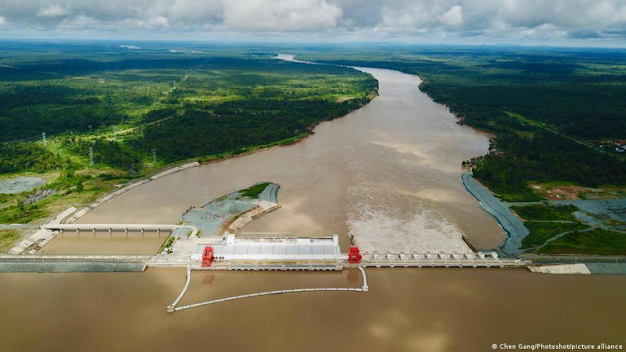
Cambodia's controversial Lower Sesan II hydroelectric dam was built with Chinese loans© Chen Gang/Photoshot/picture alliance

What are the US and Europe doing to compete with China?

AidData found that while China is spending about $80 billion annually on lending to low and middle-income countries, the United States is playing catch up.

Washington spends approximately $60 billion in similar development finance each year, due in large part to the financing of private sector projects by the US International Development Finance Corporation (DFC).

One example of US financing is the planned construction of a deep-water shipping container terminal in Sri Lanka's Port of Colombo, costing half a billion dollars, which was announced earlier this month.

The Indian Ocean island nation is struggling to recover from a dire financial and economic crisis and its existing loan commitments to China's BRI have hampered efforts to resolve its financial woes.

Beijing loaned cash to build Hambantota Port on Sri Lanka's southeastern coast, along with an airport and city on reclaimed land. However, the projects aren't profitable enough to repay the loans.

Two years ago, G7 nations launched the Build Back Better World, or B3W initiative, another attempt by the United States and its allies to counterbalance the BRI.

And just last month, the European Union held its first summit for its own Global Gateway program, which is also seen as an alternative to the BRI and hoped to help retain Europe's influence, particularly in the Global South.

During the talks, deals worth nearly €70 billion were inked with governments across Europe, Asia and Africa. The EU's support, which could eventually reach €300 billion, will help projects related to critical raw minerals, green energy, and transport corridors.

European Commission Chief Ursula von der Leyen said the Global Gateway would give developing countries a "better choice" for financing infrastructure projects. While she didn't single out China's BRI for criticism, she noted how other options for financing often come at a "high price."

AidData found that while the US and its allies may be unable to match Beijing dollar for dollar on an ongoing basis, in part due to the West promising too much and being unable to deliver, the G7 did outspend China in 2021 by $84 billion.

In its report, AidData also cautioned the US and its allies against trying to compete with China's BRI as Beijing moves from large-scale construction projects to debt collection.

However, the report's authors said the failure of many BRI projects does offer an opportunity to lure affected countries, like Sri Lanka, back into the West's orbit.

Edited by: Rob Mudge

How China became the world's largest debt collector (msn.com)

Thursday, 14 December 2023

Hong Kong corporate governance tumbles to lowest in decades


14 Dec 2023, 11:28 am


(Dec 14): Hong Kong’s corporate governance ranking in Asia tumbled to the lowest level in decades, falling behind those of Japan and Singapore, amid concerns about the deterioration of minority shareholder rights and the independence of the judiciary in the city, according to a research report. 

The financial hub dropped to the sixth place this year from second, according to the Asian Corporate Governance Association’s CG Watch rankings. It’s the first time Hong Kong dropped out of the top three spots in the rankings since they began in 2003, according to the report, which was released with CLSA on Wednesday. 

The report marks the latest setback to Hong Kong’s efforts to revive its image as the region’s premier international finance centre. Banks have been eliminating jobs in the city amid a slump in deals, while the city’s benchmark Hang Seng Index is one of the worst performers among major bourses this year.   

Hong Kong’s introduction of a Beijing-led national security law and its crackdown on political activists have also eroded perceptions of the strength of its institutions and the free flow of information in the city, according to the report. 

“The independence of the judiciary and a stifling of the press and academia have also contributed to its current ranking,” the report said.

Hong Kong Chief Executive John Lee has repeatedly defended the merits of the security law, and government officials have balked at the idea that Hong Kong is losing its stature as an international hub.  

Meanwhile, Australia, which has ranked No 1 since 2016, kept its top spot. Japan jumped to No 2 for the first time since the study began, thanks to its “strong” government reforms and efforts by the local stock exchange to improve governance, according to the report.  

Singapore came third, tied with Taiwan, followed by Malaysia. 

Hong Kong corporate governance tumbles to lowest in decades (theedgemalaysia.com)


Credit Suisse disbands China onshore wealth unit, dozens depart


By Cathy Chan / Bloomberg

14 Dec 2023, 11:42 am


Credit Suisse’s push to build a wealth management business in China started to fall apart after it delayed the launch of its locally incorporated bank last year.

(Dec 14): Credit Suisse dismissed its entire wealth management team in China, scrapping its ambition to become one of the biggest foreign money managers in the country as UBS Group AG decided not to take on the staff, people familiar with the matter said. 

Those let go included at least 20 relationship managers and investment consultants as well as Wang Jing, the chief executive officer of Credit Suisse’s securities venture, the people said, asking not to be identified because the matter wasn’t public. Some support roles were also affected, they said, without being specific on the numbers. The division at one point had about 40 staff, one of the people said.

Spokespeople for UBS and Credit Suisse declined to comment.  

The dismissals come as Credit Suisse is trying to find a buyer for its securities business in China, which now consists of investment banking and brokerage operations after the wealth unit closed. UBS, which has yet to merge Credit Suisse’s entities in China, needs to sell the securities venture because it already controls one in the country and can’t hold two licences for the same business.

The job reductions at the wealth unit started in October as UBS felt Credit Suisse’s strategy of selling wealth products through bank branches was incompatible with its current model, one of the people said.

Wang was hired more than three years ago from China Merchants Bank Co to develop Credit Suisse’s wealth footprint on the mainland, and was made the CEO of the securities business last year after a reshuffle and an exodus of senior management. 

Credit Suisse’s push to build a wealth management business in China started to fall apart after it delayed the launch of its locally incorporated bank last year, the second postponement since the project was conceived in 2020. The firm had planned to build a branch network to distribute wealth products and fuel its money management business, joining other Wall Street firms that have poured billions into China. As recently as 2021, Credit Suisse had plans to triple its headcount in China within three years. 

The local bank project was delayed by a sluggish licensing process and was questioned by some senior Credit Suisse executives as China’s economy was reeling from Covid lockdowns and a crackdown on private enterprise, people familiar with the matter have said. 

Wang, the former head of private banking at China Merchants Bank, was seen as a key hire by former Asia CEO Helman Sitohang. She had helped build the Shenzhen-based lender into the nation’s biggest manager for high net worth clients during her more than two decades' stint.

Credit Suisse won approval in 2020 to take full control of a securities venture it had run with Founder Securities since 2008. The firm last year agreed to buy the remaining 49% stake from Founder for US$160 million (RM746.18 million). The deal was scrapped after UBS acquired Credit Suisse in a rescue brokered by Swiss authorities, people familiar with the matter said. 

UBS CEO Sergio Ermotti reiterated the firm’s commitment to China during a September visit to Beijing, while acknowledging the geopolitical situation has changed. UBS has “very limited” direct exposure to China real estate since the bank is mainly in the country to help people manage their wealth, he said in an interview.  

Wall Street firms have seen their business slow in China amid a sluggish economy and dearth of deals. UBS had seen strong growth, with mainland China revenue more than doubling to almost US$1 billion in 2021 from 2019, Bloomberg reported last year. The bank employed about 1,400 people in China as of January.

Across Asia, UBS is cutting hundreds of wealth-management jobs after completing the Credit Suisse takeover, Bloomberg News reported in September. The lender was set to eliminate roles that included relationship managers in Hong Kong and Singapore, the majority within Credit Suisse teams, the people said.

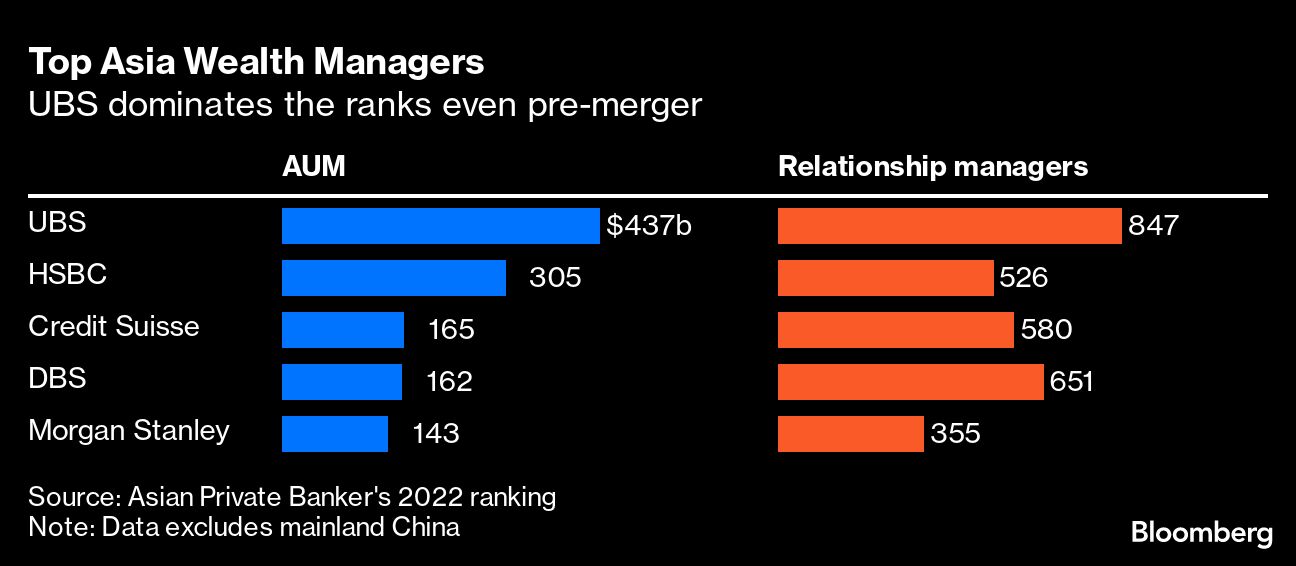
Still, the merger gives UBS the largest wealth team in Asia, with assets that top rivals including HSBC Holdings plc. Global wealth chief Iqbal Khan is betting Asia will continue to generate lucrative fees from rich clients.

Credit Suisse disbands China onshore wealth unit, dozens depart (theedgemalaysia.com)

Tuesday, 7 November 2023

Exclusive: China's clashing priorities behind rare money market distress

 SHANGHAI/SINGAPORE, Nov 6 (Reuters) - China's attempts to keep the yuan from falling contributed to last week's chaos in money markets, sources involved say, pointing to the pressure behind the scenes as Beijing tries to guide its economy and markets through a major slowdown.

Routine month-end demand for cash in China's banking system snowballed into a scramble on Oct. 31 that pushed short-term funding rates as high as 50% in some cases, an incident that authorities are now investigating.

Reuters

Six participants in the market say a confluence of factors drove fear and confusion across trading rooms in Shanghai and Beijing by late afternoon on that day.

Eventually, the People's Bank of China (PBOC), its affiliated China Foreign Exchange Trade System (CFETS) and bond clearing houses stepped in, directing lenders, extending trading hours and holding meetings with institutions to calm markets.

The contributing factors were the usual month-end demand for liquidity, cash hoarding in the lead up to a big government bond sale and a market where the biggest banks were already reticent to lend because of a mandate to counter pressure on the yuan.

"It was an accident," said Xia Chun, chief economist at wealth manager Yintech Investment Holdings, calling it an unforeseen consequence of the government's heavy hand in financial markets.

"Banks were grudging in lending, leaving non-banks asking each other for money in afternoon trade," he said. "Borrowing rates surged as a result, with some willing to take any price."

The reasons for the spike in interest rates and the ensuing market chaos are detailed here for the first time. Participants say that the vulnerability exposed will stay as long as capital outflows keep the system under pressure.

Most of them requested anonymity as they were not authorised to discuss a sensitive topic publicly.

The PBOC told Reuters that CFETS was probing "abnormal" trades on Oct. 31 involving some accounts repeatedly borrowing and lending money at "extremely high interest rates" near the end of trading hours.

'COMBAT MOOD'

Short-term financing markets, such as overnight repurchase agreements, or repos, are crucial to the daily business of banks, insurers and other financial institutions.

They affect foreign exchange movements since the markets are the major avenue for the supply of money.

Funds and non-banks borrow and roll over loans that finance their investments and trades in the repo market. The month-end is also when banks and other finance-sector participants have to square their books and comply with rules on capital buffers.

Disruptions, therefore, can threaten financial stability.

Seeds of trouble were sown in October when China approved one trillion yuan ($137.32 billion) in sovereign debt sales, to be rolled out - according to sources familiar with the plans - by sticking to the issuance schedule for the fourth quarter but increasing the size of each tranche.

Typically, said one fund manager in Shanghai, in such situations the PBOC would offset the cash drain from the extra bond issuance with extra funding support - for example by relaxing bank reserve requirements.

But putting extra cash into the system would risk adding downward pressure on the yuan - which has lost over 5% against the dollar this year - and undercut months of efforts to stabilise the currency.

"The inaction by the central bank is mainly due to its concern over yuan depreciation," said the fund manager, who declined to be identified as he was not authorised to talk to media.

On trading floors that Tuesday, the scramble for short-term funds became a stampede.

Even repo rates between banks, normally stable and the main gauge of short-term funding costs, flew from an overnight rate of 2% a day earlier to as high as 8% on Oct. 31.

DESPERATE BORROWERS

At 4 p.m. (0800 GMT) the state banks that normally lend to desperate last-minute borrowers were missing, according to three market participants.

The absence left a couple of desperate borrowers paying 30%-50% - rates not seen since defaults at China Everbright Bank (601818.SS) and Industrial bank Co Ltd (601166.SS) a decade ago - to secure the loans they needed.

At 5 p.m. markets closed with positions unfunded and trades incomplete.

"No one left the trading desk, as you don't know how things will go ... the whole trading room was in combat mood," said one fund manager in Beijing.

"If you need to square your positions in such an environment, and want to avoid default, you need to borrow at high rates," the fund manager said. "For each individual, it's rational behaviour."

The PBOC stepped into the breach, asking state banks to supply funds while the China Central Depository & Clearing Co (CCDC) and Shanghai Clearing House both reopened settlements at 6 p.m in an emergency response. By 8.30 p.m., crisis was averted and the market cleared and closed again.

DO NOT 'BE EMOTIONAL'

At a follow-up meeting with banks and brokers the next day, sources said the PBOC told institutions their behaviour was "disturbing the market" and that they should not "be emotional."

The money market operator CFETS told traders to keep a 5% ceiling on repo transactions and said anyone involved in high-rate deals closed on Oct. 31 would need to explain themselves to regulators, according to sources who received the notice.

Fear subsided with overnight rates falling back below 3%. To be sure, most see the danger as having passed.

But analysts have turned to the backdrop - intensifying control over China's currency - as an underlying source of tension.

China's economic rebound from the COVID-19 pandemic has been a disappointment. Together with rate rises around the world, it has fanned capital outflows and the yuan has suffered.

And yet, after dropping 5% on the dollar over the year to mid-August, the exchange rate has been conspicuously steady since as efforts from state-bank buying to new rules discouraging short selling have been deployed to support it.

Tighter liquidity is another method.

"If the pattern of money supply and liquidity provision remains unchanged, the whole system remains fragile. Another liquidity shock is always possible," said the Beijing-based fund manager.

Others see less risk, but expect tightness will stay as long as there is pressure on the currency. Broad dollar weakness has helped the yuan lately, but at 7.28 to the dollar it is not far from September's 16-year low of 7.351.

($1 = 7.2822 Chinese yuan)

Reporting by Shanghai Newsroom Writing by Tom Westbrook; Editing by Vidya Ranganathan and Raju Gopalakrishnan

Exclusive: China's clashing priorities behind rare money market distress | Reuters


Exclusive: Beijing pushes for toning down of China risks in IPO prospectuses

 July 24 (Reuters) - Beijing has asked law firms to tone down the language used to describe China-related business risks in Chinese companies' offshore listing documents, warning failure to do so could cost them regulatory green light for the IPOs, three people familiar with the matter said.

The move, which not been reported before, is the latest in tightening scrutiny of Chinese companies' offshore listings, and comes at a time when Beijing is stepping up controls over cross-border transfer of sensitive information.

China Securities Regulatory Commission (CSRC) building in Beijing

A Chinese national flag flutters outside the China Securities Regulatory Commission (CSRC) building on the Financial Street in Beijing, China July 9, 2021. REUTERS/Tingshu Wang/File Photo Acquire Licensing Rights


The China Securities Regulatory Commission (CSRC) on July 20 met with local lawyers and asked them to refrain from including negative descriptions of China's policies or its business and legal environment in companies' listing prospectuses, the people said.

The closed-door meeting followed informal, so-called window guidance the regulator had offered on the subject to firms that work on listing applications over the past few months, the three sources said.

A spokesperson for the U.S. Securities and Exchange Commission (SEC) declined to comment.

Last week, the securities regulator said it had directed to Chinese companies listed on U.S. stock exchanges to disclose more details about the role of the Chinese government in their operations and the impact of a 2021 law banning the import of goods from China's Uyghur region.

The letter is part of the SEC's effort to implement a 2020 law that increases scrutiny of U.S.-listed Chinese companies.

Chinese companies planning overseas share offerings would typically list changes in China's changing economic, political and social conditions as well as changes in government policies and regulations and trade tensions with the United States among business risks, their public disclosures showed.

The Chinese law firms acting as IPO advisors have been asked to drop such boilerplate risk disclosures, said one of the people, who declined to be identified as the discussions were confidential.

The latest guidance could force Chinese companies to delay or even put on hold their share offerings in the United States, since regulators there require full risk disclosure, two of the people said.

China's new offshore listing rules that came into effect on March 31 forbid any comments in the listing documents that "misrepresent or disparage laws and policies, business environment and judicial situation" of China.

However, the rules do not specify what would qualify as such comments.

All major markets require issuers to disclose to prospective investors risks related to the company itself, its business sector, and the country where it is headquartered in.

The China-specific risk statements in prospectuses prepared after March 31 caught the attention of some senior leaders in Beijing, prompting the CSRC to reiterate its stance on the subject to dealmakers, one of the sources said.

CSRC told law firms at the meeting last week not to sign off any offshore share offering disclosures, which included statements that distorted or derogated China's laws, policies and regulatory environment, according to the three sources.

The CSRC did not immediately respond to a faxed request for comment.

RISK DISCLOSURES

In its earlier "window guidance" to dealmakers, the regulator hinted that failure to comply with it might cost them and issuers a regulatory green light for listings, two of the sources said.

Representatives from the CSRC's International Cooperation Department, more than 10 Chinese law firms and other government and industry bodies attended the July 20th meeting, according to one of the people.

Large domestic law firms Fangda Partners, Han Kun Law Offices, and Zhong Lun Law Firm were among the attendees, said two of the sources.

Fangda, Han Kun and Zhong Lun did not respond to Reuters' request for comment.

The latest steps come as Beijing is scrambling to revive the world's second-largest economy that has started to rapidly lose momentum in recent months following the initial post-COVID bounce.

Many foreign companies have also expressed concerns over the changing business environment, which in recent years has been marked by a crackdown on technology firms and consultancies, as well as new anti-espionage and data security laws.

The new rules on overseas listings and data transfers have already made it harder to secure timely approvals and led to calls for Beijing to reconsider its approach.

Reporting by Julie Zhu, Kane Wu and Selena Li; Additional reporting by Michelle Price and Chris Prentice Editing by Sumeet Chatterjee and Tomasz Janowski

Exclusive: Beijing pushes for toning down of China risks in IPO prospectuses | Reuters


China ‘world’s biggest debt collector’ as poorer nations struggle with its loans

 China has become the world’s biggest debt collector, as the money it is owed from developing countries has surged to between $1.1tn (£889bn) and $1.5tn, according to a new report. An estimated 80% of China’s overseas lending portfolio in the global south is now supporting countries in financial distress.

Story by Amy Hawkins Senior China correspondent  • 17h

Photograph: Thomas Mukoya/Reuters

Photograph: Thomas Mukoya/Reuters© Provided by The Guardian

Since 2017, China has been the world’s biggest bilateral lender; its main development banks issued nearly $500bn between 2008 and 2021. While some of this predates the belt and road initiative (BRI), Beijing’s flagship development programme has mobilised much of the investment in developing countries.

But a new report by researchers at the AidData research lab at William & Mary, a public university in Virginia, found that China, the world’s second largest economy, is now navigating the role of international debt collector as well as being a bilateral funder of major infrastructure projects.

Lending from Chinese state-backed banks has helped to build railways in Kenya and power plants in Cambodia, along with thousands of other projects. The AidData researchers analysed 20,985 projects in 165 low- and middle-income countries, which were financed with grants and loans worth $1.34tn between 2000 and 2021.

The researchers found that as the debts to Chinese lenders have mounted, the number of suspended or cancelled projects has also increased. With a high share of lending directed towards countries in, or at risk of, financial distress, Beijing is now increasingly worried about the risk of defaults.

In June, Zambia reached a historic deal to restructure $6.3bn of debt, two-thirds of which is owed to the Export-Import Bank of China, one of the country’s two main policy banks.

To mitigate the risk of future defaults, Chinese policymakers have introduced a number of measures, including reducing loans for infrastructure projects while ramping up emergency lending. In 2015, infrastructure project lending accounted for more than 60% of China’s loan portfolio. By 2021, the share was just over 30%, with emergency lending accounting for nearly 60%.

“China is increasingly behaving like an international crisis manager,” the researchers concluded. China has created “a safety net” for countries in financial distress – “and, by extension, their highly exposed Chinese creditors”.

Related: China spent $240bn on belt and road bailouts from 2008 to 2021, study finds

Another way in which Chinese lenders have been trying to lower their exposure to risk is by increasing the penalties for late repayments, a move that may alienate borrowers. The AidData report cites figures from the Gallup World Poll which shows that public approval ratings for China in low- and middle-income countries fell from 56% in 2019 to 40% in 2021.

The terms and conditions of specific Chinese loans are often not transparent, but economists estimate that Chinese government loans to low-income countries typically have a 2% interest rate compared with the 1.54% norm for the World Bank’s concessional loans. But the AidData researchers found that between the early years of the BRI (2014-2017) and the latter period (2018-2021), Chinese lenders increased the maximum penalty interest rate for late repayments from 3% to 8.7%.

Bradley Parks, one of the report’s authors and the executive director of AidData, said: “Beijing is trying to find its footing as the world’s largest official debt collector at a time when many of its biggest borrowers are illiquid or insolvent. And debt collectors don’t win a lot of popularity contests.”

Still, Parks noted, “China is not going to stand by and watch its flagship global infrastructure initiative crash and burn.” Beijing is currently on a “rescue mission” to minimise debt distress, but the government is also “playing the long game”, Parks said. “It is putting in place a set of loan repayment safeguards … that are designed to futureproof the belt and road initiative.”

China ‘world’s biggest debt collector’ as poorer nations struggle with its loans (msn.com)

Most Recent Post

Man charged for borrowing rare Chinese manuscripts from UCLA library, returning fakes

  Suspect Jeffrey Ying allegedly travelled to China after checking works out using several aliases Agence France-Presse Published: 12:11pm, ...

Popular Posts - Last 30 days