Saturday, 10 July 2021

‘To get rich is glorious’: how Deng Xiaoping set China on a path to rule the world

Deng Xiaoping could lay claim to being the most significant political leader of the latter part of the 20th century, and one whose legacy continues to expand.

July 10, 2021 8.47am AEST


This piece is part of a new series in collaboration with the ABC’s Saturday Extra program. Each week, the show will have a “who am I” quiz for listeners about influential figures who helped shape the 20th century, and we will publish profiles for each one. You can read the other pieces in the series here.


Deng Xiaoping could lay claim to being the most significant political leader of the latter part of the 20th century, and one whose legacy continues to expand.

His record is remarkable.

It is at least arguable, if not certain, that had it not been for Deng’s force of personality and his willingness to take political risks, China would not have embarked in 1978 on an accelerated process of economic development.

Get news curated by experts, not algorithms.

If the Chinese economy had not achieved staggering rates of economic growth of 10% annually on average in the decades following Deng’s political re-emergence in 1977, the world would be a very different place.

In other words, one man of diminutive size — he was barely 1.5 metres tall — has had an outsize impact on world economic history.

Soviet leader Mikhail Gorbachev meeting with Deng Xiaoping in Beijing on the eve of the Tiananmen Square crackdown in 1989. Boris Yurchenko/AP

Deng’s rise, fall and rise again

Born to a landowning family in Sichuan province in 1904, Deng gradually progressed through the Chinese Communist hierarchy as a committed Marxist-Leninist and a tough field commander and political commissar.

Mao Zedong may have prevailed in a bloody revolutionary war against the Nationalists, but it was his one-time protégé who propelled a country containing one-quarter of the world’s population into a new era.

Deng Xiaoping visiting a factory in the city of Wuhan in 1958. Wikimedia Commons

History will be a lot kinder to Deng than it will be to Mao, who brought enormous grief to his country in highly destructive political campaigns, culminating in the Cultural Revolution of 1966–76.

Deng himself was a victim of these campaigns. He was banished from the Chinese leadership early in the Cultural Revolution until he was rehabilitated in 1973 by his patron, then-Premier Zhou Enlai. He was purged a second time after Zhou died in 1976.

Mao’s death not long after Zhou’s and the arrest of the Maoist acolytes known as the “Gang of Four” enabled Deng to assert himself in a series of stunning political manoeuvres that ruled a line under years of revolutionary upheaval.


Read more: Culture, free speech and celebrating Mao downunder


To get rich is glorious

Deng was, without question, an authoritarian figure who believed in the absolute power of the Chinese Communist Party. His legacy will be forever stained by his authorisation of force against the pro-democracy demonstrators on Tiananmen Square in 1989, in which hundreds are believed to have died, and many more were incarcerated.

Without excusing the excesses of the Tiananmen crackdown, however, the totality of Deng’s contribution to his country’s transition from economic laggard to modern superpower cannot be overstated.

Deng’s extraordinary achievements are too many to list here, but three dates stand out in his efforts to set his country on a path, as he put it, of “reform and opening”.

The fact he used both words — reform and opening — summed up his approach to wrenching his country from its revolutionary past to chart another course.

These dates are:

1978: Deng’s authority manifested itself at the Third Plenum of the 11th Central Committee of the Chinese Communist Party.

In modern Chinese history, this event is seen as the starting point for the massive shifts that would loosen up China’s economy and dismantle what was known as the “bamboo curtain” that had shielded it from the outside world.


Read more: The Communist Party claims to have brought prosperity and equality to China. Here's the real impact of its rule


1980: In a speech whose importance is sometimes lost in historical accounts, Deng laid down the “Great Tasks” facing China in the last two decades of the 20th century and beyond.

Among those tasks was the quadrupling of gross national product by 2000, an aspiration that was initially scoffed at. Under the Deng-initiated reforms, which included the de-collectivisation of agriculture and the unleashing of an entrepreneurial business class, China achieved that goal in a canter.

1992: Deng, then 90 and in bad health, embarked on what was described as a nanxun, or southern inspection tour, in which he re-energised the reform process after it had fallen into the doldrums following Tiananmen.

The fallout from the massacre included the purging of reformist leader Zhao Ziyang, who was general secretary of the Communist Party and a former premier. A ruthless Deng elected not to protect his protégé.

Historians may well come to regard Deng’s nanxun as not simply his last hurrah, but his most enduring contribution to China’s surging power and influence.

Deng Xiaoping meeting delegates of the Communist Party Central Committee in Beijing in 1992. AP

In all of this, it is important to remember that in 1978, China’s economy was about the same size as Italy’s. In 2021, China’s economy on a nominal GDP basis is the world’s second largest behind the United States, and should surpass the US in the next few years. At the same time, China has lifted 800 million people out of poverty. Never before in human history have we seen anything quite like this.

Of course, Deng did not achieve all of this by himself, but he was prepared to embrace what Mao had sought to suppress in a single-minded desire to maintain control over party and country. This was the extraordinary energy and enterprise of the Chinese people.

Deng’s various slogans, such as “to get rich is glorious” captured the moment, and indeed helped to unleash the full potential of the Chinese people.

Deng is celebrated in China today as the chief architect of the country’s reform and opening up. Shi Donghong/AP

Biding its time no more

None of this is to suggest Deng’s legacy will be untroubled, or that China’s surging power and influence will continue to build without impediments.

The country’s continuing economic transformation resembles a high-wire act as China’s leadership seeks to maintain its footing in a world in flux as American power recedes. China’s economy is far from having reached a plateau in which consumer demand provides a buffer against ups and downs in its export markets. These are challenging times for the post-Deng leadership in Beijing.

Deng himself may well have looked askance on the emergence of a personality cult around paramount leader Xi Jinping. In his “Great Tasks” speech of 1980, Deng had warned against this very development.

This was born of his own experiences at the hands of a tyrannical Mao. In that speech, Deng had emphasised collective leadership in the knowledge that untrammelled power corrupts.


Read more: The world has a hard time trusting China. But does it really care?


What has certainly been left astern is Deng’s advice that China should “keep a low profile” or “bide its time” – tao guang yang hui — as its power and influence grows. The use of this phrase has been variously interpreted over the years as either a warning from Deng that China should avoid throwing its weight around or a ruse in which Beijing stealthily accumulates power without making it too obvious.

Under Xi’s brand of Chinese nationalism, the tao guang yang hui approach has been discarded. This may have been inevitable as China becomes more powerful, but it is at least debatable whether a shrewd Deng Xiaoping would have countenanced an approach that risked antagonising much of the rest of the world.


See Original Source

Thursday, 8 July 2021

China fear 'Terror group' in Xinjiang amid US withdrawal from Afghanistan: Report

 Amid the ongoing US troop withdrawal from Afghanistan, China is worried about the instability to come in the country, a revival of the East Turkestan Islamic Movement (ETIM), its cross-border agitation and terrorism in Xinjiang region, said scholar Salman Rafi Sheikh. 

Jul 08, 2021


The ETIM, also known as the Turkistan Islamic Movement, is an ethnic Uighur group active in Afghanistan that has long sought to achieve independence for Xinjiang, which it envisions as a future "East Turkestan." 

The ETIM is also active in Syria's civil war, where battle-hardened fighters have largely been grouped in Idlib and other northern regions. The United Nations has categorised the group as a "terror organisation" since 2002. 

In November 2020, the former Donald Trump administration removed ETIM from America's terror list, saying at the time there was "no credible evidence" that ETIM still exists. 

In an opinion piece in Asia Times, Sheikh said as the Taliban surges north in the wake of America's troop withdrawal, it seems likely only a matter of time before the group overruns Kabul and its US-backed government, and establishes in its place a new "Islamic Emirate", as it has repeatedly said it aims to do. 

"A Taliban takeover, analysts and observers believe, will open new space for groups like ETIM to recruit and radicalize Uighur youth, many of whom are already reportedly deeply disaffected by reports of Beijing's Uighur "vocational camps" and authoritarian control of Muslim religious practices in Xinjiang," Sheikh added. 

He further stated that for Beijing, however, the concern is not merely the spread of radical ideas among Uighur Muslims in neighboring Afghanistan. Rather, it is the threat a resurgence of extremism could pose to its strategic Belt and Road Initiative in the region, not least in Pakistan. Four of China's six so-called Silk Road networks, including the China-Pakistan Economic Corridor (CPEC), emanate from or pass through Xinjiang. Those roads aim to connect China with Russia, Central, Southern, and Western Asia, reaching the Mediterranean Sea.

Specifically, Silk Road networks other than the CPEC that run through Xinjiang include the China-Central Asia-West Asia Economic Corridor, the New Eurasia Land Bridge Economic Corridor, and the China-Mongolia-Russia Economic Corridor. 

Sheikh said that while the departure of US and NATO forces from neighboring Afghanistan is no doubt broadly welcomed by China, it also puts Beijing in a new strategic quandary - one that could make or break its BRI ambitions in the region. 

"Beijing's concerns about the ETIM in Afghanistan are not simply an exaggerated threat assessment to justify its authoritarian control of Uighurs in Xinjiang. In 2008, China's Ministry of Public Security released a list of eight "terrorists" linked to ETIM with detailed charges against them, including threats to bomb the 2008 Beijing Olympics," Sheikh added. 

Citing the recent United Nations Security Council report, Sheikh said, despite the Trump administration's denials ETIM not only exists and operates in Afghanistan but is also pursuing a "transnational agenda." 

According to the report, ETIM is among the "foremost" foreign terror groups operating in Afghanistan. The report said ETIM is situated mainly in Badakhshan, Kunduz and Takhar provinces and that Abdul Haq (Memet Amin Memet) remains the group's leader, he said. 

The report goes on to say approximately 500 ETIM operate in the north and northeast of Afghanistan, primarily in Raghistan and Warduj districts, Badakhshan, with financing based in Raghistan. 

Those northern areas connect with China through the narrow Wakhan Corridor, a potential passageway for Xinjiang-bound militants. The UN report said ETIM collaborates with Lashkar-e-Islam and Tehrik-e-Taliban Pakistan, two banned Pakistani groups. 

It also said ETIM "has a transnational agenda to target Xinjiang, China, and the China-Pakistan Economic Corridor, as well as Chitral, Pakistan, which poses a threat to China, Pakistan and other regional states," he said. 

Citing another report, Sheikh said that it indicates Beijing is trying to get a grip on the situation in Afghanistan. According to media reports, in December 2020, a Chinese spy ring was arrested in Afghanistan. 

Although Beijing denied the allegation, Ahmad Zia Saraj, the chief of Afghanistan's National Directorate Security, confirmed to the Afghan Parliament that the arrests had indeed been made. What information the reputed spies may have gathered and transmitted to Beijing before their apprehensions, however, is unknown, he added. (ANI)

https://www.aninews.in/news/world/asia/china-fear-terror-group-in-xinjiang-amid-us-withdrawal-from-afghanistan-report20210708053010/

Wednesday, 23 June 2021

Closure of Hong Kong's Apple Daily - What people are saying about it

 23 Jun 2021 — HONG KONG, June 23 (Reuters) - Hong Kong pro-democracy newspaper Apple ... "Its closing seriously undermines media freedom and pluralism, ...


HONG KONG, June 23 (Reuters) - Hong Kong pro-democracy newspaper Apple Daily printed 1 million copies of its last edition on Thursday, after a year in which it was raided by police and its tycoon owner and other staff were arrested under a national security law.

Here are some comments from Hong Kong residents and others in reaction to the news.

DICKSON NG, 51, APPLE DAILY DESIGNER

“(After) today, there is no press freedom in Hong Kong ... I cannot see any future in Hong Kong.

"I feel very disappointed and angry today. I don't understand why our limited group, company, and the newspapers were forced to stop operating under such circumstances."

CHINESE FOREIGN MINISTRY

"I want to emphasise, Hong Kong is a society that has rule of law. Everyone is equal in front of the law, no one or no organisation is above the law. All rights and freedom, including media freedom, cannot go beyond the bottom line of national security."

TAIWAN'S CHINA POLICY-MAKING MAINLAND AFFAIRS COUNCIL

"This unfortunate incident has not only sounded the death knell for freedom of press, publication, and speech in Hong Kong, but has also allowed the international community to see for themselves the Communist Party regime's totalitarianism and autocracy."

APPLE DAILY SUPPORTER SAN TSANG, 27, VETERINARY NURSE

“I think it’s the end of an era so I want to come out and buy a copy. Also I don’t understand why (Hong Kong) can’t even tolerate a newspaper.”

AMNESTY INTERNATIONAL'S ASIA-PACIFIC REGIONAL DIRECTOR, YAMINI MISHRA

"The forced closure of Apple Daily is the blackest day for media freedom in Hong Kong’s recent history. The paper has been effectively banned by the government for publishing articles that criticized it, and for reporting on international discussions about Hong Kong. This is an unacceptable attack on freedom of expression.

“The arrests of Apple Daily staff, seizing of journalistic materials and freezing of its assets will send a shiver down the spine of all media outlets operating in Hong Kong. It is also deeply alarming for the readers whose media consumption is now effectively being curbed by the authorities – just as it is for people in mainland China."

RONSON CHAN, HEAD OF HONG KONG JOURNALISTS' ASSOCIATION

"We urge the government to fulfil the promise of safeguarding press freedom ... to let people working in the news industry serve Hong Kong without fear.

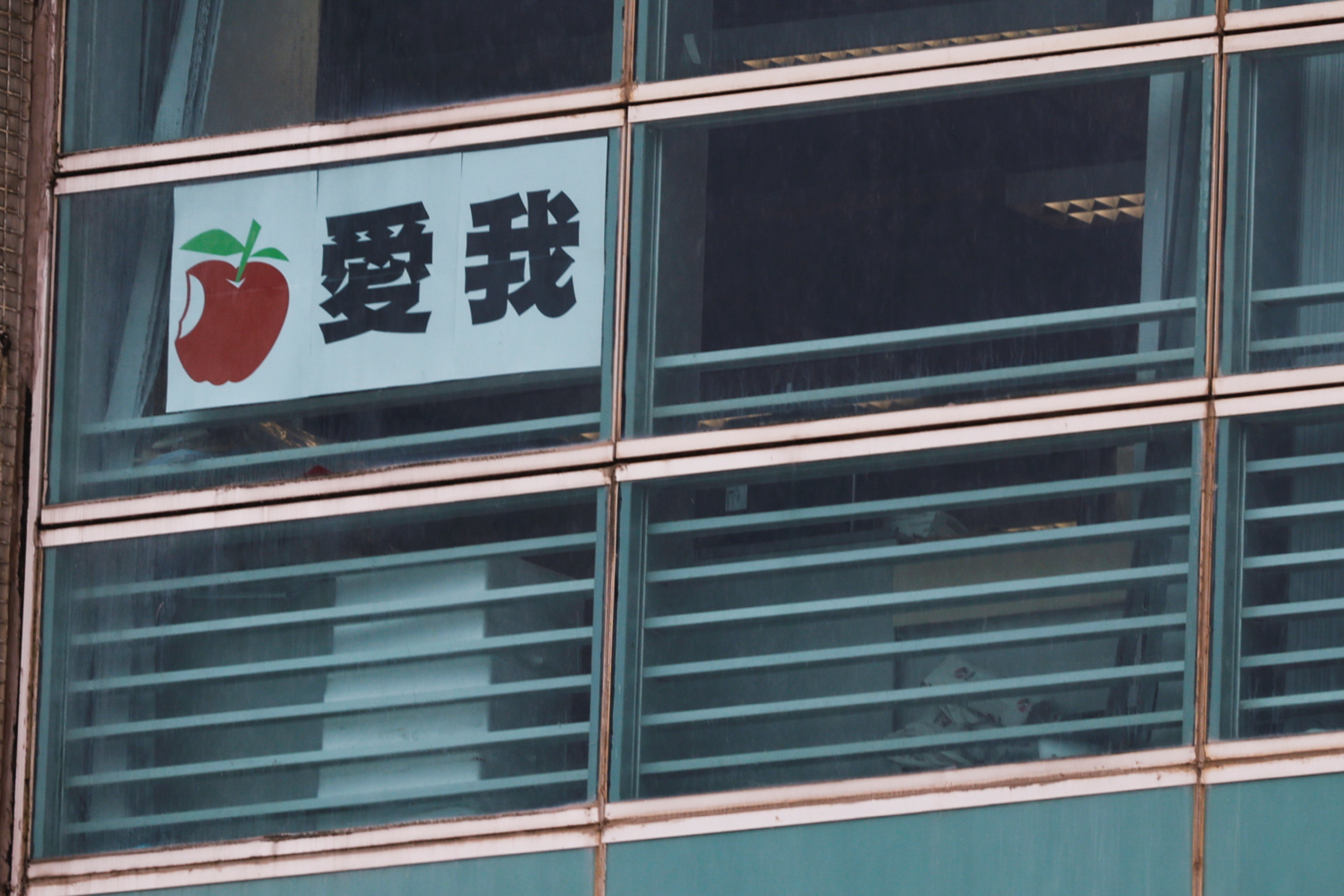
Papers showing "I love Apple Daily" are placed inside the headquarters of the Apple Daily newspaper and its publisher Next Digital in Hong Kong, China June 23, 2021. REUTERS/Tyrone Siu

"We will be very worried if there are consequences for writing an article. I’m afraid that it will make society feel, or how I feel now, that people can be put in prison because of what they write. It leads to a huge worry for the city’s freedom of speech."

BRITISH FOREIGN MINISTER DOMINIC RAAB

"The forced closure of Apple Daily by the Hong Kong authorities is a chilling blow to freedom of expression in Hong Kong.

"It is crystal clear that the powers under the national security law are being used as a tool to curtail freedoms and punish dissent - rather than keep public order."

BARBARA TRIONFI, EXECUTIVE DIRECTOR, INTERNATIONAL PRESS INSTITUTE

“The harassment of Apple Daily is yet another effort by authorities in Beijing to silence a critical news outlet.

"This violates the right of Hong Kong’s people to access independent news and is a further step toward the eradication of press freedom in the Special Administrative Region.

“One year after its enactment, China’s national security law for Hong Kong has been revealed to be exactly what critics feared: a ready-made instrument to suppress independent news coverage.

"The international community must not remain silent as Hong Kong’s freedoms are removed brick-by-brick. The IPI global network stands in solidarity with Apple Daily’s journalists and staff.”

JOHNNY KU, 55, WORKS IN BUILDING MANAGEMENT

"If Apple Daily can't survive, then there is no press freedom. If such a strong organisation can also lose its voice, I think other media organisations will also be scared."

EUROPEAN UNION SPOKESPERSON

"The closure of Apple Daily's Hong Kong operations clearly shows how the National Security Law imposed by Beijing is being used to stifle freedom of the press and the free expression of opinions.

"Its closing seriously undermines media freedom and pluralism, which are essential for any open and free society. The erosion of press freedom is also counter to Hong Kong's aspirations as an international business hub."

MARIA TSE, 39, WORKS IN EDUCATION

"My emotions are just like the weather, raining. I'm quite sad, because it's a newspaper I've been reading from a young age."

Source

Saturday, 22 May 2021

China downgrades diplomatic ties with Lithuania over Taiwan row

China has downgraded its diplomatic relations with Lithuania, days after the Baltic state allowed Taiwan to open a de facto embassy there.

22 November 2021

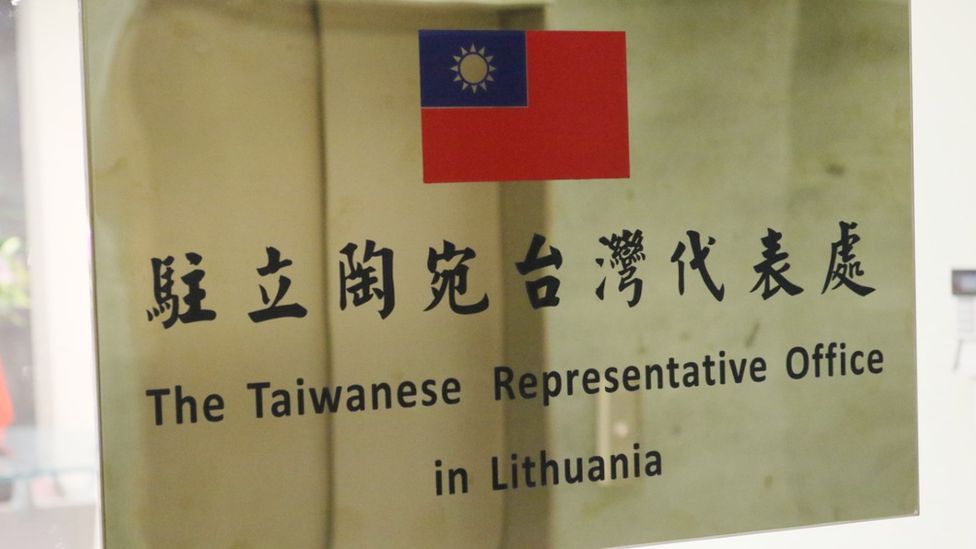
A sign announcing Taiwan's representative office in LithuaniaIMAGE SOURCE,EPA
Image caption,
Taiwan's representative office in Lithuania is its first new European outpost in 18 years

China has downgraded its diplomatic relations with Lithuania, days after the Baltic state allowed Taiwan to open a de facto embassy there.

Lithuania defended its right to have ties with Taiwan, but said it respected the "One China" policy.

Taiwan's new office in Lithuania does not equate to official diplomatic relations but could be seen as a sign of growing ties between both places.

Beijing considers Taiwan part of China, but Taiwan sees itself as independent.

The new office bears the name Taiwan rather than "Chinese Taipei", the name used by many foreign nations to avoid offending China.

This is the island's first new diplomatic outpost in Europe in 18 years. Taiwan has few allies with whom it has formal ties, due to China's pressure.

The One China policy is the diplomatic acknowledgement of China's position that there is only one Chinese government.

However, it is distinct from the One China principle, whereby China insists Taiwan is an inalienable part of one China to be reunified one day.

China's foreign ministry said the move had "undermined China's sovereignty and territorial integrity" and created a "bad precedent internationally".

It said it would reduce its diplomatic engagement with the country to the level of charge d'affaires, one rung down from an ambassadorship.

Lithuania's prime minister defended her nation's plans for greater engagement with Taiwan - a major supplier of semiconductors, lasers and other high-tech industry.

"Our government's programme says Lithuania wants a more intense economic, cultural and scientific relationship with Taiwan," Ingrida Simonyte said, according to Reuters.

"[But] I want to emphasise that this step does not mean any conflict or disagreement with the 'One China' policy."

The US has also offered its support to Lithuania to withstand Beijing.

Lithuania's move could be seen as the latest sign of some central European nations seeking greater relations with Taiwan even amid pressure from Beijing.

Last month, China spoke out after a delegation of Taiwanese officials were granted visits to Slovakia, the Czech Republic and Lithuania.

Taiwan currently has only has formal diplomatic recognition from 15 nations - most of which are Pacific or Latin American nations.

While governments like the US and Japan have fostered extensive commercial ties with Taiwan, they uphold official diplomatic ties with China and recognise its One China policy.

Source  -  https://www.bbc.com/news/world-asia-china-59370521

Most Recent Post

Man charged for borrowing rare Chinese manuscripts from UCLA library, returning fakes

  Suspect Jeffrey Ying allegedly travelled to China after checking works out using several aliases Agence France-Presse Published: 12:11pm, ...

Popular Posts - Last 30 days