Monday, 29 November 2021

Taiwan sends jets after 27 Chinese planes enter buffer zone

 TAIPEI, Taiwan (AP) — Taiwan said 27 Chinese aircraft entered its air defense buffer zone on Sunday, the latest in a long series of incursions as part of Beijing's pressure on the self-ruled island.

29 November 2021   12 Hours ago

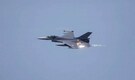
Newly commissioned upgraded F-16V fighter jets are seen at Air Force base in Chiayi in southwestern Taiwan Thursday, Nov. 18, 2021. Taiwan has deployed the most advanced version of the F-16 fighter jet in its Air Force, as the island steps up its defense capabilities in the face of continuing threats from China. (AP Photo/Johnson Lai)© Provided by Associated Press Newly commissioned upgraded F-16V fighter jets are seen at Air Force base in Chiayi in southwestern Taiwan Thursday, Nov. 18, 2021. Taiwan has deployed the most advanced version of the F-16 fighter jet in its Air Force, as the island steps up its defense capabilities in the face of continuing threats from China. (AP Photo/Johnson Lai)

The Defense Ministry said Taiwan scrambled combat aircraft to “warn” the Chinese planes to leave. It also deployed missile systems to monitor them.

Sunday’s incursion included 18 fighter jets and five H-6 bombers, as well as a Y-20 aerial refueling aircraft, according to Taiwan’s Defense Ministry.

The Chinese aircraft flew into Taiwan’s air defense identification zone near the southern part of the island and out into the Pacific Ocean before returning to China, according to a map by Taiwan authorities.

Over the past year, the frequency of Chinese incursions has increased, with about 150 aircraft over a period of four days.

China’s air force mission toward Taiwan came as Chinese President Xi Jinping met with officers at a military conference, where he called for military talent cultivation to support and strengthen the armed forces, according to state-owned news agency Xinhua.

Xi said that talent is imperative in achieving victory in military competition and gaining the upper hand in future wars, according to Xinhua.

China claims democratically ruled Taiwan as its own territory, to be brought under its control by force if necessary. It refuses to recognize the island’s government and has increasingly sought to isolate the independence-leaning administration of President Tsai Ing-wen.

Taiwan and China split during a civil war in 1949, and Beijing opposes Taiwan’s involvement in international organizations.

Source

Sunday, 28 November 2021

How should New Delhi respond to China’s growing nuclear arsenal?


Even though China’s decision to grow its nuclear weapons stockpile isn’t primarily directed at India, it nonetheless has inexorable consequences.

 
NOVEMBER 28, 2021 / 08:52 AM IST
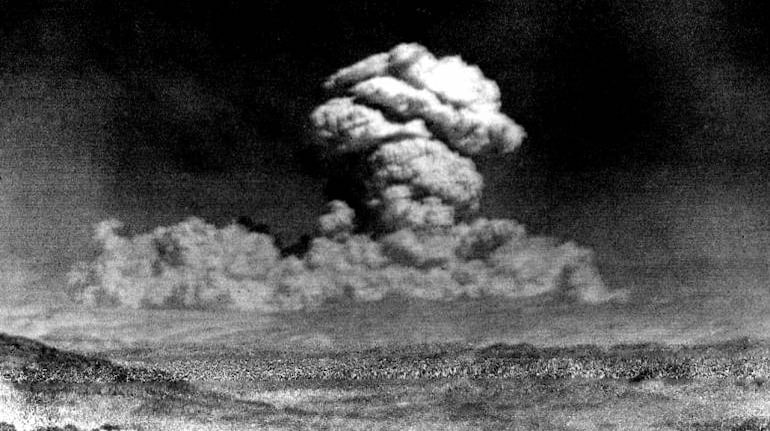
Nuclear test near Las Vegas, Nevada, in 1962. The US still enjoys a giant lead in terms of the size of its strategic weapons stockpile, the means to deliver them, and the technological means to defend itself against nuclear attack. (Image via Wikimedia Commons)

Nuclear test near Las Vegas, Nevada, in 1962. The US still enjoys a giant lead in terms of the size of its strategic weapons stockpile, the means to deliver them, and the technological means to defend itself against nuclear attack. (Image via Wikimedia Commons)

Less than a fortnight before a great mushroom cloud rose over the Lop Nor lake, a small group of analysts at the United States Defense Department issued a grim assessment of what China’s imminent test of a nuclear weapon would mean. “China is determined to gain status as a world power, primarily by reducing US power and influence in Asia and the Western Pacific,” they asserted. By 1980, Chinese nuclear capability should reach the point “where it will be necessary to think in terms of a possible 100 million U.S. deaths whenever a serious conflict with China threatens”.

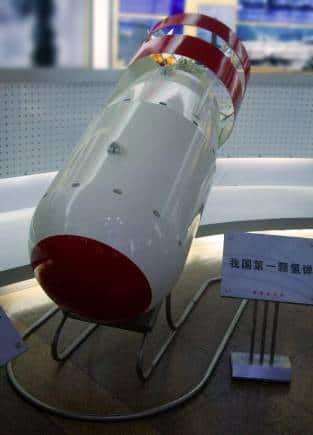
Chinese nuclear bomb on display at "Our troops towards the Sky." Podium translation: "Our first hydrogen bomb." (Photo: Megapixie - Max Smith via Wikimedia Commons Public Domain)Chinese nuclear bomb - H639-23 (Photo: Max Smith via Wikimedia Commons)

For some years now, concerns have been mounting about China’s nuclear arsenal. Earlier this month, the Pentagon warned that Beijing planned to expand its stockpile of warheads to 1,000 warheads, up from an estimated 300-400 today. In addition, China has fielded the DF17 hypersonic glide vehicle, designed to evade US anti-ballistic missile defences, taken measures to help its own missiles survive an American nuclear strike, and is working on building a new long-range bomber with stealth features, the H20.

There’s little doubt China’s build-up is driven principally by its competition with the US: the world’s principal superpower still enjoys a giant lead in terms of the size of its strategic weapons stockpile, the means to deliver them, and the technological means to defend itself against nuclear attack. This massive asymmetry, Beijing seems no longer willing to countenance.

Even though China’s decision to grow its nuclear weapons stockpile isn’t primarily directed at India, it nonetheless has inexorable consequences. China’s capacity to deliver a first strike that can annihilate a significant portion of India’s own nuclear weapons before they are launched poses an obvious threat. New Delhi has already begun growing its arsenal, as has Islamabad; most experts believe both countries will have some 250 warheads by the end of the decade.

Finding an appropriate response that doesn’t lock India into an nuclear arms race, draining precious military resources, isn’t easy. How large does India’s arsenal actually need to be to ensure the credibility of its nuclear deterrent posture? And what delivery systems and defensive technologies ought New Delhi focus on acquiring to address the new threat?

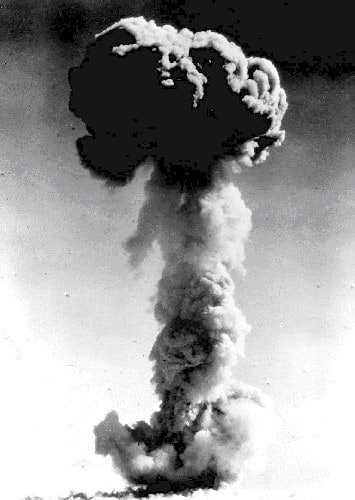
Like with so many strategic issues, part of the answer lies in a clear-eyed appraisal of the character of the threat. Fear shapes irrational responses, United States State Department experts warned in an October 16, 1964, memo, written on the same day that China’s secret Project 559 tested the country’s first nuclear device at Lop Nor. Even though China’s nuclear weapons would allow it to “pose a nuclear threat to US bases in Asia and to use nuclear weapons as an umbrella for covert non-nuclear operations and for support of insurgency”, the experts believed that that was not the whole story.

The US State Department experts argued, that “the great asymmetry in ChiCom (Chinese communist) and US nuclear capabilities and vulnerabilities makes ChiCom first use of nuclear weapons highly unlikely against Asian nations”. As important, China’s acquisition of nuclear technology did not, in itself, alter “the real relations of military power in East Asia”.

In other words, the US State Department experts concluded, “the basic military problems we will face are likely to be much like those we face now: military probing operations designed to test the level of the US commitment and response; relatively low-level border wars; ‘revolutionary’ wars supported by the ChiComs; and pressure to keep US nuclear weapons from the area”.

The strategic circumstances India now faces are different—China is, after all, an emerging economic and military superpower, not a desperately poor and insecure post-revolutionary state—but the question isn’t. India’s responses will have to carefully judge what kinds of geopolitical outcomes China seeks on its western borders, and what kinds of wars are therefore probable.

Even given the asymmetries in the nuclear capabilities of Beijing and New Delhi, it is impossible for People’s Liberation Army planners to be certain no Indian nuclear weapons would hit its cities in a future nuclear war. Thus, Beijing would only risk a conflict that crossed India’s nuclear red lines—like the loss of significant territory, or the obliteration of national sovereignty—if the gains outweighed the potential cost of losing large population and economic centres. New Delhi faces similar constraints.

There is no algorithm that allows planners exactly what the decision-making calculus of such a conflict might be, or what circumstances might bring it about. No military planning, however, can anticipate and prepare for every possible kind of war; New Delhi, therefore, needs to develop a lucid and granular understanding of what kinds of conflict it thinks are probable.

A second layer of thinking about the nuclear threat posed by China has to do with time-frames. Experts Hans Kristensen and Matt Korda, among others, have noted that the Pentagon’s estimate that China will have have 1,000 warheads by 2030 is an assessment of capability, not currently verifiable intentions. The assessment rests, Kirstensen and Korda have argued, on the construction of missile silos—some numbers of which may be decoys, intended to confuse US targeting during a first strike—and estimates of how much plutonium China could produce. There’s a difference, though, between capability and intentions.

Indeed, some experts believe China’s modernisation of its nuclear arsenal—like its programme to build Multiple Independent Reentry Vehicle, or single missiles carrying several nuclear warheads, or its hypersonic missile programme—is primarily aimed at counteracting the growth of US anti-missile defences, and its offensive forces. Even if China could be sure a significant proportion of its 350-odd missiles would hit their targets, the argument goes, it could be certain the US would not initiate a full-blown war.

New Delhi, similarly, needs certainty that its nuclear deterrent can absorb a Chinese first strike aimed at destroying its assets and command centres—and then deliver assured retaliation. This end may be better served by more sophisticated means of delivery—like expanding the numbers of warheads on ballistic-missile nuclear submarines, which are hard to detect and target—rather than expanding the size of the arsenal itself.

China's first atomic bomb, tested October 16, 1964, at Lake Lop Nor (Image source: http://www.china.org.cn/english/congress/228244.htm via Wikimedia Commons)China's first atomic bomb was tested on October 16, 1964, at Lake Lop Nor (Image source: http://www.china.org.cn/english/congress/228244.htm via Wikimedia Commons)

Finally, New Delhi needs to engage in a substantial dialogue with partners in Asia, as well as the US, on what the region’s nuclear future ought look like.  Like India, many Asian states face military threats from China, but have so far decided they are secure under the umbrella of nuclear deterrence provided by the US. Japan, notably, is the only non-nuclear weapons state to have significant plutonium stockpiles, as well as the technological capabilities to build them. It has chosen not to, though.

That might well change, should the degree to which the US is willing to commit military resources in Asia diminish. In 1971, General Park Chung-hee’s military dictatorship ordered his scientists to develop a nuclear weapon inside six years, along with long-range missiles. A now-declassified diplomatic cable sent by the United States’ ambassador Philip Habib in 1974 records that the decision was driven by “increasing doubts about (the) durability of US commitments”.

In the Korean war of 1950-1953, the historian David Halberstam has said, People’s Liberation Army troops arrived in an unceasing flow to replace the dead. The US’ citizens, residents of an affluent industrial society, were unwilling to pay the same cost, measured in sons. Like in Vietnam two decades later, the United States won each battle—but proved ultimately incapable of victory.

From Australia to South Korea and Japan, there is renewed debate on how durable America’s commitment to Asian security will prove. It is impossible to judge, yet, how this debate will end—but New Delhi’s own nuclear and strategic decision-making will clearly be contingent on its outcome.

Nuclear weapons are different from all other kinds of weapons: Their use makes the very concepts of victory or defeat irrelevant, holding out the prospect not just of mass-scale death or economic destruction, but the annihilation of entire civilisations. This is precisely why nuclear weapons deter adversaries from considering going to war in the first place. New Delhi must ensure its threat remains credible—while at once recognising that more bombs don’t necessarily mean more security.

SOURCE

Saturday, 27 November 2021

Beijing Keeps Trying to Rewrite History

The removal of a monument to the Tiananmen Square massacre is part of a broader effort in Hong Kong to erase the public memory.

Under the relentless crush of Beijing, the courtrooms of Hong Kong have become some of the few venues safe for protest in the city. Defendants accused or convicted of political crimes have turned otherwise banal hearings and bail applications into opportunities to voice dissent and challenge the arduous legal process.

In mid-November Lee Cheuk-yan, a veteran prodemocracy figure, used his mitigation hearing, where defendants can address the court in hopes of obtaining a lesser sentence, to deliver a stirring and defiant speech. He recounted his memories of the 1989 Tiananmen Square massacre, exalted Hong Kongers for never forgetting the tragedy, and excoriated city officials for curtailing basic freedoms. Lee, who for decades helped organize the annual vigil held in Hong Kong’s Victoria Park to mourn the crackdown, choked up as he addressed the courtroom.

“I want to thank the people of Hong Kong who kept the promise of 1989,” he said. “In the face of suppression, they persisted, honoring the memory of the June Fourth Massacre in Victoria Park with their candlelight. Your Honor, the people of Hong Kong who took part needed no person or organization to incite them. If there was a provocateur, it is the regime that fired at its own people.

“For 31 years,” he continued, “our unyielding memory and unrelenting conscience drove us to keep the promise, persist in honoring their memory, demand truth and accountability, and carry on the pursuit of freedom and democracy of the Chinese people.”

Yet the unyielding memory of which Lee spoke has come under sustained attack this year, part of a broader effort by Beijing, its loyalists in the city, and an ever-growing list of collaborators to erase Tiananmen from public memory. Weaponizing pandemic protocols and vague threats of possible national-security violations, authorities have canceled the once-annual vigil for the past two years. Prominent activists, Lee included, who took part in prior gatherings have been arrested. A museum dedicated to Tiananmen was abruptly closed. Its contents were hauled away by police as evidence against members of the Hong Kong Alliance in Support of Patriotic Democratic Movements of China, which organized the vigil and ran the museum. The group disbanded as a result. Unsatisfied with residents being only physically barred from viewing its displays, Hong Kong officials blocked access to the museum’s website as well. An investigation by Hong Kong Free Press found that dozens of books on the topic of Tiananmen have disappeared from the city’s libraries.

One monument that has escaped erasure, just barely and perhaps only briefly, is also the city’s most prominent dedicated to Tiananmen, the Pillar of Shame statue. An orange cenotaph of pained, contorted bodies constructed as a memorial to protesters killed in the massacre, it was put on permanent public display to serve, as its creator, Jen Galschiøt, wrote in 1997, as a test of the authorities’ “guarantees for human rights and freedom of expression in Hong Kong.” The pillar was staged at the University of Hong Kong, the city’s oldest and most prestigious institute of higher learning, in 1998, after being displayed at other campuses.

For more than two decades, the city passed Galschiøt’s assessment. Students and activists gathered every spring to ceremonially wash the structure, which across its base reads the old cannot kill the young forever. The ritual was the first in a sequence of events held every year in Hong Kong to mark the anniversary of the Tiananmen massacre culminating with the candlelight vigil. Now, though, the pillar is caught in a sort of purgatory—unwanted by the university, which has tried to remove it but faced fierce resistance, and Galschiøt’s attempts to retrieve it have gone unanswered. The awkward situation is representative of the city itself, not entirely subjugated by Beijing but not as free, open, or vibrant as it once was.

“Many things in the past in Hong Kong that were treated as normal and being a kind of symbol that Hong Kong is still enjoying freedom and a high degree of autonomy … are now facing challenges,” Richard Tsoi, the secretary of the now-dissolved alliance, told me.

The attempts at removing the horrors of Tiananmen from the popular consciousness follow a full-scale effort to rewrite more recent history in Hong Kong. Officials have consistently attempted to twist the narrative of the city’s protest movement, portraying the demonstrations as organized by a small, violent group, conspicuously omitting the occasions when more than 1 million people marched peacefully. The reasons behind the protests have been obfuscated as well. Blame, officials now say, lies with the United States and astronomical housing prices, not the continued erosion of freedoms and broken promises from Beijing. The police have taken part in some of the most blatant acts of historical revisionism, hoping that residents will forget violent actions they witnessed with their own eyes.

“The authorities … are working overtime to teach us what is the official position,” John P. Burns, an emeritus professor at HKU and the former dean of its faculty of social sciences, who has written in support of keeping the statue, told me. “Making Hong Kong more like the rest of China, that is the name of the game.”

In 1989, residents of Hong Kong were horrified by Beijing crushing the protests at Tiananmen Square. Hundreds of thousands of people marched in what The New York Times described as a “long ribbon of humanity” that stretched through the city’s streets. The outrage extended beyond those who supported full democracy. Many who signed published petitions denouncing Beijing’s actions and who took part in demonstrations are pro-Beijing stalwarts today. David Ford, then the territory’s chief secretary, wrote in a letter to the city’s vaunted civil service that residents felt a “profound feeling of shock and grief,” at what had occurred. Authorities in Beijing believed then that the city’s protests would be a one-off event, according to a former Hong Kong government official who requested anonymity because of the sensitivity of the topic, and that the territory would revert to being a purely “economic city,” whose inhabitants were uninterested in politics. This hypothesis—like many made by Beijing about Hong Kong—was totally incorrect. Instead, Hong Kong fostered a lively tradition of protests and demonstrations.

Galschiøt’s two-ton sculpture was unveiled in downtown Victoria Park eight years after the massacre and 28 days before the city’s July 1, 1997, handover to China. It was eventually relocated to HKU’s campus, and activists painted it bright orange in 2008. The artist wrote at the time of its installation that “no ban on the sculpture can diminish its symbolic value. No attack, not even the destruction of the sculpture can obliterate the symbolism of the Pillar of Shame.” One of his tenets is now being tested: “No authority will ever succeed in preventing the mounting of the Pillar of Shame in Hong Kong.”

Following the disbandment of the alliance, HKU tried to have the sculpture removed, enlisting the global law firm Mayer Brown to help. In a statement to news outlets, Lisa Sachdev, a spokesperson for the firm, said that Mayer Brown was “asked to provide a specific service on a real-estate matter for our long-term client, the University of Hong Kong.” She continued: “Our role as outside counsel is to help our clients understand and comply with current law. Our legal advice is not intended as commentary on current or historical events.” (The firm regularly comments on U.S. news events, though, including the death of George Floyd and voting-rights issues, and Mayer Brown later relented after its involvement drew considerable press and condemnation, saying, “Going forward, Mayer Brown will not be representing its long-time client in this matter.”)

Galschiøt hired his own lawyers in an effort to reclaim the statue himself. He said in an open letter this month that he would travel to Hong Kong to remove the statue but would need assurances from authorities that he wouldn’t face any legal issues. This seems highly unlikely because Galschiøt has been barred from entering Hong Kong on two previous occasions. He added that HKU has not responded to his inquiries. The university did not address the contents of Galschiøt’s letter and, when asked for comment, said only that it was working to resolve the issue in a “legal and reasonable manner.”

HKU and other universities in the territory have quickly moved to submit to Hong Kong’s new, more authoritarian political order. Maintenance workers at the university removed colorful walls of protest art, and the administration cut ties with the students’ union and barred some of its members from campus because of a union motion expressing sympathy for the “sacrifice” of a man who had killed himself after stabbing a police officer in July. The students later apologized and retracted the statement, but four were arrested under the national-security law and charged with advocating terrorism.

Burns told me that by moving to remove the sculpture, the university is “acknowledging its dependence on the mainland and on authorities in the mainland for the things the university wants.” One professor, who asked not to be named for fear of repercussions, told me that the threat of removal was part of “a wholesale embrace of the wider crackdown that we have seen in the media, civil society, and the general public,” and that the university was in “free fall into a totalitarian-friendly tertiary institution.” Another professor, who also spoke on condition of anonymity, told me about recently going out of their way to walk by the statue with colleagues to confirm that it was still standing. “I find campus very depressing,” the academic said, “because of everything that is no longer there.”

In court, Lee said that even while in jail earlier this year after being convicted for his role in a 2019 protest, he continued to uphold the memory of June Fourth by fasting and, without access to a candle, lighting a single match.

“I am proud to be a Hong Konger,” he said. “For 32 years, we have marched together in the fight to bring justice to those who put their lives on the line on 4 June 1989, and in the struggle for democracy.”

In the end, he told the judge that he was at peace with any sentence that might be handed down: “If I must go to jail to affirm my will,” he said, “then so be it.”

Timothy McLaughlin is a contributing writer at The Atlantic.

https://www.theatlantic.com/international/archive/2021/11/pillar-of-shame-tiananmen-square-massacre-symbol/620810/

Others:

https://arisechina.blogspot.com/2022/05/tiananmen-masses-axed-as-crackdown.html

https://arisechina.blogspot.com/2022/08/tiananmen-massacre-erased-from-hong.html

https://arisechina.blogspot.com/2021/12/renowned-tiananmen-massacre-monument.html

https://arisechina.blogspot.com/2022/08/beijing-keeps-trying-to-rewrite-history.html

Friday, 26 November 2021

China Headlines Summary: 19 Oct - 1 Nov 2021


China passes law to cut homework pressure on studentsOct 23, 2021 12:50 PM IST

China passes law to cut homework pressure on students

Beijing has exercised a more assertive paternal hand this year, from tacking the addiction of youngsters to online games, deemed a form of "spiritual opium", to clamping down on ”blind” worship of internet celebrities.


  • Oct 22, 2021 09:48 AM IST

    What people are saying about China Evergrande Group

    Shares of Evergrande, which is saddled with more than $300 billion in liabilities, rose as much as 8 percent early on October 22 after it wired funds to a trustee account for a bond interest payment

Most Recent Post

Man charged for borrowing rare Chinese manuscripts from UCLA library, returning fakes

  Suspect Jeffrey Ying allegedly travelled to China after checking works out using several aliases Agence France-Presse Published: 12:11pm, ...

Popular Posts - Last 30 days